Telling Cistanche Species Apart: How HPLC Fingerprinting Solves A Real Quality Problem
Nov 24, 2026
Introduction
If you buy Cistanche - whether as a dried herb, an extract powder, or a finished supplement - there is a question you may never have thought to ask: which Cistanche are you actually getting?
The answer matters more than most people realize. The name "Cistanche" does not refer to a single plant. It refers to an entire genus of desert-dwelling parasitic herbs, and not all of them are chemically equal. Some species are official medicinal plants recognized by pharmacopoeia standards. Others look similar, are sold under the same name in herb markets, and yet contain very different compounds.
This is not a trivial academic concern. When herbs are misidentified, quality suffers, and so does safety. A buyer who pays for a premium species may unknowingly receive a cheaper look-alike. A manufacturer who builds a formula around one species may find that another species behaves quite differently in the lab.
A 2021 study published in the Chinese Journal of Pharmaceutical Analysis set out to solve this problem using a modern analytical technique called HPLC fingerprinting. The researchers built detailed chemical profiles of four different Cistanche species and found a way to tell them apart quickly and reliably.
This article explains, in plain English, what that study found - and why it should matter to anyone who buys, sells, or formulates with Cistanche.

The Cistanche Family: More Than One Plant
To understand the problem, you first need to meet the family.
In China, botanists generally recognize four species (and one botanical variety) within the Cistanche genus:
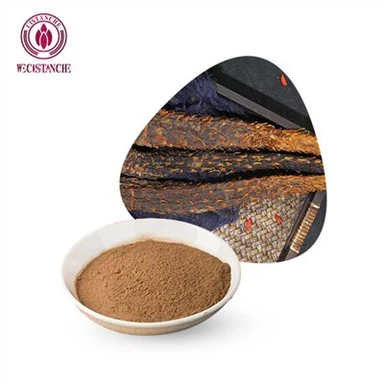
Cistanche deserticola (荒漠肉苁蓉) - the "classic" Cistanche, sometimes called desert-living Cistanche. This is the species most people mean when they simply say "Rou Cong Rong" (肉苁蓉).
Cistanche tubulosa (管花肉苁蓉) - the other officially recognized medicinal species, and the one most widely used in modern extract production because it can be cultivated at scale.
Cistanche salsa (盐生肉苁蓉) - a salt-tolerant species that also appears in herbal markets.
Cistanche sinensis (沙苁蓉) - a related plant that grows in sandy areas and is sometimes confused with true Cistanche.
There is also a white-flowered variety of Cistanche salsa, but it is less commonly discussed.
Here is the crucial point: the official Chinese Pharmacopoeia (the legal standard for herbal medicines) recognizes only Cistanche deserticola and Cistanche tubulosa as the legitimate sources of the medicine "Rou Cong Rong." The other species are not official, even though they may circulate in markets.
This creates a real-world identification problem. Cistanche grows across a vast geographic range, in both wild and cultivated forms, and is processed in many different ways depending on the region. As a result, the quality of material sold under the name "Cistanche" varies enormously. Simply measuring one or two chemical markers is not enough to reliably distinguish species - a more comprehensive approach is needed.
Why Species Identification Matters
It is worth pausing on why this matters so much, because it goes to the heart of quality control in the herbal products industry.
Cistanche's therapeutic value comes from its chemical profile. Modern research has shown that Cistanche species contain several important classes of active compounds:
Phenylethanoid glycosides - the signature compounds of Cistanche, including well-known actives like echinacoside and acteoside
Iridoids - another class of bioactive compounds found in many medicinal plants
Lignans and their glycosides
Polysaccharides
Alkaloids
Volatile oils
Different Cistanche species contain different mixtures of these compounds. A species that is high in echinacoside may be low in other actives, and vice versa. When two species are chemically different, they are not interchangeable - at least not without careful evaluation.
Misidentification, therefore, is not a cosmetic issue. It can change the entire character of a product. For consumers, it can mean buying something that does not deliver the expected benefits. For manufacturers, it can mean batch-to-batch inconsistency. And for regulators, it can mean products that fall short of legal standards.
The challenge is that telling these species apart by eye is difficult. Their dried stems look similar, and by the time material reaches a market, even experts may struggle to distinguish them visually. That is where analytical chemistry comes in.
What Is a Chemical Fingerprint?
The solution explored in this study is something called a characteristic chromatogram - often described as a "chemical fingerprint."
The idea is elegant. Every plant produces a distinctive set of chemical compounds. When you separate those compounds and measure them, the resulting pattern - a series of peaks on a chart - is unique to that species, much like a fingerprint is unique to a person.
To create this fingerprint, scientists use high-performance liquid chromatography (HPLC), a technique that separates the individual compounds in a plant extract and measures how much of each is present. The output is a chromatogram: a graph in which each compound appears as a peak at a specific time.
The researchers in this study used HPLC to analyze 62 batches of Cistanche collected from different regions and markets. Their goal was to establish reference fingerprints for each species and then use those fingerprints to identify unknown samples.
The method itself was carefully optimized. After testing different solvents, they found that extracting the herb powder with 70% methanol in water gave the best results. They used a specific type of chromatography column, a mobile phase of acetonitrile mixed with a dilute formic acid solution, and detected the compounds at a wavelength of 237 nm - the wavelength at which the greatest number of characteristic peaks appeared with good separation.
To make sure their method was trustworthy, the researchers also ran standard quality checks. They confirmed that the method was precise (repeated measurements gave consistent results), stable (samples gave consistent results even after sitting for 24 hours), and reproducible (different batches of the same material gave consistent results). These are the kinds of validations that turn a laboratory experiment into a usable quality-control tool.
The Chemical Cast of Characters
Before looking at the results, it helps to know the main compounds the researchers were tracking - because these names will come up again.
Using reference standards (purified samples of known compounds), the researchers were able to identify seven key compounds in the fingerprints of Cistanche deserticola, Cistanche tubulosa, and Cistanche salsa:
Geniposidic acid - an iridoid
8-Epiloganic acid - another iridoid
Echinacoside - a phenylethanoid glycoside and one of Cistanche's most important actives
Cistanoside A - a phenylethanoid glycoside
Acteoside (also known as verbascoside) - another signature phenylethanoid glycoside
Isoacteoside - a closely related phenylethanoid glycoside
2'-Acetylacteoside - a modified form of acteoside
For Cistanche sinensis (沙苁蓉), the picture was notably different. Its fingerprint contained several compounds that were either absent or much less prominent in the other three species:
Geniposide - an iridoid found at relatively high levels in this species
Acteoside
Poliumoside - a phenylethanoid glycoside
Isoacteoside
2'-Acetylpoliumoside - a modified form of poliumoside
The presence of high levels of geniposide, poliumoside, and 2'-acetylpoliumoside in Cistanche sinensis is important. These compounds serve as specific markers - chemical "signatures" that distinguish this species from the others. This is the first major clue that Cistanche sinensis is fundamentally different from the officially recognized medicinal species.
How the Four Species Stack Up: The Similarity Results
Once the reference fingerprints were established, the researchers could compare each species against them. They used a specialized software tool designed for evaluating the similarity of herbal fingerprints, which produces a similarity score between 0 and 1 (where 1.0 would mean identical).
The results painted a clear picture.
Cistanche deserticola samples were compared against the deserticola reference fingerprint. Their similarity scores ranged from 0.661 to 0.985 - a fairly wide spread. The researchers attributed this variability to the fact that deserticola is mostly harvested from the wild, across a wide geographic area, with different harvest seasons and processing methods. Wild material naturally varies.
Cistanche tubulosa samples, when compared against the deserticola reference, scored 0.649 to 0.804. But when the tubulosa samples were compared against their own reference fingerprint (built from all ten tubulosa batches), their similarity jumped to above 0.900 - a sign of good internal consistency. The researchers noted that tubulosa is mostly cultivated, comes from more concentrated growing regions, and therefore shows less variation within the species.
Cistanche salsa samples scored 0.691 to 0.971 against the deserticola reference. This means salsa is chemically quite close to deserticola - which, as we'll see, creates a different kind of identification challenge.
Cistanche sinensis was the outlier. When its ten batches were compared against the deserticola reference fingerprint, every single one scored below 0.300. That is a dramatic difference. In fingerprint analysis, a similarity that low essentially means "this is not the same species."
The takeaway is clear: Cistanche sinensis is chemically distinct from the other three species and can be confidently distinguished by its fingerprint alone. The other three species, however, share enough chemistry that similarity scores alone cannot reliably tell them apart - especially deserticola, tubulosa, and salsa.
When Similarity Isn't Enough: The Peak Area Ratio Trick
This is where the study gets clever.
The researchers realized that deserticola, tubulosa, and salsa contain the same kinds of compounds, but in different proportions. Similarity scores, which focus on overall pattern, could not capture these proportion differences well enough. So the researchers turned to a more discriminating tool: peak area ratios.
In a chromatogram, the area under a peak is proportional to the amount of that compound in the sample. By comparing the areas of two different peaks, you get a ratio that reflects the relative abundance of two compounds - regardless of the absolute amount of sample injected.
The researchers chose two ratios:
Ratio a = the peak area of cistanoside A divided by the peak area of echinacoside
Ratio b = the peak area of 2'-acetylacteoside divided by the peak area of acteoside
These particular ratios turned out to be remarkably diagnostic.
For Cistanche deserticola, ratio a ranged from 0.116 to 0.906, with an average of 0.443. Ratio b ranged from 0.163 to 1.791, averaging 0.735.
For Cistanche salsa, ratio a ranged from 0.018 to 0.268, averaging 0.093. Ratio b ranged from 0.039 to 1.210, averaging 0.654.
For Cistanche tubulosa, both ratios were dramatically lower. Ratio a ranged from 0.008 to 0.040, averaging just 0.024. Ratio b ranged from 0.007 to 0.091, averaging 0.045.
Look closely and a simple rule emerges:
If ratio a is less than 0.05 and ratio b is less than 0.10, the sample is Cistanche tubulosa.
If ratio a is greater than 0.05 and ratio b is greater than 0.10, the sample is either Cistanche deserticola or Cistanche salsa.
In other words, Cistanche tubulosa contains much less cistanoside A relative to echinacoside, and much less 2'-acetylacteoside relative to acteoside, than deserticola or salsa do. That single observation is enough to separate tubulosa from the other two species.
The remaining pair - deserticola and salsa - remains difficult to distinguish, because their chemical profiles are genuinely similar and their ratio ranges overlap. The researchers acknowledged this, noting that these two species are closely related and share both the types and the amounts of most key compounds. For practical purposes, however, the most important distinction in the market - between the two official species, deserticola and tubulosa - can be made cleanly using the ratio rule.

Putting the Method to the Test: 21 Real-World Samples
A fingerprinting method is only useful if it works on real, messy, real-world samples. So the researchers put their method to the test on 21 batches of Cistanche material collected during routine inspection work - the kind of samples that arrive from pharmaceutical companies, hospitals, and herb suppliers.
The similarity scores for these 21 inspection samples ranged from 0.586 to 0.910 - all within the range that could correspond to deserticola, tubulosa, or salsa. In other words, similarity alone could not identify them. This is exactly the scenario where the ratio rule becomes valuable.
When the researchers calculated ratios a and b for each of the 21 samples, a clean split emerged:
Twelve samples had ratio a greater than 0.05 and ratio b greater than 0.10 - identifying them as Cistanche deserticola.
Nine samples had ratio a less than 0.05 and ratio b less than 0.10 - identifying them as Cistanche tubulosa.
The method worked. It allowed the inspectors to classify every one of the 21 unknown samples with confidence, using a simple, reproducible calculation.
This real-world validation is what turns an interesting laboratory observation into a practical tool. It means that, in principle, a quality-control lab can take an unknown Cistanche sample, run a single HPLC analysis, calculate two ratios, and immediately know whether it is dealing with deserticola or tubulosa.
What This Means for the Cistanche Industry
The significance of this research extends well beyond the laboratory. It addresses a genuine, persistent problem in the herbal products industry: the confusion and substitution of closely related species.
Cistanche is a high-value herb. When demand is high and supply of the official species is limited, there is economic pressure to substitute cheaper or more abundant relatives. Cistanche sinensis, in particular, has sometimes been found circulating as "Cistanche" even though it is not an official medicinal species and its chemistry differs substantially.
This study provides a reliable way to catch such substitutions. The fingerprints and ratio rules give regulators, manufacturers, and honest suppliers a scientifically sound basis for:
Authenticating raw materials before they enter production
Detecting mislabeled or substituted herbs in the marketplace
Ensuring batch-to-batch consistency in finished products
Supporting the revision of quality standards for Cistanche
For manufacturers and buyers, the practical message is straightforward: not all "Cistanche" is the same, and modern analytical tools now make it possible to verify what you are actually buying.
For consumers, the research offers reassurance that the science of herbal quality control is advancing. The days of relying purely on appearance or tradition are giving way to rigorous, data-driven authentication.

Frequently Asked Questions
Q: What are the four Cistanche species compared in this study? A: Cistanche deserticola (荒漠肉苁蓉), Cistanche tubulosa (管花肉苁蓉), Cistanche salsa (盐生肉苁蓉), and Cistanche sinensis (沙苁蓉). Only the first two are officially recognized medicinal species in the Chinese Pharmacopoeia.
Q: Which Cistanche species is most different from the others? A: Cistanche sinensis (沙苁蓉). Its HPLC fingerprint scored below 0.300 similarity against the reference for Cistanche deserticola, and it contains high levels of geniposide, poliumoside, and 2'-acetylpoliumoside, which are essentially its signature compounds.
Q: How can you tell Cistanche deserticola apart from Cistanche tubulosa? A: By calculating two peak area ratios. If the ratio of cistanoside A to echinacoside is below 0.05 and the ratio of 2'-acetylacteoside to acteoside is below 0.10, the sample is Cistanche tubulosa. If both ratios are above those thresholds, it is deserticola (or salsa).
Q: What is an HPLC fingerprint? A: It is a chemical profile of a plant extract produced by high-performance liquid chromatography. Each compound appears as a peak on a chromatogram, and the overall pattern of peaks acts like a fingerprint that can identify the species.
Q: Why does species identification matter for Cistanche products? A: Because different species have different chemical compositions and, therefore, different quality and activity profiles. Misidentified or substituted material can undermine product quality, consistency, and safety.
Q: What are phenylethanoid glycosides? A: They are the signature active compounds of Cistanche, including echinacoside and acteoside. They are among the most important markers used to evaluate Cistanche quality.
Conclusion
Cistanche is a valuable herb with a rich history - but it is also a genus with a real identity problem. When four related species circulate under one name, the potential for confusion and substitution is high.
The 2021 study reviewed here offers a practical, science-based solution. By building HPLC characteristic fingerprints for Cistanche deserticola and Cistanche sinensis, and by developing simple peak area ratio rules, the researchers created a method that can quickly and reliably distinguish the main Cistanche species - including the two officially recognized ones.
The headline findings are worth remembering:
Cistanche sinensis stands clearly apart from the others, with its own distinctive chemical markers.
Cistanche deserticola and Cistanche tubulosa can be separated using two straightforward ratios of phenylethanoid glycosides.
The method was validated on 21 real-world inspection samples, correctly classifying every one.
For an industry where authenticity and quality are everything, this kind of tool is invaluable. It moves Cistanche quality control from guesswork toward precision - and helps ensure that when a product says "Cistanche," buyers can trust what they're getting.

Reference
Wang J., Yang W., Wang D., et al. Comparative studies of four Cistanche species based on HPLC characteristic chromatogram. Chinese Journal of Pharmaceutical Analysis (药物分析杂志), 2021, 41 (3): 384–393.