Cistanche‑Angelica Herb Pair: Exploring Neuroprotective Potential Against Parkinson’s Disease
Oct 12, 2026
Disclaimer: This article serves purely for educational and popular‑science purposes. It is not medical advice, cannot replace professional neurologist diagnosis, clinical treatment or prescription medications. All conclusions are derived from published in‑silico computational network‑pharmacology and deep‑learning simulation research, and have not been fully proven through human clinical trials. Do not self‑medicate with herbal supplements for Parkinson's disease.
Introduction: The Growing Global Burden of Parkinson's Disease
Parkinson's disease (PD) ranks among the most prevalent age‑related neurodegenerative movement disorders across the globePubMed. It arises from progressive loss of dopamine‑producing dopaminergic neurons inside the substantia nigra region of the human midbrain. As these critical nerve cells die off, dopamine neurotransmitter levels drop sharply, disrupting brain signal transmission that controls body movement, muscle tension, posture balance and even non‑motor physiological functions.
Classic clinical manifestations of Parkinson's disease cover both motor and non‑motor symptoms. Motor symptoms include resting tremor, limb muscle rigidity, bradykinesia (slowness of voluntary movements), unstable posture and shuffling gait. Non‑motor manifestations frequently appear years ahead of obvious shaking or stiffness, including sleep fragmentation, loss of smell, chronic constipation, mood changes such as anxiety or depression, and cognitive decline as illness advances. According to global public‑health statistics, more than 11.7 million people live with Parkinson's disease worldwide, and total patient numbers keep rising steadily driven by aging population structure across all continentsPMC. Men tend to develop PD slightly more frequently than women, and disease incidence climbs rapidly after age 60.
Modern mainstream clinical treatments for Parkinson's disease focus mainly on symptom relief rather than radical cure. Levodopa remains the gold‑standard first‑line pharmaceutical intervention. It supplements depleted dopamine within patient brains and effectively improves movement‑related symptoms. However, long‑term levodopa administration brings well‑known drawbacks. After years of continuous medication, many patients develop motor fluctuations, involuntary dyskinesia, and drug response weakening. Other prescription drugs such as dopamine receptor agonists, MAO‑B inhibitors can partially assist symptom management, yet none of currently available approved medicines can fully halt or reverse progressive neuronal degeneration. Disease progression continues even under standard drug therapy, creating huge unmet clinical demand for neuroprotective agents that slow nerve‑cell damage.
Against this background, researchers turn increasing attention toward natural medicinal herbs from Traditional Chinese Medicine (TCM). TCM clinical practice accumulated thousands‑year‑long practical experience treating age‑related neurological impairment. Among numerous botanical remedies, Cistanche deserticola (Roucongrong) and Angelica sinensis (Danggui) form a well‑researched herb pair. Cistanche, nicknamed "desert ginseng", traditionally tonifies kidney essence and nourishes vitality. Angelica sinensis, one of the most frequently used TCM root medicines, promotes blood circulation and nourishes tissues. Modern pharmacological laboratory evidence indicates both herbs carry neuroprotective, anti‑oxidant and anti‑inflammatory properties, making them promising candidates for Parkinson‑related pre‑clinical investigationFrontiers.
Unlike single‑molecule synthetic drugs, herbal remedies contain dozens of different small‑molecule phytochemical ingredients. These multiple compounds act simultaneously upon many human protein targets inside nerve cells. This "multi‑component, multi‑target" characteristic creates challenges for conventional drug‑testing workflows. Network pharmacology, paired with deep‑learning computational prediction models, offers modern bioinformatics tools to decode how complex herb mixtures may work on complicated chronic neurodegenerative illnesses such as Parkinson's disease.
This popular‑science article interprets findings from a peer‑reviewed Chinese medical study exploring Cistanche‑Angelica herb pair against Parkinson's disease, translating technical computational outputs into plain‑language reading material for general readers, natural‑product enthusiasts and early‑stage neuroscience learners. We will introduce basic background of the two herbs, explain simplified principles of network pharmacology and deep‑learning molecular‑binding prediction, walk through major research outputs including active compounds, shared disease‑drug gene targets, protein‑protein interaction networks, GO functional enrichment, KEGG signaling‑pathway results, and deep‑learning binding‑affinity matrix outcomes. We further discuss biological hypotheses, important study limitations, and future research directions for this herbal combination.

1. Background Knowledge: Parkinson's Pathology and Two Key Medicinal Herbs
1.1 Core pathological drivers of Parkinson's disease
Parkinson's disease pathology involves multiple overlapping destructive biological processes inside brain tissue, not merely dopamine shortage. Four major pathological forces jointly push disease progression:
Oxidative stress: Excessive reactive oxygen species (ROS) accumulate inside midbrain nerve cells, damaging DNA, protein structures and mitochondrial energy‑producing organelles. Dopaminergic neurons are exceptionally vulnerable to oxidative injury.
Chronic neuroinflammation: Over‑activated microglia (resident immune cells inside central nervous system) secrete large quantities of pro‑inflammatory cytokines such as TNF‑α and interleukins, triggering inflammatory cascades that induce neuron death.
Abnormal cell apoptosis and defective autophagy: Autophagy serves as cellular "waste‑cleaning system" clearing misfolded toxic proteins. When autophagy malfunctions, harmful α‑synuclein protein aggregates build up; excessive apoptotic pathways get switched on, leading to programmed death of essential dopaminergic neurons.
Disturbed intracellular signal‑pathway balance: Multiple signaling cascades including PI3K‑Akt, MAPK, AGE‑RAGE and HIF‑1 become dysregulated, jointly accelerating nerve‑cell impairment.
Effective neuroprotective candidate substances ideally can modulate several above‑mentioned pathological mechanisms at the same time. This partly explains why multi‑ingredient herbal combinations attract research interest for complex brain disorders.
1.2 Introduction to Cistanche deserticola and Angelica sinensis herb pair
1.2.1 Cistanche deserticola (Herba Cistanches, Roucongrong)
Cistanche deserticola is a parasitic succulent plant growing in arid desert zones of Northwest China. Honored as "desert ginseng" in TCM literature, it was historically prescribed for kidney‑yang deficiency, physical exhaustion, geriatric weakness and cognitive decline. Its principal bioactive chemicals include sterols, lignans, phenylethanoid glycosides and flavonoid compounds: beta‑sitosterol, suchilactone, quercetin, stigmasterol, arachidonate, yangambin and marckine.
Modern pharmacological pre‑clinical experiments demonstrate multiple biological properties for Cistanche extracts. It can scavenge harmful reactive oxygen radicals, suppress inflammatory molecule release, stabilize mitochondrial function, inhibit excessive neuronal apoptosis, and improve behavioral performance in animal models of neurological illnesspublic-pag.... Multiple rodent PD‑model studies prove Cistanche components protect dopaminergic neurons and mitigate movement impairment, laying experimental foundation for further mechanism‑oriented computational research.
1.2.2 Angelica sinensis (Danggui)
Angelica sinensis is an umbelliferous perennial plant; its dried root represents one of the most important TCM medicinal materials. Traditional applications focus on activating blood circulation, nourishing blood, relieving pain and moistening intestines. Major bioactive constituents cover polysaccharides, volatile oils, organic acids, flavonoids and sterol substances. Modern laboratory tests confirm Angelica sinensis extracts exhibit powerful antioxidant activity, clear oxygen free radicals, lower neuroinflammation levels, reduce neuron apoptosis and deliver nourishing effects for nervous‑system tissuePMC. A large volume of prior research has validated Angelica‑derived compounds protecting nerve cells from oxidative and inflammatory damage.
When used together as an herb pair, Cistanche deserticola and Angelica sinensis produce potential synergistic effects. One herb tonifies and nourishes fundamental body vitality while the other improves microcirculation inside tissues. Their combined phytochemical mixture may simultaneously interfere oxidative stress, neuroinflammation, cell autophagy and apoptosis pathways linked to Parkinson's disease pathology. Before network‑pharmacology computational analysis, however, researchers lacked a systematic overview mapping all possible molecular targets of this herb pair related to Parkinson's disease.
2. What Are Network Pharmacology and Deep‑Learning Binding Prediction? Easy‑to‑Understand Explanation
Conventional small‑molecule drug discovery commonly follows "one drug, one target" thinking: researchers search for chemical molecules that tightly bind onto one single disease‑related protein target. This paradigm works well for many simple illnesses, yet faces obvious limitations for complex multi‑factor neurodegenerative diseases and multi‑component herbal medicines. Herbal preparations contain dozens of distinct natural chemicals interacting with hundreds of human gene products simultaneously.
Network pharmacology uses bioinformatics public databases to systematically complete these analytical steps:
Screen verified orally bio‑available active chemical ingredients from medicinal herbs.
Collect all predicted human protein targets each herbal compound may interact with.
Gather comprehensive sets of human genes known to participate in disease onset and progression (Parkinson's disease in this case).
Calculate overlapping shared genes between herbal‑medicine target list and disease‑related gene list. Those shared genes represent potential molecular nodes where herbal compounds may influence disease processes.
Build Protein‑Protein Interaction (PPI) networks visualizing how these target‑proteins connect and regulate each other within human cells.
Perform Gene Ontology (GO) enrichment analysis and KEGG signaling‑pathway enrichment analysis. GO sorts target‑gene functions into three categories: biological processes (BP), cellular components (CC), molecular functions (MF). KEGG maps targets onto documented intracellular signaling pathways, revealing which cellular regulatory circuits herbal ingredients may interfere with.
While classic network pharmacology identifies potential compound‑target connections from existing published‑literature databases, it cannot quantitatively evaluate how strongly small‑molecule herbal compounds physically bind to target‑proteins. This is where deep‑learning molecular‑binding prediction comes in. The study cited in this article adopted the CNN_CNN_BindingDB pre‑trained deep‑learning model from the DeepPurpose open‑source artificial‑intelligence project. DeepPurpose uses convolutional neural networks trained with massive existing compound‑protein binding‑affinity experimental datasets. Given compound SMILES chemical structure strings and target‑protein amino‑acid sequences, the model outputs numerical binding‑strength scores. Higher scores mean the model predicts more stable physical binding between plant‑derived small‑molecule ligand and human protein receptor.
Crucial reminder for general readers: network‑pharmacology plus deep‑learning prediction belong fully to in‑silico computer simulation research. They generate testable scientific hypotheses, but cannot substitute wet‑lab cell experiments, animal‑model trials or human clinical studies. Positive simulation outputs do not constitute proof of real‑world therapeutic efficacy.
3. Key Research Outcomes from Cistanche‑Angelica Herb Pair Computational Study
The original research paper followed standardized computational workflows. Herbal chemical ingredients were filtered from TCMSP database with three strict screening thresholds: Oral Bioavailability OB ≥ 30 %, Drug‑Likeness DL ≥ 0.18, and blood‑brain barrier permeability BBB ≥‑0.85. The BBB filtering condition carries special significance for brain‑disease research: candidate compounds need adequate capacity to cross the blood‑brain barrier to reach brain parenchyma and contact diseased nerve cells. Parkinson's patients often show impaired blood‑brain barrier integrity, which makes BBB‑permeability screening even more meaningful.
Parkinson‑disease‑associated disease‑target genes were retrieved from multiple authoritative databases: GeneCards, OMIM, PharmGkb, TTD and DrugBank. Venny intersection analysis identified overlapping genes shared by herb‑pair targets and PD‑disease targets. STRING database built protein‑protein interaction networks; CytoNCA plugin executed centrality‑based core‑gene screening. R‑studio software with ClusterProfiler packages accomplished GO and KEGG enrichment analysis. DeepPurpose CNN_CNN_BindingDB model calculated compound‑target binding‑affinity prediction scores. Below we unpack all core results using accessible non‑technical language.
3.1 Screening for bio‑active herbal ingredients and shared drug‑disease targets
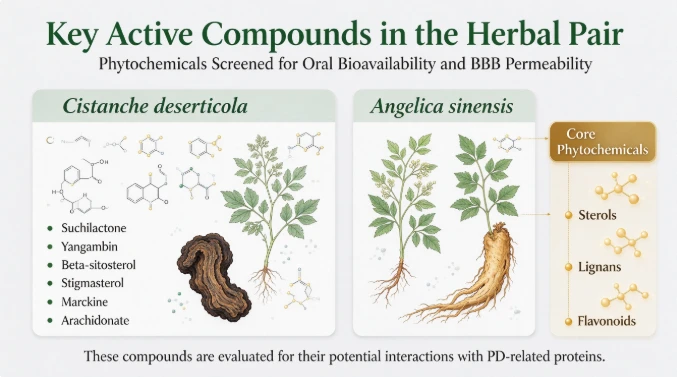
After filtering according to OB, DL and BBB permeability criteria, researchers obtained 7 bio‑active chemical constituents from the Cistanche‑Angelica herb pair, including one compound shared by both herbs. Main representative compounds are suchilactone, yangambin, beta‑sitosterol, stigmasterol, quercetin, marckine and arachidonate. These phytochemicals mainly belong to sterol, lignan and flavonoid chemical classes. Many of these substances were previously reported in independent pre‑clinical studies to deliver anti‑oxidant, anti‑inflammatory and neuroprotective bioactivities.
After gene‑ID conversion and UniProt database annotation, researchers collected 297 predicted target genes associated with the Cistanche‑Angelica herb pair. Meanwhile, comprehensive retrieval across multiple disease‑gene databases returned 11 208 Parkinson‑disease‑related human genes. Intersection calculation identified 131 shared overlapping target genes. This large set of common genes illustrates that this two‑herb combination potentially interferes hundreds of biological nodes linked to Parkinson's pathological processes, reflecting typical multi‑target intervention characteristics of TCM herb‑pair therapy. These 131 intersecting genes became core objects for subsequent PPI network construction and enrichment analysis.
3.2 PPI network analysis and identification of eleven core hub genes
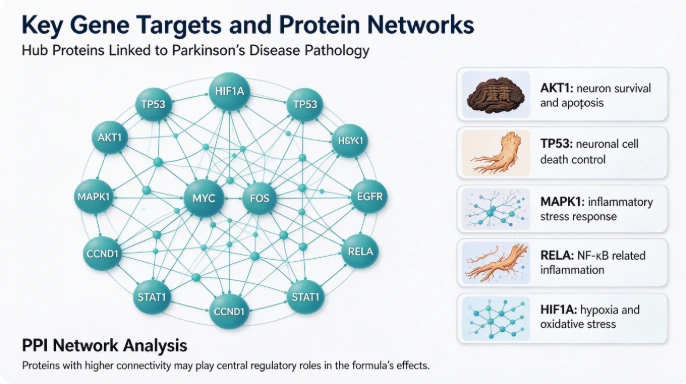
Researchers imported the 131 shared target genes into STRING database to construct protein‑protein‑interaction network, setting species as Homo sapiens and interaction confidence threshold at highest confidence > 0.9. They then applied multi‑round centrality‑value filtering through CytoNCA plugin, evaluating four different centrality metrics: betweenness centrality (BC), closeness centrality (CC), degree centrality (DC), eigenvector centrality (EC). Two‑step strict screening finally pinpointed 11 core hub genes: HIF1A, TP53, MYC, MAPK1, HSP90AA1, FOS, EGFR, RELA, STAT1, CCND1 and AKT1.
These eleven hub‑proteins occupy central regulatory positions inside the biological network related to Parkinson's pathology. We briefly explain their primary biological functions in nervous‑system context:
AKT1: Core protein within PI3K‑Akt signaling pathway. It controls neuron survival‑apoptosis balance, supports nerve‑cell survival, regulates autophagy activity, and participates in inflammatory‑response modulation. Abnormal AKT‑pathway activity closely correlates with dopaminergic‑neuron injury in PD.
TP53: Well‑known tumor‑suppressor protein; also major controller of neuronal apoptosis. Excess TP53 activation triggers programmed death of damaged nerve cells, accelerating neurodegeneration.
MAPK1: Mitogen‑activated protein kinase‑1, central component of MAPK inflammatory‑stress‑response cascade. Over‑active MAPK signaling amplifies neuroinflammation and promotes dopaminergic‑neuron death.
HIF1A: Hypoxia‑inducible factor‑1 alpha, master regulator under low‑oxygen and oxidative‑stress circumstances. It modulates inflammatory‑factor release inside brain tissue and participates in PD‑related neuro‑injury processes.
RELA: Sub‑unit of NF‑κB transcription‑factor complex, a classic molecular switch driving pro‑inflammatory‑gene expression in microglia. RELA over‑activation fuels neuroinflammation within Parkinson‑affected brains.
STAT1: Signal transducer and activator of transcription‑1, mediates interferon‑ and cytokine‑triggered inflammatory responses in central nervous‑system immune cells.
HSP90AA1: Heat‑shock‑protein‑90‑alpha‑A1, molecular chaperone assisting correct protein folding; linked to handling misfolded α‑synuclein protein aggregates characteristic of Parkinson's disease.
MYC, FOS, CCND1, EGFR: These proteins regulate cell‑cycle progression, gene‑transcription reprogramming and cellular stress responses, all of which influence neuron fate under pathological stress conditions.
Identifying these hub‑proteins tells us that Cistanche‑Angelica herb‑pair predicted targets cover cell survival/apoptosis control, oxidative‑stress sensing, neuro‑inflammatory signal transduction and protein‑homeostasis regulation, which match major pathological mechanisms of Parkinson's disease.
3.3 GO functional enrichment analysis results
GO enrichment analysis processed all 131 intersecting shared target genes, sorting biological roles into biological‑process (BP), cellular‑component (CC), molecular‑function (MF) categories.
Translating key enriched GO entries into plain‑language description:
Biological Process (BP): Highly enriched biological responses include response to exogenous‑factor stimulation, response to infection, lipopolysaccharide‑triggered inflammatory reactions, reactive‑oxygen‑species response, regulation of cell apoptotic signaling, and autophagy‑related biological events. This computational output suggests that the herb‑pair may mitigate PD pathology mainly by counteracting oxidative stress, suppressing excessive neuroinflammation, adjusting neuronal apoptosis and modifying autophagy cleaning function inside nerve cells. All these biological processes are confirmed major drivers of Parkinson's disease progression.
Cellular Component (CC): Enriched cellular locations involve plasma‑membrane micro‑vesicles, membrane rafts, intracellular granule lumens and nuclear‑protein‑complex structures. Many target‑proteins function at cell‑membrane signal‑receptor sites and inside cell nucleus, mediating signal transmission from cell surface deep to gene‑expression control inside nucleus.
Molecular Function (MF): Dominant enriched molecular‑activity terms cover DNA‑binding transcription‑factor binding capacity, ubiquitin‑like‑protein ligase binding activity, and nuclear‑receptor activity. Most hub‑target proteins work as transcription‑factors, signal kinases or protein‑modification enzymes, reshaping overall gene‑expression profiles of nerve and glial cells.
From GO enrichment results we can draw a clear conceptual picture: the Cistanche‑Angelica herb pair is predicted not to influence only one isolated biochemical reaction. Instead, multiple herbal ingredients together remodel broad‑scale cellular stress‑response networks, restraining oxidative damage, lowering neuro‑inflammatory intensity, balancing neuron life‑and‑death signals, and improving intracellular waste‑clearance autophagy function.

3.4 KEGG signaling‑pathway enrichment analysis
KEGG pathway‑enrichment analysis mapped 131 shared target genes onto documented intracellular signaling cascades. Several statistically meaningful pathways closely connect with Parkinson's disease molecular pathology deserve special attention:
AGE‑RAGE signaling pathway: Advanced glycation end‑products (AGE) bind RAGE receptors and then activate downstream NF‑κB‑driven inflammatory cascades. AGE‑RAGE pathway over‑activation promotes oxidative injury and neuroinflammation, and participates in multiple age‑related neurodegenerative illnesses including Parkinson's disease and Alzheimer's disease. Suppressing abnormal AGE‑RAGE signal represents one potential neuroprotective strategy.
PI3K‑Akt signaling pathway: This well‑studied pathway acts as central switch governing dopaminergic‑neuron survival, apoptosis inhibition and autophagy modulation. Appropriate PI3K‑Akt activation protects nerve cells against oxidative and inflammatory insults.
MAPK signaling pathway: Stress‑responsive inflammatory pathway; sustained MAPK phosphorylation drives microglial over‑activation and pro‑inflammatory‑cytokine release inside brain tissue.
TNF, IL‑17 inflammatory‑related signaling pathways: These pathways control production and release of multiple pro‑inflammatory cytokines that fuel neuro‑inflammation in PD patient brains.
HIF‑1 signaling pathway: Hypoxia‑stress‑response pathway that modulates inflammatory‑factor secretion under oxidative‑stress circumstances.
Additionally, KEGG output also contained entries such as chemical carcinogenesis‑receptor‑activation pathway. It should be noted that appearance of cancer‑related pathways in network‑pharmacology results is very common for neurological‑disease herbal research. This phenomenon arises because cell‑cycle, apoptosis, inflammation‑regulating genes are shared between tumor biology and neurodegeneration biology. It does not mean this herb pair treats cancer; it only reflects overlapping molecular‑machinery across diverse disease contexts.
Collectively KEGG enrichment results support the hypothesis: Cistanche‑Angelica phytochemical mixture may jointly regulate multiple interconnected signaling networks, principally restraining neuroinflammation, alleviating oxidative‑stress harm, adjusting autophagy‑apoptosis equilibrium, so as to protect vulnerable dopaminergic neurons.
3.5 Deep‑learning binding‑affinity prediction outcomes
Traditional network pharmacology only provides qualitative association relationships between compounds and target proteins. To achieve quantitative assessment of physical binding potential, researchers utilized DeepPurpose open‑source artificial‑intelligence toolkit, running pre‑trained CNN_CNN_BindingDB deep‑learning model. Input materials included amino‑acid sequences of eleven core hub target‑proteins retrieved from UniProt database and SMILES chemical‑structure strings of seven core herbal compounds obtained from PubChem database. The model generated binding‑prediction scores for each compound‑target pair, visualized as a grayscale heat‑matrix diagram. In this visualization, darker color represents higher predicted binding score, meaning higher model‑predicted possibility of stable physical interaction between small‑molecule ligand and target‑protein receptor.
Prediction results showed that core phytochemical molecules from Cistanche‑Angelica herb pair (yangambin, marckine, arachidonate, quercetin, suchilactone etc.) achieved relatively high binding‑prediction scores against multiple core hub targets such as AKT1, CCND1, TP53, MYC and FOS. Among all tested compounds, yangambin, marckine and arachidonate displayed particularly strong predicted binding affinity toward many of the eleven hub‑proteins. Quercetin also exhibited decent binding potential against most core‑target proteins. By contrast, stigmasterol and beta‑sitosterol showed relatively weaker predicted binding strength for several hub‑protein receptors.
This deep‑learning simulation output offers new supporting evidence from artificial‑intelligence computation perspective: major bio‑active components extracted from Cistanche deserticola‑Angelica sinensis herb pair have theoretical capacity to physically combine with PD‑relevant core target‑proteins. Still we have to emphasize repeatedly: these are pure computational prediction results, not real experimental measurements. Actual binding affinity needs further cell‑free biochemistry binding assays, cellular‑level experiments and animal‑model tissue verification.

4. Comprehensive Discussion: Interpreting Computational Findings and Key Research Limitations
Combining active‑ingredient screening, shared‑target identification, PPI‑network hub‑gene selection, GO functional enrichment, KEGG pathway analysis and deep‑learning binding‑affinity prediction, we can reconstruct a hypothetical mechanistic narrative for Cistanche‑Angelica herb pair interfering Parkinson's‑disease pathological progress. Important note: this whole scenario is hypothesis derived entirely from in‑silico simulation data, not clinically proven treatment mechanism.
The hypothesized working model can be summarized as follows: orally absorbed bio‑available phytochemicals (sterols, lignans, flavonoids including suchilactone, quercetin, yangambin, arachidonate, marckine etc.) from Cistanche‑Angelica herb pair cross the blood‑brain barrier and enter central‑nervous‑system tissue. These small‑molecule substances interact with core hub‑proteins including AKT1, TP53, MAPK1, RELA, HIF1A, STAT1 and other key nodes. Downstream biological consequences may unfold along several parallel lines of action:
First, modulation of PI3K‑Akt and TP53‑related signaling pathways stabilizes survival signals for dopaminergic neurons, suppresses excessive apoptotic pathway activation, and maintains viability of vulnerable midbrain nerve cells. Second, herbal ingredients may inhibit NF‑κB‑RELA, MAPK, TNF‑mediated neuro‑inflammatory cascades, restraining over‑activation of brain microglia and lowering harmful pro‑inflammatory‑cytokine accumulation inside brain parenchyma. Third, compounds interfere AGE‑RAGE and ROS‑response biological processes to mitigate oxidative‑stress damage to neurons and mitochondrial organelles. Fourth, phytochemicals regulate autophagy function inside nerve cells, assisting clearance of misfolded toxic protein aggregates such as α‑synuclein. Collectively these multi‑angle biological influences may slow progressive dopaminergic‑neuron loss and relieve pathological changes driving Parkinson's‑disease symptom development.
This computational‑derived hypothesis aligns partially with previously‑published independent pre‑clinical laboratory discoveries. Prior separate studies have confirmed quercetin delivers anti‑oxidant and anti‑neuroinflammation effects; Cistanche total‑glycosides protect dopaminergic neurons in PD animal models; Angelica‑sinensis polysaccharides reduce oxidative neuronal apoptosis. The consistency across separate research increases plausibility for this network‑pharmacology‑generated hypothesis. Nevertheless, readers must fully understand significant inherent limitations of in‑silico network‑pharmacology plus deep‑learning simulation study:
All outputs come purely from database mining and AI simulation, not direct wet‑lab biological experiments. Databases aggregate historical published‑literature data; prediction results produce testable hypotheses, not definitive proof of pharmacological efficacy. All compound‑target binding predictions from DeepPurpose model still need biochemical assay validation.
This simulation cannot fully model real‑world herbal‑remedy complexity: raw‑herb quality fluctuation, different extraction techniques, dosage variation, compound‑compound synergistic or antagonistic interactions, human gastrointestinal absorption, liver metabolism and excretion of phytochemical substances are not comprehensively simulated. Even compounds satisfying BBB threshold in computational filtering may not effectively reach brain tissue in living human bodies.
This original research paper does not supply safe and effective human‑use dosage guidance for Cistanche‑Angelica herb‑pair preparation. No human‑subject clinical trial data is presented. Patients diagnosed with Parkinson's disease must never replace prescription anti‑Parkinson medications with self‑selected Cistanche‑Angelica herbal supplements without formal neurologist supervision.
Predicted enriched signaling pathways cover many biological circuits not limited only to nervous‑system function. This reflects broad multi‑target characteristic of plant‑derived natural compounds. One identical phytochemical molecule can take part in dozens of physiological processes across diverse human organs, which implies potential off‑target biological impacts that cannot be ignored.
5. Future Research Outlook and Practical Take‑Home Messages
Parkinson's disease represents a huge unmet global‑medical need. Current clinical medicines can ease patient movement symptoms but cannot halt underlying neurodegeneration progression. Natural‑plant‑derived neuroprotective substances attract growing research interest as potential adjuvant therapeutic candidates. TCM herb‑pair preparations represented by Cistanche deserticola‑Angelica sinensis embody holistic multi‑target therapeutic thinking. Network‑pharmacology combined with deep‑learning‑binding‑prediction acts as low‑cost high‑throughput preliminary‑screening tool, helping researchers narrow thousands of possible compound‑target combinations down to high‑priority candidates for follow‑up laboratory verification work.
Looking forward, multiple critical research directions should be promoted step‑by‑step:
Conduct in‑vitro cell‑culture experiments: apply Cistanche‑Angelica total herbal extracts and purified core individual compounds (quercetin, suchilactone, yangambin etc.) onto dopaminergic‑neuron cell models. Detect changes of hub‑target‑protein expression level, neuron survival rate, apoptosis status, reactive‑oxygen‑species concentration, inflammatory‑cytokine secretion. Verify whether PI3K‑Akt, MAPK, AGE‑RAGE signaling pathways change as computational study predicted.
Carry out Parkinson‑disease animal‑model intervention experiments, such as MPTP or 6‑OHDA‑induced PD rodent models. Evaluate animal behavioral performance, mid‑brain dopaminergic‑neuron survival quantity, brain‑tissue inflammatory‑factor levels, target‑protein‑expression alterations inside substantia‑nigra tissue.
If pre‑clinical cell‑and‑animal data support neuroprotective potential, further work needs to establish standardized herbal‑extract preparation protocols, set up quality‑control detection indicators, complete systematic toxicology‑safety assessment. Only after finishing above pre‑clinical evaluation can researchers consider designing well‑controlled human clinical trials to assess safety and biological effects in human PD participants.
For ordinary readers searching for Parkinson‑disease‑related health knowledge:
Parkinson's disease is a serious progressive neurodegenerative medical illness. If you or your family members develop suspected PD‑related symptoms, please consult professional neurologists immediately, receive standardized diagnosis and follow regular clinical‑treatment plans.
Cistanche deserticola and Angelica sinensis herbal products should be treated as objects of ongoing pre‑clinical research at present. They are not proven replacement therapy for prescription Parkinson‑disease medications. You must never stop or adjust doctor‑prescribed PD medicines on your own initiative for herbal supplements.
Maintaining brain health for elderly populations primarily relies on regular physical exercise, balanced nutritional intake, sufficient sleep, cognitive‑activity stimulation, avoiding neurotoxic‑substance exposure and completing regular neurological health check‑ups for high‑risk groups.
Conclusion
This popular‑science article summarizes in‑silico network‑pharmacology and deep‑learning simulation research investigating neuroprotective potential of TCM herb‑pair Cistanche deserticola‑Angelica sinensis for Parkinson's disease. Computational analysis identified seven candidate bio‑active phytochemical constituents from this herbal combination. Researchers predicted total 131 overlapping shared drug‑disease target genes. Eleven core hub proteins (HIF1A, TP53, MYC, MAPK1, HSP90AA1, FOS, EGFR, RELA, STAT1, CCND1, AKT1) were screened out as central molecular nodes. GO functional enrichment analysis indicates this herb‑pair may regulate biological responses including oxidative‑stress reaction, neuro‑inflammation, cell apoptosis and autophagy. KEGG pathway enrichment highlights AGE‑RAGE, PI3K‑Akt, MAPK, TNF‑related inflammatory signaling pathways as major suspected intervention routes. Deep‑learning‑based binding‑affinity prediction suggests core herbal small‑molecule compounds possess theoretical capacity to bind with multiple PD‑relevant hub‑target proteins.
All above outputs support the scientific hypothesis that Cistanche‑Angelica herb pair may exert neuroprotective influence against Parkinson's‑disease pathological damage through multi‑component, multi‑target and multi‑pathway regulatory patterns. However, all these findings are derived purely from bio‑informatics computational simulation. Further cell‑level laboratory experiments, animal‑model research and well‑designed human‑clinical investigations remain absolutely indispensable to verify real‑world pharmacological efficacy and complete safety profile. This herb‑pair provides promising research leads for developing natural neuroprotective adjuvant therapeutic agents inspired by traditional Chinese‑medicine heritage.