Cistanche And Erectile Dysfunction: What Modern Science Is Beginning To Uncover
Nov 26, 2026
For centuries, a desert herb has quietly carried one of the most intriguing reputations in traditional medicine. Known in China as Rou Cong Rong (肉苁蓉) and in the West as Cistanche, this parasitic plant has long been associated with male vitality, kidney health, and sexual function. Today, researchers are asking a more precise question than tradition ever could: if Cistanche really does support sexual health, which specific compounds inside it are responsible - and how might they actually work in the body?
That question matters. Erectile dysfunction (ED) is far more common than most people admit, and it is increasingly understood not as an isolated "performance" problem but as an early signal of deeper cardiovascular, metabolic, and hormonal health. A growing body of research is turning to natural botanicals for answers, and Cistanche is one of the most studied candidates.
This article walks through what the latest scientific modeling has uncovered about Cistanche and erectile function - in plain language, with an honest look at both the promise and the limits of the evidence.
1. Erectile Dysfunction Is More Than a "Performance" Problem
Erectile dysfunction is generally defined as the consistent inability to achieve or maintain an erection firm enough for satisfactory sexual activity. It is not an occasional difficulty; it is a persistent pattern.
What many men do not realize is that erection is fundamentally a blood-flow event. It depends on the coordinated work of blood vessels, nerves, hormones, and smooth muscle. When any of those systems is compromised, erectile function can suffer. That is why doctors now treat ED as a potential early warning sign: the same processes that damage blood vessels and reduce circulation throughout the body can show up first in the small, sensitive vessels of the penis.
Common contributors include:
Vascular problems - atherosclerosis, high blood pressure, high cholesterol, and reduced nitric oxide signaling all impair the relaxation of blood vessels needed for erection.
Metabolic conditions - diabetes, obesity, and insulin resistance damage both nerves and blood vessels over time.
Hormonal imbalances - low testosterone and shifts in other sex hormones can reduce desire and affect erectile tissue.
Neurological factors - nerve damage, stress, anxiety, and depression can disrupt the brain-to-body signals that trigger erection.
Medication and lifestyle - certain drugs, smoking, alcohol, and lack of physical activity are all well-known contributors.
The standard medical treatments - most famously the PDE5 inhibitor drugs such as sildenafil and tadalafil - work by helping blood vessels relax. They are effective for many men, but they do not work for everyone, and they treat the symptom rather than the underlying causes. This has driven genuine interest in complementary approaches, including diet and botanicals that may support the body's own vascular, hormonal, and nervous systems.
It is within this context that Cistanche has attracted scientific attention.
2. What Is Cistanche?
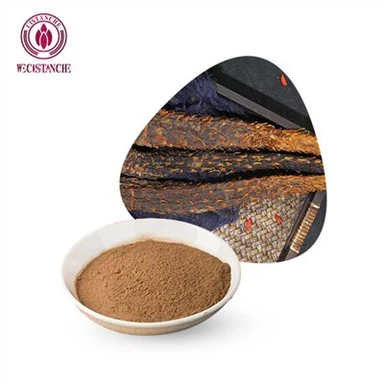
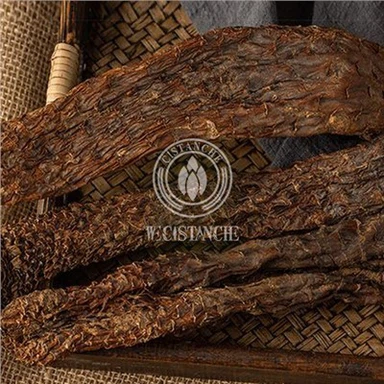
Cistanche is a genus of desert-dwelling, parasitic plants that attach themselves to the roots of host shrubs in arid regions. The two species most relevant to human health are Cistanche deserticola and Cistanche tubulosa. Both are used as Rou Cong Rong in traditional Chinese medicine, and both are known as "desert ginseng" because of their reputation as energizing tonics.
In traditional practice, Cistanche has been used for centuries as a gentle tonic for the kidneys, for supporting vitality and stamina, and for maintaining male reproductive and sexual health. Ancient texts describe it as warming and nourishing, and it was traditionally regarded as suitable for long-term, gentle support rather than as a quick fix.
Modern research has begun to validate some of these traditional uses. Laboratory and animal studies have reported a wide range of activities for Cistanche extracts, including antioxidant, anti-aging, neuroprotective, immune-modulating, and - most relevant here - hormone-related and reproductive effects. Studies in rodents have suggested that Cistanche extracts can influence sex hormone levels and support reproductive function, which provides a biological thread connecting the ancient uses to modern investigation.
The key to understanding how Cistanche might work lies in its chemistry.
3. What's Inside Cistanche: A Look at Its Bioactive Compounds
Cistanche is not a single compound; it is a complex botanical cocktail. Researchers have cataloged hundreds of chemical constituents in the plant, and a handful of families stand out as the most biologically important.
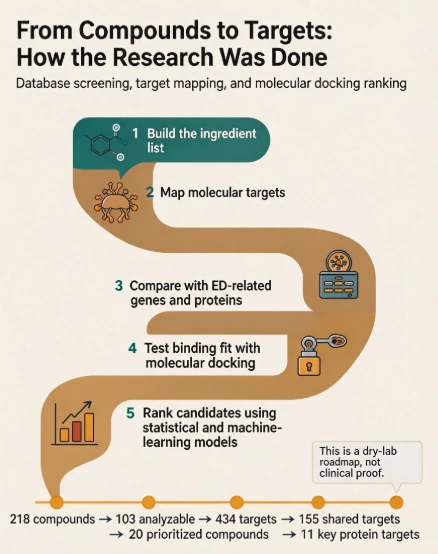
Phenylethanoid glycosides (PhGs) are widely considered the signature active family in Cistanche. This group includes familiar names such as echinacoside and acteoside (also called verbascoside). PhGs are known for their strong antioxidant activity and their ability to interact with a wide range of cellular targets. In fact, Cistanche tubulosa is one of the richest known natural sources of echinacoside and acteoside.
Iridoids are a second important family, with compounds such as geniposide and catalpol. Iridoids are common in many medicinal plants and are associated with anti-inflammatory and protective effects.
Lignans are a smaller but still significant group of polyphenolic compounds, examples being syringaresinol and pinoresinol. They contribute to the plant's overall antioxidant and health-supporting profile.
Beyond these three headline families, Cistanche also contains sugars, amino acids (including arginine, isoleucine, and leucine), nucleosides (such as inosine and uridine), and various organic acids and fatty acids. While these are less glamorous than the specialized polyphenols, they help make up the full nutritional and functional picture of the plant.
The challenge for scientists has always been this: with so many compounds present, how do you figure out which ones actually matter for a specific health goal? That is where modern computational biology comes in.
4. How the Research Was Done - Without a Single Animal
Traditional drug discovery is slow and expensive. Testing every compound in a plant against a disease, one by one, in laboratory animals, would take years and enormous resources. So researchers have developed powerful "dry lab" methods - computer-based approaches - to narrow down the field first.
A recent study took exactly this approach for Cistanche and erectile dysfunction. The process, though technical, is elegant once translated into plain language:
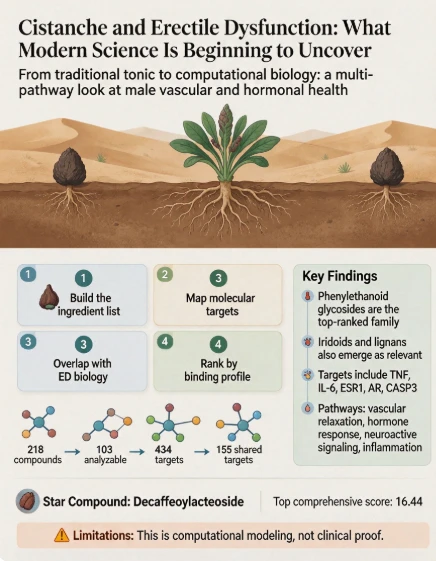
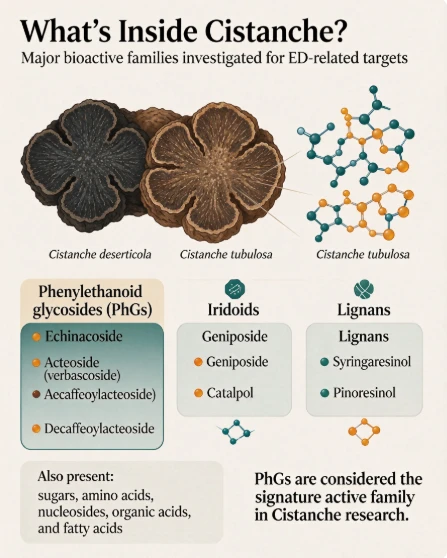
Step 1: Build the ingredient list. Researchers combed scientific databases and the published literature to identify 218 compounds reported in Cistanche, then narrowed that list to 103 compounds that could be reliably analyzed.
Step 2: Find what each compound "touches." Using public databases of molecular targets, the researchers mapped which proteins in the human body each Cistanche compound might interact with. This produced 434 potential targets.
Step 3: Compare with the disease. Separately, they identified 1,614 genes and proteins associated with erectile dysfunction from disease databases. When the two lists were overlaid, 155 targets overlapped - meaning these are the points where Cistanche's chemistry and ED's biology potentially meet.
Step 4: See how well they fit. The researchers selected 20 promising compounds and 11 key protein targets and ran molecular docking - a computer simulation that predicts how tightly a small molecule fits into a protein's binding site, a bit like testing whether a key fits a lock. A more negative "binding affinity" score generally means a stronger, more stable fit.
Step 5: Rank the candidates. Finally, they combined several measures of binding quality using statistical methods and machine-learning models to produce an objective ranking of which compounds showed the strongest overall profile for ED-related targets.
The result was a shortlist of compounds and biological pathways worth deeper investigation - a roadmap that saves time and money before any laboratory or clinical work begins.
5. What the Study Found: A Network of Targets and Pathways
The computer modeling painted a detailed picture of how Cistanche might touch the biology of erectile function. Several findings stand out.
Three compound families rose to the top. The analysis consistently pointed to phenylethanoid glycosides, iridoids, and lignans as the most relevant groups for ED-related targets. This aligns with what researchers already suspected: the phenylethanoid glycosides in particular are considered the plant's principal active constituents.
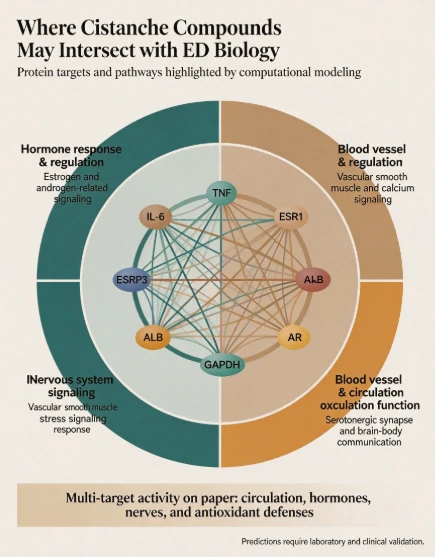
The targets tell a coherent story. Among the 155 shared targets, several well-known proteins repeatedly appeared at the center of the network, including TNF and IL-6 (both key players in inflammation), ALB (albumin, involved in transport and antioxidant capacity), GAPDH (a core enzyme in energy metabolism), and CASP3 (linked to programmed cell death). Also notable were the estrogen receptor ESR1 and the androgen receptor AR - receptors at the heart of sex-hormone signaling.
The pathways connect to real biology. When the researchers grouped the targets by their biological functions, several themes emerged that are directly relevant to erectile function:
Hormone response and regulation - targets involved in responding to estrogen and in regulating hormone levels.
Blood vessel and circulation function - pathways linked to atherosclerosis, vascular smooth muscle contraction, and calcium signaling, all of which govern how blood vessels relax and fill with blood.
Nervous system signaling - pathways such as the serotonergic synapse, which connects to mood, stress, and the brain-body signals involved in arousal.
Inflammation and oxidative stress - including the NF-kappa B inflammatory pathway and responses to external and oxidative stress.
In other words, the model did not point to a single magic mechanism. It suggested that Cistanche's compounds may act on multiple fronts at once - supporting circulation, hormone balance, nerve signaling, and antioxidant defenses - which is exactly the kind of multi-target behavior that makes a botanical potentially useful for a complex condition like ED.
6. The Star Compound: Decaffeoylacteoside
Perhaps the most striking result of the study was the identification of a single standout compound: decaffeoylacteoside, a phenylethanoid glycoside closely related to acteoside.
In the ranking analysis, decaffeoylacteoside earned the highest comprehensive score (16.44) among all 20 candidate compounds, ahead of several well-known cistanosides. Its molecular docking results were consistently strong across the key protein targets, suggesting it fits especially well into multiple ED-relevant proteins.
This is significant because it gives researchers - and the botanical industry - a more specific lead to pursue. Rather than speaking vaguely about "Cistanche extract," future work can focus on the phenylethanoid glycoside fraction in general, and decaffeoylacteoside in particular, when studying mechanisms and standardizing products.
It is worth noting that decaffeoylacteoside is part of the same chemical family as echinacoside and acteoside, the compounds for which Cistanche is already most famous. This means the study's headline finding is fully consistent with, and reinforces, what is already known about the plant.
7. How Cistanche Might Support Sexual Health - Connecting the Dots
Taken together, the study's findings suggest a plausible, multi-pathway explanation for Cistanche's traditional use in supporting male sexual health. None of these individual mechanisms is proven in humans, but the pieces fit together logically.
Supporting healthy blood flow. Erection depends on the ability of blood vessels to relax and expand. Several of the pathways highlighted in the study - vascular smooth muscle contraction, calcium signaling, and cAMP signaling - are the same molecular machinery targeted by conventional ED drugs and involved in nitric-oxide-driven vasodilation. By potentially influencing these pathways, Cistanche's compounds may help maintain the vascular responsiveness that healthy erections require.
Moderating inflammation and oxidative stress. Chronic low-grade inflammation and oxidative damage are known enemies of vascular and nerve health. The study's emphasis on TNF, IL-6, and the NF-kappa B pathway, combined with the documented antioxidant activity of phenylethanoid glycosides, suggests Cistanche may help protect the delicate tissues involved in erectile function.
Touching hormone signaling. The appearance of estrogen and androgen receptors among the top targets is intriguing. Sex-hormone balance is a recognized factor in male sexual health, and earlier animal studies have reported that Cistanche extracts can influence hormone levels. The computer model offers a molecular rationale for those observations.
Connecting to the nervous system. Because psychological stress, mood, and nerve signaling all play roles in erectile function, the study's identification of serotonergic and other neural pathways is also meaningful. It hints that Cistanche might offer support not only at the vascular level but also at the brain-body interface.
The key word throughout is might. These are predictions from computational modeling, not clinical conclusions.
8. What This Study Does Not Prove
It is just as important to be clear about the limits of the evidence as it is to explain the findings.
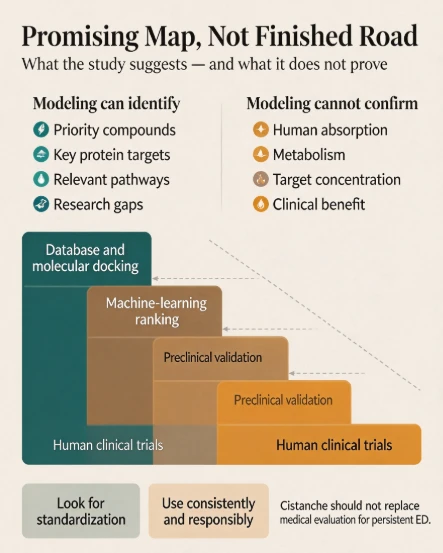
First, this was a bioinformatics study - work done entirely with databases and computer models. It did not involve human participants, animals, or even cells in a dish. The models predicted which compounds could interact with which targets; they did not demonstrate that these interactions happen in a living person or that they produce a measurable improvement in erectile function.
Second, the machine-learning models performed extremely well on the study's own dataset - with the logistic regression model reaching an AUC of 1.00 and the Gaussian naive Bayes model an AUC of 0.99 - but this is a sign of how well the models fit the molecular docking data they were given, not proof of clinical benefit. A near-perfect score on a small, carefully curated dataset does not automatically translate into real-world effectiveness.
Third, the study itself acknowledges important limitations: it did not account for how compounds interact with each other, how the body metabolizes them after consumption, or whether they reach their targets at meaningful concentrations. These are all critical unknowns.
The honest summary is this: the research provides a promising map, not a finished road. It identifies the most likely active compounds and mechanisms, which makes future laboratory and clinical studies far more efficient - but it does not, on its own, establish that Cistanche treats or cures erectile dysfunction.
9. Choosing and Using Cistanche Wisely
If you are considering Cistanche as part of a broader approach to men's health, a few practical principles are worth keeping in mind.
Look for standardization. Because phenylethanoid glycosides - especially echinacoside, acteoside, and related compounds - are the best-characterized active constituents, a quality Cistanche extract should clearly state its echinacoside and/or acteoside content. Standardized extracts make it possible to compare products and take a consistent amount.
Know your species. Both Cistanche deserticola and Cistanche tubulosa are used traditionally, and both contain the key phenylethanoid glycosides. Cistanche tubulosa is particularly valued for its high echinacoside content.
Think long-term, not overnight. Cistanche is a traditional tonic, not a fast-acting drug. Whatever benefit it may offer is most plausibly seen with consistent use over time, in the context of overall healthy habits - good sleep, exercise, a balanced diet, and managing stress.
Address the root causes. If you are experiencing persistent erectile dysfunction, it is worth treating it as a health signal rather than a source of embarrassment. Underlying issues such as blood pressure, blood sugar, cholesterol, hormone levels, and mental health are all worth checking with a professional. A botanical supplement can complement that process, but it should not replace it.
Choose reputable sources. As with any botanical, purity, identity, and manufacturing quality matter enormously. Choose products from suppliers who provide third-party testing and clear sourcing information.
Frequently Asked Questions
Is Cistanche a proven treatment for erectile dysfunction? No. Current evidence is preliminary. Laboratory modeling and animal studies are promising, but Cistanche has not been proven in large human clinical trials to treat ED. It should be viewed as a potential supportive botanical, not a replacement for medical treatment.
What is the most important active ingredient in Cistanche? The phenylethanoid glycosides are generally considered the most important active family, with echinacoside and acteoside (verbascoside) as the most famous members. A recent computational study highlighted decaffeoylacteoside as a particularly promising compound for ED-related targets.
How does Cistanche relate to blood flow? Computational research suggests Cistanche compounds may interact with pathways involved in vascular relaxation and circulation, which are central to erectile function. However, this is a prediction from modeling and has not been confirmed in humans.
What is the difference between Cistanche deserticola and Cistanche tubulosa? Both are used as Rou Cong Rong in traditional medicine and share key phenylethanoid glycosides. Cistanche tubulosa is especially known for its high echinacoside content.
How long does Cistanche take to work? Because Cistanche is a traditional tonic rather than a drug, any potential benefits are likely to build gradually with consistent use over weeks or months, rather than producing an immediate effect.
Can I take Cistanche with other medications? If you take prescription medications - especially for blood pressure, heart conditions, or hormone therapy - consult a qualified healthcare professional before adding any supplement, including Cistanche.
A Responsible Closing Word
The story of Cistanche is a compelling example of how ancient botanical wisdom and modern computational science can begin to meet. What was once a matter of tradition is now being dissected into specific compounds, targets, and pathways - and the early results are genuinely interesting. The phenylethanoid glycosides at the heart of Cistanche appear, on paper, to touch the very systems involved in erectile function: circulation, hormones, nerves, and inflammation.
But interest is not the same as proof. The most responsible way to talk about Cistanche is also the most credible way to market it: as a well-studied, tradition-backed botanical with promising preliminary evidence and a clear direction for future research - not as a miracle cure.
Disclaimer
This article is for educational and informational purposes only. It is not medical advice and is not intended to diagnose, treat, cure, or prevent any disease. The statements made here have not been evaluated by a food or drug regulatory authority. If you have erectile dysfunction or any other health concern, consult a qualified healthcare professional. Always speak with your doctor before starting any supplement, especially if you are taking medication or have a medical condition.