Cistanche Tubulosa And The Art Of Processing: How Traditional Methods Change Its Chemistry
Nov 26, 2026
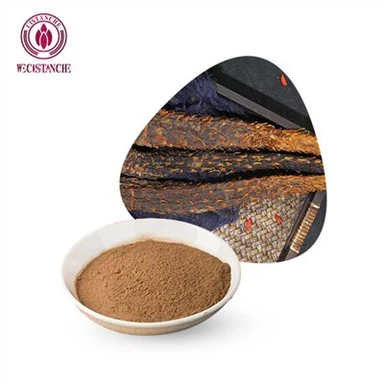
Deep in the deserts of northwestern China grows a plant that looks, at first glance, like nothing special - a fleshy, scaly stem poking out of the sand. Yet this humble plant, Cistanche tubulosa, is one of the most valued botanicals in traditional Chinese medicine, prized for its ability to support vitality, kidney energy, and reproductive health.
What many people do not realize is that the Cistanche you buy is rarely the raw, freshly harvested plant. Before it reaches the market, it usually passes through a traditional processing step - steaming, wine-bathing, or other methods refined over centuries. And as a recent scientific study confirms, that processing step changes the plant's chemistry in measurable, important ways.
This article explores what happens inside Cistanche tubulosa when it is processed, which compounds matter most, and why understanding this matters for anyone buying, selling, or using Cistanche products today.
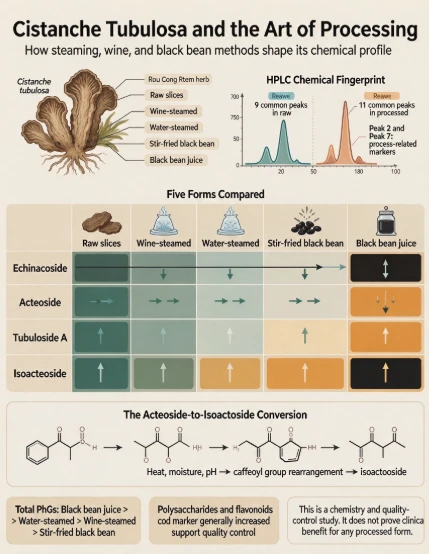
1. What Is Cistanche Tubulosa?
Cistanche tubulosa is a perennial parasitic herb in the broomrape family (Orobanchaceae). Like its better-known relative Cistanche deserticola, it survives by attaching itself to the roots of host shrubs - in this case, plants of the Tamarix (tamarisk) genus - and drawing nutrients from them.
The plant thrives in harsh, saline, arid environments, growing in the Gobi Desert and similar regions. In China, its most famous producing region is the Hotan (Hetian) area of Xinjiang, where both wild and cultivated populations are found.
In the official Chinese Pharmacopoeia, Cistanche tubulosa is recognized alongside Cistanche deserticola as a legitimate source of the medicine known as Rou Cong Rong. The part used is the dried, fleshy stem with its scale-like leaves. Traditionally, it is described as warm in nature and sweet and salty in taste, with actions associated with supporting kidney yang, replenishing essence and blood, and moistening the intestines.
What makes Cistanche tubulosa especially interesting from a modern scientific perspective is its chemical richness. The plant contains a remarkable array of bioactive compounds, including:
Phenylethanoid glycosides (PhGs) - the most abundant and most studied active family
Iridoids and their glycosides
Lignans
Oligosaccharide esters and polyols
Polysaccharides
Flavonoids
Among these, the phenylethanoid glycosides are considered the primary active constituents and the most important quality markers. They are the compounds most closely linked to Cistanche's antioxidant, metabolism-supporting, memory-enhancing, and reproductive-health properties.
2. What Does "Processing" Actually Mean?
To a Western reader, "processing" might sound like an industrial afterthought. But in traditional Chinese medicine, processing - known as pao zhi (炮制) - is a deliberate, sophisticated art. It is a way of transforming raw botanical material to change its properties, reduce harshness, improve safety, or enhance specific effects.
The methods used for Cistanche have evolved over more than a thousand years. Ancient medical texts record techniques such as washing in wine, stir-frying with wine, steaming, and baking, as well as more elaborate procedures involving repeated steaming cycles or the use of black beans. Modern practice has largely settled on a handful of standardized methods, including wine-steaming, plain steaming, and black bean-based processing.
Why go to all this trouble? Because processing genuinely changes the chemistry. Heating, moisture, and the addition of other ingredients can:
Break down or convert certain compounds
Concentrate others
Reduce undesirable or harsh components
Improve shelf stability and safety
A growing body of research has shown that different processing methods can significantly shift the levels of key active compounds in Cistanche - sometimes increasing them, sometimes decreasing them. Understanding these shifts is essential for anyone who wants to standardize and control the quality of Cistanche products.
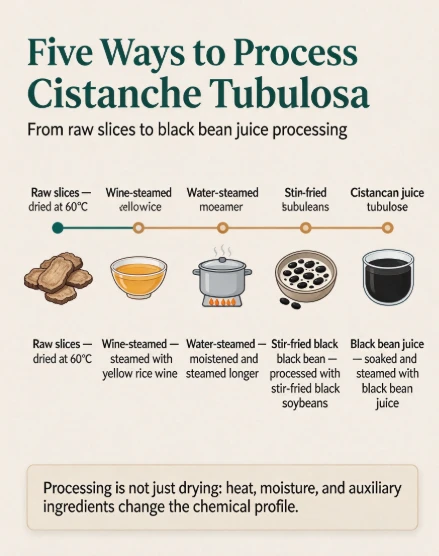
3. The Five Forms Compared in the Study
A recent study from the Xinjiang Institute of Materia Medica set out to systematically compare the chemistry of Cistanche tubulosa in five different forms:
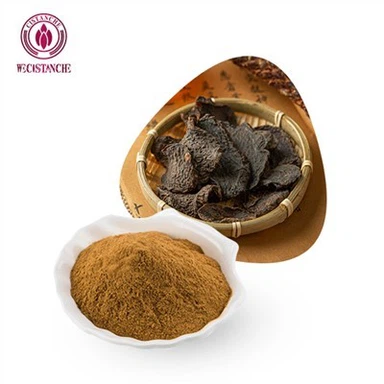
Raw slices (生片) - fresh stems cut into thin slices and dried at 60°C. This is the "unprocessed" baseline.
Wine-steamed slices (酒蒸片) - slices steamed with yellow rice wine, following the traditional wine-steaming method described in the Chinese Pharmacopoeia.
Water-steamed slices (水蒸片 / 蒸制片) - slices moistened with a small amount of water and steamed for an extended period.
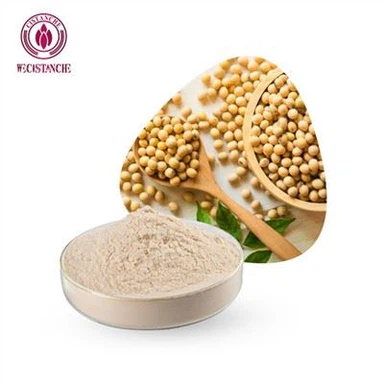
Stir-fried black bean slices (炒黑豆制片) - slices processed together with stir-fried black soybeans, a traditional method that uses roughly 1 kg of black beans per 10 kg of Cistanche.
Black bean juice slices (黑豆汁制片) - slices soaked and steamed with the juice extracted from black beans, again using black beans in the same proportion.
By preparing each form under controlled conditions and analyzing all of them with the same rigorous methods, the researchers were able to isolate the effect of each processing method on the plant's chemical profile.
4. How Scientists "Fingerprint" a Plant
To compare five forms of Cistanche fairly, you need more than a single measurement of one compound. You need a chemical "fingerprint" - a picture of the whole profile of compounds present.
The tool used in this study is high-performance liquid chromatography (HPLC), a laboratory technique that separates the individual chemical components in a sample and produces a characteristic pattern of peaks, each peak representing one compound. The pattern of peaks - their positions, sizes, and relative heights - acts like a fingerprint that identifies and characterizes the material.
The researchers found that the raw Cistanche slices showed 9 common peaks (compounds consistently present across batches), while all four processed forms showed 11 common peaks. Two of those peaks - labeled Peak 2 and Peak 7 - appeared only in the processed products, making them useful markers for distinguishing processed Cistanche from raw.
By comparing the fingerprint against purified reference standards, the researchers identified four specific, commercially and biologically important compounds in the profile:
Echinacoside (松果菊苷)
Tubuloside A (管花苷 A)
Acteoside (毛蕊花糖苷,also known as verbascoside)
Isoacteoside (异毛蕊花糖苷,also known as isoverbascoside)
These four phenylethanoid glycosides are among the most valuable quality markers for Cistanche, and they became the focus of the detailed content comparisons.
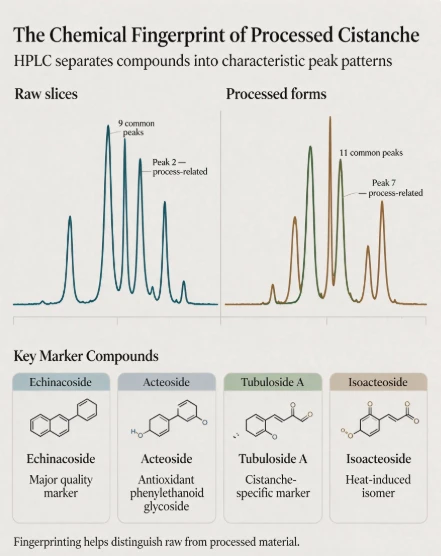
5. The Four Star Compounds, Explained
Before diving into what processing does, it helps to understand what these four compounds are and why they matter.
Echinacoside is arguably the most famous compound in Cistanche. It is a phenylethanoid glycoside known for strong antioxidant and neuroprotective activity, and it is used as a primary marker of quality in Cistanche products. Cistanche tubulosa is one of the richest natural sources of echinacoside in the world.
Acteoside (verbascoside) is a close chemical relative of echinacoside. It, too, is a powerful antioxidant and has been the subject of extensive research for its cellular-protective properties. In Cistanche, acteoside is present at meaningful levels and is frequently measured alongside echinacoside.
Tubuloside A is a Cistanche-specific phenylethanoid glycoside that contributes to the plant's distinctive chemical profile. It is found in relatively small amounts but is a valuable marker for authenticity and processing.
Isoacteoside (isoverbascoside) is a structural isomer of acteoside - the same atoms arranged in a slightly different way. It is important here because it sits at the center of one of the study's most interesting findings: the heat-driven conversion of acteoside into isoacteoside.
Together, these four compounds provide a sensitive readout of both the quality and the processing history of a Cistanche sample.
6. What Processing Does to the Chemistry
The study's central finding is straightforward but significant: different processing methods change the levels of Cistanche's key compounds in different, predictable ways.
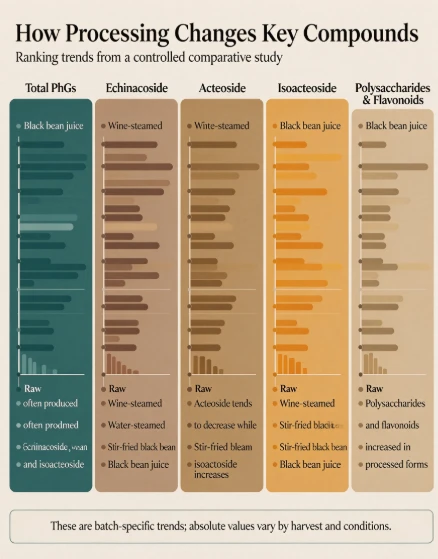
Looking at total phenylethanoid glycosides (the headline active family), the ranking from highest to lowest was:
Black bean juice > raw > water-steamed > wine-steamed > stir-fried black bean.
The total phenylethanoid glycoside content ranged from 3.80% to 7.07% across all samples. Notably, black bean juice processing was the only method that increased total phenylethanoid glycosides relative to the raw material, while the other three methods all caused a decrease.
For the four individual marker compounds, the picture was more nuanced:
Echinacoside (4.11%–5.99%) increased in all four processed forms compared with raw slices, with the black bean juice method showing the largest gain.
Acteoside (0.67%–1.34%) decreased in three of the four processed forms - the exception being stir-fried black bean processing, where it actually increased.
Tubuloside A (0.06%–0.36%) increased across all processed forms.
Isoacteoside (0.25%–1.66%) increased substantially in all processed forms, again most dramatically with black bean juice.
This pattern - acteoside going down while isoacteoside goes up - is not random. It points to a specific, well-understood chemical reaction.
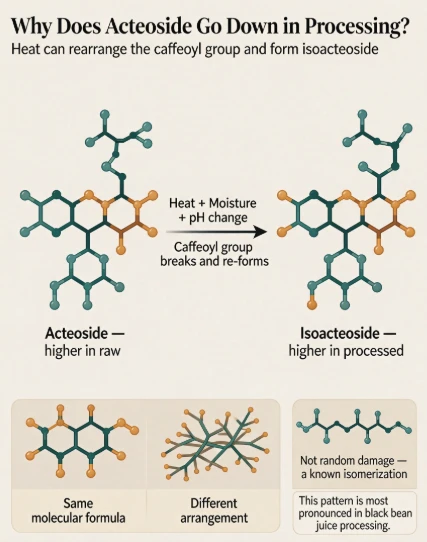
7. The Acteoside-to-Isoacteoside Story
One of the most elegant findings in the study concerns the relationship between acteoside and isoacteoside.
Acteoside is a phenylethanoid glycoside that carries a caffeoyl group attached to its sugar backbone. Under the influence of heat, moisture, and pH changes - exactly the conditions created by steaming - the ester bond holding that caffeoyl group can break and then re-form in a slightly different arrangement, converting acteoside into its isomer, isoacteoside.
This explains the observed pattern beautifully: the processed samples, all of which experienced high-temperature steaming, showed lower acteoside and higher isoacteoside compared with raw slices. The black bean juice method, which produced the most dramatic shift, is consistent with the most pronounced heat-driven conversion.
This is not a defect. It is a natural chemical transformation that researchers have also documented in other heat-processed botanicals, such as rehmannia (Rehmannia glutinosa). Understanding it matters because it tells quality-control laboratories why two otherwise similar Cistanche products might show different acteoside and isoacteoside levels - and helps them use those levels to identify how a sample was processed.
8. Beyond the Markers: Polysaccharides and Flavonoids
While the four phenylethanoid glycosides steal the spotlight, the study also measured two other important classes of compounds.
Total polysaccharides ranged from 5.85% to 6.70%, with the ranking: water-steamed > wine-steamed > stir-fried black bean > black bean juice > raw. In other words, every processing method increased polysaccharide content relative to raw material.
Total flavonoids ranged more widely, from 14.16% to 24.26%, with the ranking: black bean juice > water-steamed > stir-fried black bean > wine-steamed > raw. Again, all processing methods increased total flavonoid content.
These results matter because polysaccharides and flavonoids are themselves associated with health benefits - including antioxidant and immune-supporting activity. The fact that processing generally boosts these fractions suggests that traditional processing was not merely a preservation technique; it may genuinely have altered the plant in ways that enhance certain functional properties.
It is also worth noting the influence of the black bean itself. Black soybeans contribute their own array of compounds, including anthocyanins and other polyphenols, which may partly explain why black bean-based processing produced higher flavonoid levels. This is a reminder that in traditional processing, the "helper" ingredients are not neutral - they become part of the final chemical picture.
9. A Statistical Check: Do the Five Forms Really Differ?
Chemistry can be noisy. Batch-to-batch variation, measurement error, and natural biological differences can all blur the picture. That is why the researchers did not rely on raw numbers alone - they applied two statistical methods to confirm that the differences were real and meaningful.
Cluster analysis grouped the samples by similarity. At a defined distance threshold, the raw slices clustered separately from the processed forms, and the five forms separated into three distinct groups. This confirmed that raw and processed Cistanche have genuinely different chemical profiles.
Principal component analysis (PCA) reduced the complex, multi-peak fingerprint down to just three underlying components that together explained more than 90% of the variation among samples. When the samples were scored along these components, the black bean juice, water-steamed, and wine-steamed forms ranked highest - indicating that these processing methods produced the most distinctive and, in the study's framework, most chemically "developed" profiles.
In short, the statistics backed up the chemistry: processing does not just rearrange the furniture; it creates a detectably different product.
10. Why This Matters for Quality Control
For an industry built on botanical ingredients, this kind of research has practical, real-world value.
The HPLC fingerprint developed in the study is specific - it can reliably tell raw Cistanche tubulosa apart from its processed forms. That may sound like an academic nicety, but it has concrete consequences. The marketplace is full of Cistanche products of varying quality, and raw and processed materials are often mixed together and hard to distinguish by appearance alone. A fingerprint method gives manufacturers, regulators, and laboratories an objective tool to identify what a product actually is.
The four marker compounds - echinacoside, acteoside, tubuloside A, and isoacteoside - provide a practical basis for standardization. By setting clear content specifications for these compounds, producers can ensure batch-to-batch consistency and give buyers confidence in what they are purchasing.
This is especially relevant for Cistanche tubulosa because, unlike the better-documented raw slices and wine-steamed slices, the other processed forms have historically lacked clear, official quality standards. Research like this helps fill that gap.
11. What It Means for Consumers and Buyers
So what should an informed buyer take away from all of this?
Processing changes the product - and that is not a bad thing. Traditional processing is not just about making a plant easier to store. It genuinely transforms the chemistry, sometimes increasing the very compounds that matter most. The fact that black bean juice processing raised total phenylethanoid glycosides and flavonoids is a good example of processing as a functional enhancement, not a compromise.
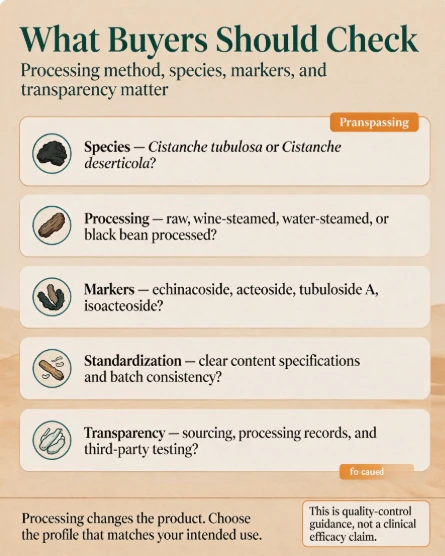
Look for standardized, transparent products. A quality Cistanche extract should tell you which species it comes from and specify its key marker content - most importantly echinacoside, and ideally acteoside and other phenylethanoid glycosides. If a supplier cannot tell you the echinacoside content of their Cistanche, that is a red flag.
Echinacoside is the benchmark, but not the whole story. Because Cistanche tubulosa is one of the richest natural sources of echinacoside, echinacoside content is a useful shorthand for quality. But the full picture - the balance of acteoside, isoacteoside, tubuloside A, polysaccharides, and flavonoids - also matters, and it depends on how the material was processed.
Different processing suits different purposes. There is no single "best" Cistanche. Raw, wine-steamed, water-steamed, and black bean-processed forms each have a different chemical profile, reflecting the traditional understanding that different preparations serve different needs. For a modern extract intended for supplementation, the key is that the producer controls and documents the processing method and verifies the resulting chemistry.
12. What This Study Does Not Address
As always, scientific honesty requires acknowledging the limits.
This was a chemistry and quality-control study. It tells us what compounds are present and how processing changes their levels. It does not test clinical outcomes in humans, and it does not claim that any particular processing method produces a "better" product in terms of health effects.
The identification of the two new peaks (Peak 2 and Peak 7) that appear after processing is a valuable lead, but the identity of those compounds has not yet been confirmed. The researchers explicitly note this as a direction for future work.
Finally, while the study observed consistent trends across multiple batches, botanical materials are inherently variable. The specific numbers reported here are for the batches analyzed in this study; different harvests, growing regions, and processing conditions can produce different absolute values.
Frequently Asked Questions
What is Cistanche tubulosa? It is a desert-dwelling parasitic plant in the broomrape family, recognized alongside Cistanche deserticola as a source of Rou Cong Rong in traditional Chinese medicine. It is especially valued for its high content of phenylethanoid glycosides such as echinacoside.
What are the most important compounds in Cistanche tubulosa? The phenylethanoid glycosides are considered the principal active constituents, with echinacoside and acteoside (verbascoside) being the most important markers. Tubuloside A and isoacteoside are also significant.
Does processing destroy the active compounds? Not necessarily. Some compounds decrease with heating - acteoside, for example, partially converts to isoacteoside - but others, including echinacoside, tubuloside A, polysaccharides, and flavonoids, generally increased after processing in this study. Black bean juice processing even increased total phenylethanoid glycosides.
Why does acteoside decrease after processing? Heating causes the caffeoyl group in acteoside to break and re-form, converting part of it into its isomer, isoacteoside. This is a natural chemical transformation, not a sign of damage.
What is a "fingerprint" in herbal quality control? An HPLC fingerprint is a characteristic pattern of chemical peaks that identifies and characterizes a botanical material. It allows laboratories to confirm the identity of a sample and distinguish between, for example, raw and processed Cistanche.
Which processing method produced the highest levels of key compounds? Black bean juice processing generally produced the highest levels of total phenylethanoid glycosides, total flavonoids, echinacoside, and isoacteoside in this study.
What should I look for in a quality Cistanche product? Look for clear species identification and standardized content of key markers, especially echinacoside. Transparent sourcing, documented processing methods, and third-party testing are all positive signs.
A Closing Word
There is something quietly satisfying about seeing an ancient craft validated by modern chemistry. For centuries, practitioners of traditional medicine steamed Cistanche in wine, or with black beans, believing these steps changed the herb for the better. Now, high-performance liquid chromatography shows exactly how - down to the movement of a single chemical group as acteoside transforms into isoacteoside under heat.
For the modern Cistanche industry, the lesson is clear: processing is not an afterthought. It is a variable that shapes the product at the molecular level, and it deserves the same rigorous attention as sourcing, harvesting, and extraction. Studies like this one give producers and buyers alike the tools to move beyond tradition and habit, and toward a Cistanche market defined by identity, consistency, and verifiable quality.
Disclaimer
This article is for educational and informational purposes only. It is not medical advice and is not intended to diagnose, treat, cure, or prevent any disease. The statements made here have not been evaluated by a food or drug regulatory authority. Cistanche products are not intended to replace any medical treatment. Consult a qualified healthcare professional before using any supplement, especially if you are pregnant, nursing, taking medication, or have a medical condition.