Fan Yongping’s Experience In The Treatment Of Multiple Sclerosis Based On The Theory Of “The Kidney Governs Bone, Generates Marrow, And Communicates With The Brain”
Nov 18, 2026
HU Linyuan¹, FAN Yongping², CHEN Wei¹*
Department of Neurology, The First Affiliated Hospital of Yunnan University of Chinese Medicine, Kunming 650021, China
Department of Traditional Chinese Medicine, Beijing Tiantan Hospital, Capital Medical University, Beijing 100070, China
Abstract: Professor Fan Yongping believes that the pathogenesis of multiple sclerosis lies in a deficiency of kidney essence. Kidney deficiency and marrow depletion constitute the foundation of the disease, while the intermingling of phlegm and blood stasis is the key factor. Congenital insufficiency of kidney essence is the main internal cause, while external invasion by the six exogenous pathogens, internal injury from the seven emotions, improper diet, overwork, trauma, and post-partum emptiness of the meridians are triggering factors. Professor Fan proposes that treatment principles include tonifying the kidney and replenishing qi, promoting blood circulation and removing blood stasis. Based on the TCM theory of "tonifying the kidney to generate marrow and nourish the brain," he formulated the experiential prescription Bushen Yisui Decoction (Kidney-Tonifying and Marrow-Benefiting Decoction), with rehmannia root as the chief ingredient, along with prepared rehmannia root, unprepared rehmannia root, prepared fleeceflower root, common yam rhizome, desertliving cistanche, dodder seed, and others to nourish the liver and kidney. In addition, he emphasizes combining tonification of deficiency with purgation of excess. On the basis of tonifying the kidney, he adds herbs that promote blood circulation, remove blood stasis, and open the collaterals, in order to achieve a balanced effect. He applies these methods in the clinical treatment of multiple sclerosis and has achieved good therapeutic effects.
Keywords: multiple sclerosis; kidney governing bone and generating marrow; Fan Yongping
Introduction
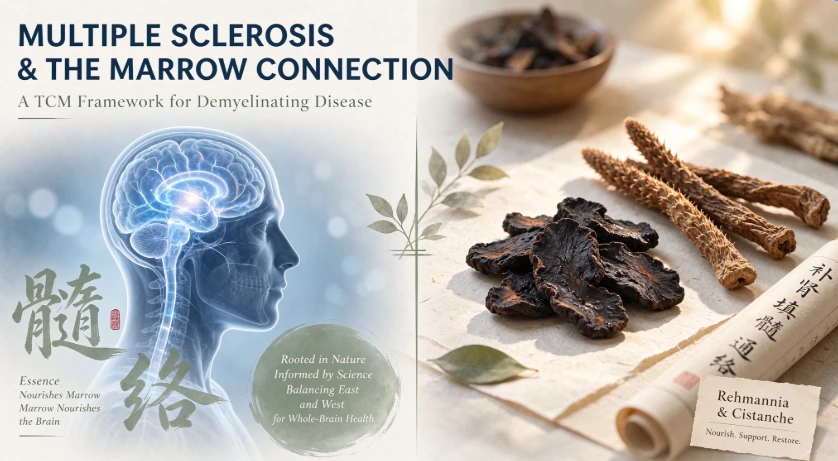
Multiple sclerosis (MS) is an immune-mediated inflammatory demyelinating disease of the central nervous system (CNS), characterized by dissemination in time and space of lesions. MS is included in China's first batch of rare diseases and remains clinically difficult to treat. Current Western medicine guidelines recommend high-dose steroid pulse therapy in the acute phase and disease-modifying therapies (DMTs) in the remission phase. Although effective, these therapies still cannot fully control relapse and progression and may increase infection risk and other adverse reactions due to immunosuppression. Fan Yongping has decades of clinical experience treating MS and has developed a distinctive theoretical system that provides ideas for TCM treatment of this disease.
Fan Yongping is a nationally recognized senior TCM practitioner and an outstanding national TCM clinical talent, well versed in the classics, with extensive experience in neurological disorders. This paper introduces Fan Yongping's treatment thinking for MS based on the theory that "the kidney governs bone, generates marrow, and communicates with the brain."
1. The Concept of "Marrow"
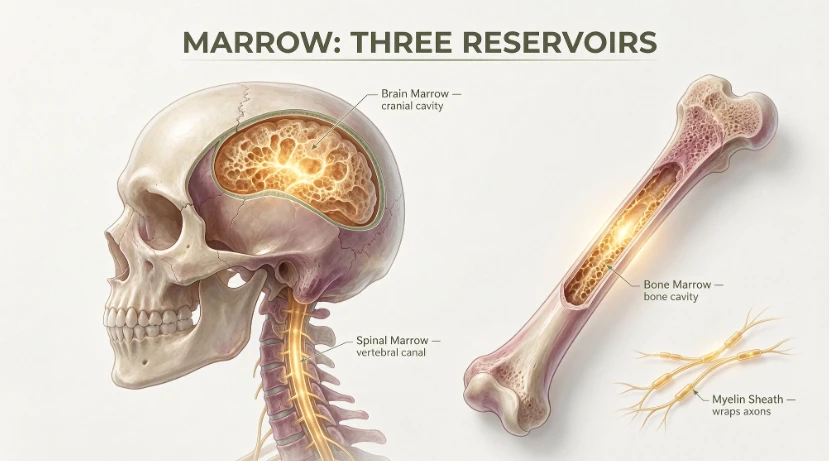
Shuowen Jiezi states: "Marrow is the fat within bone." That is, marrow is a paste-like substance distributed in the bone cavity. In TCM, marrow is stored in bone and is an essential refined substance required for forming and maintaining life activities. It includes brain marrow, spinal marrow, and bone marrow. That in the cranial cavity is brain marrow; that in the vertebral canal is spinal marrow, which connects upward to brain marrow and downward through the coccyx and sacrum; that in the bone cavity is bone marrow. Marrow is transformed from congenital essence and nourished by acquired essence, and belongs to the extraordinary fu-organs.
Modern medicine classifies brain marrow and spinal marrow within the CNS; the myelin sheath that wraps axons is an important component. Therefore, Fan Yongping considers the myelin sheath also part of the TCM category of "marrow." Studies have confirmed that tonifying the kidney can promote myelin repair in the CNS.
2. Theoretical Basis of "The Kidney Governs Bone, Generates Marrow, and Communicates with the Brain"
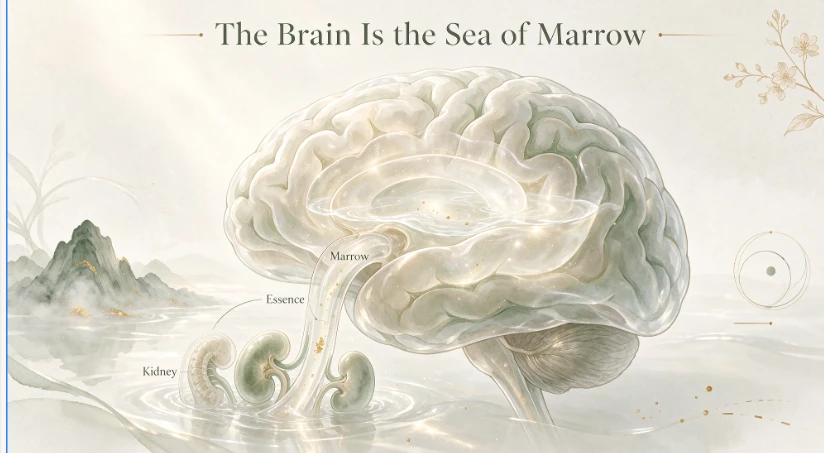
The phrase "the kidney governs bone, generates marrow, and communicates with the brain" first appears in the Huangdi Neijing. The Suwen · Xuanming Wuqipian says "the kidney governs bone," and Suwen · Wei Lun says "the kidney governs the body's bone marrow." Suwen · Wuzang Shengcheng states "all marrow belongs to the brain," revealing the close physiological and pathological relationship among kidney–essence–marrow–brain.
Lingshu · Hailun clearly points out "the brain is the sea of marrow," suggesting that kidney essence generates marrow which rises to fill the brain, maintaining normal brain function. Lingshu · Wulong Jinye Bie describes how the fluids of grains combine into a rich essence that infiltrates the bone cavities, benefits the brain marrow, and then flows downward; disharmony of yin and yang leads to leakage downward and reduction of marrow fluid, causing deficiency with low back pain and soreness. Suwen · Niao Diao Lun states "if the kidney does not generate, the marrow cannot be full." Lingshu · Jingmai states: "At birth, essence forms first; when essence forms, brain marrow is generated." Based on these theories, Fan Yongping proposes that demyelinating changes in MS reflect damage to kidney essence.
Later physicians further developed the theory. Nanjing · 28th Difficulty discusses the Governing Vessel entering the brain; Sisheng Xinyuan states that marrow and bone are generated by kidney water and strengthened by abundant kidney qi; Duyi Suibi says marrow and brain both belong to essence; and Wang Qingren in Yilin Gaicuo · Nao Sui Shuo wrote that the clear part of essence transforms into marrow, which ascends through the spine into the brain. These statements indicate that marrow and brain are transformed from kidney essence. Therefore, Fan Yongping asserts that tonifying the kidney can nourish brain marrow, promote myelin repair in MS, and improve disease conditions.
3. Clinical Manifestations of MS Are Closely Related to Kidney Deficiency and Marrow Depletion
3.1 Kidney deficiency and marrow depletion explain the diverse clinical manifestations
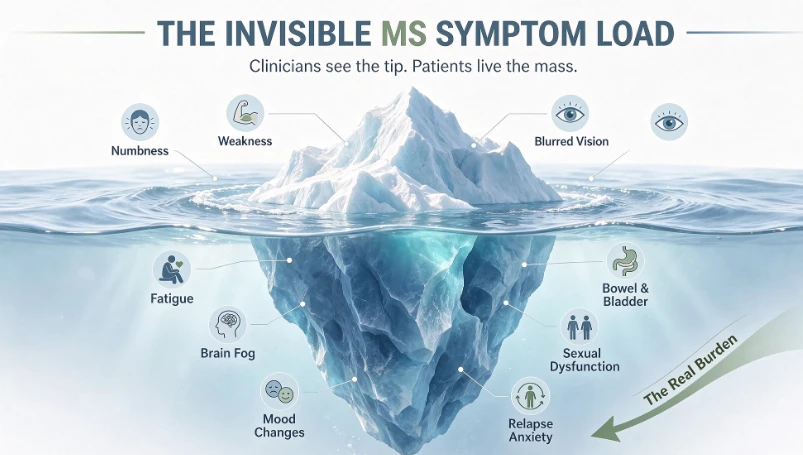
Lingshu · Hailun says: "If the sea of marrow is abundant, one is light, vigorous, and strong; if insufficient, there is dizziness, tinnitus, soreness of the shins, blurred vision, and lassitude with a desire to lie down." Fan Yongping believes this describes the diverse MS symptoms: visual changes, dizziness, tinnitus, sensory abnormalities, motor dysfunction, cognitive impairment, fatigue, bowel/bladder dysfunction, and sexual dysfunction. It also clarifies that kidney deficiency and marrow depletion are the mechanism underlying symptom diversity.
3.2 Kidney deficiency and marrow depletion and cognitive decline
"The brain is the sea of marrow" and relates to cognition; reduced marrow in the bone cavities leads to cognitive decline. Li Shizhen first clearly proposed "the brain is the organ of original spirit." Yizong Jinjian further explained that the head contains brain marrow and the brain governs the body. Fan Yongping noted that cognitive decline in MS is related to kidney deficiency and marrow depletion. Yilin Gaicuo also states that memory and mental agility are in the brain, and insufficient brain marrow in children or depletion in the elderly affects memory. Modern studies show reduced brain volume and worse cognition in MS, with negative correlation between brain volume and cognitive scores. Pathology commonly shows white-matter demyelination and axonal breakdown, leading to brain atrophy and cognitive effects. Fan Yongping thus proposed that tonifying the kidney to generate marrow and connect to the brain can improve cognition; prior team research confirmed this effect.
3.3 Kidney deficiency and marrow depletion and visual changes
The liver and kidney share a common source; essence and blood transform into each other. Kidney essence deficiency can affect liver blood, leading to poor nourishment of the eyes. Vision depends on the essence of the five zang organs, and the kidney stores the essence of all organs; kidney deficiency and marrow depletion lead to insufficiency affecting the eyes. Classical texts and later works link kidney essence decline with vision issues. Therefore, Fan suggests tonifying the kidney enriches essence which transforms into brain marrow and nourishes the eyes.
3.4 Kidney deficiency and marrow depletion and motor dysfunction
MS motor problems include gait abnormality, ataxia, and fine motor difficulty. Suwen · Linglan Midian Lun states: "The kidney is the official of strength; skill comes from it," linking kidney to motor strength and precision. Other classics relate inability to turn the waist to kidney exhaustion. Fan believes MS leads to kidney deficiency and marrow depletion causing motor dysfunction. Kidney stores essence, governs bone and generates marrow; sufficient essence and marrow support strong bones and coordinated movement.
3.5 Kidney deficiency and bowel/bladder dysfunction
Bowel/bladder dysfunction is common in MS and can be highly distressing. Classics state the kidney opens to the two yin orifices and governs opening/closing, affecting urination and defecation. Kidney deficiency can cause constipation or diarrhea; impaired qi transformation leads to urinary problems. Modern research suggests demyelinating lesions in CNS white-matter tracts controlling bladder/bowel contribute to dysfunction. Fan's team found over half of MS patients have bowel/bladder issues; kidney-tonifying marrow-generating methods can improve them.
3.6 Kidney deficiency and reproductive/sexual dysfunction
The kidney governs reproduction. Sexual dysfunction is common but often hidden in MS. Classics relate kidney qi decline with reduced sexual and reproductive function. Fan's team found about half of female MS patients had sexual dysfunction.
3.7 Kidney deficiency and marrow depletion and fatigue
Fatigue is highly prevalent in MS. Fan believes kidney deficiency and marrow depletion cause this, consistent with classical descriptions of marrow insufficiency leading to lassitude and desire to sleep. Demyelination and axonal damage delay nerve conduction and increase energy costs, worsening fatigue. Fan categorizes this as deficiency; tonifying the kidney, replenishing essence, and benefiting marrow may improve fatigue.
3.8 Kidney deficiency and emotional disorders
Classics state "the kidney governs fear; fear injures the kidney." The kidney stores essence and houses willpower; deficiency can manifest as low mood. Other texts link kidney water depletion and uncontrolled heart fire with restlessness. Kidney essence deficiency may lead to low mood, and persistent low mood further consumes kidney essence, worsening the cycle. Fan proposes nourishing kidney essence and brain marrow can interrupt this vicious cycle.
4. Diagnostic and Treatment Thinking for MS
4.1 Overview based on "tonifying the kidney to generate marrow and communicate with the brain"
Fan believes kidney essence deficiency leads to insufficient generation of "marrow," manifesting as impaired myelin production or accelerated destruction. Congenital insufficiency and kidney essence deficiency are primary internal causes. External pathogens, emotional injury, improper diet, overwork, trauma, and postpartum meridian emptiness are triggers. "Where evil gathers, qi must be deficient." MS relates to constitutional deficiency and weakened upright qi. The kidney is the congenital root but depends on acquired nourishment; if spleen/stomach are weak, qi and blood transformation lacks source, essence is insufficient, upright qi weakens, and kidney essence deficiency with liver yin-blood insufficiency leads to qi deficiency, blood stasis, phlegm-dampness-heat accumulation, eventually resulting in MS.
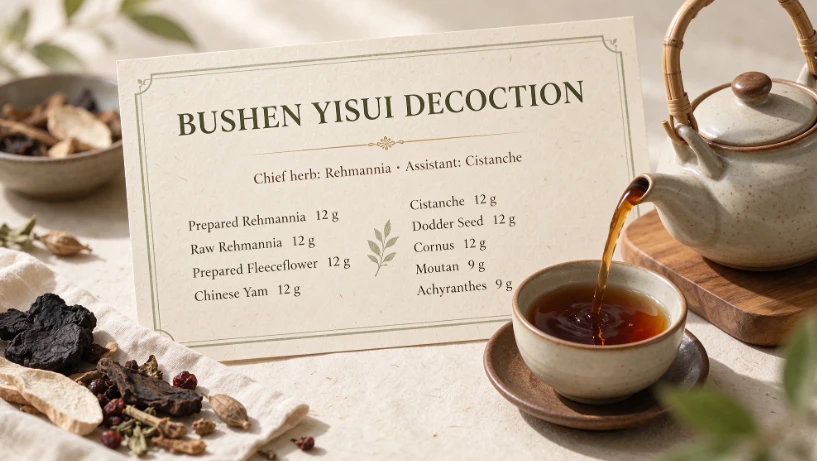
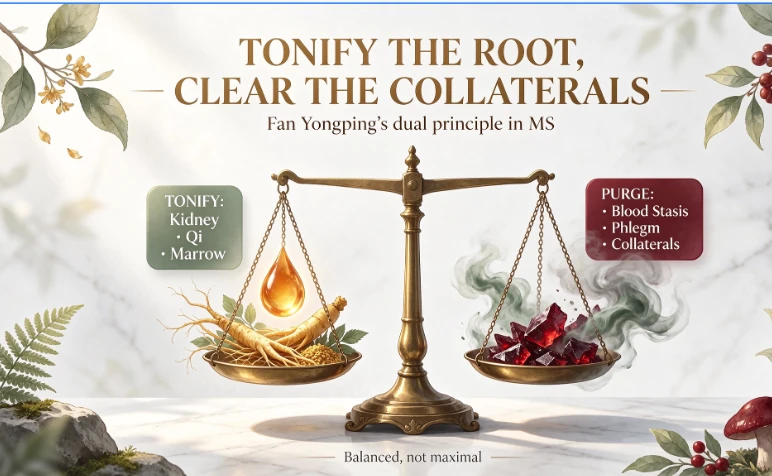
Fan's long clinical experience and research found kidney-essence-deficiency syndrome elements are most widely distributed among MS patients; he believes kidney deficiency and marrow depletion are the foundation, while phlegm and stasis intermixing is the key. Kidney deficiency is the root; phlegm-stasis is the evolution product. Research has shown kidney-tonifying methods regulate immune function; catalpol (an active component in rehmannia) can promote oligodendrocyte precursor proliferation/differentiation, reduce myelin/axonal loss in MS/EAE models, and reduce steroid adverse effects. Based on the theory and clinical research, Fan summarized that the experiential formula with rehmannia as chief (Bushen Yisui Formula, formerly Erhuang Formula) is very effective. Experimental studies suggest it reduces inflammatory infiltration, repairs myelin, protects nerves, and modulates immunity. Catalpol from prepared rehmannia can promote oligodendrocyte generation and myelin formation; taking the formula in remission can reduce annual relapse rate.
4.2 Medication experience
4.2.1 For relapsing–remitting MS
Based on the theory, Fan often uses prepared rehmannia, unprepared rehmannia, prepared fleeceflower root, yam, Cistanche deserticola, dodder seed, etc., combining them so the prescription is warm but not dry, nourishing but not cloying, balancing yin and yang. He also considers repeated attacks and chronic progression further damage kidney essence; prolonged kidney yin deficiency can impair kidney yang. On the basis of nourishing yin, he often adds yang-warming kidney-tonifying herbs such as epimedium, Cistanche, Morinda officinalis, and cinnamon, reflecting the idea of seeking yang within yin and yin within yang. With long-term syndrome-based regulation, upright qi gradually strengthens; relapse frequency decreases and may even cease.
4.2.2 For progressive MS
Based on classics, Fan links flaccidity syndromes to lung and ultimately kidney; long-term kidney deficiency fails to nourish brain marrow. Along with chronic disease entering the collaterals, residual toxic pathogens may persist, gradually damaging brain marrow; symptoms worsen without obvious relapses ("silent progression"). Treatment emphasizes supporting upright qi while dispelling pathogens, combining tonification and purgation. If prolonged disease affects the blood aspect with stasis and collateral obstruction, he adds blood-activating, stasis-resolving, collateral-opening herbs or sometimes "blood-and-flesh" products to search the collaterals (e.g., leech, salvia, notoginseng, red peony, earthworm, peach kernel, safflower) selecting one or two. If greasy tongue coating persists, he also addresses phlegm and opens collaterals. His prescriptions show meticulous strategy.
5. Case Example
Mr. Ji, male, 15 years old, first visit on April 24, 2024.
Chief complaint: recurrent left limb numbness for more than 2 months.
History: In February 2024, numbness in left limbs occurred without clear trigger, no movement disorder, remitted spontaneously after a few days. Another episode in mid-March lasted several days; late March recurred with right eye abduction limitation and diplopia. He visited a local hospital and was diagnosed with MS. He then visited Huashan Hospital and received methylprednisolone pulse therapy with symptom improvement; oral methylprednisolone tapering from 6 tablets over 7 days then stopped.
Auxiliary examinations:
March 2024: CSF oligoclonal bands positive (type 2); serum demyelinating antibody panel (6 items) negative.
April 2024 brain MRI: multiple abnormal signal lesions in pons, left cerebellar hemisphere, bilateral frontal lobes, left parietal lobe, and right temporo-occipital lobe.
No special past history.
Tongue/pulse: dark red tongue, slightly greasy yellow coating, slippery slightly wiry pulse.
TCM diagnosis: MS (kidney essence deficiency with phlegm-stasis obstruction).
Prescription: prepared rehmannia 12 g, unprepared rehmannia 12 g, Zhejiang fritillaria 12 g, cornelian cherry fruit 12 g (wine-processed), moutan bark 9 g, achyranthes bidentata 9 g, scorpion 5 g, stir-fried white mustard seed 10 g, hedyotis diffusa 12 g, coix seed 12 g, poria 18 g. 14 doses, decocted, 1 dose daily divided morning and evening.
Second visit (June 27, 2024): numbness improved, no relapse; appetite/sleep normal, bowel/bladder normal. Tongue dark red with slightly greasy yellow coating; pulse slippery slightly wiry. Modified formula: removed white mustard seed and scorpion; added safflower 9 g and peach kernel 9 g. 14 doses.
Third visit (August 27, 2024): numbness basically resolved; no discomfort; appetite/sleep/bowel-bladder okay; energy okay. Tongue red with slightly greasy white coating. Modified formula: removed white mustard seed and scorpion; added acorus 6 g, pinellia (processed) 6 g, tangerine peel 10 g, stir-fried bitter orange 12 g. 30 doses. Follow-up: stable condition, no significant symptoms.
Comment: Early onset attributed to congenital insufficiency leading to kidney essence deficiency, empty sea of marrow, and impaired myelin generation. Treatment consistently focused on tonifying the kidney. The first formula used rehmannia and related herbs to nourish kidney essence, combined with phlegm-resolving and collateral-unblocking herbs; symptoms stabilized. Early-stage disease, timely treatment, early TCM intervention, and adherence contributed to rapid recovery.
6. Summary
MS is a difficult-to-treat disease; Western pathology mainly involves CNS demyelination. Fan Yongping, based on deep study of mechanisms, believes kidney deficiency and marrow depletion are the pathological foundation. He takes tonifying the kidney and qi, enriching essence and benefiting marrow, and activating blood to resolve stasis as basic principles. His long-term clinical practice has achieved notable results, providing valuable experience for MS treatment.
References: (same as provided; omitted here for brevity in translation formatting unless you want me to keep the full citation list in English style)
Part 2 - What pain points this solves for C-end users (consumer insights)
Even though the paper is clinician-facing, it maps to very real C-end pain points:
Unpredictable relapse/progression anxiety: people want a long-term "plan," not only acute steroids.
Daily function problems: numbness, weakness, coordination, walking, fine motor tasks.
"Invisible symptoms": fatigue, brain fog/cognitive decline, mood changes, sexual dysfunction-often ignored but life-changing.
Bowel/bladder embarrassment: high distress, low willingness to discuss; looking for supportive approaches.
Side effects and long-term burden of immunosuppression: people want safer supportive strategies (adjunct, not replacement).
Consistency and personalization: "one-size-fits-all" feels inadequate; they want pattern-based management.
This is why content about "kidney–marrow–brain" feels compelling: it offers a coherent story connecting many symptoms into one framework and promises a system approach.

Part 3 - New SEO article for your Rou Cong Rong (Cistanche) factory site (US B2B, compliant)
Below is a publish-ready article designed for an independent site. It targets businesses who want organic, standardized ingredients for products positioned around vitality / fatigue / healthy aging / blood health support, while handling PRCA safely.
Important: I will not claim Rou Cong Rong can treat PRCA or "fix red blood cell aplasia." This article is written to be FDA/FTC-friendly (structure/function + education + referral to medical care).

Organic Cistanche (Rou Cong Rong) Extract: Consumer Pain Points, Quality Markers, and a Compliance-Safe "Blood & Vitality" Product Story for US Brands
Meta Description
Looking for organic Rou Cong Rong (Cistanche) extract for US supplements? Learn consumer pain points, standardized markers (PhGs/echinacoside/acteoside), and compliant blood-vitality positioning.

1) Why US consumers search for "blood", "energy", and "fatigue" solutions
In the US supplement market, many consumers don't start by searching an herb name. They search a problem:
"fatigue every day"
"low energy and motivation"
"healthy aging support"
"recovery support"
"blood health support" (often meaning "iron support", "circulation", "vitality")
For brands, the commercial challenge is: consumers want benefits, but US compliance requires no disease-treatment claims.
That's why a successful Rou Cong Rong product story must connect:
traditional use language (carefully framed),
standardized actives (quality you can prove),
structure/function benefits (what the body supports, not what disease it treats).

2) Where Rou Cong Rong fits: "vitality + resilience" (not disease treatment)
Rou Cong Rong (Cistanche) is widely used in traditional wellness systems and is commonly positioned for:
vitality and endurance
healthy aging support
daily energy and resilience
recovery routines
sexual wellness support (where permitted and appropriately worded)
Brands should avoid implying it treats neurological disease, autoimmune disease, or blood disorders.
3) A necessary medical note: PRCA and severe anemia require medical care
Some consumers and caregivers search online for natural options for serious conditions such as pure red cell aplasia (PRCA) or severe anemia.
PRCA is a serious medical condition involving markedly reduced red blood cell production. Anyone with suspected PRCA or severe anemia symptoms (fainting, chest pain, shortness of breath, rapid heartbeat, extreme weakness) should seek urgent medical evaluation and care from a qualified clinician (often a hematologist). Dietary supplements and herbal extracts are not treatments for PRCA and should not delay evidence-based diagnosis and therapy.
This education paragraph protects your customers and reduces compliance risk for your business partners.
4) The B2B buying reality: standardization beats "ratio-only" extracts
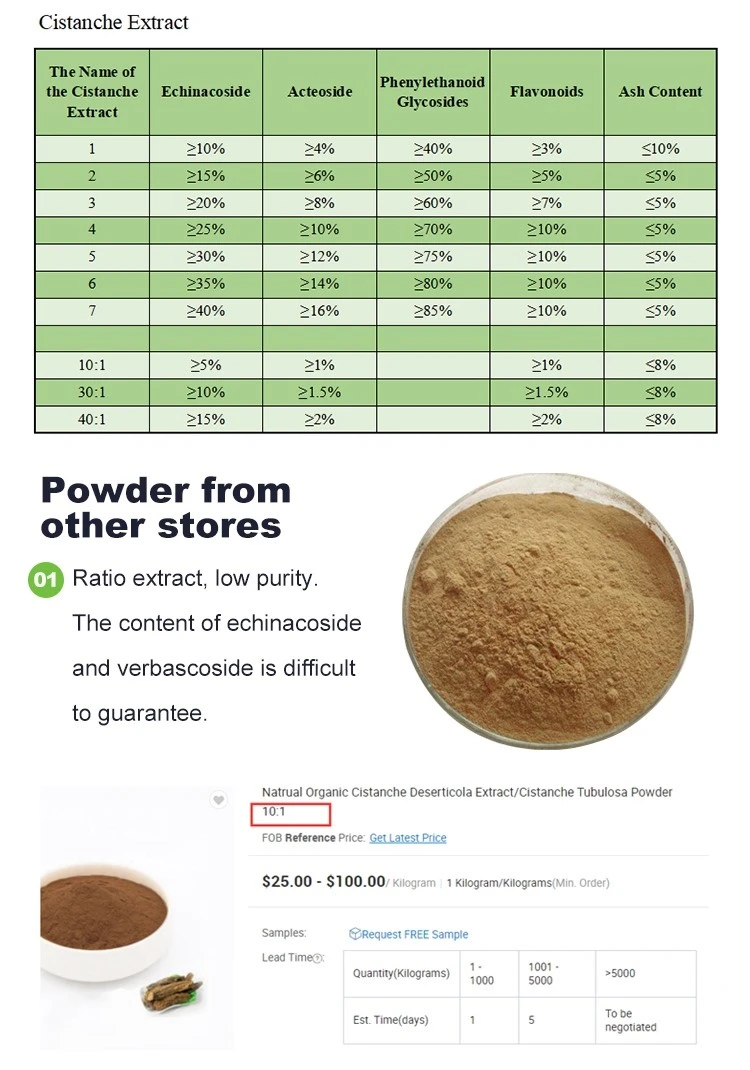
Many suppliers sell "10:1" or "30:1" Cistanche extracts. A ratio alone does not guarantee the content of key actives.
US brands increasingly prefer standardized Cistanche extract with defined markers such as:
Cistanche extract specs
Supportive Service of Wecistanche
Email:wallence.suen@wecistanche.com
Total Phenylethanoid Glycosides (PhGs)
Echinacoside
Acteoside (Verbascoside)
Why it matters commercially:
consistent label claims and marketing language
better batch-to-batch repeatability
stronger QA confidence for Amazon/retail audits
fewer reformulation surprises
5) What to put on the spec sheet
When a US buyer requests "COA-ready" Rou Cong Rong, they typically expect:
Identity & actives
Botanical identity + part used
HPLC/HPTLC fingerprint
PhGs %, echinacoside %, acteoside %
Purity & safety
Ash
Microbial limits
Heavy metals
Pesticide residues (if required)
Residual solvents (if applicable)
Commercial readiness
lot-to-lot consistency statement
stability/shelf life
packaging, MOQ, lead time
organic documentation (if applicable)
6) Turning consumer pain points into compliant claims (examples)
Here are structure/function angles that are commonly easier to support and safer in the US:
"Supports daily energy and vitality"
"Supports healthy aging and resilience"
"Supports physical performance and recovery routines"
"Supports antioxidant defenses" (only if substantiated)
"Supports blood health" (requires careful substantiation; do not imply anemia treatment)
Avoid:
"treats anemia / PRCA / MS"
"increases red blood cells" (this becomes a drug-like claim)
"repairs myelin / cures autoimmune disease"
7) Recommended page structure for an ingredient supplier (SEO + conversion)
H2: Organic Rou Cong Rong (Cistanche) Extract Overview
H2: Standardized Markers: PhGs, Echinacoside, Acteoside
H2: Why Brands Choose Standardized Extract vs 10:1 Powder
H2: Quality Control (COA, Methods, Ash, Micro, Metals, Pesticides)
H2: Applications (capsules, tablets, sachets, drink mixes)
H2: OEM/ODM Support (private label, custom potency, blends)
H2: Compliance FAQ (US claims, labeling, warnings)
8) FAQ (B2B, US-facing)
Q: Can we market Rou Cong Rong for PRCA or severe anemia?
A: In the US, PRCA and severe anemia are diseases requiring medical care. Supplements should not be marketed as treatments. Brands can position Rou Cong Rong for general vitality and wellness support and include appropriate disclaimers.
Q: What's the difference between 10:1 and standardized extract?
A: Ratio describes input/output concentration but not guaranteed active markers. Standardized extracts specify measurable actives (e.g., PhGs/echinacoside/acteoside) for consistent quality.
Q: Do you provide COA and method references?
A: Yes-COA per batch and test method details can be provided upon request (HPLC/HPTLC identity and active quantification).