How Quality Is Measured In Cistanche: An Inside Look At Phenylethanoid Glycosides And HPLC Testing
Nov 18, 2026
Introduction: Why "Quality" Is the Hardest Word in Herbal Medicine
Ask almost anyone who works with plant-based health products what the single biggest challenge is, and they will usually give the same answer: consistency. A plant is not a factory. Its chemical makeup shifts with the soil it grows in, the altitude, the rainfall, the time of year it is harvested, and the way it is dried and processed after harvest. Two batches of what is nominally "the same" herb can differ substantially in the very compounds that give it value.
This is especially true for Cistanche, one of the most treasured tonic herbs in traditional Chinese medicine. Known as "desert ginseng," Cistanche has been prized for centuries for its reputed ability to support kidney energy, bone and reproductive health, healthy aging, and even memory. But not all Cistanche is created equal - and until recently, there was a surprising gap in how the industry could prove that.
This article explores that gap and how modern analytical chemistry is closing it. At the center of the story is a family of plant compounds called phenylethanoid glycosides, a laboratory technique known as high-performance liquid chromatography, or HPLC, and a study that set out to measure four of Cistanche's most important active compounds in both the raw herb and its concentrated extracts.
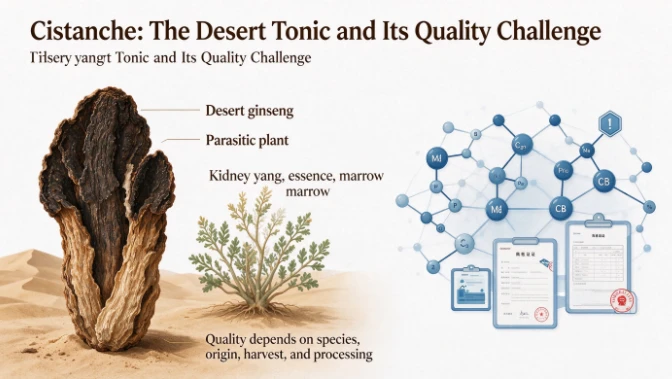
What Is Cistanche?
Cistanche, whose Chinese name is Rou Cong Rong, is a remarkable plant in more ways than one. Botanically, it belongs to the Cistanche genus within the broomrape family, and it grows as a parasite on the roots of desert shrubs such as saxaul and tamarisk. This unusual lifestyle - drawing its nourishment from a host plant rather than from sunlight and soil alone - is part of what makes Cistanche both rare and chemically interesting.
The plant is found mainly in the arid regions of northwestern China, including Inner Mongolia, Qinghai, Xinjiang, and Ningxia. The part used in traditional medicine is the dried, fleshy stem covered with scale-like leaves. In classical Chinese medical texts, Cistanche is described as sweet and salty in taste and warm in nature, and it is said to enter the kidney and large intestine channels. It appears in one of the oldest known Chinese pharmacopoeias, the Shennong Bencao Jing, where it is listed among the top-grade herbs - a category reserved for substances considered both valuable and gentle enough for long-term use.
Traditional uses of Cistanche are broad. It has been employed to warm and reinforce kidney yang, to moisten the intestines and relieve constipation, and to support the liver. It has also been associated with anti-aging, anti-fatigue, and immune-supporting effects, and it has traditionally been used for weakness of the lower back and knees, declining memory, and certain cases of female infertility. These many uses earned Cistanche its nicknames: "desert ginseng" and, in some classical sources, "a treasure among medicines."
The Chemistry Inside Cistanche
What makes Cistanche so active is not one single ingredient but a whole collection of natural chemicals. Modern phytochemical research has shown that plants in the Cistanche genus contain several major classes of compounds, including phenylethanoid glycosides, iridoids, alkaloids, and lignans. Of these, the phenylethanoid glycosides have emerged as the most important group from a medicinal standpoint.
A "glycoside" is a molecule in which a sugar is chemically attached to a non-sugar part called an aglycone. In the case of phenylethanoid glycosides, the non-sugar portion is based on a structure called phenylethanol, and the sugar chains are often complex, with additional chemical decorations such as caffeic acid groups attached. These compounds are potent natural antioxidants and have been the focus of a great deal of research into aging, memory, and immune function.
Two phenylethanoid glycosides in particular stand out: echinacoside and acteoside (also known as verbascoside). These two compounds are considered the primary pharmacologically active constituents of Cistanche, and they are the official "marker compounds" used in the Chinese Pharmacopoeia to evaluate and control the quality of Cistanche raw material. If you have ever seen a Cistanche extract labeled with a percentage of "echinacoside" or "acteoside," that number is a direct measure of these marker compounds.
The Four Compounds at the Heart of This Story
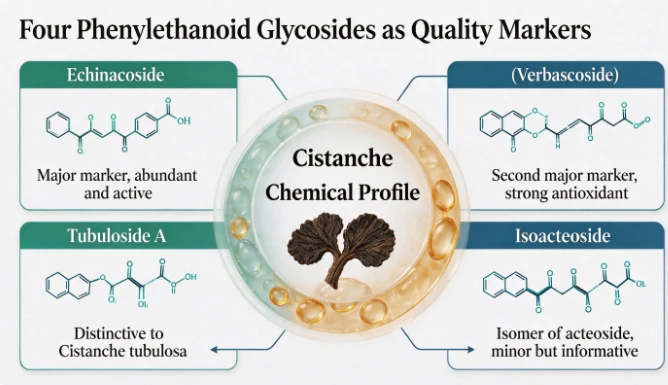
The study this article is based on focused on four specific phenylethanoid glycosides, chosen because they are the most representative active compounds found in Cistanche from Xinjiang, the region that produces most of the world's Cistanche tubulosa. Getting to know these four names is the key to understanding the rest of the story.
Echinacoside is the most abundant and arguably the most important of the four. It is a large, complex phenylethanoid glycoside known for its antioxidant and neuroprotective properties, and it is the primary quality marker for Cistanche in modern standards.
Acteoside (verbascoside) is a close relative and the second major marker compound. Like echinacoside, it is a powerful antioxidant, and the two often appear together in Cistanche and are discussed together in quality specifications.
Tubuloside A is a compound found specifically in Cistanche tubulosa, one of the two main source species of Cistanche. Its name reflects this origin, and it serves as a distinctive chemical fingerprint of this particular species.
Isoacteoside is, as the name suggests, an isomer of acteoside - the same atoms arranged in a slightly different way. It is typically present in smaller amounts than acteoside but is still a valuable part of the overall chemical profile.
Together, these four compounds tell a detailed story about the identity, quality, and concentration of a Cistanche product. But to tell that story reliably, you need a way to separate them from one another and measure each one precisely. That is where HPLC comes in.
What Is HPLC? A Laboratory Technique Explained Simply
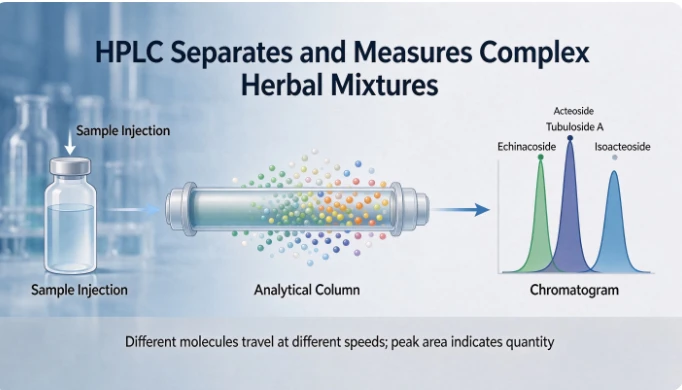
High-performance liquid chromatography, or HPLC, is one of the most widely used tools in modern analytical chemistry. Its job is to separate the individual components of a complex mixture so that each one can be identified and measured. You can think of it as a high-tech sorting machine for molecules.
Here is the basic idea, in plain language. A small liquid sample is pushed under high pressure through a narrow tube packed with a special material called the stationary phase. Different molecules in the sample interact with this packing material to different degrees: some stick to it briefly, others pass through quickly, and still others move at intermediate speeds. As a result, the molecules separate from one another and exit the tube at different times. A detector then measures each separated substance as it comes out, producing a series of peaks on a graph called a chromatogram. Each peak corresponds to a specific compound, and the size of the peak corresponds to how much of that compound is present.
The beauty of HPLC is that it can handle the kind of messy, multi-compound samples that herbs naturally produce. For a plant like Cistanche, which contains dozens of related chemicals, HPLC makes it possible to measure four closely related phenylethanoid glycosides in a single run - a task that would be nearly impossible with simpler methods.
Why This Method Was Needed
Before this study, there was a genuine problem in the Cistanche industry. Researchers had already published HPLC methods for measuring phenylethanoid glycosides in Cistanche raw herbs and prepared slices, but these methods stopped at the raw material. There was no equivalent national standard for Cistanche tubulosa extracts - the concentrated powders made by processing the herb with water or alcohol.
This gap mattered, and it mattered more than it might sound. Extracts, not raw herbs, are the form in which most modern Cistanche products are sold to international buyers and used in supplements. An extract is a concentrated version of the plant, and its value depends entirely on how much of the active compounds it actually contains. Without a reliable, validated method to measure those compounds in extracts, buyers and manufacturers had no consistent way to verify the quality of what they were purchasing. Different suppliers could label their products with different numbers, measured in different ways, and there was no agreed-upon yardstick.
The researchers behind this study - a team from Xinjiang Medical University working with a Cistanche extraction company in Hotan, Xinjiang - set out to fill that gap. Their goal was to build a single HPLC method that could simultaneously measure all four key phenylethanoid glycosides in both Cistanche decoction pieces and Cistanche tubulosa extracts, and to prove that the method was accurate and reliable enough to be used for real quality control.
How the Method Works
The method itself is a model of careful analytical chemistry. The team chose a specific type of chromatography column - an Inertsil ODS-3 column, measuring 250 millimeters long and 4.6 millimeters wide, packed with 5-micrometer particles - and a carefully tuned liquid system that pushes the sample through the column. The mobile phase, the liquid that carries the sample, was a mixture of acetonitrile and a 0.1 percent solution of formic acid in water, and its proportions were changed gradually over the course of the run in a process called gradient elution. This gradual change in the solvent mixture is what allows four closely related compounds to separate cleanly from one another.
Several other parameters were optimized as well. The flow rate was set at 1.0 milliliters per minute, the column was held at a steady 30 degrees Celsius, and each injection contained 10 microliters of sample. The detection wavelength was set at 330 nanometers, which is in the ultraviolet range and matches the wavelength at which these phenylethanoid glycosides absorb light most strongly.
The sample preparation was also standardized. For the raw herb and decoction pieces, about one gram of powdered material was extracted with 50 percent methanol using ultrasound for 40 minutes. For the concentrated extracts, a smaller amount - about 0.2 grams - was treated the same way. This careful, repeatable preparation is essential, because an analytical method is only as good as the sample preparation behind it.
Proving the Method Works: Validation in Plain Language
Building a method is one thing; proving it can be trusted is another. In analytical chemistry, this proof is called method validation, and it involves a series of standard tests. The study subjected its HPLC method to all of them, and the results are worth understanding even for a non-scientist, because they are what separate a rigorous quality test from a rough estimate.
The first test is linearity, which checks that the method gives a consistent, proportional response across a range of concentrations. If a sample contains twice as much of a compound, the detector signal should be about twice as large. The four compounds all showed excellent linearity across their measured ranges, with correlation coefficients greater than 0.9993 - very close to a perfect 1.0.
The next tests establish the limits of detection and quantification. The detection limit is the smallest amount of a compound that can be reliably distinguished from background noise, while the quantification limit is the smallest amount that can be measured accurately. For the four compounds, these limits were in the low-microgram-per-milliliter range, meaning the method is sensitive enough to detect even tiny amounts.
Then come the tests of precision, stability, and repeatability. Precision measures whether the instrument gives the same answer when the same sample is injected repeatedly; stability measures whether a prepared sample holds up over time (it was tested over 24 hours); and repeatability measures whether the whole process gives consistent results when the same material is prepared and analyzed multiple times. For all four compounds, these tests produced relative standard deviations of less than 3 percent - a benchmark that indicates the method is highly consistent.
Finally, there is the recovery test, which is arguably the most important check of accuracy. In this test, a known amount of each compound is deliberately added to a sample, and the method is then used to measure how much is "found." If the method is accurate, it should recover close to 100 percent of what was added. The study found average recoveries ranging from 97.70 percent to 100.95 percent for the four compounds, with most of the variation again below 3 percent. These numbers mean the method not only measures precisely, but measures correctly.
What the Results Revealed: A Tale of Two Species and Three Extracts
With the method validated, the researchers turned to real samples. They analyzed four batches of Cistanche decoction pieces - two from Cistanche deserticola grown in Inner Mongolia, and two from Cistanche tubulosa grown in Xinjiang - along with three different extracts made from Cistanche tubulosa by a company in Hotan. The results were striking, and they tell a clear story about where Cistanche's active compounds are most concentrated.
Across all samples, echinacoside was consistently the most abundant of the four compounds, followed by acteoside. Tubuloside A and isoacteoside were present in much smaller amounts. This ordering was true everywhere, but the actual levels varied enormously from sample to sample.
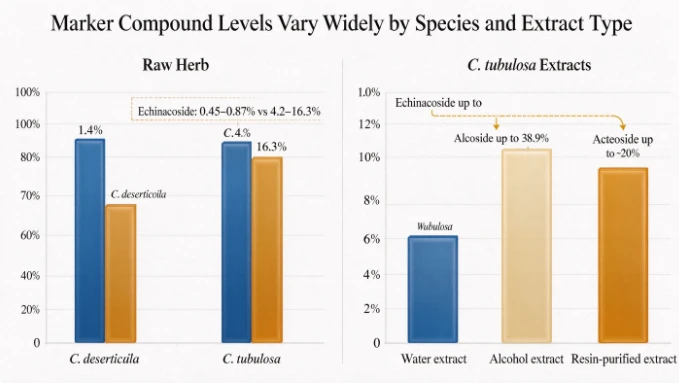
Among the raw herbs, the two desert Cistanche samples contained relatively modest amounts of echinacoside - roughly 0.45 percent and 0.87 percent. The two Cistanche tubulosa herb samples were far richer, with echinacoside levels of about 4.2 percent and 16.3 percent. In other words, even among raw herbs, the Xinjiang Cistanche tubulosa dramatically outperformed the desert Cistanche on this key marker compound.
The extracts told an even more dramatic story. The three Cistanche tubulosa extracts - a water extract, an alcohol extract, and an alcohol extract that had been further purified on a resin column - contained echinacoside at roughly 32.1 percent, 26.6 percent, and 38.9 percent, respectively. The resin-purified extract was the richest, with an acteoside content of nearly 20 percent as well. These are concentrations many times higher than those found in the raw herb, which is exactly what you would expect from a properly made extract: the active compounds are concentrated while inactive plant material is removed.

Why Content Varies So Much - and Why It Matters
One of the study's most important insights is that Cistanche's chemical content is far from fixed. The four phenylethanoid glycosides differed greatly not only between the two species, but also between different batches from the same species and even the same general region.
The reasons are familiar to anyone who works with botanicals. Geographic environment, temperature, climate, and the specific harvesting and processing methods all influence how much of each compound a plant accumulates. A Cistanche plant grown in one valley may be chemically different from one grown in another, and two batches harvested and dried at different times can diverge as well. This is the fundamental challenge of herbal standardization.
There is a second, subtler point buried in the findings. The two source species of Cistanche - desert Cistanche and Cistanche tubulosa - contain broadly similar types of compounds, but they differ in the amounts of those compounds. Because the different marker compounds are associated with somewhat different effects, choosing the right source species for a given purpose matters. This is why modern Cistanche products increasingly specify not just "Cistanche" but the exact species and the concentration of specific marker compounds.
For a buyer or formulator, the practical lesson is clear: the label should tell you which species you are getting, and it should tell you the measured content of the key compounds, backed by a validated method. Vague claims about "high-quality Cistanche" mean little without numbers to support them.
What This Means for the Cistanche Industry
This study matters for several reasons beyond its immediate technical contribution. First, it provides a validated, practical tool that fills a real gap: a way to measure four key phenylethanoid glycosides simultaneously in Cistanche tubulosa extracts, for which no national standard previously existed. This gives manufacturers and quality-control laboratories a defensible basis for testing their products.
Second, the content data offer a useful benchmark. By measuring real samples from different species, regions, and processing methods, the study gives the industry reference points for what reasonable quality looks like - and makes it possible to spot products that fall short. A standardized extract can now be verified against numbers, not just promises.
Third, the work highlights the importance of the source species and the processing method. The finding that Cistanche tubulosa and, in particular, its resin-purified extract are especially rich in echinacoside and acteoside is directly relevant to anyone selecting a Cistanche material for a supplement or functional food. It is the kind of evidence that can guide sourcing decisions in a market where quality has historically been hard to judge.
Finally, and perhaps most importantly for readers outside the laboratory, this study illustrates a broader shift in the herbal industry. Traditional herbs like Cistanche are no longer being sold on reputation alone. Increasingly, they are being held to the same standards as any other ingredient: defined by measurable, validated markers, and verified by reproducible methods. For consumers, that is genuinely good news, because it means the products they buy are becoming more transparent and more reliable.
The Limitations and the Honest Caveat
As with any analytical study, it is worth being precise about what this research does and does not establish. This is a methodology and quality-control study. It proves that a particular HPLC method can accurately measure four compounds, and it reports the levels of those compounds in a specific set of samples. It does not, by itself, prove any particular health benefit.
The sample set, while informative, was also limited in size - four batches of herb and three extracts. Larger surveys across more origins and more production lots would strengthen the reference data further. And while the four phenylethanoid glycosides measured here are widely regarded as key quality markers for Cistanche, the full picture of a product's quality also involves other compounds and other considerations.
None of this diminishes the value of the work. It simply places it where it belongs: as a solid, reproducible foundation for quality control, and as a step toward the kind of transparency that benefits both the industry and the people who use its products.
A Note on Reading This Article Responsibly
The information in this article is provided for educational purposes only. It is not medical advice, and it is not intended to diagnose, treat, cure, or prevent any disease. Cistanche and its extracts are botanical ingredients, and any use of them should be discussed with a qualified healthcare professional, particularly for individuals who are pregnant, nursing, taking medication, or managing a medical condition. Statements about traditional uses and chemical properties reflect historical and scientific literature and are not claims that any product can treat a specific illness.