Cistanche For Fatigue Support: A Yang-Deficiency Formula And B2B Development Guide
Nov 09, 2026
Meta description:
Explore a Cistanche-containing formula for Yang-deficiency research, including composition, study data, manufacturing methods, and B2B development considerations.
Suggested URL slug:
/cistanche-fatigue-support-yang-deficiency-formula/
Primary topic:
Cistanche-containing formulations for fatigue-support product research
Related search terms to incorporate naturally:
Cistanche supplement formulation
Cistanche extract supplier
Rou Cong Rong traditional use
Yang-deficiency formula
botanical formulation for vitality support
herbal supplement manufacturing
Cistanche ingredient quality control
Suggested image alt text:
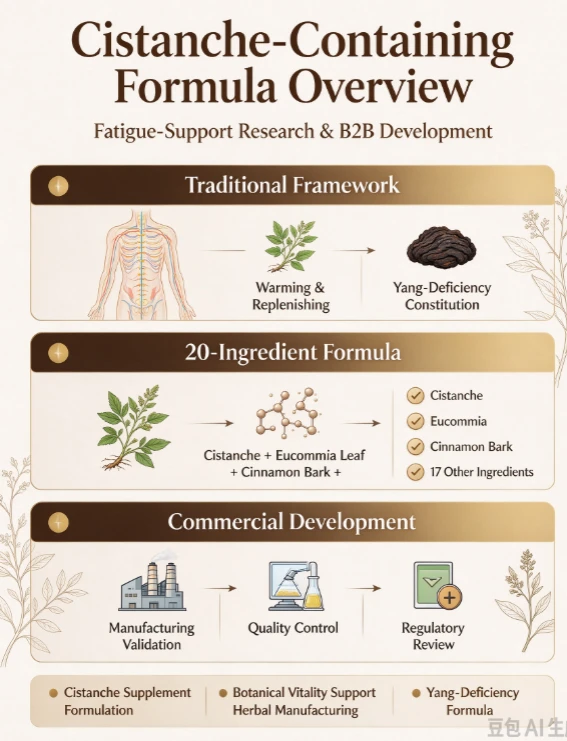
"Twenty-ingredient Cistanche-containing formula and manufacturing considerations for botanical supplement development"
Recommended content classification:
Technical Research / Formulation Insights
Cistanche for Fatigue Support: A Yang-Deficiency Formula and B2B Development Guide
For supplement brands, contract manufacturers, and botanical ingredient distributors, traditional Chinese medicine can provide useful starting points for formulation research. However, translating a traditional formula into a commercially viable product requires more than translating its ingredient list.
A Chinese patent document titled "A Traditional Chinese Medicine Composition for Managing Yang-Deficient Constitution and Uses Thereof" describes a 20-ingredient formulation containing Cistanche, Eucommia leaf, cinnamon bark, ginger, Astragalus, Codonopsis, and other traditional materials.
The document reports animal experiments and a three-month human comparative study involving 186 participants.
Its value for product developers lies in three areas:
A documented formulation framework centered on traditional warming and replenishing functions.
A practical aqueous-extraction and concentrated-paste manufacturing process.
Preliminary research findings that can inform further investigation.
It does not establish that Cistanche alone treats fatigue, that the formula treats myalgic encephalomyelitis/chronic fatigue syndrome, or that the formulation is approved for sale as a supplement in the United States or Europe.
Research scope: This article reviews the supplied patent text. The patent publication number, current legal status, original study reports, and independent verification of the reported results were not provided. The complete technical translation follows the commercial-development discussion.
1. What Does "Yang Deficiency" Mean for Western Readers?
In traditional Chinese medicine, a Yang-deficient constitution describes a pattern associated with features such as:
Sensitivity to cold.
Cold hands and feet.
Low vitality or fatigue.
Weakness or soreness in the lower back and knees.
Loose stools.
Frequent urination, particularly at night.
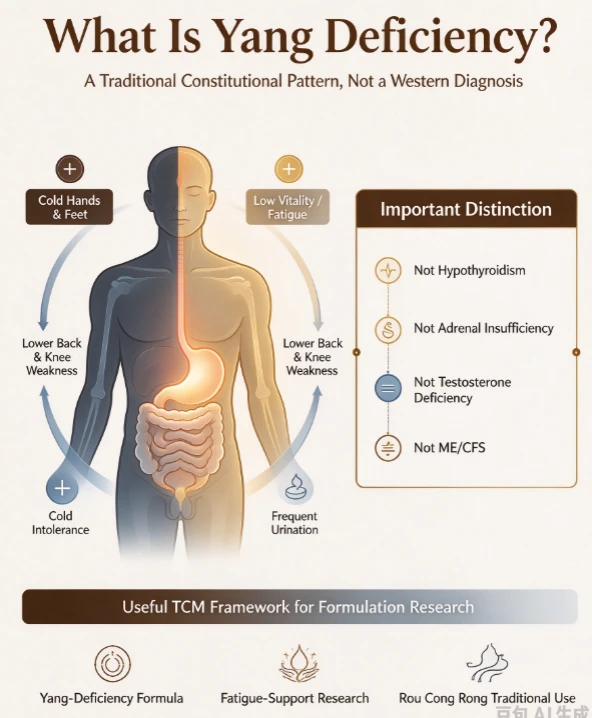
This is a traditional constitutional classification, not a direct equivalent of a Western biomedical diagnosis.
It should not be presented as interchangeable with:
Hypothyroidism.
Adrenal insufficiency.
Testosterone deficiency.
Anemia.
Myalgic encephalomyelitis/chronic fatigue syndrome, or ME/CFS.
People with persistent fatigue or cold intolerance may require medical assessment to identify an underlying condition.
For formulation teams, the most useful interpretation is that the document investigates a traditionally defined symptom pattern that includes fatigue, rather than a clearly established treatment for a specific Western disease.
2. Why Is Cistanche Included in This Formula?
Cistanche, known in Chinese as Rou Cong Rong, is positioned in the document as one of the formula's two principal ingredients, alongside cinnamon bark.
Within the traditional rationale, Cistanche is used to support "Kidney Yang" and replenish "essence and blood." These terms belong to the TCM explanatory framework; they should not be translated into unsupported claims about kidney function, hormone production, or blood-cell formation.
The formulation does not evaluate Cistanche in isolation. It evaluates a combination containing 20 medicinal materials.
Consequently:
The reported outcomes cannot be attributed to Cistanche alone.
The study does not establish a clinically effective dose for a standalone Cistanche extract.
The formulation's results cannot automatically be transferred to another Cistanche species, extraction method, or standardized extract.
A key sourcing issue: species identity
The supplied formula names 肉苁蓉 / Rou Cong Rong, but does not specify the botanical species.
For commercial procurement, "Cistanche" is not a sufficiently precise specification. Buyers should establish:
Accepted botanical name.
Plant part.
Geographical origin.
Cultivation or collection method.
Processing conditions.
Authentication method.
Extraction solvent, where applicable.
Extract ratio and native extract content.
Marker-compound specifications and analytical methods.
For example, Cistanche deserticola and Cistanche tubulosa should not be treated as interchangeable solely because both may appear in Cistanche-related trade literature.
3. The 20-Ingredient Formulation at a Glance
The preferred formulation in the document contains 100 total parts by weight of medicinal materials.
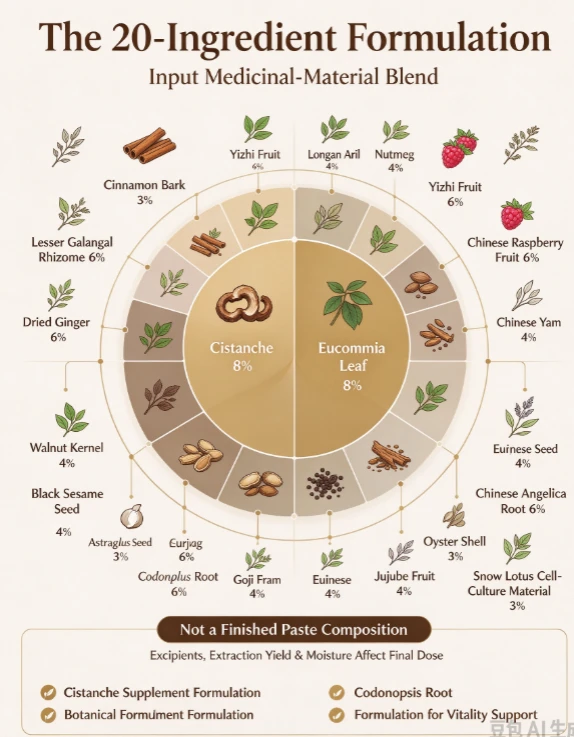
| Ingredient | Preferred parts by weight | Share of medicinal-material blend |
|---|---|---|
| Eucommia leaf | 8 | 8% |
| Cistanche | 8 | 8% |
| Cinnamon bark | 3 | 3% |
| Lesser galangal rhizome | 6 | 6% |
| Dried ginger | 6 | 6% |
| Chinese raspberry fruit | 6 | 6% |
| Yizhi fruit | 6 | 6% |
| Nutmeg | 6 | 6% |
| Walnut kernel | 4 | 4% |
| Black sesame seed | 4 | 4% |
| Goji fruit | 4 | 4% |
| Longan aril | 4 | 4% |
| Chinese yam | 4 | 4% |
| Jujube fruit | 4 | 4% |
| Euryale seed | 3 | 3% |
| Astragalus root | 6 | 6% |
| Codonopsis root | 6 | 6% |
| Oyster shell | 3 | 3% |
| Chinese angelica root | 6 | 6% |
| Snow lotus cell-culture material | 3 | 3% |
| Total | 100 | 100% |
Important formulation distinction: These percentages describe the input medicinal-material blend. They do not represent the composition of the finished paste, which also contains excipients and undergoes extraction and concentration.
Is this a fully plant-based formula?
No. The formulation contains oyster shell, an animal-derived material.
It should therefore not be described as:
Vegan.
Entirely botanical.
A 100% plant-based formula.
The document also includes snow lotus cell-culture material, which requires its own identity, manufacturing, safety, and regulatory assessment.
4. What Did the Human Study Report?
The document describes 186 participants classified as having a Yang-deficient constitution. They were reportedly randomized into two groups of 93 participants each.
Formula group: 10 g of the finished paste, three times daily.
Comparator group: Jin Gui Shen Qi Wan, 20 water-honey pills twice daily.
Duration: Three months.
Both groups reportedly improved on TCM symptom scores, fatigue assessments, and Yang-deficiency constitution scores.
Selected results
| Outcome | Cistanche-containing formula | Comparator |
|---|---|---|
| FS-14 fatigue score, before intervention | 9.41 ± 1.52 | 9.58 ± 1.76 |
| FS-14 fatigue score, after intervention | 7.17 ± 1.46 | 7.26 ± 1.32 |
| FAI score, before intervention | 138.64 ± 12.63 | 142.51 ± 13.47 |
| FAI score, after intervention | 107.65 ± 9.26 | 103.74 ± 10.17 |
| Yang-deficiency score, before intervention | 60.73 ± 4.28 | 62.47 ± 4.51 |
| Yang-deficiency score, after intervention | 39.14 ± 2.47 | 37.52 ± 2.64 |
| Response rate under the document's criteria | 86/93, or 92.47% | 85/93, or 91.40% |
| Reported adverse-reaction incidence | 0/93 | 5/93 |
How should these findings be interpreted?
The results are potentially useful for planning further research, but they have important limitations.
First, this was not a placebo-controlled study.
An active-comparator design, without a clearly described placebo group or blinding, cannot readily separate treatment effects from expectation, natural symptom changes, or other influences.
Second, "no statistically significant difference" does not establish equivalence.
The document reports similar post-intervention outcomes between groups. However, an equivalence or non-inferiority conclusion requires an appropriate design, prespecified margins, and suitable statistical analysis.
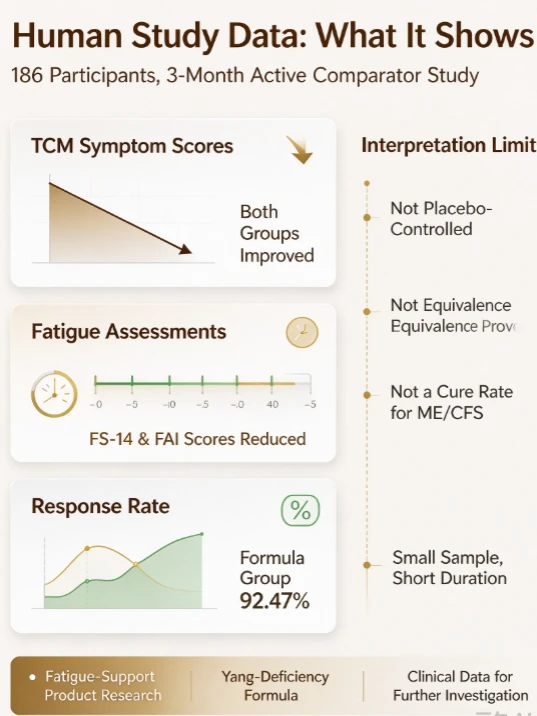
Third, the "92.47% response rate" is not a cure rate for fatigue or ME/CFS.
The study counted participants as responders when their TCM symptom scores fell by at least 30%. That is a study-specific classification.
Fourth, no adverse reactions observed in 93 participants does not prove zero risk.
The study was relatively small and lasted three months. Using the approximate "rule of three," zero events in 93 participants remains compatible with a true event rate of roughly 3.2% at an approximate one-sided 95% upper confidence limit.
Fifth, the adverse-event significance claim needs statistical review.
The source marks the difference between 0/93 and 5/93 as statistically significant. A two-sided Fisher's exact test gives approximately P = 0.059, illustrating that the conclusion depends on the statistical method used.
The supplied text does not report a trial registration number, ethics approval identifier, detailed randomization procedure, allocation concealment, or a full participant-flow analysis.
5. What Can the Animal Experiments Tell Product Developers?
The animal study used a model involving parental and offspring exposure to a bitter-cold traditional medicinal preparation and a cold environment.
The reported endpoints included:
Open-field movement distance.
Movement speed.
Immobility time.
Time spent on a warm plate.
Hippocampal BDNF, TrkB, CREB, TRPC3, and TRPC6.
Hippocampal and serum serotonin, dopamine, and norepinephrine.
The complete formula reportedly performed better than two reduced-ingredient comparison formulas.
However, these findings do not establish:
A mechanism of action in humans.
A treatment effect in ME/CFS.
A benefit from lowering these biomarkers in otherwise healthy people.
Pharmacological synergy in the formal experimental sense.
Showing that a larger formula performs differently from a smaller formula is not, by itself, proof of synergy. Such a conclusion generally requires a design capable of distinguishing additive effects from interactions, with appropriately controlled exposures.
6. Manufacturing Lessons for Supplement Developers
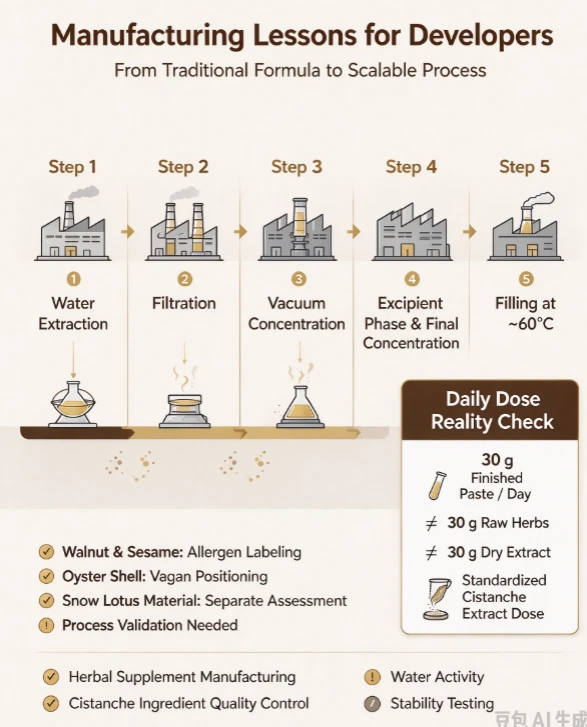
The document's preferred dosage form is a concentrated oral herbal paste, traditionally called gaozhi.
Its principal production stages are:
Water extraction of all medicinal materials except snow lotus cell-culture material.
Filtration.
Vacuum concentration.
Preparation of an isomaltooligosaccharide-based excipient phase.
Addition of the concentrated extract and snow lotus material.
Further concentration.
Filling into 10 g sachets.
Why this cannot be converted directly into a capsule specification
The reported human intake was 30 g of finished paste per day.
It was not:
30 g of raw herbs per day.
30 g of dry extract per day.
2.4 g of Cistanche per day.
A validated dose of a standardized Cistanche extract.
Although Cistanche represents 8% of the preferred medicinal-material blend, the finished-product dose cannot be translated into a Cistanche dose without information on:
Extraction yield.
Finished batch yield.
Residual moisture.
Excipient contribution.
Recovery of relevant constituents.
Whether individual ingredients extract proportionally.
A capsule, gummy, tablet, or powder made from different extracts would be a new development project, not a clinically interchangeable version of the studied paste.
Technical issues requiring validation
| Development issue | Why it matters |
|---|---|
| Long aqueous heating | May alter or reduce volatile constituents from aromatic materials |
| High excipient loading | Affects serving size, sweetness, nutrient profile, and tolerability |
| Walnut and sesame | Require allergen assessment and appropriate labeling |
| Oyster shell | Affects vegan positioning, identity testing, and animal-source documentation |
| Snow lotus cell-culture material | Requires separate specifications and market-entry assessment |
| Nutmeg and cinnamon materials | Require constituent-specific safety assessment at the intended exposure |
| Filling at approximately 60°C | Does not, by itself, establish a validated microbial-control process |
| Solids content of at least 70% | Does not replace water-activity, microbial, and stability testing |
| "Golden and transparent" processing endpoint | Needs objective, reproducible manufacturing criteria |
| Broad excipient list | Does not mean every listed material is suitable or permitted in oral supplements |
A commercially useful process should define acceptable ranges for extraction yield, marker recovery, viscosity, water activity, microbial limits, and shelf-life stability.
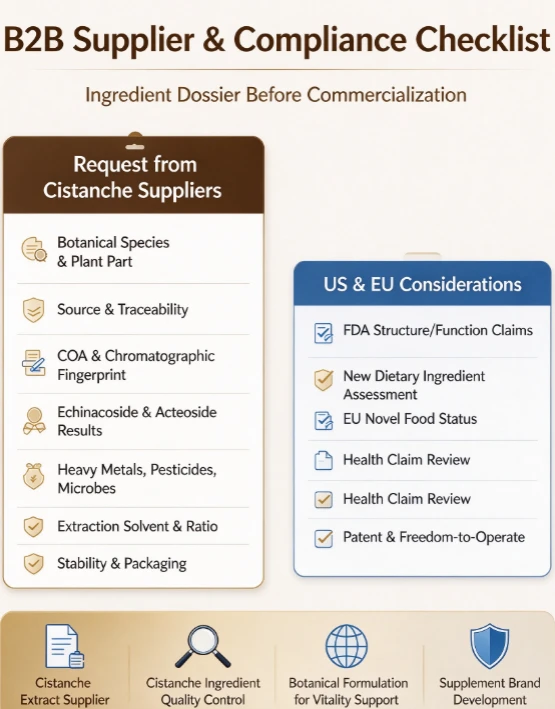
7. What Should Buyers Request from a Cistanche Supplier?
A serious B2B discussion should start with an ingredient dossier rather than a broad promise of "anti-fatigue activity."
Supplier qualification checklist
Identity and traceability
Botanical species and plant part.
Source location and supply-chain traceability.
Authentication records.
Batch-to-batch identity controls.
Composition and analytical quality
Batch-specific certificate of analysis.
Chromatographic fingerprint.
Echinacoside and acteoside/verbascoside results where relevant.
Explanation of any "total phenylethanoid glycosides" claim.
Validated or suitably verified analytical methods.
Moisture, ash, and relevant physical specifications.
Contaminant control
Heavy metals.
Pesticide residues.
Microbiological quality.
Mycotoxins where relevant.
Residual solvents for extracted ingredients.
Adulteration screening.
Manufacturing and formulation information
Extraction solvent.
Drug-to-extract ratio and whether it refers to native or formulated extract.
Carrier type and percentage.
Solubility and dispersibility.
Particle size and bulk density.
Stability information.
Packaging and storage conditions.
Commercial and regulatory documentation
Minimum order quantity.
Lead time.
Available sample quantities.
Change-control policy.
Target-market regulatory assessment.
Evidence supporting any intended product claims.
Higher marker content is not automatically better. It may also represent a different exposure profile from a traditional decoction and may require different safety and regulatory support.
8. U.S. and European Market Considerations
United States
A patent description does not authorize a dietary supplement to claim that it treats fatigue syndrome or another disease.
Structure/function claims require adequate substantiation, must not be misleading, and are subject to applicable notification and disclaimer requirements. Relevant FDA guidance is available under Structure/Function Claims.
Depending on the ingredient and its history of use, a new dietary ingredient notification may be required. FDA describes the applicable process in its New Dietary Ingredient Notification Procedures and Timeframes.
Phrases such as "supports everyday vitality" are not automatically compliant simply because they sound less medical. The full context, evidence, formulation, and target audience matter.
European Union
Ingredient legality and health-claim legality must be assessed separately.
The European Commission's Novel Food Status Catalogue is a non-binding orientation tool and should be considered together with the Union list and relevant national requirements.
A particularly important Cistanche-specific point is that EFSA evaluated a particular water extract of Cistanche tubulosa stems and concluded that its safety had not been established. The assessment concerned a specified extract and should not be generalized into a blanket conclusion about every Cistanche preparation. Equally, that extract must not be described as "EFSA-approved." See the EFSA safety assessment.
Health claims require a separate review under the EU framework. Botanical claims involve additional legal complexity and should not be presumed permissible. See the European Commission's Nutrition and Health Claims overview.
The United Kingdom should be assessed separately where relevant.
Patent and freedom-to-operate review
The supplied material is a patent document, not evidence of unrestricted commercial use.
Before reproducing the formula commercially, businesses should investigate:
Publication and application numbers.
Applicant and ownership.
Whether claims were granted.
Current legal status.
Geographic coverage.
Relevant patent families.
Licensing requirements.
Freedom to operate.
Changing a few ingredients or converting a paste into a capsule does not automatically resolve patent issues.
9. Frequently Asked Questions
Does this document prove that Cistanche treats chronic fatigue syndrome?
No. The human participants were selected using a TCM Yang-deficiency classification. The supplied text does not establish that they met ME/CFS diagnostic criteria.
Was Cistanche tested as a single ingredient?
No. It was included in a 20-ingredient formula.
Does the reported 92.47% response rate mean that 92.47% of people were cured?
No. It reflects the source's combined categories of "cured," "markedly improved," and "improved," based on reductions in TCM symptom scores.
Can the formula be marketed as a vegan herbal product?
Not in its disclosed form. It contains oyster shell.
Does the patent establish a recommended daily dose of Cistanche extract?
No. It describes a daily amount of finished paste, not a standardized Cistanche extract dose.
What is the most useful takeaway for a supplement brand?
The document offers a formulation concept and preliminary research leads. A market-ready product still needs identity control, safety assessment, manufacturing validation, legal review, and product-specific substantiation.
10. From Traditional Formula to Commercial Development Brief
For businesses exploring Cistanche-containing products, the next step is to define the development brief:
Target country or region.
Intended consumer population.
Proposed product category.
Dosage form.
Maximum daily serving size.
Desired ingredient specification.
Allergen and vegan requirements.
Evidence requirements.
Cost target and anticipated order volume.
A well-documented ingredient specification is more valuable than an unsupported therapeutic promise. The strongest B2B opportunity is to connect traditional formulation knowledge with reproducible manufacturing, transparent evidence, and market-specific compliance.
Technical Appendix: Complete English Translation of the Supplied Patent Text
Translation and source notes
The following section translates the supplied patent text and the eight supplied tables. Statements about efficacy, safety, mechanisms, and innovation are claims made in the source document, not independent conclusions of this article.
"Yang-deficient constitution" is retained as a TCM term. It is not translated as ME/CFS or another biomedical diagnosis.
Common English medicinal-material names are used for readability. The source does not provide complete botanical specifications for all ingredients.
"Oyster" is rendered as "oyster shell," reflecting the usual medicinal material meant by 牡蛎 in this context.
Data and significance markings are transcribed from the supplied images. The original high-resolution patent PDF should be checked before regulatory, legal, or scientific reuse.
Apparent source errors are preserved and identified rather than silently corrected.
(54) Title of the Invention
A Traditional Chinese Medicine Composition for Managing Yang-Deficient Constitution and Uses Thereof
(57) Abstract
The invention provides a traditional Chinese medicine composition for managing Yang-deficient constitution and uses thereof.
The composition consists of the following medicinal ingredients in parts by weight:
Eucommia leaf, 6–10 parts; Cistanche, 6–10 parts; cinnamon bark, 2–4 parts; lesser galangal rhizome, 5–7 parts; dried ginger, 5–7 parts; Chinese raspberry fruit, 5–7 parts; Yizhi fruit, 5–7 parts; nutmeg, 5–7 parts; walnut kernel, 3–5 parts; black sesame seed, 3–5 parts; goji fruit, 3–5 parts; longan aril, 3–5 parts; Chinese yam, 3–5 parts; jujube fruit, 3–5 parts; Euryale seed, 2–4 parts; Astragalus root, 5–7 parts; Codonopsis root, 5–7 parts; oyster shell, 2–4 parts; Chinese angelica root, 5–7 parts; and snow lotus cell-culture material, 2–3 parts.
The invention states that the composition has a simple preparation method, a rational ingredient combination, and a high overall response rate in clinical testing.
Claims
Claim 1
A traditional Chinese medicine composition for managing Yang-deficient constitution, characterized in that it consists of the following medicinal ingredients in parts by weight:
Eucommia leaf, 6–10 parts; Cistanche, 6–10 parts; cinnamon bark, 2–4 parts; lesser galangal rhizome, 5–7 parts; dried ginger, 5–7 parts; Chinese raspberry fruit, 5–7 parts; Yizhi fruit, 5–7 parts; nutmeg, 5–7 parts; walnut kernel, 3–5 parts; black sesame seed, 3–5 parts; goji fruit, 3–5 parts; longan aril, 3–5 parts; Chinese yam, 3–5 parts; jujube fruit, 3–5 parts; Euryale seed, 2–4 parts; Astragalus root, 5–7 parts; Codonopsis root, 5–7 parts; oyster shell, 2–4 parts; Chinese angelica root, 5–7 parts; and snow lotus cell-culture material, 2–3 parts.
Claim 2
The composition according to Claim 1, characterized in that it consists of:
Eucommia leaf, 8 parts; Cistanche, 8 parts; cinnamon bark, 3 parts; lesser galangal rhizome, 6 parts; dried ginger, 6 parts; Chinese raspberry fruit, 6 parts; Yizhi fruit, 6 parts; nutmeg, 6 parts; walnut kernel, 4 parts; black sesame seed, 4 parts; goji fruit, 4 parts; longan aril, 4 parts; Chinese yam, 4 parts; jujube fruit, 4 parts; Euryale seed, 3 parts; Astragalus root, 6 parts; Codonopsis root, 6 parts; oyster shell, 3 parts; Chinese angelica root, 6 parts; and snow lotus cell-culture material, 3 parts.
Claim 3
The composition according to Claim 1, characterized in that it consists of:
Eucommia leaf, 10 parts; Cistanche, 10 parts; cinnamon bark, 4 parts; lesser galangal rhizome, 7 parts; dried ginger, 7 parts; Chinese raspberry fruit, 7 parts; Yizhi fruit, 7 parts; nutmeg, 7 parts; walnut kernel, 5 parts; black sesame seed, 5 parts; goji fruit, 5 parts; longan aril, 5 parts; Chinese yam, 5 parts; jujube fruit, 5 parts; Euryale seed, 4 parts; Astragalus root, 7 parts; Codonopsis root, 7 parts; oyster shell, 4 parts; Chinese angelica root, 7 parts; and snow lotus cell-culture material, 3 parts.
Claim 4
The composition according to any one of Claims 1–3, further comprising a pharmaceutically acceptable carrier or excipient.
Claim 5
The use according to Claim 4, characterized in that the carrier or excipient is selected from one or more of:
Starch, diluents, cellulose derivatives, alginates, gelatin, polyvinylpyrrolidone, glycerol, agar, calcium carbonate, sodium bicarbonate, quaternary ammonium compounds, cetyl alcohol, kaolin, soap clay, talc, calcium stearate, magnesium stearate, polyethylene glycol, flavoring agents, preservatives, and potassium sorbate.
Translator's note: The source calls this a "use," although Claim 4 concerns a composition. "Soap clay" is a literal rendering of 皂黏土; the intended pharmaceutical material requires clarification.
Claim 6
The use according to Claim 5, characterized in that the diluents include fructooligosaccharides, polydextrose, erythritol, sucrose, and isomaltooligosaccharides.
Claim 7
The composition according to Claim 5 or 6, characterized in that its preparation method comprises:
According to the medicinal formula of the invention, decoct all raw medicinal ingredients except snow lotus cell-culture material in water one to three times, for one to two hours each time. Filter, and concentrate the filtrate under reduced pressure to obtain an extract paste with a relative density of 1.23–1.28 at 60°C. Set aside.
Take a carrier or excipient in an amount equal to 0.5–1.5 times the mass of the raw medicinal materials. Add water and heat to dissolve. Use water in an amount equal to 70%–80% of the mass of the carrier or excipient. Maintain boiling for 1.8–1.5 hours, until the mixture is golden and transparent. Add the extract paste obtained in Step 1 and the snow lotus cell-culture material. Continue processing until the relative density reaches 1.28–1.30 at 100°C, then stop heating. Confirm a solids content of at least 70% to obtain the concentrated oral paste.
Translator's note: "1.8–1.5 hours" is reproduced as written. It is a reversed range and should be clarified from the original record.
Claim 8
The composition according to Claim 4, characterized in that its dosage form is selected from tablets, granules, drop pills, pastes, capsules, and oral liquids.
Claim 9
Use of the traditional Chinese medicine composition according to any one of Claims 1–8 in a traditional Chinese medicine composition for managing Yang-deficient constitution.
Translator's note: The circular wording is present in the supplied claim. Paragraph [0020] below instead describes use in the preparation of a medicine.
Description
A Traditional Chinese Medicine Composition for Managing Yang-Deficient Constitution and Uses Thereof
Technical Field
[0001] The invention relates to the field of traditional Chinese medicine, specifically to a traditional Chinese medicine composition for managing Yang-deficient constitution and uses thereof.
Background Art
[0002] Yang-deficient constitution refers to a constitutional state characterized, in TCM terms, by insufficient Yang Qi and a predominance of Yin-cold, with loss of normal Yang-Qi metabolic and regulatory functions, resulting in reduced or disturbed functions across bodily systems. It is often associated with weakness of the Spleen and Stomach and deficiency of Kidney Yang. Cold environments, inappropriate diet, and other factors may aggravate the condition. People with a Yang-deficient constitution commonly present with sensitivity to cold, cold hands and feet, easy fatigability, and soreness or weakness of the lower back and knees.
[0003] Epidemiological investigations are stated to have found that Yang deficiency has become the most common imbalanced constitution in contemporary populations and is closely related to the development and progression of various diseases. Therefore, the management of Yang-deficient constitution and investigation of its mechanisms are described as important for preventing progression toward disease and conserving medical resources.
[0004] Academician Wang Qi, a National Master of Traditional Chinese Medicine, proposed the theory of "constitution–disease correlation." This theory holds that constitutional status determines an individual's susceptibility to certain pathogenic factors and tendencies toward disease development and progression. A particular imbalanced constitution is considered the "soil" in which corresponding diseases develop.
For people with a Yang-deficient constitution, congenital insufficiency or inadequate acquired nourishment may lead to insufficient production of Yang Qi. Even before disease develops, they may exhibit a cluster of symptoms strongly overlapping with fatigue, including low spirits, tiredness, weakness, aversion to cold, and preference for warmth. Yang-deficient constitution is therefore described as the "soil" for the development and progression of fatigue.
Zheng Shouquan of the Qing dynasty advocated in Yi Fa Yuan Tong that managing Yang deficiency should focus on "supporting Yang," rather than merely replenishing deficiency. He emphasized using warming medicinal materials to open the channels and facilitate the movement of Qi and blood, enabling Yang Qi to "reach upward to the crown and downward through the Spleen and Stomach."
[0005] The Suwen, in the chapter "Tiao Jing Lun," states: "Yang deficiency gives rise to external cold." Yi Li Ji Yao states: "Those who readily become ill from cold have an underlying deficiency of Yang Qi."
People with a Yang-deficient constitution therefore display various signs of external cold, such as aversion to cold, cold limbs, and a pale or lustreless complexion.
The source further states that, over time, conditions such as irritable bowel syndrome, rheumatoid arthritis, arthritis, menstrual irregularities, polycystic ovary syndrome, infertility, erectile dysfunction, and premature ejaculation may occur. Timely intervention in Yang-deficient constitution is therefore presented as beneficial for preventing disease development and progression.
Editorial note: These disease associations and preventive implications are statements in the source, not established indications for the disclosed formula.
[0006] Among external TCM interventions for Yang-deficient constitution, commonly used approaches include "Sanfu patches," applied during the hottest summer days under the principle of "treating winter disease in summer," and "Sanjiu patches," used during the coldest winter periods as consolidation and continuation.
However, because the annual intervention periods are short and the treatment frequency is limited, efficacy often requires two to three years to evaluate. This may reduce adherence and consequently affect overall outcomes.
[0007] A search of existing patents identified multiple disclosed formulations. For example, CN111265645A, "A Traditional Chinese Medicine Composition for Managing Yang-Deficient Constitution, Preparations Thereof, and Uses Thereof," describes active components prepared from the following raw medicinal materials in parts by weight:
Sun-dried ginseng, 50–150 parts; Astragalus root, 70–230 parts; white Atractylodes rhizome, 50–150 parts; Chinese yam, 50–150 parts; Poria, 50–150 parts; Chuanxiong rhizome, 50–80 parts; coix seed, 50–150 parts; Cornus fruit, 80–120 parts; dodder seed, 80–120 parts; Epimedium, 80–120 parts; Morinda officinalis root, 80–120 parts; goji fruit, 80–130 parts; Ophiopogon root, 100–300 parts; Saposhnikovia root, 80–120 parts; aged citrus peel, 50–90 parts; licorice, 50–100 parts; jujube fruit, 50–150 parts; hawthorn fruit, 70–130 parts; Peilan herb, 80–120 parts; finger citron fruit, 80–130 parts; dried ginger, 50–90 parts; nutmeg, 80–120 parts; Chinese raspberry fruit, 80–120 parts; Yizhi fruit, 80–120 parts; sprouted grain, 80–120 parts; white peony root, 120–180 parts; and Fushen, 80–120 parts.
[0008] CN106267099A discloses "A Traditional Chinese Medicine Composition for Treating Kidney-Yang Deficiency and a Preparation Method Thereof," prepared from the following medicinal materials:
Codonopsis root, 15–28 g; ginseng, 3–12 g; processed aconite lateral root, 3–15 g; goji fruit, 10–20 g; Yunnan Poria, 15–25 g; cinnamon bark, 3–8 g; Chinese angelica root, 8–16 g; white Atractylodes rhizome, 8–15 g; dried ginger, 3–10 g; prepared Rehmannia root, 20–48 g; deer-antler gelatin, 10–20 g; Chinese yam, 15–30 g; Alisma rhizome, 10–20 g; Taxillus herb, 10–16 g; dodder seed, 15–25 g; Dipsacus root, 10–16 g; Cornus fruit, 5–10 g; Curculigo rhizome, 3–10 g; Astragalus root, 15–28 g; Cibotium rhizome, 10–16 g; Plantago seed, 10–16 g; Chinese raspberry fruit, 6–10 g; clove, 1.5–5 g; walnut kernel, 8–16 g; flatstem milkvetch seed, 10–15 g; and licorice, 2–12 g.
Editorial note: These are cited prior-art formulations, not preparation or self-medication recommendations. Processed aconite, in particular, requires specialist safety controls.
[0009] The above prior-art formulations are described as having complex combinations, numerous medicinal materials, relatively high procurement costs, substantial economic burdens for long-term users, and cumbersome preparation procedures.
Accordingly, the development of a new composition for managing Yang-deficient constitution, together with its preparation method and applications, is described as significant.
Summary of the Invention
[0010] In view of the deficiencies of the prior art, the purpose of the invention is to provide a traditional Chinese medicine composition for managing Yang-deficient constitution. The source states that the composition has high safety, no toxic side effects, synergistic enhancement among its ingredients, good management outcomes, and reduced adverse reactions.
[0011] The technical solution is a composition consisting of the following medicinal ingredients in parts by weight:
Eucommia leaf, 6–10 parts; Cistanche, 6–10 parts; cinnamon bark, 2–4 parts; lesser galangal rhizome, 5–7 parts; dried ginger, 5–7 parts; Chinese raspberry fruit, 5–7 parts; Yizhi fruit, 5–7 parts; nutmeg, 5–7 parts; walnut kernel, 3–5 parts; black sesame seed, 3–5 parts; goji fruit, 3–5 parts; longan aril, 3–5 parts; Chinese yam, 3–5 parts; jujube fruit, 3–5 parts; Euryale seed, 2–4 parts; Astragalus root, 5–7 parts; Codonopsis root, 5–7 parts; oyster shell, 2–4 parts; Chinese angelica root, 5–7 parts; and snow lotus cell-culture material, 2–3 parts.
[0012] In a preferred embodiment, the composition consists of:
Eucommia leaf, 8 parts; Cistanche, 8 parts; cinnamon bark, 3 parts; lesser galangal rhizome, 6 parts; dried ginger, 6 parts; Chinese raspberry fruit, 6 parts; Yizhi fruit, 6 parts; nutmeg, 6 parts; walnut kernel, 4 parts; black sesame seed, 4 parts; goji fruit, 4 parts; longan aril, 4 parts; Chinese yam, 4 parts; jujube fruit, 4 parts; Euryale seed, 3 parts; Astragalus root, 6 parts; Codonopsis root, 6 parts; oyster shell, 3 parts; Chinese angelica root, 6 parts; and snow lotus cell-culture material, 3 parts.
[0013] In another preferred embodiment, the composition consists of:
Eucommia leaf, 10 parts; Cistanche, 10 parts; cinnamon bark, 4 parts; lesser galangal rhizome, 7 parts; dried ginger, 7 parts; Chinese raspberry fruit, 7 parts; Yizhi fruit, 7 parts; nutmeg, 7 parts; walnut kernel, 5 parts; black sesame seed, 5 parts; goji fruit, 5 parts; longan aril, 5 parts; Chinese yam, 5 parts; jujube fruit, 5 parts; Euryale seed, 4 parts; Astragalus root, 7 parts; Codonopsis root, 7 parts; oyster shell, 4 parts; Chinese angelica root, 7 parts; and snow lotus cell-culture material, 3 parts.
[0014] The composition further comprises a pharmaceutically acceptable carrier or excipient.
The source states that the amount of carrier or excipient may vary without affecting efficacy and that its main purposes are dilution, filling, shaping, or preparation of a suitable dosage form.
The amount of carrier or excipient is 0.5–1.5 times the mass of the raw medicinal materials.
[0015] Preferably, the carrier or excipient is selected from one or more of:
Starch, diluents, cellulose derivatives, alginates, gelatin, polyvinylpyrrolidone, glycerol, agar, calcium carbonate, sodium bicarbonate, quaternary ammonium compounds, cetyl alcohol, kaolin, soap clay, talc, calcium stearate, magnesium stearate, polyethylene glycol, flavoring agents, preservatives, and potassium sorbate.
[0016] Preferably, the diluents include fructooligosaccharides, polydextrose, erythritol, sucrose, and isomaltooligosaccharides.
[0017] The preparation method comprises:
According to the medicinal formula, decoct all raw medicinal ingredients except snow lotus cell-culture material in water one to three times, for one to two hours each time. Filter, and concentrate the filtrate under reduced pressure to an extract paste with a relative density of 1.23–1.28 at 60°C. Set aside.
Take a carrier or excipient in an amount equal to 0.5–1.5 times the mass of the raw medicinal materials. Add water and heat to dissolve, using water equal to 70%–80% of the mass of the carrier or excipient. Maintain boiling for 1.8–1.5 hours until golden and transparent. Add the extract paste from Step 1 and the snow lotus cell-culture material. Continue processing until the relative density reaches 1.28–1.30 at 100°C, then stop heating. Confirm a solids content of at least 70% to obtain the concentrated oral paste.
[0018] In Step 2, after the mixture becomes golden and transparent, additional excipients such as the preservative potassium sorbate may be added.
[0019] Preferably, the composition may be prepared as tablets, granules, drop pills, pastes, capsules, or oral liquids.
[0020] The invention further provides the use of the composition in preparing a medicine for managing Yang-deficient constitution.
Traditional Formulation Rationale
[0021] The source provides the following explanation of the prescription.
Principal Ingredients: Cistanche and Cinnamon Bark
[0022] Cistanche is described as sweet, salty, warm, and moistening; warming without excessive dryness; and capable, in TCM terms, of replenishing Kidney Yang and nourishing essence and blood.
Its relatively substantial amount is intended to establish the foundation of primordial Yang.
Cinnamon bark is described as pungent, sweet, and strongly hot, replenishing fire, assisting Yang, and guiding fire back to its source.
The two ingredients are used together to act directly on the lower burner and strongly replenish the "fire of the Gate of Life." Together, they serve as the principal ingredients, addressing what the source identifies as the core pathogenesis of Yang-deficient constitution.
Supporting Ingredients: Eucommia Leaf, Chinese Raspberry Fruit, Yizhi Fruit, Walnut Kernel, and Goji Fruit
[0023] Eucommia leaf is described as replenishing the Liver and Kidneys and strengthening the sinews and bones. Used in the same amount as Cistanche, it is intended to reinforce the warming and strengthening action, supporting Kidney Yang while nourishing the lower back and knees.
Chinese raspberry fruit and Yizhi fruit are described as warming the Kidneys, securing essence, reducing excessive urination, and preventing leakage, so that restored Yang Qi can be retained.
Walnut kernel is described as replenishing the Kidneys, warming the Lungs, and moistening and nourishing the lower source.
Goji fruit is described as gently replenishing Yin and Yang while moderating the dryness of warming ingredients.
Together, these five ingredients are intended to assist the principal ingredients in warming Kidney Yang without promoting leakage, securing essence, and addressing both the underlying pattern and its manifestations.
Assisting Ingredients: Two Groups
[0024] Group 1: Warming the middle, strengthening the Spleen, replenishing Qi, and nourishing blood
This group includes lesser galangal rhizome, dried ginger, nutmeg, Chinese yam, Euryale seed, Astragalus root, Codonopsis root, Chinese angelica root, longan aril, and black sesame seed.
Lesser galangal rhizome, dried ginger, and nutmeg are described as warming the Stomach, dispersing cold, activating the Spleen, and drying dampness. The rationale follows the principle of "replenishing fire to generate earth," supporting Spleen Yang and digestive transformation so that the source of Kidney essence remains available.
Chinese yam and Euryale seed are described as strengthening the Spleen and securing leakage, replenishing earth to regulate water, and being particularly suited to loose stools and frequent urination associated with Yang deficiency.
Astragalus root and Codonopsis root are described as strongly replenishing the Qi of the Spleen and Lungs, enabling abundant Qi to generate Yang.
Chinese angelica root and longan aril are described as nourishing blood and supporting the Heart. Black sesame seed is described as nourishing the Liver and Kidneys and replenishing essence and blood.
Together, these materials are intended to replenish Qi and blood and seek Yin within Yang, allowing the formula to warm without excessive intensity and enabling Yang Qi to develop gradually with the support of Yin and blood.
[0025] Group 2: Anchoring, calming, facilitating the channels, and preventing excessive dispersal
This group includes oyster shell and snow lotus cell-culture material.
Oyster shell is described as salty, cold, heavy, and descending. Its traditional functions are presented as calming the spirit, astringing and securing, anchoring floating Yang, and preventing excessive upward dispersal caused by large amounts of warming ingredients.
Snow lotus cell-culture material, described as artificially cultured Tianshan snow lotus cells, is assigned the functions of warming the channels, facilitating the collaterals, dispelling wind and dampness, and assisting the circulation of Yang Qi.
The two ingredients are presented as a complementary pairing: one cold and one warm, one securing and one dispersing. The source states that this allows Yang to circulate without provoking excessive fire and provides astringency without retaining pathogenic factors, improving suitability for Yang deficiency accompanied by cold-damp obstruction of the channels.
Harmonizing Ingredient: Jujube Fruit
[0026] Jujube fruit is described as replenishing the middle and Qi, harmonizing the medicinal properties, and supporting Qi, blood, and the nutritive and defensive aspects of the body. It is intended to make the formula's replenishing action gentle, sustained, and gradual.
Overall Combination Principles
[0027] The source states that the invention moves beyond simple warming and replenishing by establishing a three-part approach of warming, replenishing, and securing.
The formula takes the warming and replenishment of Kidney Yang as its foundation and combines this with securing essence, reducing excessive urination, warming and activating Spleen Yang, replenishing Qi and blood, and using balancing cool or moistening materials to facilitate the channels.
The resulting framework is described as simultaneously addressing the Spleen and Kidneys, generating Yang with the support of Yin, combining replenishment with astringency, and balancing dispersal with retention.
The stated innovations are:
Replenishing fire to generate earth and warming both Yang systems.
Cinnamon bark, dried ginger, and related materials act on the Kidney and Spleen channels. Strengthened Kidney Yang is compared to fuel beneath a cooking vessel, warming the Spleen and addressing poor digestion and dawn diarrhea associated with Yang deficiency.
Seeking Yang within Yin while preventing dryness and excessive fire.
Goji fruit, black sesame seed, Chinese angelica root, and related ingredients nourish blood and Yin, providing a foundation for warming Yang and avoiding the TCM concept of "excessive fire consuming Qi."
Combining replenishment with astringency and balancing movement with retention.
Chinese raspberry fruit, Yizhi fruit, Euryale seed, nutmeg, and oyster shell form an astringent combination, described as particularly suitable for frequent urination and loose stools associated with Yang deficiency, sinking Qi, and failure to retain essential substances.
Snow lotus cell-culture material and oyster shell provide a warm–cold pairing intended to balance dispersal and retention, facilitate the Governing Vessel and collaterals, and prevent stagnation.
[0028] The source concludes that the formula is particularly suitable for sensitivity to cold, cold limbs, soreness or weakness of the lower back and knees, frequent nighttime urination, low spirits, fatigue, and loose stools attributed to insufficient Kidney Yang and weak Spleen Yang.
It describes the formula as warming without excessive dryness, replenishing without heaviness, and securing without retaining pathogenic factors, and claims advantages for long-term management of Yang-deficient constitution.
Stated Beneficial Effects
[0029] Compared with the prior art, the source states that pharmacodynamic data demonstrate that the composition can:
Increase movement distance and movement speed in the open-field test in rats with the modeled Yang-deficient constitution.
Reduce immobility time.
Reduce time spent on the warm plate in the temperature-preference test.
Reduce hippocampal BDNF, TrkB, CREB, TRPC3, and TRPC6 levels.
Reduce hippocampal and serum 5-HT, DA, and NE levels.
These findings are interpreted in the source as indicating a beneficial effect on the rat model.
[0030] The source states that clinical use demonstrated reductions in TCM symptom scores, fatigue severity, and Yang-deficiency constitution scores, with a high overall response rate, outcomes close to those of the Jin Gui Shen Qi Wan group, no adverse reactions, and high safety.
[0031] The source states that the composition has a simple preparation method, a rational ingredient combination, and a high overall response rate in clinical testing.
[0032] Compared with the comparison formulations, the source claims stronger synergistic enhancement among the ingredients and better efficacy.
[0033] The detailed structure of the invention is further described below with reference to the accompanying drawing and specific embodiments.
Brief Description of the Drawing
[0034] Figure 1 is a flow chart of the product-manufacturing process.
[0035] The invention is further explained below with reference to the drawing and specific embodiments.
Editorial note: Figure 1 was not included in the supplied materials.
Detailed Embodiments
Example 1
[0036] A traditional Chinese medicine composition for managing Yang-deficient constitution consists of the following ingredients in parts by weight:
Eucommia leaf, 8 parts; Cistanche, 8 parts; cinnamon bark, 3 parts; lesser galangal rhizome, 6 parts; dried ginger, 6 parts; Chinese raspberry fruit, 6 parts; Yizhi fruit, 6 parts; nutmeg, 6 parts; walnut kernel, 4 parts; black sesame seed, 4 parts; goji fruit, 4 parts; longan aril, 4 parts; Chinese yam, 4 parts; jujube fruit, 4 parts; Euryale seed, 3 parts; Astragalus root, 6 parts; Codonopsis root, 6 parts; oyster shell, 3 parts; Chinese angelica root, 6 parts; and snow lotus cell-culture material, 3 parts.
[0037] A diluent is used as the excipient. In this example, the diluent is isomaltooligosaccharide.
[0038] All raw materials are commercially available products. The snow lotus cell-culture material is also commercially available. The source specifies purchasing a dry powder containing:
Protein: at least 20% by mass.
Total flavonoids: at least 7% by mass.
Preparation Process
[0039] Step 1: Decoction and filtration
Decoct all raw materials except snow lotus cell-culture material twice in water.
First decoction: add eight times the raw-material mass of water and decoct for two hours.
Second decoction: add six times the raw-material mass of water and decoct for one hour.
Combine the decoction liquids and filter through 200-mesh filter cloth.
[0040] Step 2: Vacuum concentration
Concentrate the filtrate under reduced pressure at 60–80°C and a reported vacuum of −0.06 to −0.08 MPa until an extract paste with a relative density of 1.23–1.28 at 60°C is obtained.
Filter through 100-mesh filter cloth and set aside.
[0041] Step 3: Excipient-phase preparation
Add an appropriate amount of water to the paste-processing vessel, corresponding to 70% of the isomaltooligosaccharide mass, and bring to a boil.
Add isomaltooligosaccharide in an amount equal to the mass of the raw medicinal materials. Heat until completely dissolved.
Maintain a gentle boil for more than one hour, until the mixture is golden and transparent.
[0042] Step 4: Final concentration
Add the extract paste from Step 2 and the snow lotus cell-culture material.
Continue processing until the relative density reaches 1.28–1.30 at 100°C, then stop heating.
The solids content must be at least 70%. A drop of the paste liquid placed in cold water should sink and form a mass without dissolving.
[0043] The snow lotus cell-culture material may first be mixed with a small amount of water before addition.
The source states that the amount of water added does not affect the process because the mixture will subsequently be concentrated into a paste; the purpose of the small water addition is simply to facilitate incorporation.
It further states that, in Step 4, other excipients such as potassium sorbate may be added after the mixture becomes golden and transparent.
[0044] Step 5: Packaging
Cool the concentrated paste to approximately 60°C and rapidly fill into clean, dry, sterilized packaging sachets.
Fill weight: 10 g per sachet.
Comparative Example 1
[0045] A traditional Chinese medicine composition contains the following ingredients in parts by weight:
Eucommia leaf, 8 parts; cinnamon bark, 3 parts; lesser galangal rhizome, 6 parts; Chinese raspberry fruit, 6 parts; nutmeg, 6 parts; Chinese yam, 4 parts; jujube fruit, 4 parts; Euryale seed, 3 parts; Astragalus root, 6 parts; and Codonopsis root, 6 parts.
[0046] The preparation process is the same as in Example 1, except that there is no snow lotus cell-culture material addition step.
[0047] Specifically, decoct the raw materials twice in water:
First decoction: eight times the raw-material mass of water for two hours.
Second decoction: six times the raw-material mass of water for one hour.
Combine the decoction liquids and filter through 200-mesh filter cloth.
[0048] Concentrate the filtrate under reduced pressure at 60–80°C and a reported vacuum of −0.06 to −0.08 MPa until an extract paste with a relative density of 1.23–1.28 at 60°C is obtained.
Filter through 100-mesh filter cloth and set aside.
[0049] Add water corresponding to 70% of the isomaltooligosaccharide mass to the processing vessel and bring to a boil.
Add isomaltooligosaccharide in an amount equal to the mass of the raw medicinal materials. Heat until completely dissolved.
Maintain a gentle boil for more than one hour until golden and transparent.
[0050] Add the extract paste obtained above and continue processing until the relative density reaches 1.28–1.30 at 100°C.
Stop heating and confirm that the solids content is at least 70%.
A drop placed in cold water should sink and form a mass without dissolving.
[0051] Cool the paste to approximately 60°C and rapidly fill into clean, dry, sterilized sachets, at 10 g per sachet.
Comparative Example 2
[0052] A traditional Chinese medicine composition contains the following ingredients in parts by weight:
Eucommia leaf, 8 parts; cinnamon bark, 3 parts; lesser galangal rhizome, 6 parts; Chinese raspberry fruit, 6 parts; Yizhi fruit, 6 parts; nutmeg, 6 parts; black sesame seed, 4 parts; goji fruit, 4 parts; longan aril, 4 parts; Chinese yam, 4 parts; jujube fruit, 4 parts; Euryale seed, 3 parts; Astragalus root, 6 parts; Codonopsis root, 6 parts; and Chinese angelica root, 6 parts.
[0053] The preparation process is the same as in Example 1, except that there is no snow lotus cell-culture material addition step.
Example 2: Animal Pharmacodynamic Study
Effects of Example 1 and the Comparison Formulations on Rats with a Modeled Yang-Deficient Constitution
1. Study Objective
[0054] The objective was to establish a rat model of Yang-deficient constitution and investigate the effects of the Example 1 composition, providing experimental evidence for its clinical application.
2. Study Materials
[0055] The test materials were the compositions of Example 1, Comparative Example 1, and Comparative Example 2, supplied by Guyitang Health Technology Group Co., Ltd.
Proposed clinical administration:
Route: oral.
Amount per administration: 10 g.
Frequency: three times daily.
Proposed course: three months.
Experimental animals were described as:
Specific-pathogen-free Sprague–Dawley rats.
Male.
Total: 60.
Body-weight range: 180–225 g.
Supplier: Hunan SJA Laboratory Animal Co., Ltd.
Translator's note: The supplier name is an English rendering of 湖南斯莱克景达实验动物有限公司. The animal description above conflicts with the following protocol, which specifies 60 parental rats of both sexes and 65 male offspring.
3. Study Methods
3.1 Model Establishment and Administration
Sixty quarantined and qualified male and female SD rats were randomly allocated, using a random-number table, to a parental control group or parental model group.
Parental control group: 10 females and 5 males.
Parental model group: 30 females and 15 males.
Two estrous females were housed with one male from the same group. The males were removed after the females became pregnant.
The parental control group received normal husbandry.
The parental model group continuously received salt-processed Phellodendron formula granules by gavage at 0.54 g/kg/day and was exposed to an artificial cold environment at 4°C for one hour per day, continuing until the offspring were weaned at three weeks of age.
The dose was described as twice the adult-equivalent amount after body-surface-area conversion from the maximum adult daily dose, using a conversion in which 1 g of formula granules corresponded to 4 g of prepared medicinal slices.
A total of 65 male offspring were selected:
Thirteen offspring from the parental control group formed the offspring control group, also called the blank control group.
Fifty-two offspring from the parental model group were selected and assigned using a random-number table:
Thirteen to the offspring model group, also called the model control group.
Thirty-nine to intervention groups, with 13 each receiving Comparative Example 1, Comparative Example 2, or Example 1.
From three weeks of age, the offspring control group continued normal husbandry.
The offspring model and intervention groups continued to receive salt-processed Phellodendron formula granules at 0.54 g/kg/day by gavage and exposure to 4°C for one hour per day.
Model establishment ended at 12 weeks of age.
A significant increase in time spent on the warm plate in the model group compared with the offspring control group, at P < 0.05, was considered evidence of successful model establishment.
From eight weeks of age, while model induction continued, the intervention groups received their respective formulations by gavage once each morning at an administration volume of 10 mL/kg.
Intervention continued until 12 weeks of age.
3.2 Dose Setting
[0056] The proposed clinical dose for Example 1 and both comparison formulations was 30 g/day.
The rat clinical-equivalent dose was calculated by body-surface-area conversion as:
Adult dose × 0.018 × 5 = 2.7 g/kg.
3.3 Observation Parameters
[0057] During the experiment, the animals were closely monitored for:
External appearance and physical signs.
Behavior and activity.
Secretions.
Excreta.
Food and water intake.
Any animals that died or became moribund were to undergo prompt dissection and examination.
Body weight was measured weekly.
3.4 Behavioral Tests
[0058] Behavioral testing was performed at 12 weeks of age, beginning two days before euthanasia and tissue collection.
Day 1: open-field test.
Day 2: temperature-preference test.
[0059] 3.4.1 Open-field test
Each rat was placed in the central area of the experimental arena.
Test duration: five minutes.
Computer software recorded movement distance, movement speed, and immobility time. A camera tracked and plotted the movement path.
[0060] 3.4.2 Temperature-preference test
At a room temperature of 25°C, the experimental apparatus contained two floor-temperature zones:
A cool plate at room temperature.
A warm plate heated to 40°C.
Test duration: ten minutes.
Time spent on the warm plate was recorded.
3.5 ELISA Measurements
[0061] After behavioral testing, the rats were fasted for 12 hours with free access to water.
Animals in the blank control, model control, and three intervention groups were anesthetized with 2% sodium pentobarbital at 40 mg/kg, adjusted to body weight, before collection of blood and brain tissue.
According to the assay-kit instructions, ELISA was used to measure:
Hippocampal BDNF, TrkB, CREB, TRPC3, and TRPC6.
Hippocampal and serum 5-HT, DA, and NE.
For clarity:
BDNF: brain-derived neurotrophic factor.
TrkB: tropomyosin receptor kinase B.
CREB: cAMP response element-binding protein.
TRPC3 and TRPC6: transient receptor potential canonical channels 3 and 6.
5-HT: serotonin.
DA: dopamine.
NE: norepinephrine.
3.6 Statistical Analysis
[0062] SPSS 21.0 was used for statistical analysis. Data were expressed as mean ± standard deviation.
For comparisons among multiple groups, normality and homogeneity of variance were assessed first.
If the data were normally distributed with homogeneous variance, one-way analysis of variance was used.
If the data were not normally distributed, the source states that a "Nonparametric T test" was used.
If the data were normally distributed but variance was heterogeneous, Tamhane's T2 test was used.
The source additionally states that non-normally distributed data were analyzed with the Kruskal–Wallis test, followed by Mann–Whitney tests for pairwise comparisons.
A value of P < 0.05 indicated statistical significance. A value of P < 0.01 was described as highly statistically significant.
Translator's note: The reference to a "Nonparametric T test" and the overlapping descriptions of nonparametric analysis appear in the source and require clarification.
4. Study Results
4.1 Behavioral Comparisons
[0063] Compared with the blank control group, the model control group showed significantly reduced open-field movement distance and speed, and significantly increased immobility time and warm-plate time, all at P < 0.01.
Compared with the model control group, all three intervention groups showed:
Increased movement distance and speed.
Reduced immobility time and warm-plate time.
The reported significance levels were P < 0.05 or P < 0.01.
Compared with Comparative Example 1, Comparative Example 2 and Example 1 showed increased movement distance and speed and reduced immobility time and warm-plate time, at P < 0.05 or P < 0.01.
Compared with Comparative Example 2, Example 1 showed increased movement distance and speed, at P < 0.05 or P < 0.01, and reduced immobility time and warm-plate time, at P < 0.05 or as otherwise marked in the table.
[0064] Table 1. Behavioral comparisons among rat groups, mean ± SD, n = 13
| Group | Movement distance, m | Movement speed, mm/s | Immobility time, s | Warm-plate time, s |
|---|---|---|---|---|
| Blank control | 56.72 ± 9.16 | 187.18 ± 26.71 | 49.32 ± 8.69 | 226.40 ± 68.54 |
| Model control | 25.62 ± 6.37 ** | 86.32 ± 16.45 ** | 130.58 ± 17.39 ** | 471.61 ± 61.52 ** |
| Comparative Example 1 | 32.25 ± 7.12 △ | 105.76 ± 19.47 △ | 112.43 ± 12.66 △ | 406.38 ± 62.45 △ |
| Comparative Example 2 | 41.74 ± 6.08 △△# | 137.64 ± 18.73 △△# | 89.74 ± 11.57 △△# | 341.73 ± 57.62 △△# |
| Example 1 | 54.42 ± 8.15 △△##▲▲ | 175.36 ± 21.72 △△##▲ | 56.32 ± 9.46 △△##▲▲ | 257.60 ± 60.74 △△##▲ |
[0065] Significance key:
**: P < 0.01 versus blank control.
△: P < 0.05 versus model control.
△△: P < 0.01 versus model control.
#: P < 0.05 versus Comparative Example 1.
##: P < 0.01 versus Comparative Example 1.
▲: P < 0.05 versus Comparative Example 2.
▲▲: P < 0.01 versus Comparative Example 2.
4.2 Hippocampal BDNF, TrkB, CREB, TRPC3, and TRPC6
[0066] Compared with the blank control group, the model control group showed significantly increased hippocampal BDNF, TrkB, CREB, TRPC3, and TRPC6 levels, all at P < 0.01.
Compared with the model control group, the intervention formulations were reported to reduce all five markers, at P < 0.05 or P < 0.01.
The source lists "Comparative Example 1" twice in this sentence; the table presents Comparative Example 1, Comparative Example 2, and Example 1.
Compared with Comparative Example 1:
Comparative Example 2 and Example 1 showed reduced BDNF and TRPC3, at P < 0.05 or P < 0.01.
Example 1 showed reduced TrkB, CREB, and TRPC6, at P < 0.05.
Comparative Example 2 showed decreases in TrkB, CREB, and TRPC6, but these differences were not statistically significant, at P > 0.05.
Compared with Comparative Example 2, Example 1 showed reduced levels of all five markers, at P < 0.05.
[0067] Table 2. Hippocampal BDNF, TrkB, CREB, TRPC3, and TRPC6, mean ± SD, pg/mL
| Group | n | BDNF | TrkB | CREB | TRPC3 | TRPC6 |
|---|---|---|---|---|---|---|
| Blank control | 13 | 154.38 ± 5.42 | 213.74 ± 6.39 | 251.65 ± 7.14 | 138.62 ± 6.47 | 30.16 ± 0.64 |
| Model control | 13 | 225.76 ± 6.53 ** | 304.28 ± 7.45 ** | 359.71 ± 6.37 ** | 232.57 ± 7.32 ** | 48.28 ± 1.35 ** |
| Comparative Example 1 | 13 | 201.41 ± 5.97 △ | 272.46 ± 7.14 △ | 316.34 ± 6.75 △ | 203.65 ± 6.15 △ | 42.74 ± 1.08 △ |
| Comparative Example 2 | 13 | 179.53 ± 5.38 △△# | 253.26 ± 7.36 △ | 295.42 ± 7.58 △ | 176.34 ± 7.08 △△# | 40.28 ± 0.76 △ |
| Example 1 | 13 | 157.82 ± 5.21 ##▲ | 219.43 ± 6.56 #▲ | 258.61 ± 7.23 #▲ | 143.39 ± 5.83 ##▲ | 34.62 ± 0.72 #▲ |
[0068] Significance key:
**: P < 0.01 versus blank control.
△: P < 0.05 versus model control.
△△: P < 0.01 versus model control.
#: P < 0.05 versus Comparative Example 1.
##: P < 0.01 versus Comparative Example 1.
▲: P < 0.05 versus Comparative Example 2.
Translator's note: The supplied table does not visibly display model-control comparison symbols in the Example 1 row, although the narrative reports those comparisons. The symbols have not been added.
4.3 Monoamine Neurotransmitters in the Hippocampus and Serum
Compared with the blank control group, the model control group showed significantly increased hippocampal and serum 5-HT, DA, and NE levels, all at P < 0.01.
Compared with the model group, all three intervention groups showed reduced hippocampal and serum 5-HT, DA, and NE levels, at P < 0.05 or P < 0.01.
Compared with Comparative Example 1:
Comparative Example 2 and Example 1 showed reduced hippocampal and serum DA and NE, at P < 0.05 or P < 0.01.
Example 1 showed reduced hippocampal and serum 5-HT, at P < 0.05 or P < 0.01.
Comparative Example 2 showed reduced 5-HT, but the differences were not statistically significant, at P > 0.05.
Compared with Comparative Example 2, Example 1 showed reduced hippocampal and serum 5-HT, DA, and NE, at P < 0.05.
[0069] Table 3A. Hippocampal 5-HT, DA, and NE, mean ± SD, pg/mL
| Group | n | 5-HT | DA | NE |
|---|---|---|---|---|
| Blank control | 13 | 413.37 ± 10.23 | 210.74 ± 5.71 | 136.57 ± 4.82 |
| Model control | 13 | 607.62 ± 11.35 ** | 345.62 ± 8.34 ** | 231.68 ± 6.27 ** |
| Comparative Example 1 | 13 | 541.62 ± 10.78 △ | 297.36 ± 7.45 △ | 201.53 ± 6.73 △ |
| Comparative Example 2 | 13 | 517.74 ± 9.83 △ | 268.74 ± 7.16 △△# | 172.45 ± 5.46 △△# |
| Example 1 | 13 | 437.28 ± 10.34 △△#▲ | 232.75 ± 5.58 △△##▲ | 145.37 ± 4.67 △△##▲ |
Table 3B. Serum 5-HT, DA, and NE, mean ± SD, pg/mL
| Group | n | 5-HT | DA | NE |
|---|---|---|---|---|
| Blank control | 13 | 451.31 ± 5.27 | 81.65 ± 3.78 | 127.43 ± 7.21 |
| Model control | 13 | 642.38 ± 7.81 ** | 136.72 ± 5.34 ** | 245.26 ± 9.62 ** |
| Comparative Example 1 | 13 | 578.36 ± 7.16 △ | 120.41 ± 5.61 △ | 214.68 ± 6.82 △ |
| Comparative Example 2 | 13 | 537.48 ± 6.72 △ | 106.39 ± 4.78 △△# | 183.34 ± 6.53 △△# |
| Example 1 | 13 | 476.15 ± 7.48 △△#▲ | 89.35 ± 3.16 △△##▲ | 159.95 ± 7.45 △△##▲ |
The original Table 3 has been divided into hippocampal and serum sections for online readability; its measurements are retained.
[0070] Significance key:
**: P < 0.01 versus blank control.
△: P < 0.05 versus model control.
△△: P < 0.01 versus model control.
#: P < 0.05 versus Comparative Example 1.
##: P < 0.01 versus Comparative Example 1.
▲: P < 0.05 versus Comparative Example 2.
Animal-Study Conclusion
[0071] Under the conditions of this experiment, Comparative Example 1, Comparative Example 2, and Example 1 increased open-field movement distance and speed to varying degrees in rats with the modeled Yang-deficient constitution.
They also reduced:
Immobility time.
Warm-plate time in the temperature-preference test.
Hippocampal BDNF, TrkB, CREB, TRPC3, and TRPC6.
Hippocampal and serum 5-HT, DA, and NE.
The source concludes that Example 1 produced better outcomes than both comparison formulations, showed an apparent synergistic enhancement, and had a beneficial effect in the rat model.
Example 3: Clinical Analysis of the Example 1 Composition
General Information
[0072] A total of 186 participants meeting the criteria for Yang-deficient constitution were selected for observation and reportedly randomized into an Example 1 group and a control group, with 93 participants in each.
Control group
Men: 53.
Women: 40.
Age: 25–53 years.
Mean age: 38.31 ± 5.27 years.
Reported condition duration: 8–25 months.
Mean duration: 13.52 ± 3.71 months.
Example 1 group
Men: 51.
Women: 42.
Age: 26–55 years.
Mean age: 39.16 ± 5.61 years.
Reported condition duration: 7–23 months.
Mean duration: 13.17 ± 4.18 months.
The source states that these baseline characteristics did not differ significantly between groups, at P > 0.05, and that the groups were comparable.
TCM Diagnostic Criteria
[0073] Diagnosis referred to the criteria for Yang-deficient constitution in the 2009 Classification and Determination of Constitution in Traditional Chinese Medicine, issued by the China Association of Chinese Medicine.
Each question was scored using a five-level scale. Raw and transformed scores were calculated, and constitution type was determined according to the standard.
Transformed score ≥40: Yang-deficient constitution.
Score 30–39: tendency toward Yang-deficient constitution.
Score <30: not classified as Yang-deficient constitution.
Inclusion Criteria
[0074]
Meeting the criteria for Yang-deficient constitution.
Age 20–60 years, without sex restriction.
No serious chronic internal medical disease.
No use of medicines likely to affect the study.
Exclusion Criteria
[0075]
Failure to meet the diagnostic or inclusion criteria.
Pregnancy or breastfeeding.
Cardiac, hepatic, or renal insufficiency; hematological or cardiovascular/cerebrovascular disease; cancer; asthma; infectious disease; autoimmune disease; or psychiatric disease.
Outcome Measures
[0076] TCM symptom score
Symptoms including aversion to cold and cold limbs, fatigue and weakness, shortness of breath with reluctance to speak, and cold pain in the lower back and knees were graded as:
Absent: 0.
Mild: 1.
Moderate: 2.
Severe: 3.
Higher scores indicated greater symptom severity.
Fatigue severity
Fatigue was assessed using:
Fatigue Scale-14, or FS-14.
Fatigue Assessment Instrument, or FAI.
The source describes FS-14 as containing 14 items, each scored one point, and FAI as containing 29 items, each scored from 1 to 7.
Higher scores indicated greater fatigue severity.
Translator's note: The source's FS-14 scoring description is abbreviated and does not provide complete administration or scoring instructions.
[0077] Yang-deficiency constitution score
The groups were compared for changes in Yang-deficiency constitution scores after intervention.
According to the symptom-grading questionnaire in Classification and Determination of Constitution in Traditional Chinese Medicine, the raw score was the sum of all item scores.
The transformed score was calculated as:
Transformed score = [(raw score − number of items) ÷ (number of items × 4)] × 100.
The maximum score was 100. Higher scores indicated a more pronounced Yang-deficient constitution.
Clinical Response Criteria
[0078] With reference to the Guiding Principles for Clinical Research on New Chinese Medicines, Trial Edition, response was classified as:
| Source category | Reduction in TCM symptom score |
|---|---|
| "Cured" | ≥95% |
| Markedly improved | ≥70% and <95% |
| Improved | ≥30% and <70% |
| No response | <30% |
Overall response rate = "cured" rate + markedly improved rate + improved rate.
Editorial note: "Cured" is the source's outcome-category label. It should not be interpreted as proof of cure of ME/CFS or another disease.
Adverse-Reaction Monitoring
[0079] Participants were observed for adverse reactions during intervention, including:
Nausea.
Abdominal distension.
Diarrhea.
Acid reflux.
Reduced appetite.
Itching.
Intervention Methods
[0080] The control group received Jin Gui Shen Qi Wan water-honey pills, supplied by Beijing Tong Ren Tang, in bottles containing 360 pills.
Administration: 20 pills orally, twice daily.
The Example 1 group received the product prepared according to Example 1, supplied by Guyitang Health Technology Group Co., Ltd., in 10 g sachets.
Administration: one sachet orally, three times daily.
Both groups continued intervention for three months.
Statistical Methods
[0081] SPSS 16.0 was used for data organization and analysis.
Quantitative data were compared using t tests.
Categorical data were compared using chi-square tests.
P < 0.05 indicated statistical significance.
Clinical Results
[0082] Table 4. TCM symptom scores in the two groups
| Group | n | Time | Aversion to cold and cold limbs | Fatigue and weakness | Shortness of breath and reluctance to speak | Cold pain in lower back and knees |
|---|---|---|---|---|---|---|
| Control | 93 | Before | 2.23 ± 0.51 | 2.28 ± 0.23 | 2.37 ± 0.14 | 2.31 ± 0.37 |
| Control | 93 | After | 1.72 ± 0.42 * | 1.75 ± 0.38 * | 1.83 ± 0.23 * | 1.72 ± 0.34 * |
| Example 1 | 93 | Before | 2.21 ± 0.54 | 2.24 ± 0.16 | 2.32 ± 0.12 | 2.29 ± 0.41 |
| Example 1 | 93 | After | 1.74 ± 0.49 * | 1.81 ± 0.41 * | 1.86 ± 0.25 * | 1.75 ± 0.36 * |
[0083] * indicates P < 0.05 versus the same group before intervention.
[0084] Table 5. Fatigue scores in the two groups
| Group | n | Time | FS-14 | FAI |
|---|---|---|---|---|
| Control | 93 | Before | 9.58 ± 1.76 | 142.51 ± 13.47 |
| Control | 93 | After | 7.26 ± 1.32 * | 103.74 ± 10.17 * |
| Example 1 | 93 | Before | 9.41 ± 1.52 | 138.64 ± 12.63 |
| Example 1 | 93 | After | 7.17 ± 1.46 * | 107.65 ± 9.26 * |
[0085] * indicates P < 0.05 versus the same group before intervention.
[0086] Table 6. Yang-deficiency constitution scores before and after intervention
| Group | n | Before intervention | After intervention |
|---|---|---|---|
| Control | 93 | 62.47 ± 4.51 | 37.52 ± 2.64 * |
| Example 1 | 93 | 60.73 ± 4.28 | 39.14 ± 2.47 * |
[0087] * indicates P < 0.05 versus the same group before intervention.
[0088] Table 7. Clinical response classifications, number of participants (%)
| Group | n | "Cured" | Markedly improved | Improved | No response | Overall response, n (%) |
|---|---|---|---|---|---|---|
| Control | 93 | 19 | 36 | 30 | 8 | 85 (91.40) |
| Example 1 | 93 | 16 | 41 | 29 | 7 | 86 (92.47) |
[0089] The source's table note states that * indicates P < 0.05 versus the control group after intervention. No asterisk is displayed on the response-rate values in the supplied table.
[0090] Table 8. Observed adverse reactions, number of participants (%)
| Group | n | Nausea | Abdominal distension, diarrhea, or acid reflux | Reduced appetite | Itching | Incidence, n (%) |
|---|---|---|---|---|---|---|
| Control | 93 | 1 | 2 | 1 | 1 | 5 (5.38) |
| Example 1 | 93 | 0 | 0 | 0 | 0 | 0 * |
[0091] * indicates P < 0.05 versus the control group after intervention, as reported in the source.
[0092] According to Tables 4–8, the groups did not differ significantly before intervention in TCM symptom scores, fatigue severity, or Yang-deficiency constitution scores, at P > 0.05.
After intervention, all three categories of scores were lower than their corresponding pre-intervention values within each group, at P < 0.05.
Post-intervention TCM symptom scores, fatigue severity, and Yang-deficiency constitution scores were similar between the control and Example 1 groups, with no statistically significant differences, at P > 0.05.
The source states that the two groups had similar clinical outcomes and high overall response rates.
It further states that the incidence of adverse reactions in the Example 1 group was lower than in the control group, with a statistically significant difference at P < 0.05.
The source concludes that Example 1 reduced TCM symptom scores, fatigue severity, and Yang-deficiency constitution scores, achieved a high overall response rate, and produced no observed adverse reactions.
Editorial note: These statements reproduce the source's interpretation. They do not establish statistical equivalence, absence of risk, or efficacy against a defined fatigue syndrome.
Example 4
[0093] A traditional Chinese medicine composition for managing gallstones consists of the following ingredients in parts by weight:
Eucommia leaf, 10 parts; Cistanche, 10 parts; cinnamon bark, 4 parts; lesser galangal rhizome, 7 parts; dried ginger, 7 parts; Chinese raspberry fruit, 7 parts; Yizhi fruit, 7 parts; nutmeg, 7 parts; walnut kernel, 5 parts; black sesame seed, 5 parts; goji fruit, 5 parts; longan aril, 5 parts; Chinese yam, 5 parts; jujube fruit, 5 parts; Euryale seed, 4 parts; Astragalus root, 7 parts; Codonopsis root, 7 parts; oyster shell, 4 parts; Chinese angelica root, 7 parts; and snow lotus cell-culture material, 3 parts.
Translator's note: "Gallstones" is reproduced from the supplied Chinese text, which reads 调治胆结石. It conflicts with the invention's title and the surrounding disclosure and appears to be an editorial or copying error. No gallstone study was supplied.
[0094] The preparation method is the same as in Example 1. The source states that its effects are similar to those of the Example 1 composition and does not repeat the details.
Closing Statement
[0095] The foregoing describes specific embodiments of the invention, but the scope of protection is not limited to those embodiments.
Any equivalent substitution or modification made by a person skilled in the art, within the technical disclosure and on the basis of the technical solution and inventive concept, is intended to fall within the scope of the claims.
Publication Note
This technical resource is intended for professional discussion of ingredient sourcing, formulation research, and product development. It is not medical advice, a recommendation to self-administer the disclosed formula, or confirmation that the composition is lawful to market in any particular jurisdiction.
Patent disclosure, traditional use, animal findings, and preliminary human observations are different forms of information. None should be presented as a substitute for product-specific safety assessment, appropriate clinical evidence, or regulatory authorization.