What Really Matters in Cistanche Tubulosa: The Active Phytochemical Matrix
Nov 09, 2026
Why Cistanche tubulosa Is Defined by Its Compounds, Not Just Its Name

Main Chemical Constituents of Cistanche tubulosa
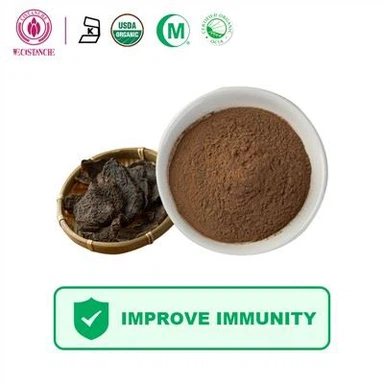
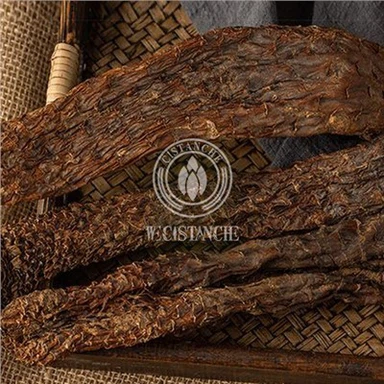
Cistanche tubulosa, often called "desert ginseng," has moved far beyond a traditional herbal story. In modern nutraceuticals, functional foods, and standardized botanical extracts, its value is determined by one thing above all: the measurable active phytochemical profile.
For C. tubulosa, the priority hierarchy is clear:
Phenylethanoid glycosides - the primary bioactive class
Polysaccharides and oligosaccharides - the gut and immune foundation
Iridoids, lignans, flavonoids, betaine, and minor metabolites - the synergistic layer
A product that simply says "Cistanche extract" without defining these components is leaving its most important value unexplained.
1. Phenylethanoid Glycosides: The Core Asset of C. tubulosa

Phenylethanol glycoside is the main active component of Cistanche tubulosa
C. tubulosa is especially valued because its phenylethanoid glycoside content is typically higher and more standardizable than that of C. deserticola. This makes it ideal for concentrated, batch-stable extracts.
Echinacoside

Echinacoside, the main chemical component of Cistanche tubulosa
Echinacoside is usually the most abundant phenylethanoid glycoside in C. tubulosa. Structurally, it combines a phenethyl alcohol core, caffeic acid units, and an oligosaccharide chain containing glucose, rhamnose, and xylose residues. This structure gives it good water solubility and broad biological accessibility.
Research directions include:
Neuroprotection: reducing neuronal apoptosis, supporting antioxidant enzymes such as SOD and GSH, lowering MDA accumulation in cerebral ischemia-reperfusion models
Cognitive support: improving learning and memory performance in rodent models
Bone metabolism: supporting bone density and osteoblast-related markers
Vascular function: promoting endothelium-dependent relaxation
Antioxidant defense: scavenging free radicals and limiting lipid peroxidation
In industrial terms, echinacoside content is the first real quality marker. Common specifications range from 10% to 50% or higher.
Verbascoside / Acteoside
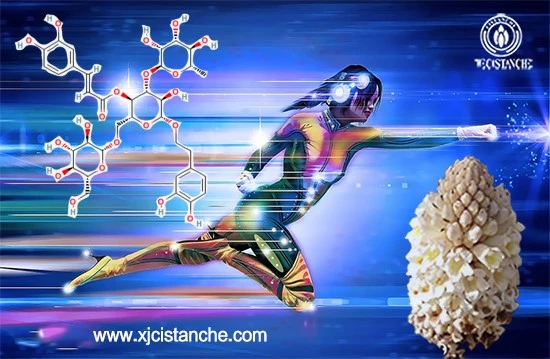
Acteoside is the main chemical component of Cistanche tubulosa
Verbascoside, also known as acteoside, is the second key marker compound. It is not merely "another glycoside"; it has distinct functional emphasis.
Key researched activities:
Strong radical scavenging against DPPH, hydroxyl radicals, and superoxide anions
Anti-inflammatory modulation through redox-sensitive signaling pathways
Immunomodulation, including effects on histamine, TNF-α, and IL-4 release
Skin and healthy-aging applications through antioxidant and tyrosinase-regulating effects
Reproductive and endocrine support in preclinical models
Echinacoside and verbascoside should not be treated as interchangeable. Echinacoside leans toward neural, vascular, and bone-related research; verbascoside leans toward antioxidant intensity, inflammation, immunity, and skin health.
Additional Phenylethanoid Glycosides
C. tubulosa also contains cistanosides, tubuloside B, isoacteoside, 2′-acetylacteoside, cistanoside F, and related structures. Individually minor, collectively important, they contribute to:
neuroinflammatory modulation
aldose reductase inhibition
vascular smooth muscle relaxation
broader antioxidant coverage
The biological effect is not from one molecule alone, but from a metabolic and synergistic glycoside network.
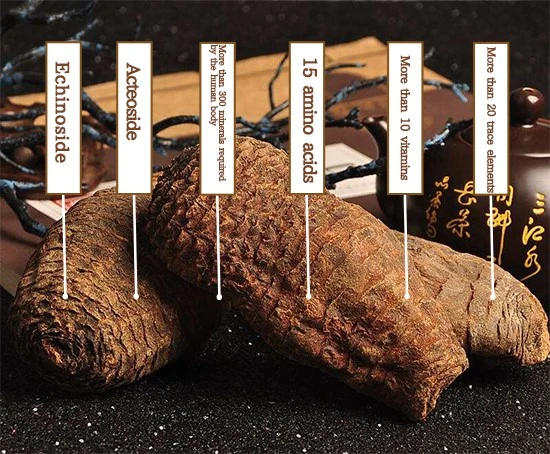
Main Chemical Constituents of Cistanche tubulosa
2. Polysaccharides and Oligosaccharides: The "Moistening and Regulating" Layer
The traditional TCM functions of "nourishing essence" and "moistening the intestines" are increasingly explained by the carbohydrate fraction.
Polysaccharides
C. tubulosa polysaccharides are heterogeneous structures containing arabinose, galactose, glucose, and uronic acid residues. Their roles include:
activating macrophages and natural killer cells
modulating cytokine release in a balanced, non-overreactive way
serving as prebiotic substrates for Bifidobacterium and Lactobacillus
supporting short-chain fatty acid production and gut-brain communication
contributing to fatigue resistance and immune homeostasis
Oligosaccharides and Galactitol-Related Components
Rather than acting like stimulant laxatives, these components:
increase intraluminal osmotic pressure
retain water in the colon
gently promote peristalsis
This explains the traditional use of Cistanche for senile or deficiency-type constipation. It is a "moistening" mechanism, not an irritant mechanism.
3. Secondary But Non-Negligible Components
Iridoid Glycosides
Compounds such as 8-epiloganic acid and genipic acid contribute to anti-inflammatory, hepatoprotective, and mild sedative-synergistic effects.
Lignan Glycosides
These support antioxidant defense and add structural diversity to the extract's pharmacological profile.
Flavonoids
Components such as isorhamnetin-related compounds may help:
inhibit platelet aggregation
improve microcirculation
stabilize capillary permeability
support vascular comfort
Betaine
Betaine contributes to:
homocysteine regulation
liver fat metabolism
cellular osmotic protection
auxiliary antioxidant activity
Amino Acids and Trace Metabolites
Arginine, proline, and related compounds support metabolic recovery, tissue repair, and nitrogen balance.
4. C. tubulosa vs C. deserticola: Different Phytochemical Logic
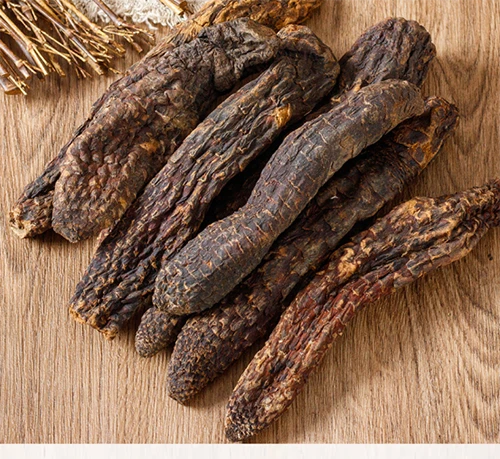
Cistanche tubulosa (Schrenk) Wight

Cistanche deserticola Y.C.Ma
|
Dimension |
Cistanche tubulosa |
Cistanche deserticola |
|
Phenylethanoid glycosides |
High, highly standardizable |
Lower, more variable |
|
Echinacoside / verbascoside |
Clear specification possible |
Harder to standardize |
|
Polysaccharides |
Present and functional |
Strong traditional "moistening" role |
|
Best use case |
Extracts, supplements, export raw material |
Traditional slices, food-heritage use |
|
Marketing logic |
Compound-driven |
Constitution-driven |
For C. tubulosa, the correct positioning is not merely "a Cistanche product." It is:
A standardized source of echinacoside, verbascoside, and functional polysaccharides.
5. Specifications That Matter in Trade and Compliance
For raw material supply, export documentation, and brand claims, the following are essential:
Total phenylethanoid glycosides, HPLC
Echinacoside content
Verbascoside / acteoside content
Total polysaccharides
Moisture, ash, heavy metals, pesticide residues, microbiological limits
Species authentication and chromatographic fingerprinting
Typical commercial specifications:
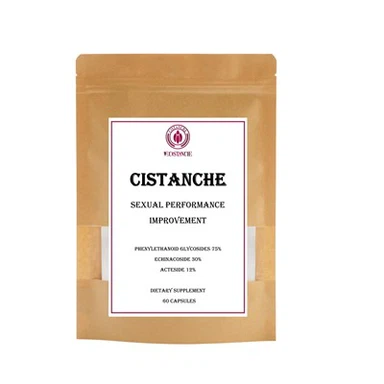
Total glycosides 40%: echinacoside ≥10%, verbascoside ≥4%
Total glycosides 50%: echinacoside ≥20%, verbascoside ≥6%
High-potency grade: echinacoside 50%+, verbascoside 10%+
Batch-to-batch consistency is more important than a one-time high number.
6. Responsible Claim Framework
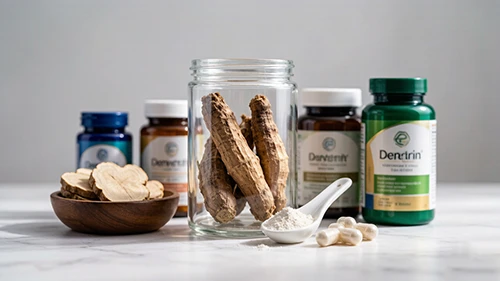
Unsafe claims:
"Cures dementia"
"Treats infertility"
"Clinically proven to reverse aging"
"Guaranteed testosterone change"
Professional claims:
Supports antioxidant defense
Assists cognitive and neural health maintenance
Traditional use for intestinal moisture, supported by polysaccharide research
Supports fatigue recovery and physical endurance
Contributes to immune balance
Standard disclaimer for dietary supplement markets:
This product is a dietary supplement or traditional herbal ingredient and is not intended to diagnose, treat, cure, or prevent any disease.

cistanche supplement near me
Click here to view Cistanche Tubulosa Extract Natural Supplement Powder
【Ask for more】 Email:cindy.xue@wecistanche.com / WhatsApp: 0086 18599088692 / WeChat: 18599088692