Cistanche & Sarcopenia: Herbal Formula Research For Brands
Nov 13, 2026
Meta description:
Explore a Cistanche-containing herbal formula for sarcopenia research, with preclinical muscle data, formulation insights and B2B sourcing considerations.
Primary keyword:
Cistanche sarcopenia research
Secondary keywords:
herbal formula for muscle health
botanical ingredients for healthy aging
mitochondrial function and sarcopenia
Cistanche ingredient sourcing
SIRT1 ATF5 muscle research
herbal product development
Cistanche and Sarcopenia Research: What a 10-Herb Formula Means for Muscle-Health Product Development
Developing a botanical product for age-related muscle health requires more than a compelling ingredient story. Brands and manufacturers need a clear formulation rationale, relevant performance endpoints, reproducible raw materials and an honest understanding of the evidence.
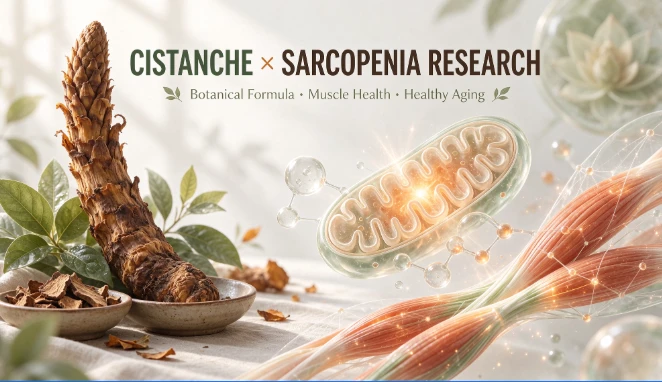
A supplied Chinese patent-style disclosure describes a ten-herb formulation containing Cistanche, also known as Rou Cong Rong, that targets the mitochondrial unfolded protein response, or UPRmt.
In the reported mouse experiment, the preferred formulation produced:
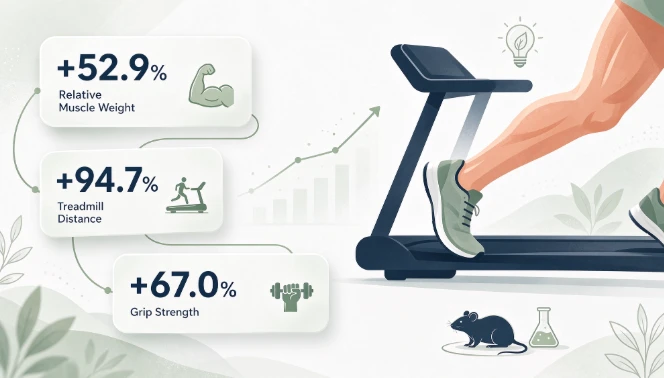
52.9% higher relative muscle weight
94.7% greater treadmill running distance
67.0% higher grip strength
These comparisons are against the untreated model group-not against people, and not against a clinically validated treatment.
For botanical brands, OEM/ODM manufacturers and natural-drug developers, the opportunity is therefore not a ready-made sarcopenia treatment claim. It is a testable formulation concept supported by reported preclinical measurements.
Evidence note: The numerical results below come from the supplied disclosure and accompanying tables. Its publication identity and underlying datasets have not been independently verified. No human clinical trial of this exact formula is provided.
Why Mitochondrial Function Matters in Muscle-Health Research
Muscle performance depends on more than muscle size. Energy production, oxidative stress and cellular quality-control systems also influence how muscle functions.
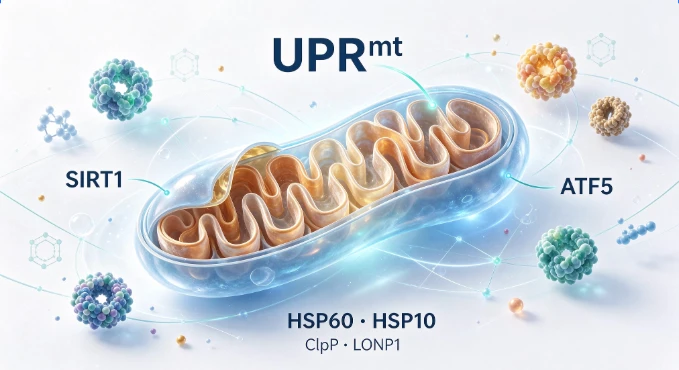
UPRmt is a stress-response system involved in mitochondrial protein quality control. The supplied disclosure focuses on:
SIRT1 and ATF5: signaling regulators associated with the proposed mechanism.
ClpP and LONP1: mitochondrial proteases involved in protein quality control.
HSP60 and HSP10: molecular chaperones involved in protein folding.
The research question is whether a multi-herb formulation can improve muscle-related outcomes while influencing these mitochondrial pathways.
However, UPRmt is not a universal "more is better" target. A separate mouse study published in Aging found that ATF5 contributed to mitochondrial quality control and endurance while also having complex effects on muscle mass. This supports a context-dependent interpretation rather than a simple activation claim. Read the study.
For product developers, functional outcomes should remain central. Changes in pathway markers are useful supporting measurements, but they do not independently establish efficacy.
The 10-Herb Formula: Where Cistanche Fits
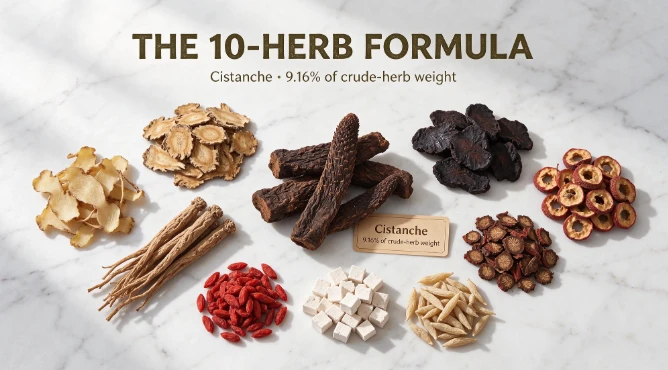
The preferred formulation in the supplied disclosure contains the following proportions:
| Ingredient | Chinese name | Preferred parts by weight |
|---|---|---|
| Polygonatum rhizome | Huang Jing / 黄精 | 20 |
| Chinese angelica root | Dang Gui / 当归 | 15 |
| Codonopsis root | Dang Shen / 党参 | 15 |
| Prepared Rehmannia root | Shu Di Huang / 熟地黄 | 15 |
| Cistanche | Rou Cong Rong / 肉苁蓉 | 12 |
| Goji fruit | Gou Qi Zi / 枸杞子 | 12 |
| Poria | Fu Ling / 茯苓 | 12 |
| Hawthorn fruit | Shan Zha / 山楂 | 10 |
| Ophiopogon root | Mai Dong / 麦冬 | 10 |
| Salvia miltiorrhiza root | Dan Shen / 丹参 | 10 |
| Total | 131 |
Cistanche accounts for approximately 9.16% of the starting crude-herb weight in this preferred formulation.
That figure is useful for initial raw-material planning. It is not the percentage of Cistanche extract in the finished product, because extraction yield and excipient addition change the composition.
What Can Be Said About Cistanche's Role?
The disclosure places Cistanche among the assistant herbs in the traditional formulation framework, describing its role in supporting the formula's kidney-tonifying and essence-nourishing rationale.
The measured outcomes, however, belong to the complete ten-herb formulation.
The supplied experiments do not include:
Cistanche alone.
The full formula with only Cistanche removed.
Multiple Cistanche inclusion levels.
A comparison of different standardized Cistanche extracts.
Consequently, the results do not establish how much of the observed effect comes specifically from Cistanche.
For a manufacturer, this is an actionable research gap: a Cistanche-specific omission study would provide stronger ingredient-level evidence than generalizing from the whole formula.
What the Reported Muscle Data Actually Show
The disclosure describes an eight-week oral-gavage experiment using SAMP8 mice, with C57BL/6 mice as normal controls.
The stated treatment dose was 1 g/kg daily, expressed as the prepared dry powder. The exact active-extract exposure remains unclear because the manufacturing process includes substantial starch addition.
Functional Results for the Preferred Formulation
| Endpoint | Normal control | Untreated model | Preferred formula: Example 1 | Descriptive change vs. model |
|---|---|---|---|---|
| Relative muscle weight, % | 4.82±0.354.82 \pm 0.354.82±0.35 | 2.95±0.282.95 \pm 0.282.95±0.28 | 4.51±0.324.51 \pm 0.324.51±0.32 | +52.9% |
| Treadmill running distance, m | 896.5±78.3896.5 \pm 78.3896.5±78.3 | 423.8±56.7423.8 \pm 56.7423.8±56.7 | 825.7±72.5825.7 \pm 72.5825.7±72.5 | +94.7% |
| Grip strength, g | 18.6±2.118.6 \pm 2.118.6±2.1 | 10.3±1.510.3 \pm 1.510.3±1.5 | 17.2±1.917.2 \pm 1.917.2±1.9 | +67.0% |
The percentages are calculated from the reported group means. They are descriptive comparisons, not independently calculated statistical effect sizes or clinical response rates.
Example 1 reached approximately:
93.6% of the normal-control relative muscle weight.
92.1% of the normal-control running distance.
92.5% of the normal-control grip strength.
The important development signal is that the reported improvement appears across mass-related and functional endpoints, rather than in a single biomarker.
Energy and Oxidative-Stress Measurements
| Endpoint | Untreated model | Example 1 | Descriptive change vs. model |
|---|---|---|---|
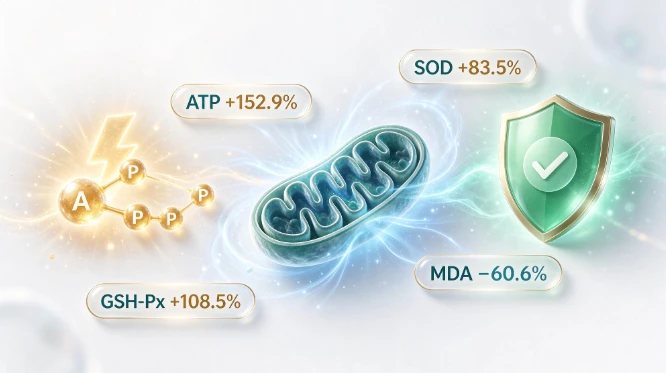
| MDA, nmol/mg protein | 3.86±0.323.86 \pm 0.323.86±0.32 | 1.52±0.201.52 \pm 0.201.52±0.20 | −60.6% |
| SOD, U/mg protein | 65.3±7.865.3 \pm 7.865.3±7.8 | 119.8±10.2119.8 \pm 10.2119.8±10.2 | +83.5% |
| GSH-Px, U/mg protein | 42.5±6.342.5 \pm 6.342.5±6.3 | 88.6±8.288.6 \pm 8.288.6±8.2 | +108.5% |
| ATP, μmol/mg protein | 1.02±0.151.02 \pm 0.151.02±0.15 | 2.58±0.232.58 \pm 0.232.58±0.23 | +152.9% |
These measurements are directionally consistent with the reported functional results: lower MDA and higher antioxidant-enzyme activity and ATP.
They do not, by themselves, prove the proposed mechanism or show that a commercial product will produce the same response in humans.
Mitochondrial Protein Markers
The disclosure also reports higher relative expression of ClpP, LONP1, HSP60, HSP10, SIRT1 and ATF5 after treatment.
For example:
| Protein | Untreated model | Example 1 | Normal control |
|---|---|---|---|
| ClpP | 0.32±0.050.32 \pm 0.050.32±0.05 | 0.89±0.070.89 \pm 0.070.89±0.07 | 1.00±0.081.00 \pm 0.081.00±0.08 |
| LONP1 | 0.35±0.060.35 \pm 0.060.35±0.06 | 0.92±0.080.92 \pm 0.080.92±0.08 | 1.00±0.091.00 \pm 0.091.00±0.09 |
| SIRT1 | 0.29±0.050.29 \pm 0.050.29±0.05 | 0.88±0.080.88 \pm 0.080.88±0.08 | 1.00±0.091.00 \pm 0.091.00±0.09 |
| ATF5 | 0.31±0.050.31 \pm 0.050.31±0.05 | 0.90±0.070.90 \pm 0.070.90±0.07 | 1.00±0.081.00 \pm 0.081.00±0.08 |
These results support further investigation of the proposed pathway. Establishing that the pathway is necessary for the effect would require additional work, such as inhibition, knockdown or rescue experiments.
Does the Full Formula Outperform the Comparators?
The supplied tables report better outcomes for Example 1 than for:
A Polygonatum-only preparation.
An eight-herb formula without Ophiopogon and Salvia.
A preparation described as Huangjing Yangji Decoction.
An ATF5-inhibitor comparator.
For instance, Example 1's running distance was 825.7 m, compared with 652.7 m for Comparative Example 3-a descriptive difference of approximately 26.5%.
This is potentially interesting for formulation development, but the comparison requires clarification.
Comparative Examples 2 and 3 are described with the same ingredients, preparation method and powder specification, yet their reported results differ. Moreover, neither comparison isolates Cistanche's contribution.
The practical conclusion is:
The reported results justify testing the complete formulation against clearly defined comparators. They do not yet establish a unique Cistanche effect or definitive multi-herb synergy.
Turning the Formula Into a Commercial Development Plan
1. Define the Product Category First
A muscle-health supplement and a drug intended to treat sarcopenia follow different development and regulatory pathways.
For a supplement project, developers should establish the permitted ingredients, doses and claims in the intended market.
For a treatment project, the program would require appropriately designed pharmaceutical development, safety assessment and clinical trials.
Disease-treatment wording should not be used for a supplement merely because the underlying research discusses sarcopenia.
2. Match the Studied Material Before Changing the Formula
The disclosure uses a water-extracted multi-herb preparation.
Replacing it with a blend of separately produced, high-concentration extracts may change:
Chemical composition.
Relative constituent exposure.
Solubility.
Extraction interactions.
Finished-product dose.
Likewise, switching from crude Cistanche material to a standardized Cistanche extract should be treated as a formulation change requiring analytical and biological bridging-not as an automatically equivalent substitution.
3. Resolve the Manufacturing Details
The supplied process offers a starting point: two water extractions, reduced-pressure concentration and conversion into oral dosage forms.
Before scale-up, manufacturers should clarify:
Extraction yield and crude-herb equivalence.
Whether concentration pressure is absolute pressure or vacuum-gauge pressure.
Filtration feasibility for finely milled herbal material.
The effect of starch addition on final potency.
Granule particle size and capsule fill properties.
Stability-indicating specifications.
A finished-product label based only on "500 mg powder" would not adequately communicate the amount of botanical extract or its crude-herb equivalent.
4. Build a Cistanche Raw-Material Specification
For a Cistanche-containing development program, request:
| Specification area | What to verify |
|---|---|
| Botanical identity | Exact species and identity-testing method |
| Plant part and processing | Medicinal material used, processing and any pretreatment |
| Material form | Crude herb, powder or extract |
| Extraction information | Solvent, extraction ratio, native extract content and carriers, if applicable |
| Chemical profile | Relevant marker assays and chromatographic fingerprint |
| Contaminants | Heavy metals, pesticides, microorganisms and other market-specific requirements |
| Traceability | Source, harvest information and batch records |
| Consistency | Comparable specifications and representative batch results |
| Stability | Storage conditions and supported shelf life |
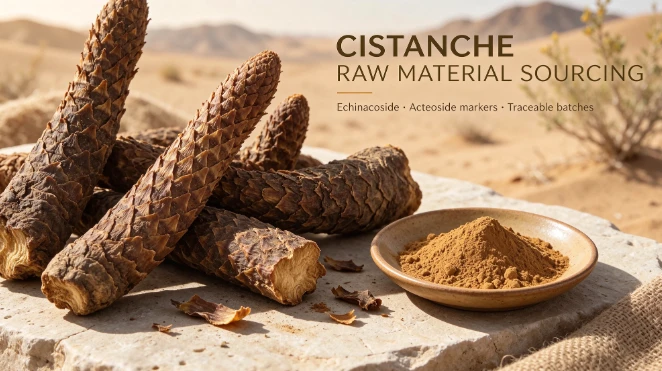
Echinacoside and acteoside may be considered as analytical markers where appropriate to the selected species and specification. Marker content should not be presented as a validated sarcopenia-efficacy threshold.
5. Design the Next Study Around the Main Evidence Gaps
A stronger development program would include:
A clearly reconciled animal allocation and sample-size calculation.
Appropriate controls for strain differences.
Blinded outcome assessment.
Defined extract exposure rather than excipient-containing powder weight alone.
Cistanche-specific omission and dose-ranging groups.
Mechanistic intervention studies.
Safety and interaction assessment.
Human testing with relevant muscle-performance and body-composition endpoints.
For commercial teams, these are not merely academic details. They determine whether the ingredient story can become a defensible product dossier.
Why the ATF5 Story Requires Careful Interpretation
The disclosure also discusses cells carrying the mitochondrial m.3243A>G mutation.
In that model, ATF5 is described as abnormally elevated, and treatment is reported to bring it closer to normal. This differs from the mouse muscle model, where ATF5 is reported to be low and treatment raises it.
The cited earlier ATF5 patent and related publication also describe benefits from ATF5 knockdown in high-mutation urine-derived stem cells. View the patent and the related research.
The implication for developers is straightforward:
"Supports mitochondrial homeostasis" is a research hypothesis that needs context-specific testing. "Always activates ATF5" is not an adequate development strategy.
Bottom Line for Botanical Brands and Manufacturers
The supplied formulation provides a potentially useful starting point for muscle-health research: a defined ten-herb composition, reported improvements in mouse muscle function, and measurements related to energy metabolism and mitochondrial quality control.
Its strongest commercial value is as a development hypothesis, not a ready-to-use treatment claim.
For a Cistanche factory or ingredient supplier, the most credible contribution is to help customers obtain reproducible raw materials and clear technical specifications for further testing.
The World's Largest TCM Cistanche Factory
Supportive Service Of Wecistanche-The largest cistanche exporter in the China:
Email:wallence.suen@wecistanche.com
Planning a Cistanche-containing muscle-health formulation? Prepare a sourcing brief covering your intended market, material form, botanical identity, analytical requirements and pilot-batch needs. Use that brief to align ingredient sourcing with the formulation you actually intend to study.
Sources and Evidence Status
This article is intended for professional ingredient and product-development discussion. It does not provide medical advice or establish that any ingredient or formulation is approved to treat sarcopenia.