CISTANCHE TUBLULOSA COULD BE CONSIDERED AS MEDICINAL PLANT IN HALOPHYTES FARMING Ⅱ
Aug 30, 2022
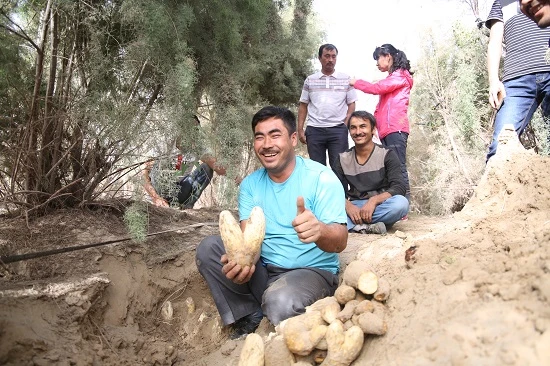
C. tubulosa was collected from Yazd in the Central plateau of Iran. The soils of this region are moderate to heavy texture and saline, ground water sources are very salty. Framers grow Tamarix as windbreak around Pistachio Orchard. The host of the C. tubulosa in this site was Alhaji, Tamarix and Seidlitzia.
The studied area is 53° 10’ longitude and 32° 28’ latitude and elevation from sea level is 1036 meters with a rainfall of 61 mm and 2789 mm evapotranspiration. The mean temperature of warmest month of the year is 32°C and the coldest month of the year is 6°C. Geologically, the region is from Precambrian Period to the Quaternary. The Desert Chah Afzal in the past was a lake that has dried up due to severe evaporation and become desert. In this region Tamarix and Haloxylon cultivated in 3000 hectares by government support for greenification. Twelve Cistanche tubulosa without inflorescence removed from the soil. Fleshy stem were washed with tap water and cleaned. Then cut into small pieces and dried in an oven with 50°C temperature during 7 days.
Total carbohydrate percentage = 100- (Ash percentage + protein percentage + moisture content +Fat percentage).

Get a Good Quality of Cistanche Made in China
0.75 (l/min), Nebulizer type: Cross flow, Spray chamber: Scott, Integration time: .1 second.
The powdered plant (33 g) was mixed with 70% ethanol (50 cc). The mixture was subjected to extraction at 30°C for 5 hours under stirrer conditions. The extract was filtered with Whatman No. 42 filter paper to separate the biomass. The extraction juice passed through a 0.45 µm filter membrane.
o Injection volumes: 10µL

The herbal extracts were dried in oven, and then solutions of sample (50, 100, 200, 400, 800 ppm) were prepared. DPPH radical scavenging assay was determined using DPPH (2, 2-diphenyl 1-picryl hydrazyl) radical.
Evaluation of 48 elements in C. tubulosa showed that Na, K, Mg, S, Ca, P and Fe is the dominant elements in stem. Zheng and Du (2011) evaluated minerals content of C. deserticola at different growth stage and the proportion of K: Na: P: Ca: Mg was 12: 3.4: 1.6: 1.4: 1 at succulent stem stage and Fe content was the highest and can reach to 97.31 µg g-1.
Amount of Fe in C. philypaea reported 8.04 ppm (Elwakil et al., 2016) but in C. tubulosa was 142 ppm in this stage (Table 3). K/Na ratio was 0.49 but in C. phelypaea was 8. K content ratio to Mg, S, Ca, P, and Fe in C. tubulosa were 7.7, 10.0, 15.65, 36.15 and 186.35 (Table 3)


Echinacoside, 2-Acetylacteoside, Tubuloside B) identified. In Cistanche salsa the main components was echinacoside (1097.9 mg 100 g-1)(Kartbaeva, Sakipova, Ibragimova, Kapsalyamova, & Ternynko, 2015).
In C. deserticola, C. salsa and, C. sinesis phenylethanoid glycosides (PhGs) reported in which echinocoside and acteoside are the major components.

Echinacoside prevent programmed cell death in the developing nervous system and had protective and therapeutic effects on radiation-induced skin damage (Li, Zheng, Liu, & Jia, 1992; Sui et al., 2011). Echinacoside could protect neuronal cells from radical scavenging and had an anti-tumor effect (Liu, Li, & Du, 2008)

Table 4 shows the dose dependent activity of DPPH in C. tubulosa. DPPH used for testing radical scavenging capacity of the extracts (Pavithra& Vadivukkarasi, 2015). The extracts showed high levels of DPPH radical scavenging activity over the range of 50 –800 ppm concentration.


In this section, each type of food composition amount in Cistanche is compared to other Food items and some common vegetables. Also, in order to more accurately assess the nutritional value of this sample, the importance and the amount of each type of food composition are briefly introduced.
3.1. Proximate Composition Content
As shown in Table 2, the protein content of this halophyte is in the range of 9.8 % of the dry weight of the plant, which is relatively good compared to the protein sources presented in the Food Additive Table (USDA, 2016).
This amount was found to be high in animal meat resources with higher quality and biological value (with higher absorption and higher essential amino acids for human) which were measured in egg with (35.6%), egg yolk with (15.7%), beef with (15.7%), chicken with (17.44%), salmon with (22%) and milk with (7.99%) amount. Lentil and soybean were known to have protein sources, which have 24.6% and 51.46% protein amount, respectively. Based on the fresh weight of the plant, vegetable protein content such as spinach was reported to have 4.01% of protein, and cucumber, potato, leek and broccoli were reported to have (0.59%), (2.38%), (1.5%) and (4.28%) amount of protein, respectively.
As it is seen, protein content in this halophyte is lower than the highly valued biological resources of animal. Also, the percentage of this protein is slightly lower than the known vegetable sources such as peas, but it is higher than some plant sources.

If you have any question, please send us Email: wallence.suen@wecistanche.com