Cistanche Tubulosa: 5× The Active Compounds Of Desert Cistanche — Yet 90% Of Buyers Still Get It Wrong
Nov 04, 2026
The Name Game Nobody Tells You About
If you source tonic herbs, formulate supplements, or deal in functional ingredients, you have almost certainly encountered Cistanche - the "ginseng of the desert," celebrated in traditional Chinese medicine for kidney yang tonification, moistening the intestines, and supporting healthy aging.
What most buyers do not realize is that the raw material traded under the single name "Rou Cong Rong" / "Cistanche" actually represents two pharmacopoeially distinct species:

Cistanche deserticola Y.C. Ma - commonly called "Desert Cistanche," parasitizing the roots of Haloxylon ammodendron (saxaul). Historically associated with the Alxa League of Inner Mongolia. Known in trade as "Rou Da Yun" (soft Cistanche).
Cistanche tubulosa (Schenk) Wight - commonly called "Tube-flowered Cistanche," parasitizing the roots of Tamarix spp. (tamarisk / red willow). Native to the Hotan, Kashgar, and Aksu regions along the southern edge of the Taklamakan Desert in Xinjiang. Known in trade as "Ying Da Yun" (hard Cistanche).
The Chinese Pharmacopoeia lists these as two separate monographs with two different content specifications. They are not interchangeable raw materials - and the gap in active compound density between them is measured in multiples, not percentages.
So why is it that roughly 90% of procurement professionals - many of whom have sourced Cistanche for years - still end up buying the lower-potency species?
How Large Is the Gap, Exactly?
The pharmacologically active constituents of Cistanche are the phenylethanoid glycosides (PhGs). The two marker compounds that the Chinese Pharmacopoeia uses as the official quality benchmark are echinacoside and acteoside (verbascoside).

Phenylethanol glycoside is the main active component of Cistanche tubulosa
These two molecules are the legal "ruler" against which every batch of Cistanche is measured.
Measured Content Comparison (pre-flowering, dried stems)
|
Marker Compound |
C. tubulosa (Hotan, Xinjiang) |
C. deserticola (Alxa, Inner Mongolia) |
Fold Difference |
|
Echinacoside |
~16.04 mg/g |
~4.50 mg/g |
~3.6× |
|
Acteoside |
~3.71 mg/g |
~1.25 mg/g |
~3.0× |
|
Total phenylethanoid glycosides |
Significantly higher |
Baseline |
~3–8× |
Data sources: UPLC-QQQ-MS/MS comparative studies on PhG profiles across species, origins, and growth stages of Cistanche.
The industry shorthand - "C. tubulosa contains roughly five times the active compounds of C. deserticola" - is not marketing hyperbole. Across peer-reviewed measurements, the total PhG content ratio consistently falls in the 3× to 8× range, making "fivefold" a fair central estimate.

Main Chemical Constituents of Cistanche
Why the Pharmacopoeia Split the Standards
Because the compositional gap between the two species is so large, the Chinese Pharmacopoeia (2020 edition) did something it had not done previously: it wrote separate minimum content thresholds for each species.
Cistanche deserticola: total echinacoside + acteoside ≥ 0.30% (dried basis)
Cistanche tubulosa: minimum content threshold substantially higher than the desert species
This is the regulatory acknowledgment of an industry reality: C. tubulosa has a fundamentally higher active-compound density. This is why pharmaceutical manufacturers, extract producers, and supplement brands overwhelmingly choose C. tubulosa as their extraction feedstock - it delivers more marker compounds per kilogram, which directly lowers cost of goods sold (COGS) per unit of finished extract.
Why 90% of Buyers Still Choose the Wrong Species
If C. tubulosa is the higher-potency, industry-preferred raw material, why does the market still see so much C. deserticola flowing through procurement channels?
Three stacked cognitive traps are at work.
Trap 1: "Softer = Better" - Textural Heuristic Overrides Analytical Data

Cistanche deserticola
C. deserticola has a higher polysaccharide fraction. When dried, it feels soft, fleshy, and oily - hence the trade name "soft Da Yun" / "oil Cistanche." C. tubulosa, with a relatively lower polysaccharide content and coarser fiber, dries harder and is called "hard Da Yun."
Over centuries of trade, an informal rule of thumb emerged: the softer and oilier, the better; the harder and woodier, the lower grade.
This heuristic was developed in an era without analytical chemistry. It was - and remains - a valid proxy for texture and mouthfeel. But it is not a valid proxy for active compound content.
That soft, oily stem you are paying a premium for? It may carry only one-third to one-fifth of the echinacoside and acteoside found in the "harder" C. tubulosa.
Trap 2: "Alxa Is the Authentic Origin" - Historical Geographies vs. Modern Phytochemistry
Classical materia medica texts describe Cistanche as growing in the "Hexi Corridor" and the ancient commanderies of Dai and Yanmen - corresponding broadly to modern Gansu and Inner Mongolia. This historical association has cemented the belief that "Alxa Cistanche is the authentic, superior grade."

Cistanche deserticola
But C. tubulosa is ecologically specialized. It grows only south of the Tianshan Mountains, around the Taklamakan Desert basin - Hotan, Kashgar, Aksu. This region receives over 2,800 hours of annual sunlight, has extreme diurnal temperature variation, and has near-zero precipitation with very high evaporation. These are precisely the environmental conditions that drive the accumulation of secondary metabolites - including phenylethanoid glycosides - in parasitic plants.
Modern analytical data confirms what the ecology predicts: the echinacoside content of C. tubulosa from Xinjiang substantially exceeds that of C. deserticola from Inner Mongolia.
"Daodi" (authentic-origin) was the best judgment available to practitioners working without chromatography. With modern assay data in hand, it is time to update the map.
Trap 3: Buying by Appearance, Ignoring the Root-to-Top Gradient
This is the most insidious trap, and it costs buyers the most.
Within a single C. tubulosa plant, the active compound concentration varies dramatically between the underground basal portion (root) and the emergent apical portion (top):

Fresh Cistanche
Echinacoside concentration in the basal root is up to 22.4× that of the apical top.
Acteoside concentration in the basal root is up to 16.7× that of the apical top.
Total PhG concentration in the basal root is up to 8.7× that of the apical top.
In other words: a thick, long, visually impressive Cistanche stem that is predominantly apical tissue may deliver less than one-tenth of the active compound content of a basal-root piece of the same weight.
Yet the bulk herbal trade prices material by size, girth, and visual uniformity. The apical portions grow thicker, straighter, and more cosmetically appealing - and therefore command a higher price. The basal portions, being thinner, curved, and visually less attractive, are often graded as lower quality.
This is the core information asymmetry: buyers pay premium prices for attractive "top-grade" material that carries only a fraction of the active compounds they are paying for.
Additional Pitfalls Beyond Species Selection
Even after you have correctly specified C. tubulosa as your target species, several hidden risks remain
Harvest Timing: Pre-flowering vs. Post-flowering

Harvest of Cistanche tubulosa
Cistanche emerges from the soil in spring, bolts, flowers, and sets seed. Research consistently shows that pre-flowering harvest (when the shoot first breaches the soil surface) yields the highest echinacoside content. Once flowering begins, metabolic resources are diverted toward the inflorescence, and active compound levels in the stem decline rapidly.
The ordering is unambiguous: pre-flowering > haustorial stage > post-flowering. Procuring post-flowering material to save cost means accepting a substantial discount on active compound yield
Processing and Extraction: Marker Content Can Drop Threefold

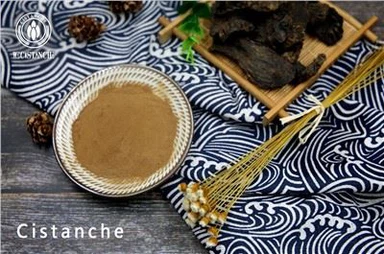
cistanche powder
Click here to view Cistanche Tubulosa Extract Natural Supplement Powder
【Ask for more】 Email:cindy.xue@wecistanche.com / WhatsApp: 0086 18599088692 / WeChat: 18599088692
"Fine, I buy C. tubulosa crude material - that should settle it, right?"
Not necessarily. When the same C. tubulosa raw material is processed into powder or aqueous decoction:
Echinacoside falls from approximately 19.81% to 5.90%
Acteoside falls from approximately 2.45% to 0.54%
Processing and extraction method alone can drive a threefold swing in marker compound recovery.
If you are purchasing Cistanche powder, tea bags, or extract, you must ask: What is the extraction ratio? What is the assayed echinacoside content? Is it a generic 10:1 extract, or a standardized extract titrated to, say, 20% echinacoside?
Without these specifications, the label "Cistanche tubulosa" is essentially a placebo
Adulterant Species: C. salsa and Related Taxa
The market also contains Cistanche salsa (salt Cistanche) and other related species that resemble C. deserticola visually but contain far lower PhG levels. These are substantially cheaper and are occasionally blended into consignments. Visual inspection alone is insufficient.
Reputable procurement should always require an HPLC fingerprint chromatogram confirming:
Correct botanical identity (C. tubulosa vs. C. deserticola vs. adulterant)
Assayed echinacoside and acteoside content against a qualified reference standard.
A Correct Procurement Framework: From "By Eye" to "By Assay"
The core principle is straightforward: stop grading Cistanche by texture and appearance. Grade it by assay data
Four Non-Negotiable Specifications for Buyers
1. Specify the species first. For extracts, dietary supplements, and export-grade ingredients, specify Cistanche tubulosa (Schenk) Wight. Its higher PhG density delivers better cost efficiency per unit of active compound. If your product is positioned as a traditional Chinese herbal slice and requires the classic soft texture, you may choose C. deserticola - but enter that decision with eyes open about the potency gap.

Cistanche tubulosa
2. Judge by marker content, not by size. Require a third-party HPLC Certificate of Analysis (CoA). The two numbers that matter are: echinacoside content and acteoside content. Their sum is the pharmacopoeial quality metric. The minimum accepted threshold for C. tubulosa is materially higher than the 0.30% floor for C. deserticola.
3. Clarify the plant part. The basal (underground) portion carries far higher active compound density than the emergent apical portion. If purchasing mixed-grade whole stems, negotiate for a defined basal-root ratio - or specify basal-root material directly.
4. Confirm harvest window. Spring pre-flowering harvest (March–April, at first soil breach) yields the highest active compound content. Post-flowering material, regardless of price, should be treated as a different (and lower-potency) product category.
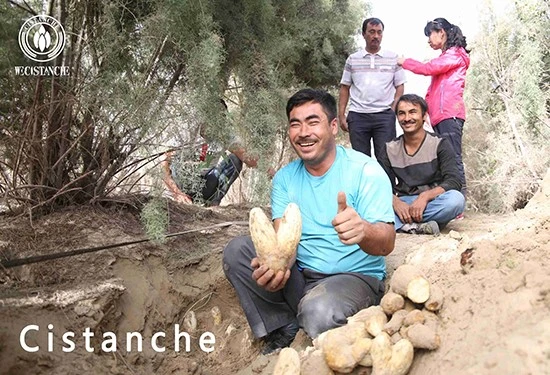
Cistanche tubulosa - a bumper harvest for farmers