Cistanche Tubulosa Extract Vs. Cistanche Deserticola Extract: A Multi-Dimensional Buyer's Guide For Export
Nov 03, 2026
|
Bottom line up front: For export-oriented dietary supplement and functional-food ingredients, Cistanche tubulosa (Schrenk) Wight extract is the default choice. Cistanche deserticola Y.C.Ma is reserved for the domestic Chinese "medicine-food dual-purpose" market and for laxative/gut-health positioning. Both are official pharmacopoeia species, but their active-marker baseline, overseas literature base, customer recognition, and regulatory pathways are materially different.
Cistanche tubulosa and Cistanche deserticola |

1. Botanical Identity: Two Pharmacopoeia Species, Two Commercial Paths
The Chinese Pharmacopoeia (CP) recognizes only two official Cistanche species: Cistanche deserticola Y.C.Ma (desert-branching cistanche, grown in Inner Mongolia, Gansu and Ningxia, parasitic on Haloxylon ammodendron) and Cistanche tubulosa (Schrenk) Wight (tubular cistanche, grown in southern Xinjiang, predominantly Hotan/Kashgar, parasitic on Tamarix ramosissima). C. tubulosa was added to the CP in the 2005 edition as a separate species.
The decisive regulatory split is on the food side. In 2023, China's National Health Commission and SAMR (Announcement No. 9 of 2023) listed "Cistanche (desert)" - Latin name Cistanche deserticola Y.C.Ma, fleshy stem - as a traditionally both-food-and-medicine substance. C. tubulosa, although a pharmacopoeia species, is not on the food-material list and may only be used in Chinese medicinal slices, proprietary Chinese medicines, or approved health-food products within China.
|
Dimension |
C. tubulosa |
C. deserticola |
|
Domestic food status |
Not on the medicine-food list; medicinal slices / health-food raw material only |
Listed in 2023 as both food and medicine; permitted in ordinary foods and solid beverages |
|
Main origin |
Southern Xinjiang (Hotan, Kashgar), parasitic on Tamarix |
Inner Mongolia (Alxa), Gansu, Ningxia, parasitic on Haloxylon |
|
CP content limit |
Echinacoside + Verbascoside ≥ 1.5% (dried basis) |
Echinacoside + Verbascoside ≥ 0.30% (dried basis) |
|
Functional orientation |
Kidney-yang tonification, anti-fatigue, energy support |
Intestinal lubrication, laxative, moistening purgative action |

Cistanche deserticola

Cistanche tubulosa
2. Active-Marker Content: The Hard Currency of Export Pricing
Before an overseas buyer places an order, the first question is almost always: "What is your HPLC assay for Echinacoside and Verbascoside?" These two phenylethanoid glycosides are the internationally referenced markers for Cistanche and the two numbers that must appear on every export COA.
2.1 A roughly 5-fold gap in natural baseline
The pharmacopoeia itself sets a 5-fold difference: C. tubulosa ≥1.5% versus C. deserticola ≥0.30%. This is not a method artifact; it reflects the secondary-metabolite baseline of the plant under the high-irradiation, large day-night temperature, and Tamarix-host ecosystem of southern Xinjiang, where phenylethanoid glycosides accumulate far more densely.
Practical consequence: to produce an extract standardized to, say, "Echinacoside 10% + Verbascoside 2%", C. tubulosa feedstock requires a lower concentration factor, lower solvent cost, and tighter batch-to-batch consistency. Achieving the same specification from C. deserticola requires heavier concentration, co-enrichment of polysaccharides, chlorophyll, and impurities, and higher purification cost.
|
Common extract spec |
C. tubulosa feasibility |
C. deserticola feasibility |
Buyer acceptance |
|
Total phenylethanoid glycosides ≥20% (HPLC) |
Mature, mainstream commercial spec |
Needs heavy concentration; costly and variable |
High |
|
Echinacoside ≥10% (HPLC) |
Routine spec |
Marginal, high batch variation |
High |
|
Verbascoside ≥5% (HPLC) |
Routine spec |
Low native level, poor cost performance |
High |
|
Polysaccharides 10–30% |
Achievable, but not the strength |
Strong spec; higher native polysaccharide |
Medium (only gut/laxative buyers) |

Main Chemical Constituents of Cistanche tubulosa
2.2 Why overseas buyers require HPLC and reject UV "total glycoside" claims
Domestic price lists often quote "Total glycosides 40%" or "Total glycosides 60%" by UV spectrophotometry. UV uses a single marker (usually Echinacoside) and measures total absorbance at 330 nm; other phenolics and amino acids in the matrix also absorb at that wavelength, so the result is systematically inflated. Brand owners in the US, EU, and Korea universally require HPLC single-marker quantitation; UV "total glycoside" is acceptable only as a process reference, never as an acceptance criterion.
A credible export quotation must state three things: (1) the assay method (HPLC); (2) the individual content of Echinacoside and Verbascoside; (3) whether results are reported on a dried basis. Quoting only "10:1" or "20:1" concentration ratios is, for overseas buyers, essentially a non-answer.
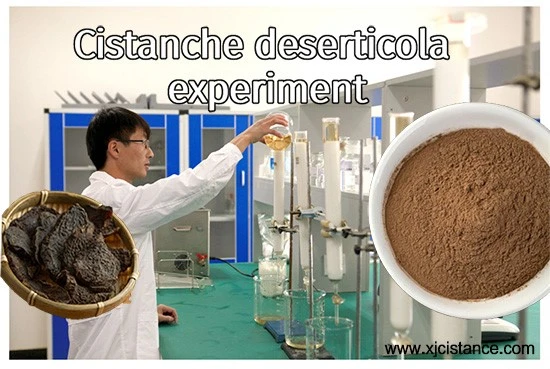
Cistanche tubulosa experiment
3. Overseas Recognition and Literature Base: C. tubulosa is the "international SKU"
3.1 What buyers find when they search
A PubMed / Google Scholar / ScienceDirect search for "Cistanche tubulosa extract" returns a large body of work on renal function, anti-fatigue, erectile function, Parkinson's models, and skin anti-aging, including human intervention studies. "Cistanche deserticola" retrieves mainly Chinese-language journals centered on laxative and bowel-moistening effects. In the Japanese and Korean supplement markets, "Cistanche tubulosa extract" is already a recognized commodity ingredient, routinely blended with maca, Panax ginseng and Epimedium in men's-health formulations.
When a Western buyer searches for a raw material, the default query is "Cistanche tubulosa / Echinacoside / Verbascoside"; the reference standards, formula calculations, and stability models in their files are built around the tubulosa profile. Quoting a deserticola lot forces the buyer to re-verify botanical identity and re-validate methods, which lengthens the deal cycle and often loses the order.

Cistanche tubulosa extract
Click here to view Cistanche Tubulosa Extract Natural Supplement Powder
【Ask for more】 Email:cindy.xue@wecistanche.com / WhatsApp: 0086 18599088692 / WeChat: 18599088692
3.2 Regulatory framing: dietary ingredient, not TCM
In the United States, Cistanche extract is generally treated as a dietary ingredient under DSHEA; it does not require pre-market FDA approval, but suppliers must operate under cGMP and provide ingredient disclosure and self-determined safety assessment. In the EU, most member states manage it under novel-food or traditional-herbal (THR) pathways. In Korea, MFDS registers it as a health-functional-food raw material. Across all three paths, the buyer's core questions are the same: Is the phytochemical profile stable? Is there peer-reviewed literature? Is there GRAS-equivalent or comparable safety evidence? On all three, C. tubulosa has a deeper evidence base.
4. Export Compliance and Registration Difficulty
4.1 Origin documentation and CITES compliance
Wild Cistanche is a Class-II protected wild plant in China and has historically been listed under CITES. Export lots must be cultivated and supported by: plantation registration, host-plant certification (Tamarix / Haloxylon), harvest year, and artificial-inoculation records. Hotan in southern Xinjiang hosts the world's largest cultivated C. tubulosa base with a mature export-compliance workflow (customs, commodity inspection, certificate of origin). Inner Mongolia's C. deserticola cultivation is also scaled, but the export volume and trade-service ecosystem are comparatively thinner.
4.2 Mandatory testing matrix for target markets
|
Test item |
US / EU buyer expectation |
C. tubulosa vs. C. deserticola |
|
Heavy metals (Pb, Cd, As, Hg) |
Per USP <232> / Ph. Eur. general chapter; Pb typically ≤0.5 mg/kg |
Both controlled; deserticola deep-rooted on Haloxylon carries slightly higher cadence risk |
|
Pesticide residues (GB 2763 / EU 396/2005) |
EU list is the strictest; full-screen against EU MRL list |
Xinjiang Gobi cultivation uses very little pesticide; lower residue risk |
|
Microbiology (GB 7101 / USP 2021) |
TVC, yeast & mold, coliforms, Salmonella |
Both species routinely pass after spray-drying |
|
Solvent residues (GB 5009.262) |
Ethanol, methanol, n-butane; if macroporous resin purification is used, styrene/divinylbenzene residuals must be tested |
Tubulosa high-standard extracts commonly use resin purification - residual-monomer testing is mandatory |
|
SO₂ residue |
EU ≤50 mg/kg; Chinese food-material list ≤400 mg/kg |
For export, apply the EU limit, which is far stricter |

cistanche powder
4.3 Labeling and serving-size guidance
China's medicine-food list recommends ≤3 g/day of C. deserticola and excludes pregnant and lactating women and infants. This rule does not directly apply to Western labels, but buyers will ask the supplier for a recommended serving size and a safety dossier (ADI / NOAEL references). For C. tubulosa, Japanese and Korean markets have already converged on a mature daily-use figure (typically 300–600 mg/day of extract), which can be cited directly.
5. Supply Chain, Cost and Process Stability
On the ground: Hotan, Xinjiang, has built a complete "inoculation → harvest → slicing → extraction → spray-drying" chain for C. tubulosa, with several export-oriented factories holding standing inventory of mainstream specifications such as 20% total phenylethanoid glycosides and 10% echinacoside. C. deserticola extract plants primarily serve domestic Chinese medicinal-slice and health-food orders; export-ready stock and dedicated foreign-trade teams are comparatively limited.
One process detail matters: fresh Cistanche contains hydrolytic enzymes that can degrade phenylethanoid glycosides if slicing and drying are delayed. Export-grade production must lock in the full chain of "fresh harvest → steam inactivation of enzymes → low-temperature extraction → spray drying". This workflow is more mature in the Xinjiang tubulosa supply chain.
6. Quick Selection by Buyer Use Case
|
Buyer/order direction |
Recommended species |
Key spec and messaging |
|
Men's health / anti-fatigue / energy |
C. tubulosa |
HPLC phenylethanoid glycosides ≥20%; Echinacoside ≥10%; cite overseas literature |
|
Skin anti-aging / antioxidant |
C. tubulosa |
Verbascoside ≥5%; attach DPPH scavenging data |
|
Gut health/laxative |
C. deserticola |
Polysaccharides ≥20%, betaine ≥1.5%; smaller overseas demand |
|
Domestic Chinese ordinary food / solid beverage |
C. deserticola |
Must be C. deserticola; attach the 2023 food-material announcement |
|
TCM slices / proprietary medicine to overseas Chinese markets |
Either, per formula |
Supply to the CP monograph that the buyer's formula requires |

cistanche supplement near me
7. Five Clauses That Must Be Locked into the Export Contract
Latin binomial: Cistanche tubulosa (Schrenk) Wight - never quote only as "Cistanche extract".
Assay method: HPLC for Echinacoside and Verbascoside, with chromatograms and reference-standard information.
Result basis: Reported on a dried basis; state moisture.
Origin and cultivation: Cultivated in Hotan, Xinjiang; attach plantation certificate, non-wild statement, and CITES compliance declaration.
Acceptance clause: Final acceptance per third-party retest by SGS / Eurofins / Intertek; non-conforming lots to be returned or replaced at the supplier's testing cost.