Cistanche Tubulosa Vs. Cistanche Deserticola Extracts For Export: A Multi-Dimensional Sourcing, Regulatory And Formulation Analysis
Nov 03, 2026
|
Executive summary. For export into the US, EU, Korean and Japanese dietary-supplement markets, Cistanche tubulosa (Schenk) Wight - the Xinjiang Hotan species that parasitises Tamarix shrubs - is the rational default choice. It is the species that has already cleared an EFSA Novel Food opinion, that Western brands have standardised by echinacoside and acteoside, and that can be sourced at industrial scale from traceable plantation bases. Cistanche deserticola Y.C.Ma, the Alxa species parasitising Haloxylon ammodendron, remains a strong domestic Chinese tonic herb and a niche "dao-di" ingredient, but it carries higher regulatory, formulation and cost penalties when positioned as an export standardised extract. Both species are listed on CITES Appendix II, so an export permit from the CITES Management Authority is non-negotiable regardless of which species is chosen.
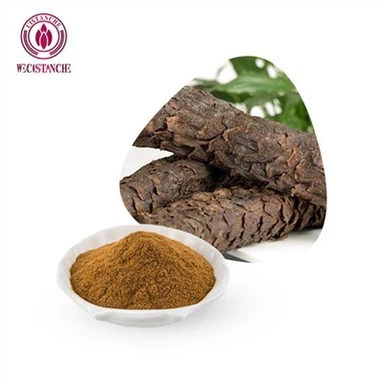
Cistanche tubulosa extract |

1. Why the two species are not interchangeable at export
Inside China, the two Cistanche species have historically been traded as two commercial grades of a single herb: the Inner Mongolian "you-cong-rong" (oily cistanche) and the Xinjiang "ying-da-yun" (hard dayun) sit side by side on the same dispensary shelf, differing mainly in price and appearance. The moment a shipment leaves the country, however, that common identity collapses. Overseas buyers do not purchase "cistanche" as a bulk crude drug; they purchase a specification - a defined extract ratio, a quantified marker compound measured by HPLC, a heavy-metal and pesticide dossier, and a label that must survive regulatory review in the destination market.
Choosing between C. tubulosa and C. deserticola for export is therefore not a question of which plant is "better" in a pharmacological or cultural sense. It is a question of six operational issues:
Which botanical identity the destination pharmacopoeia and regulator actually recognises, and at what assay limit.
Which species can reproducibly hit the marker-compound specifications that Western formulators write into their COAs.
Which species already has a recognised regulatory pathway in the major destination markets.
Whether a CITES Appendix II export permit can be obtained for the chosen botanical form.
Whether the raw-material supply base can deliver consistent, traceable volumes at an economically viable cost.
How much market-education cost the buyer will incur if the chosen species diverges from what the Western category currently looks like.
This article walks through each of these issues for an exporter or exporter-facing trader, and ends with a decision framework and a documentation checklist. The analysis is written from the standpoint of a mid-sized Chinese manufacturer with both plantation access and cross-border documentation capability.

Cistanche tubulosa and Cistanche deserticola
2. Taxonomy and pharmacopoeial identity: the "birth certificate" of the export product
The two species are easily confused but morphologically and chemically distinct.
|
Attribute |
Cistanche tubulosa (Schenk) Wight |
Cistanche deserticola Y.C.Ma |
|
Host plant |
Tamarix spp. (tamarisk) |
Haloxylon ammodendron (saxaul) |
|
Main cultivation area |
Xinjiang Hotan prefecture (Yutian, Minfeng), southern Taklamakan fringe |
Inner Mongolia Alxa League, Gansu, parts of northern Xinjiang |
|
Pharmacopoeial assay limit (ChP 2020) |
Echinacoside + acteoside ≥ 1.5% |
Echinacoside + acteoside ≥ 0.30% |
|
Physical character |
Firm, "hard dayun", paler transverse sections |
Fleshy, oily sections, dark brown "you-cong-rong" |
|
Chinese food status |
Pharmacopoeial drug; not on the dual-use food-and-herb list |
C. deserticola is on the NHC pilot list of traditionally both food and medicine |

Cistanche deserticola

Cistanche tubulosa
The five-fold gap in pharmacopoeial assay limit is the single most important number in this entire analysis. A crude drug that naturally contains 1.5% of the two marker phenylethanoid glycosides (PhGs) can be extracted and standardised to 10%, 20% or even 50% echinacoside with reasonable yields and batch-to-batch consistency. A crude drug that contains only 0.30% requires proportionally more plant material, longer processing, and yields that swing far more between harvest years. The ChP 2020 monographs did not simply describe two plants; they documented that one is intrinsically a PhG-rich feedstock and the other is not.
Two further regulatory facts frame everything that follows. First, the entire genus Cistanche is listed on CITES Appendix II, and Chinese customs have publicly enforced this by intercepting unpermitted mail and courier shipments. Any export, whether general trade, cross-border e-commerce parcel or sample shipment, requires a prior CITES export permit from the Endangered Species Import and Export Management Office. Second, the EU Novel Food catalogue and EFSA opinion letters have, to date, recognised C. tubulosa - not C. deserticola - as the cistanche species with an established safety evaluation. This asymmetry is decisive.
3. Phytochemical profile: why marker compounds define export specifications
Overseas buyers do not write purchase orders in terms of "cistanche root". They write them in terms of HPLC- quantified markers. The two species sit at opposite ends of the PhG-versus-polysaccharide axis, and this determines what kind of extract a factory can reasonably offer.
|
Property |
C. tubulosa extract |
C. deserticola extract |
|
Dominant chemical class |
Phenylethanoid glycosides (echinacoside, acteoside/verbascoside, tubuloside A, 2′-acetylacteoside) |
Polysaccharides, oligosaccharides, mannitol, betaine; lower baseline PhGs |
|
Commercially standardisable specs |
Echinacoside 10%, 20%, 30%, 50% by HPLC; echinacoside + acteoside 20%/40%; 10:1 or 20:1 water or hydroalcoholic extract |
Polysaccharide 10%/30%; 10:1 crude extract; high-PhG specifications are difficult to guarantee |
|
Extract physical form |
Yellow-brown to reddish-brown free-flowing powder; manageable hygroscopicity |
Highly viscous, darkly pigmented, hygroscopic; poor capsule-fill and tableting behaviour |
|
Existing Western brand positioning |
Double Wood, Boscent, cistancheusa.com and comparable DTC brands all label C. tubulosa at 10% echinacoside + 1% acteoside, with premium lines at 50% echinacoside + 10% acteoside |
Rarely used as a standardised extract in mainstream US/EU supplement lines |

Main Chemical Constituents of Cistanche tubulosa
The reason Western brands converged on C. tubulosa is not arbitrary. The modern cistanche supplement category is marketed around male vitality, support for healthy testosterone, cognitive and BDNF support, and antioxidant activity - claims that trace back mechanistically to echinacoside and acteoside. A feedstock that is naturally rich in these molecules is the natural input for that product story. C. deserticola, with its comparatively higher polysaccharide and mannitol content, simply does not align with the marker-driven claim architecture that Western formulators have built around the category.
There is also a formulation-level reason to prefer C. tubulosa. Its extracts are free-flowing, pigment-controllable, and blend cleanly with maca, tongkat ali, panax ginseng, and other common male-health actives. C. deserticola extracts, by contrast, produce sticky, dark, highly hygroscopic powders that can cause capsule-shell deformation and content caking on the shelf - a formulation defect that no brand will accept at commercial scale.
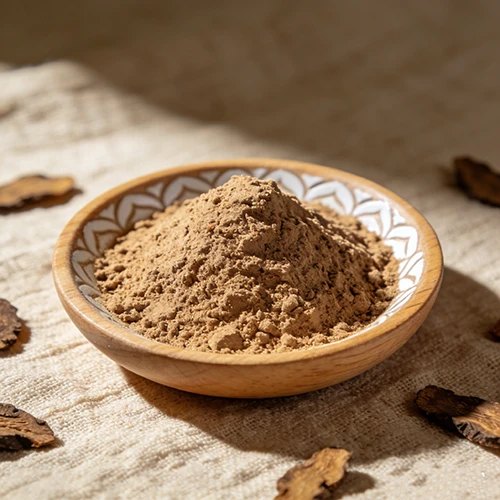
cistanche powder
4. Destination-market regulatory pathways
4.1 European Union: Novel Food approval exists only for C. tubulosa
Under Regulation (EU) 2015/2283, a food ingredient without a significant history of consumption in the EU before 15 May 1997 must obtain Novel Food authorisation before it can be placed on the market. In January 2021, the EFSA Panel on Nutrition, Novel Foods and Food Allergens (NDA) adopted a positive opinion on the water extract of C. tubulosa stems, authorising its use in food supplements at a maximum intake of 2 g/day and in foods for special medical purposes (FSMP) at 100 g/kg, for the adult general population, with pregnant and lactating women excluded.
This is the only cistanche safety opinion on the EFSA register. For an EU-bound shipment, the practical consequences are sharp:
C. tubulosa stem water extract, at or below the authorised use level and with the authorised labelling exclusions, can be sold into the EU supplementary-food market on the back of an existing, public EFSA assessment.
An exporter wishing to ship C. deserticola extract into the EU would need to run its own Novel Food application, with its own toxicological dossier and market surveillance. The cost, timeline, and uncertainty of that route are disproportionate for most mid-sized manufacturers.
Formulators and EU importers will design their labels around the EFSA opinion. Hence, any specification that deviates from "water extract of C. tubulosa stems, 2 g/day maximum, adult non-pregnant/non-lactating" triggers a fresh regulatory review.

cistanche supplement near me
4.2 United States: DSHEA, NDI and the category default
The US places botanical extracts in DSHEA's dietary-supplement framework (1994). Any dietary ingredient first marketed in the US after 15 October 1994 requires a New Dietary Ingredient (NDI) notification; ingredients in legitimate use before that date may rely on grandfathered status. Operationally, three observations matter for an exporter.
First, the Western category has already converged on C. tubulosa. Amazon best-sellers, DTC brands, and major contract manufacturers all reference C. tubulosa, and the supporting scientific literature they cite is predominantly tubulosa-focused. An exporter offering C. deserticola to a US brand must explain why the label, the literature base and the claim architecture would need to change - a sales cost that compounds across every prospect.
Second, modern high-potency extracts - especially standardised echinacoside levels of 10% and above - sit in a grey zone that prudent exporters manage by working with the customer's regulatory counsel on either an NDI filing or a GRAS determination. The exporter should be ready to supply the safety data, manufacturing history, and HPLC method validation that such a filing requires. C. tubulosa's longer Western market history makes that data package easier to assemble.
Third, US buyers audit heavily on third-party COAs, heavy metals (USP <2232>), microbes (USP <2021>), and non-GMO and organic status. A Xinjiang Tamarix-based supply chain that can provide field-level traceability and EU/US organic certificates is structurally aligned with these buyer expectations; an Alxa wild-harvest chain is not.
4.3 Republic of Korea: MFDS health functional food (HFF) framework
Korea's Ministry of Food and Drug Safety (MFDS) administers cistanche-derived materials under the Health Functional Foods Act. A manufacturer wishing to make a functional claim in Korea must either use a standardised ingredient already on the MFDS list, or obtain Individual Recognised Functional Ingredient (IRFI) status, which requires human intervention trials and typically takes at least 120 days of review, with functional data held exclusively by the applicant. HFF products are also excluded from simplified customs clearance and must be declared consignment by consignment under imported-food rules.
The strategic implication for an exporter is not to attempt IRFI self-registration, but to supply Korean HFF brands that are already conducting their own IRFI dossiers. The closer the exporter's specification matches the EFSA-recognised "C. tubulosa stem water extract at 2 g/day" profile, the lower the Korean customer's downstream evidence burden will be. This is another reason C. tubulosa is the easier sell into Korea.
4.4 Japan and Southeast Asia
Japan draws a sharp regulatory line between food and pharmaceutical products. A cistanche extract marketed as food must satisfy the Food Sanitation Act and JAS/ organic requirements; any product making therapeutic claims would require Japanese pharmaceutical manufacturing and marketing licences, which a foreign exporter cannot practically hold. Southeast Asian markets - Singapore, Malaysia, Thailand, Vietnam - are driven largely by ethnic-Chinese tonic demand, where the two species are not well distinguished and price and packaging dominate. Even there, however, the importer will still need the ingredient to appear on the destination country's permitted food-additive or food-ingredient list, and a C. tubulosa water extract with an EFSA dossier is the easier reference document to present.
5. CITES and the export-document reality
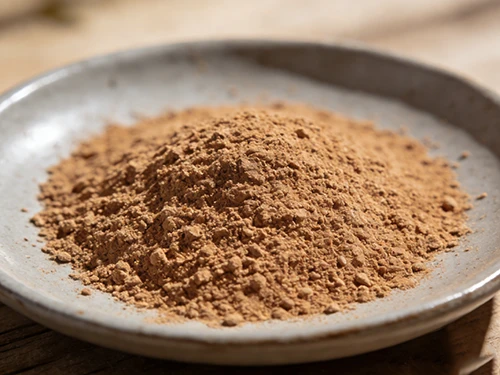
Cistanche tubulosa extract
Click here to view Cistanche Tubulosa Extract Natural Supplement Powder
【Ask for more】 Email:cindy.xue@wecistanche.com / WhatsApp: 0086 18599088692 / WeChat: 18599088692
Both species fall under CITES Appendix II. In practice, this means every commercial shipment, every sample shipment, and every courier parcel must be accompanied by an export permit issued by the Chinese CITES Management Authority (the Endangered Species Import and Export Management Office of the PRC, or its regional offices). Customs enforcement on this point has been visible: Chinese customs have publicly reported interceptions of unpermitted cistanche parcels and passenger baggage, with material seized and consignees cited.
The operational checklist that follows from this is straightforward but non-trivial:
The permit application must state the correct scientific name, the processed form (dried whole tuber, sliced tuber, extract powder), the net weight, the country of destination, and the importer details. A mismatch between the permit and the commercial invoice will cause the shipment to be held.
The exporter must retain traceability records linking the finished batch back to a named plantation or collection area. This is easier to maintain for C. tubulosa, where the Hotan plantation base is already organised around village cooperatives and county-level procurement stations, than for wild-harvested C. deserticola.
For repeated shipments, an annual export quota or a batch-by-batch permit may be appropriate depending on the volume; this should be discussed with the regional CITES office well in advance of the first commercial order.
6. Supply chain, host plant and cost dynamics
Export customers typically require 12-month continuous supply, quarterly re-testing, and a traceability file reaching back to the growing site. The two species sit at very different levels of supply-chain maturity.
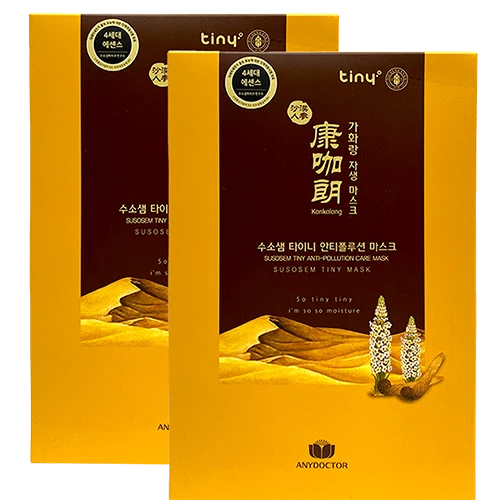
Cistanche facial mask
6.1 C. tubulosa: a scaled, policy-supported Xinjiang plantation base
Public reporting from Hotan prefecture describes a rapidly industrialising plantation sector. Yutian county alone had 240,000 mu (around 16,000 hectares) of inoculated cistanche in 2025, producing roughly 36,000 tonnes of fresh material and generating about RMB 187 million in output. Shaya County, operating a "Haloxylon + cistanche" model, reports 250,000 mu and over 20,000 tonnes of fresh annual yield. Field-level fresh-material procurement prices are reported at RMB 11–13/kg, which, after accounting for drying ratios, leaves a feedstock cost that is compatible with industrial extract manufacturing.
This matters for an exporter because it provides three things simultaneously: (i) enough volume to support multi-year brand contracts; (ii) a chain of custody that runs through county and cooperative stations, which is exactly what Western auditors want; and (iii) alignment with Chinese desert-control and rural-development policy, which brings predictable investment in roads, drying facilities and lab capacity. It also allows a "process in Xinjiang, extract inland or coastal" model, where primary slicing and low-temperature drying happen near the field, and the final extraction happens in a GMP facility - a structure that satisfies both traceability and food-safety expectations.
6.2 C. deserticola: authentic but supply-inelastic
Alxa C. deserticola commands a strong domestic price premium, particularly in the Chinese gift, liquor-steeping and herbal-paste market. From an export standpoint, however, three weaknesses stand out. Wild populations are protected and harvest-restricted under CITES and domestic wildlife law. Planted Haloxylon stands produce lower, slower yields, so supply is inelastic, and prices swing with the domestic tonic market. And the premium itself is anchored to the Chinese domestic narrative of "Alxa dao-di", a story that Western end-customers do not reward. The result is a product that is expensive, variable and poorly aligned with what export buyers actually want to pay for.
7. Formulation, colour and labelling implications
The dominant Western dosage forms are HPMC or gelatin capsules, compressed tablets and stick-pack powders. At the formulation bench, C. tubulosa extract behaves predictably: free-flowing, pigment-controllable to a yellow-brown, and compatible with the standard male-health and nootropic blends. A 500–1000 mg capsule at 20:1 concentration is a straightforward development project.
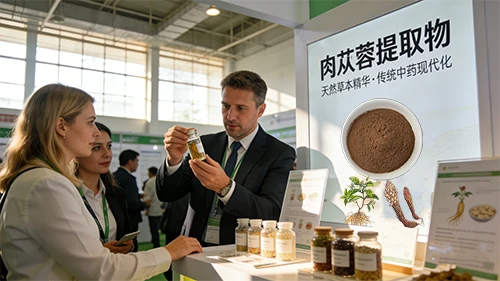
During the Chengdu Wecistanche Bio-tech Co., Ltd. Cistanche tubulosa extract exhibition
C. deserticola extract behaves less predictably: it is sticky, dark, and hygroscopic, and will pull moisture through capsule shells or leach pigment into tablet excipients over shelf life. Where it does have a useful role - in viscous syrups, oral liquids or high-polysaccharide "moistening" preparations - those dosage forms are a small share of the Western supplement market. For an exporter optimising for the largest possible addressable product base, this is a further argument in favour of C. tubulosa.
Labelling reinforces the same point. Western brands sell cistanche with structure-function language - "supports healthy testosterone", "promotes cognitive vitality", "provides antioxidant support" - and each claim is anchored to a literature base that is overwhelmingly about C. tubulosa phenylethanoid glycosides. Re-labelling around C. deserticola would require both a revised botanical name and a revised evidence story, neither of which the brand's regulatory counsel will take on voluntarily.
8. A decision framework by buyer type
The six dimensions above can be compressed into a practical matrix that an export sales team can use in customer conversations.
|
Export scenario |
C. tubulosa extract |
C. deserticola |
Primary rationale |
|
US/EU supplement brands (capsules, tablets, powders) |
Preferred |
Not recommended |
EFSA Novel Food opinion; HPLC specifications; category default |
|
EU food supplements and FSMP |
Only realistic route |
Self-initiated Novel Food application |
EFSA 2021 opinion covers only C. tubulosa stem water extract |
|
US Amazon/DTC brands, echinacoside-standardised lines |
Preferred |
Not recommended |
10%/50% echinacoside specs are market-standard |
|
Korean HFF customers running their own IRFI dossiers |
Preferred |
Requires customer re-assessment |
Specification close to EFSA-accepted profile lowers customer filing cost |
|
Japanese Kampo / clinical channels |
Acceptable as extract input |
Buyer-specified |
Japan has its own botanical traditions; follow the customer's label |
|
Southeast Asian ethnic-Chinese tonic market (crude herb, steeping) |
Price-led |
Buyer-specified |
End-market does not distinguish species; price and packaging drive |
|
Chinese domestic food-and-herb products, tonic wines, pastes |
Acceptable as input |
Preferred |
C. deserticola is on the NHC dual-use list |
|
Premium "Alxa dao-di" storytelling brands |
Not applicable |
Preferred |
Customer pays a regional-origin premium; small volume, high margin |
9. Documentation checklist before signing an export contract
Regardless of species, the following items should be closed before the first commercial contract is signed.
CITES export permit from the Endangered Species Import and Export Management Office, stating scientific name, processed form, net weight, and destination. No permit, no shipment.
Origin and GAP/organic documentation: Xinjiang plantation records, cooperative-level traceability, and any USDA Organic, EU Organic, or JAS certification as a separate annex to the COA.
HPLC assay report: echinacoside and acteoside content per the customer's agreed specification, method referenced to ChP 2020 or the customer's validated method, with retained samples per batch.
Heavy metals and pesticides: per USP <2232> for the US, EU 1881/2006 and the limits accepted in the EFSA opinion for the EU, and MFDS official methods for Korea.
Microbiology: total plate count, yeasts and moulds, coliforms, Salmonella, per USP <2021> or customer spec.
US regulatory package: if the customer requests, co-prepare an NDI or GRAS file; clarify whether the product is grandfathered or a post-1994 dietary ingredient.
EU regulatory package: confirm the product is the "water extract of C. tubulosa stems" covered by the EFSA opinion, at ≤2 g/day, with pregnant and lactating women excluded on the label.
HS classification and rebate: crude herb typically falls under heading 1211.90 (around 9% export rebate); extracts may fall under 1302 (vegetable saps and extracts) or 3004 (medicament preparations). Confirm classification with the customs broker before quoting, to avoid rebate-mismatch surprises.
Label claims: no treatment, cure, or disease-prevention language in the US/EU; structure-function claims must be supported by literature and, in the US, accompanied by the standard FDA disclaimer.