Losing Your Hair? How Cistanche Tubulosa Supports Hair Growth And Follicle Health
Jul 14, 2026
It starts subtly. A few extra strands on the pillow. A thinning at the temples or widening of the part. Then one day you look in the mirror and realize your hair isn't what it used to be. Hair loss is profoundly personal-it can erode confidence, age your appearance, and leave you feeling powerless against a process that seems genetically predetermined. While genetics play a significant role, particularly in androgenetic alopecia (male and female pattern baldness), modern research has revealed that oxidative stress, micro-inflammation, and poor scalp circulation are key co-conspirators. An ancient desert tonic, Cistanche tubulosa, is gaining attention for its multi-targeted ability to support the follicular environment-potentially addressing several drivers of hair loss simultaneously.

The Complex Biology of Hair Loss
Hair growth is a cyclical process. Each follicle cycles through anagen (active growth, lasting 2–7 years), catagen (transition, lasting a few weeks), and telogen (resting, lasting about 3 months). At any given time, about 85–90% of scalp hairs are in anagen. In pattern hair loss, several pathological mechanisms conspire to shorten anagen, prolong telogen, and miniaturize follicles.
In androgenetic alopecia, the primary hormonal driver is dihydrotestosterone (DHT), a potent androgen converted from testosterone by the enzyme 5-alpha-reductase within hair follicles. DHT binds to androgen receptors in genetically susceptible follicles, triggering a cascade that shortens the growth cycle and shrinks follicles until they produce only fine, barely visible vellus hairs. This is the target of finasteride and dutasteride, which inhibit 5-alpha-reductase. But DHT alone doesn't explain everything.
Oxidative stress is now recognized as a major contributor. The hair follicle is one of the most metabolically active structures in the body, with rapidly dividing matrix cells that consume large amounts of oxygen. This creates abundant reactive oxygen species (ROS). In a healthy follicle, endogenous antioxidants neutralize these ROS. But with age, UV exposure, smoking, pollution, and systemic inflammation, oxidative defenses falter. ROS accumulate and directly damage follicular keratinocytes and dermal papilla cells-the command centers of the follicle. This oxidative damage accelerates the transition from anagen to catagen, pushing follicles into premature rest.
Micro-inflammation also plays a critical role. Low-grade inflammatory infiltrates around the follicular bulge-the region housing hair follicle stem cells-are consistently observed in pattern hair loss. Pro-inflammatory cytokines like TNF-α and IL-1β disrupt the normal signaling between dermal papilla cells and stem cells, impairing regeneration. This perifollicular inflammation is not the redness and pain of acute inflammation; it's subtle, chronic, and cumulative.
Finally, microcirculation matters. Hair follicles are fed by a dense capillary network. When scalp blood flow is compromised-due to tension, aging, or endothelial dysfunction-oxygen and nutrient delivery to the follicle declines, further weakening its capacity to produce thick, healthy hair. Minoxidil, one of the two FDA-approved hair loss treatments, works in part by vasodilating scalp vessels and improving blood flow.
An ideal natural hair support agent would therefore inhibit DHT production at the follicular level, protect dermal papilla cells from oxidative stress, calm perifollicular inflammation, and enhance scalp microcirculation. This is precisely the multi-targeted profile emerging for Cistanche tubulosa.

How Cistanche Tubulosa Supports Hair Growth
Cistanche tubulosa contains echinacoside and acteoside, two phenylethanoid glycosides with properties that address all four pillars of follicular health.
1. Inhibiting 5-Alpha-Reductase and Reducing DHT
In vitro studies have demonstrated that acteoside possesses 5-alpha-reductase inhibitory activity, reducing the conversion of testosterone to DHT in cultured dermal papilla cells. By blocking this enzyme locally within the follicle, acteoside may help reduce the androgenic signal that drives follicular miniaturization. This mechanism is similar to that of finasteride but potentially gentler and localized, as the phenylethanoid glycosides in Cistanche are delivered systemically but exert their effects through modulation of cellular enzymes rather than a systemic hormonal blockade.
2. Protecting Dermal Papilla Cells from Oxidative Stress
Dermal papilla cells are the master regulators of the hair cycle. They secrete growth factors that instruct stem cells to proliferate and form new hair shafts. When these cells are damaged by oxidative stress, the entire follicle suffers. Echinacoside is a potent Nrf2 activator, meaning it upregulates the cell's own antioxidant defense systems-superoxide dismutase (SOD), glutathione peroxidase, catalase, and heme oxygenase-1 (HO-1). By boosting these endogenous antioxidants within dermal papilla cells, echinacoside helps protect them from ROS-induced apoptosis and premature senescence. In preclinical models, cells pre-treated with echinacoside showed significantly greater survival and function when exposed to hydrogen peroxide, a standard oxidative stressor, compared to untreated cells.
3. Suppressing Perifollicular Inflammation
As we have explored in depth in a previous article on chronic inflammation, acteoside directly suppresses the NF-κB pathway, the master inflammatory switch. In the context of hair loss, this means reduced production of TNF-α, IL-1β, and IL-6 around the follicular unit. Calming this low-grade inflammation helps preserve the follicular stem cell niche in the bulge region, potentially slowing the rate at which follicles are lost to the miniaturization process. This anti-inflammatory mechanism also helps address the itching, scaling, and sensitivity that often accompany inflammatory scalp conditions.
4. Enhancing Scalp Microcirculation
Hair follicles are highly vascularized and require a steady supply of oxygen and nutrients. As detailed in previous articles on vascular health and erectile function, Cistanche phenylethanoid glycosides support endothelial nitric oxide synthase (eNOS) activity, increasing the production of nitric oxide (NO). NO relaxes vascular smooth muscle, dilating blood vessels and improving blood flow. In the scalp, this enhanced microcirculation means better delivery of the amino acids, vitamins, and minerals that hair follicles need for robust keratin synthesis, and better removal of metabolic waste products.
5. Supporting Overall Nutritional Status for Hair Growth
Hair is a non-essential tissue from the body's perspective-when resources are scarce, hair is the first to be sacrificed. Cistanche's broad tonic effects-its ability to support blood production, adrenal function, and energy metabolism-contribute to an internal environment where the body can afford to invest in hair growth. This is particularly relevant for postpartum hair loss, post-illness shedding, and the diffuse thinning associated with chronic fatigue and nutrient depletion. Traditional Chinese medicine explicitly links hair health to the quality of "Kidney essence" and "Blood," both of which Cistanche is renowned for nourishing.
A comprehensive 2022 review in Frontiers in Pharmacology catalogs the antioxidant, anti-inflammatory, vascular-protective, and systemic tonic properties of Cistanche tubulosa, providing a strong scientific foundation for its application in conditions involving oxidative stress and microcirculatory compromise-both of which are central to hair loss. (Frontiers in Pharmacology review on Cistanche tubulosa)
The Traditional Connection: "The Kidneys Manifest in the Hair"
In classical Chinese medicine, hair is considered the "surplus of the blood" and a direct reflection of Kidney essence. The saying goes: "The Kidneys govern the bones, produce marrow, and their brilliance manifests in the hair." When Kidney essence is abundant-typically in youth-hair is thick, lustrous, and firmly rooted. When Kidney essence wanes-with age, overwork, illness, or childbirth-hair grays, thins, and falls. Cistanche has been a cornerstone herb for "nourishing the Kidney essence" for over two thousand years. It was prescribed for premature graying, hair loss, and dry, brittle hair, often combined with herbs like He Shou Wu (Fo-Ti) and Dong Quai (Angelica sinensis) in formulas designed to "enrich the blood and nourish the follicles." This ancient clinical observation-that a Kidney tonic can restore hair health-is now finding molecular validation in the herb's ability to inhibit 5-alpha-reductase, protect dermal papilla cells, and enhance scalp circulation.

How to Integrate Cistanche for Hair Health
Hair growth is a slow process. Follicles operate on a timeline of months, not days. Any intervention for hair loss must be sustained for at least three to six months to evaluate its effect. A daily dose of 400–600 mg of a standardized Cistanche tubulosa extract, providing consistent levels of acteoside and echinacoside, is a sensible evidence-informed range. It can be taken with a meal to enhance absorption.
Cistanche pairs well with other evidence-based hair-supportive nutrients: saw palmetto provides additional 5-alpha-reductase inhibition; biotin and zinc support keratin synthesis; vitamin D (which many hair loss sufferers are deficient in) modulates the hair cycle; and iron is critical for those with deficiency-related shedding. The extract is not a replacement for minoxidil or finasteride in individuals with advanced androgenetic alopecia, but it may serve as a complementary botanical layer, addressing the oxidative, inflammatory, and circulatory dimensions that these drugs do not fully target.
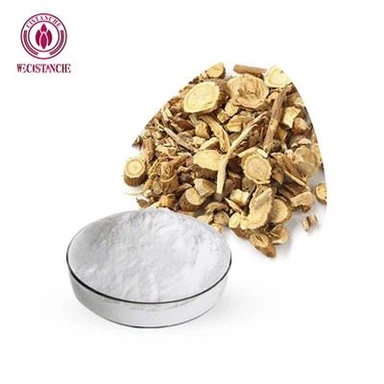
Our FollicleGuard Cistanche Extract is sourced from authentic Cistanche tubulosa and standardized for a high concentration of the phenylethanoid glycosides that research links to follicular protection and scalp health. Each batch is third-party tested for purity, ensuring you are giving your hair the cleanest possible support.
Safety and When to See a Dermatologist
Cistanche tubulosa is well tolerated and safe for long-term use. It does not cause sexual side effects, mood changes, or liver enzyme elevations associated with finasteride. However, hair loss can sometimes indicate underlying medical conditions-thyroid disorders, autoimmune disease (alopecia areata), or iron deficiency anemia-that require specific diagnosis and treatment. Any sudden, patchy, or scarring hair loss warrants a dermatologist's evaluation. For the millions navigating the slow thinning of pattern hair loss or the diffuse shedding of stress and postpartum, this desert root offers a gentle, scientifically grounded addition to a comprehensive hair preservation strategy.
Supportive Service Of Wecistanche-For more details about cooperation
Business contact: goujinsong@wecistanche.com