Cistanche And The Desert Herb Formula For Constipation: What Modern Science Reveals About A Natural Path To Digestive Health
Oct 23, 2026
Introduction: When "Regularity" Is Not So Regular
There is a subject that almost everyone deals with at some point in life, yet almost nobody likes to talk about: constipation. It is uncomfortable, frustrating, and often quietly endured. But constipation is far more than a minor inconvenience. For millions of people - especially as they grow older - it becomes a recurring struggle that affects energy, mood, sleep, and overall quality of life. In some cases, it can even be linked to more serious health concerns.
For centuries, traditional Chinese medicine has offered a different approach to this problem. Instead of reaching for a harsh laxative, herbal practitioners turned to gentle, nourishing plants that support the digestive system from within. Among the most trusted of these is Cistanche - the same "desert ginseng" that modern research has been investigating for brain protection. Now, a new line of study suggests Cistanche may also have a remarkable gift for the digestive tract.
This article translates that research into plain language. We will look at what constipation really is, meet the four natural ingredients at the heart of a traditional formula, walk through what scientists found when they tested it, and explain - step by step - how these humble desert plants may help restore healthy, comfortable bowel function.
Part One: The Quiet Epidemic of Constipation
More Common Than You Think
Constipation is one of the most common digestive complaints in the world. According to large-scale reviews, about one in five older adults struggles with it, and women tend to be affected more often than men. The numbers are striking: when researchers looked at older populations across the globe, they found a prevalence of roughly 19 percent. That means nearly one in every five people over the age of sixty deals with persistent constipation.
But constipation is not just an "old person's problem." Busy lifestyles, low-fiber diets, dehydration, stress, certain medications, and hormonal changes can all contribute to it at any age.
What Constipation Actually Feels Like
The typical picture of constipation includes:
Infrequent bowel movements,
Difficulty or straining when passing stool,
Hard, dry, pellet-like stools,
A feeling that the bowel is not fully emptied.
Beyond the obvious discomfort, chronic constipation can lead to bloating, abdominal pain, loss of appetite, and a general sense of sluggishness. Over time, it can disturb the whole rhythm of daily life - interfering with work, sleep, and even social activity.
Why It Deserves Serious Attention
Constipation is sometimes dismissed as trivial, but it carries real risks. The straining it causes can raise pressure in ways that matter for people with certain heart conditions. It is associated with an increased risk of cardiovascular events in some studies, and it can aggravate existing gastrointestinal disorders. For older adults, severe constipation can even contribute to dangerous complications.
Perhaps most importantly, constipation tends to be recurrent. Many people find themselves caught in a cycle: a laxative provides temporary relief, but the bowel becomes dependent, and the problem returns - sometimes worse than before. This is why there is growing interest in approaches that treat the underlying causes rather than simply forcing a bowel movement.
Part Two: Meeting the Four Ingredients
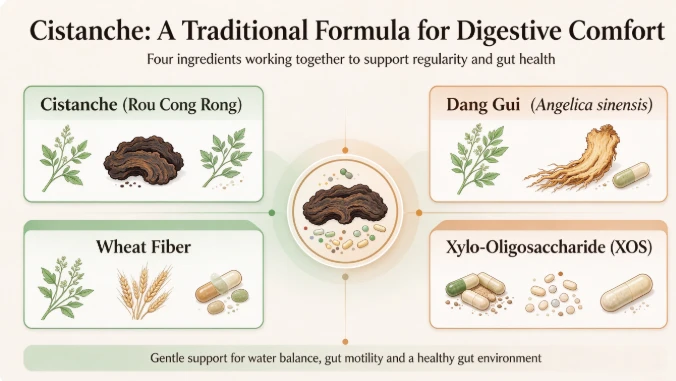
The study at the heart of this article tested a formula made from four carefully chosen ingredients. Each one brings something different to the table, and together they aim to address constipation from several angles at once.
Ingredient One: Cistanche (Rou Cong Rong)
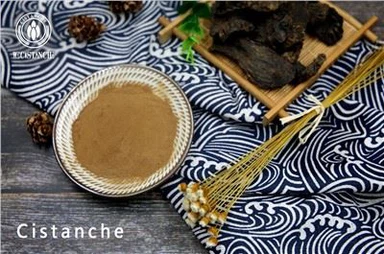
You have met Cistanche before if you have read about the "desert ginseng." It is a parasitic plant that grows in the deserts of northern China, and its thick stem has been used in Chinese medicine for centuries. In digestive health, Cistanche has traditionally been used as a gentle, lubricating tonic - something that softens stool and supports healthy bowel movement without harsh stimulation.
Modern studies have shown that Cistanche can help regulate water channels in the intestine and support the movement of the bowel, which is exactly the kind of action that matters for constipation. Its active compounds - including a family of molecules called phenylethanoid glycosides - appear to support the health of the digestive lining and the cells that keep the gut moving.
Ingredient Two: Dang Gui (Angelica Sinensis)
Dang Gui, also called "female ginseng," is one of the most famous herbs in Chinese medicine. Traditionally used to nourish the blood and support circulation, it is also a classic ingredient in formulas designed to relieve constipation. Research suggests Dang Gui works partly by influencing the very same water channels in the colon that Cistanche affects - helping the body manage fluid in a way that keeps stool from drying out.
Ingredient Three: Wheat Fiber
This ingredient needs little introduction. Wheat fiber is rich in both insoluble and soluble dietary fiber - the structural "roughage" that gives stool bulk and the gelling fiber that helps hold water. Fiber is the single most recommended dietary remedy for constipation in mainstream medicine, and it works by making stool larger, softer, and easier to pass. In this formula, wheat fiber plays the role of the structural helper.
Ingredient Four: Xylo-Oligosaccharide (XOS)
Xylo-oligosaccharides are a type of prebiotic - a compound that feeds the beneficial bacteria living in our gut. A healthy, balanced gut microbiome supports regular bowel movements in several ways: the good bacteria help ferment fiber into substances that stimulate the gut, they influence inflammation, and they contribute to a healthy digestive environment. XOS is a low-calorie sweet-tasting oligosaccharide that has been studied for its ability to support gut flora and soften stool.
How the Four Work Together
The traditional logic of the formula is to "treat the root and the branch together." Cistanche and Dang Gui address the body's internal balance and fluid handling. Wheat fiber adds bulk and softness. XOS nourishes the gut bacteria that keep everything humming. Together, they aim to support the entire system rather than forcing a single, temporary result.
Part Three: Understanding Why Constipation Happens
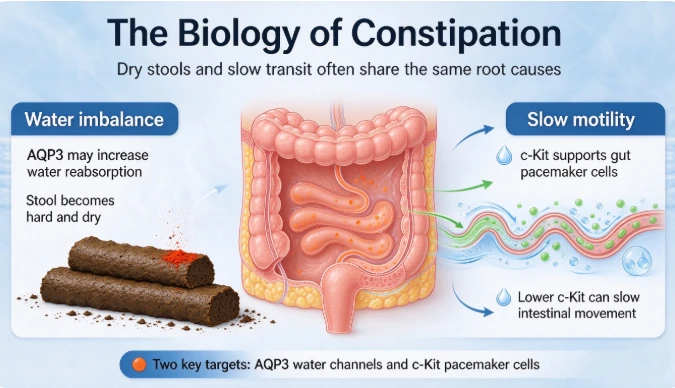
To appreciate what this formula does, it helps to understand the biology behind constipation. Two processes in particular are central: water management and gut movement.
The Problem of Water: A Stool That Gets Too Dry
A healthy stool is mostly water. The body constantly moves fluid into and out of the intestine. In the colon - the final section of the digestive tract - the body normally absorbs water from the passing contents to concentrate waste before it is eliminated.
This is where a group of proteins called aquaporins comes in. Aquaporins are essentially water channels embedded in cell membranes - tiny pores that let water flow in and out of cells quickly and selectively. Think of them as the plumbing valves of the intestine.
One particular aquaporin, called AQP3, is highly active in the colon. When AQP3 is overexpressed - when the body makes too much of it - the colon absorbs too much water, and the stool dries out. The result is exactly what every constipated person knows too well: hard, dry, difficult-to-pass stool.
The Problem of Movement: A Gut That Slows Down
The second key issue is motility - the movement of the intestine that pushes waste along. The intestine does not just sit there; it contracts and relaxes in waves, propelling contents forward. This movement depends on specialized cells called interstitial cells of Cajal (ICCs). These are sometimes called the "pacemakers" of the gut because they generate the rhythmic electrical signals that drive intestinal muscle contractions.
You can think of the ICCs as the gut's conductor, setting the rhythm for the muscles to follow. If these cells are damaged or reduced in number, the gut loses its pace, and transit slows down. Waste sits in the colon longer, more water is absorbed, and constipation takes hold.
A protein called c-Kit is a marker closely tied to these pacemaker cells. c-Kit is a receptor on the surface of ICCs, and its activity is linked to the health, survival, and proper function of these cells. When researchers want to know whether the gut's pacemaker cells are doing well, they often look at c-Kit levels.
Putting It Together
Constipation, then, is often a story of two failures happening together:
The water gate is too open - too much AQP3 pulls water out of the stool, drying it out.
The pacemaker is too quiet - reduced c-Kit means weaker gut movement, so waste lingers too long.
An effective natural approach, therefore, should ideally address both: restore balanced water handling and revive the gut's rhythm.
Part Four: The Study in Plain Language
How Scientists Created a "Realistic" Constipation
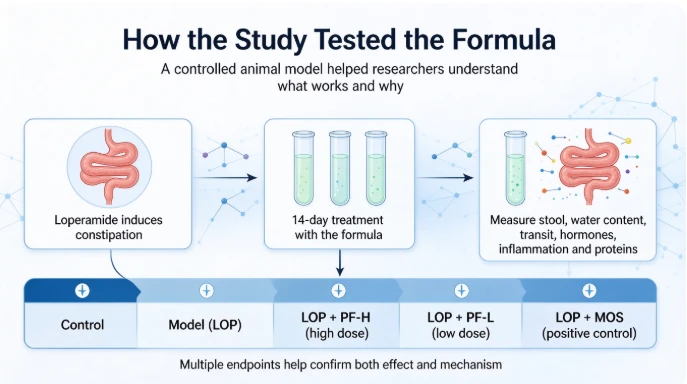
To test the formula, researchers needed a reliable animal model of chronic constipation. They used a drug called loperamide, which is commonly used (in humans) to slow diarrhea. Given to mice, loperamide artificially slows gut movement and reduces intestinal secretion - essentially mimicking the slow-transit constipation that many people experience.
This created a clear picture: untreated mice developed hard, dry, pellet-like stools, lost water from their feces, and showed slower gut transit - all the hallmarks of constipation.
The Experimental Groups
The mice were divided into several groups:
Control group: healthy mice given only water.
Model group (LOP): mice with induced constipation, given no treatment.
High-dose compound group (LOP + PF-H): constipated mice given the formula at a high dose.
Low-dose compound group (LOP + PF-L): constipated mice given the formula at a lower dose.
Positive control group (LOP + MOS): constipated mice given a standard prescription drug (mosapride), to serve as a reference for how well a conventional treatment works.
The doses were set in relation to a recommended human intake: the high dose was 30 times the recommended human amount, and the low dose was 5 times, adjusted for the animals' body size. Treatment lasted for 14 days.
What the Researchers Measured
Over the treatment period, the researchers tracked:
Stool appearance - did the feces look healthy, or hard and pellet-like?
Fecal water content - how much water was in the stool? (Higher is better.)
Intestinal transit - how quickly food and waste moved through the small intestine? They measured this using a charcoal "ink" that travels along the gut.
Gastrointestinal hormones - levels of motilin (MTL) and gastrin (GAS), two hormones that stimulate gut movement and stomach function.
Inflammatory markers - levels of TNF-α and IL-1β, two substances that signal inflammation.
Colon tissue health - examined under a microscope after staining.
AQP3 and c-Kit levels - the water channel and pacemaker markers, using two independent techniques.
This comprehensive design allowed the researchers to see not only whether the formula worked, but how it worked.
Part Five: What the Study Found
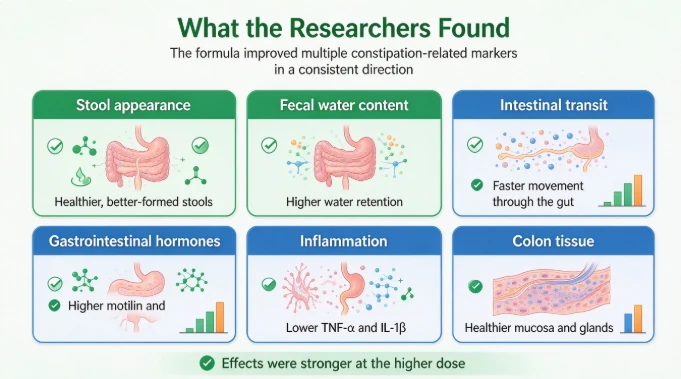
The results were consistent and encouraging. Here is what happened.
The Stool Returned to Normal
First, and most visibly, the formula improved the appearance of the mice's stool. While the constipated model mice produced small, hard, dry, bead-like pellets that grew worse over time, the mice receiving the formula produced healthier, better-formed feces. Notably, none of the treated mice experienced diarrhea - the treatment was gentle, not overcorrecting in the opposite direction.
Water Content Rose
Measuring the actual water in the feces confirmed the visual picture. The constipated mice had significantly lower fecal water content - their stool was drying out. The mice given the compound had higher fecal water content, especially at the higher dose. In other words, the formula helped the bowel hold on to the water that keeps stool soft.
Gut Movement Speeded Up
The charcoal transit test showed that the formula improved the movement of the small intestine. The constipated mice had much slower transit - the "ink" traveled less far in a set time. The treated mice, particularly at the higher dose, showed significantly faster transit. The gut was moving again, at a healthier rhythm.
Digestive Hormones Got a Boost
Two hormones that drive gut activity - motilin and gastrin - were abnormally low in the constipated mice. After treatment with the compound, especially at the higher dose, both hormones rose significantly. This is meaningful because motilin and gastrin are the signals that tell the stomach and intestine to get moving. Restoring them is a sign that the gut's engine was being switched back on.
Inflammation Calmed Down
Constipation is associated with low-grade inflammation in the gut. The constipated mice had elevated levels of inflammatory markers TNF-α and IL-1β. Treatment with the formula brought these levels down significantly, especially at the higher dose. This suggests the formula was helping soothe the irritated gut environment - not just forcing stool out, but improving the health of the tissue underneath.
The Colon Itself Looked Healthier
Under the microscope, the constipated mice showed damage to the colon lining - the protective mucosa was injured, and the intestinal glands were shrunken and disorganized. In the treated mice, this damage was visibly improved: the mucosa looked healthier, and the glands were better preserved. The formula was protecting the very tissue of the gut.
The Water Gate Was Rebalanced
This is where the mechanism becomes clear. In the constipated mice, the water channel AQP3 was significantly elevated - remember, more AQP3 means more water is sucked out of the stool. After treatment, AQP3 levels dropped significantly back toward normal. The overactive water gate was being closed down, which explains why the stool held onto more water.
The Pacemaker Was Revived
Finally, the pacemaker marker c-Kit told the other half of the story. In the constipated mice, c-Kit levels were significantly reduced - the gut's rhythm-setting cells were suffering. Treatment raised c-Kit levels back up, indicating that the health of the gut's pacemaker cells was being restored. This helps explain the improved gut movement.
A Clear Dose–Response Relationship
Across all these measures, the higher dose of the formula generally produced stronger effects than the lower dose. This dose–response relationship is a good sign in research - it means the effects are genuinely linked to the treatment, not random.
Part Six: The Mechanism, Explained Simply
Let us now pull all the threads together into one clear story.
The Two Switches
The entire mechanism can be understood through two "switches" that the formula appears to help reset:
Switch One: The Water Gate (AQP3)
Too much AQP3 → colon over-absorbs water → stool dries out.
The formula lowers AQP3 → less water is pulled from the stool → stool stays soft and moist.
Switch Two: The Pacemaker (c-Kit / Interstitial Cells of Cajal)
Too little c-Kit → gut pacemaker cells are weak → gut moves slowly.
The formula raises c-Kit → pacemaker cells recover → gut movement speeds up.
The Supporting Cast
Two other processes reinforce these switches:
Gastrointestinal Hormones (MTL, GAS): These are the "start signals" for the digestive engine. The formula restores them, helping the stomach and intestine work at a normal rhythm.
Inflammation (TNF-α, IL-1β): Chronic inflammation damages the gut lining and can harm the pacemaker cells. By lowering inflammation, the formula creates a healthier environment in which the gut can recover - both its tissue and its movement.
The Complete Picture
So the formula works like this:
The four ingredients deliver fiber, prebiotics, and the traditional herbs' active compounds.
This helps calm inflammation in the gut.
A healthier gut environment allows the pacemaker cells (c-Kit) to recover, restoring normal movement.
The herbs help rebalance the water channel (AQP3), so the colon stops over-absorbing water.
Normal movement plus well-hydrated stool means comfortable, regular bowel movements - without harsh stimulation and without diarrhea.
In short, the formula does not simply force a bowel movement. It helps restore the gut's own ability to manage water and movement - treating the underlying problem rather than masking the symptom.
Part Seven: Why This Matters Beyond the Laboratory
A Gentler Alternative to the Laxative Cycle
One of the most important messages from this research is that a natural, multi-ingredient approach may offer a gentler path than repeatedly using harsh laxatives.
Many people who suffer from chronic constipation end up in a frustrating cycle. A strong laxative provides relief, but the bowel can become reliant on it, and the underlying problem - slow transit, over-absorption of water - remains untouched. The formula studied here addressed both the movement and the water management directly, and it did so without causing diarrhea. That is exactly the profile people hope for in a long-term digestive aid.
The Prebiotic + Fiber Advantage
The inclusion of wheat fiber and xylo-oligosaccharides is worth emphasizing. Fiber and prebiotics are not "drugs" - they are the kind of support that nourishes the gut in a sustainable way. Fiber gives the stool bulk, while prebiotics feed the beneficial bacteria that help keep the digestive environment healthy. This aligns the traditional formula with the best modern understanding of gut health: a healthy gut needs both structural fiber and a balanced microbiome.
Relevance to Everyday Digestive Health
Even for people who do not have severe constipation, the principles here are valuable. Supporting healthy water balance in the gut, keeping the pacemaker cells strong, and managing low-grade inflammation are all relevant to comfortable digestion at any age. A formula that does these things gently could be useful for anyone prone to sluggish digestion, hard stools, or the discomfort of occasional irregularity.
Part Eight: A Note on Quality - Choosing Cistanche and Gut-Health Products
If this research interests you, the practical question is how to find products that deliver real benefits. Several factors matter.
1. Standardization of Active Compounds
The traditional herbs in such formulas contain complex mixtures. For a product to be reliable, the manufacturer should be able to tell you what is in it - ideally with measurable levels of key active compounds (for Cistanche, these include echinacoside and acteoside). Standardized extracts with published analysis are more trustworthy than vague "herbal blend" labels.
2. Quality of the Raw Herbs
Cistanche species differ in their content of active compounds, and so does the quality of the raw material depending on where and how it was grown and harvested. Reputable suppliers source their herbs carefully and verify them against official standards.
3. Transparency and Testing
Look for products with third-party testing and clear Certificates of Analysis. A company that openly publishes its assay data is demonstrating that what's on the label is actually in the product.
4. A Balanced Formula
As this study shows, the value often comes from how ingredients work together. A thoughtful combination of traditional herbs, dietary fiber, and prebiotics may be more effective than a single ingredient alone - because constipation is a multi-factor problem.
For anyone interested in natural digestive health - whether for personal use or for building a product line - these are the standards that separate a meaningful supplement from a marketing claim.
Part Nine: An Honest Look at Limitations and Safety
A responsible article should also be clear about what this research does and does not show.
What This Study Shows
A carefully controlled animal study found that a four-ingredient formula (Cistanche, Dang Gui, wheat fiber, and xylo-oligosaccharides) improved constipation in mice.
It reduced stool dryness, improved gut movement, lowered inflammation, restored digestive hormones, repaired colon tissue, rebalanced the water channel AQP3, and revived the pacemaker marker c-Kit.
The effects showed a clear dose–response relationship and were consistent across multiple independent measurements.

What It Does Not Yet Show
This was a study in mice, not humans. While animal models are the standard first step in medical research, human results can differ.
It does not establish a specific dose for humans. The doses tested were multiples of a recommended human intake, and translating animal doses to people requires careful clinical research.
It does not claim to cure any disease. It describes the relief of constipation in an experimental model.
General Safety Notes
This formula includes common food-grade ingredients (Cistanche and Dang Gui are recognized as medicinal-food plants in China, and wheat fiber and prebiotics are ordinary dietary components). Still, individual responses vary.
Pregnant or nursing women, and people with chronic conditions or who take medications, should consult a health-care professional before using herbal products.
A healthy, high-fiber diet and adequate hydration remain the foundation of digestive health; supplements should complement, not replace, a good diet.
Persistent or severe constipation can sometimes signal a more serious condition, and anyone with worrying symptoms should see a doctor.
This honest framing matters. It builds trust, and it keeps the content responsible - which is also better for the reputation of any brand publishing it.
Part Ten: The Big Picture - A Desert Plant, A Modern Answer
There is something quietly elegant about this story. A plant that has thrived for millennia in one of the harshest environments on Earth - a place where water is scarce and survival is hard - turns out to carry compounds that help the human body manage its own water balance and keep things moving smoothly.
Cistanche has long been called the "desert ginseng." For centuries, traditional healers recommended it for nourishment and vitality. Now, modern research is explaining, molecule by molecule, why. Whether it is protecting brain cells after a stroke through the Nrf2 pathway, or helping the gut rebalance its water channels and revive its pacemaker cells, Cistanche keeps appearing as a remarkably versatile natural ally.
And this particular study adds an important lesson beyond Cistanche itself: the best natural solutions are often combinations. Fiber for bulk, prebiotics for the microbiome, and traditional herbs for the deeper regulation of the gut - together, they address a problem that is itself multi-layered. Constipation is not a single failure; it is a failure of water management, movement, and tissue health all at once. So it makes sense that the solution should be just as multi-layered.

Conclusion: What This Means for You
Let us bring everything together into a few clear takeaways.
Constipation is common and worth taking seriously. It affects a large share of the population, especially older adults, and can be linked to broader health risks.
The biology is understandable. Two central problems - too much water being pulled out of the stool (via the AQP3 water channel) and a sluggish gut (due to weakened pacemaker cells marked by c-Kit) - underlie most constipation.
A natural formula can address both. A combination of Cistanche, Dang Gui, wheat fiber, and xylo-oligosaccharides was shown in an animal study to soften stool, speed gut movement, lower inflammation, restore digestive hormones, repair colon tissue, rebalance AQP3, and revive c-Kit.
It works with the body, not against it. The formula improved function without causing diarrhea - it helped restore the gut's own ability to manage water and movement.
Quality matters. For anyone using Cistanche or gut-health products, standardized, transparently tested products with meaningful amounts of active compounds are the ones worth trusting.
Be responsible. This is early-stage research in animals. For real digestive concerns, combine supplements with a healthy, high-fiber diet, good hydration, and professional medical guidance.
The desert ginseng has quietly supported human health for centuries. With every study, modern science is revealing exactly how - and the story of constipation relief is one more chapter worth sharing.
Disclaimer: This article is for general educational and informational purposes only and is not medical advice. It describes scientific research findings and does not claim to diagnose, treat, cure, or prevent any disease. Always consult a qualified health-care professional before using any supplement, especially if you have a medical condition or take medications.