Sharper Memory, Naturally: How Cistanche Tubulosa Supports Cognitive Function And Recall
Jul 20, 2026
You forget a name seconds after hearing it. You walk into a room and can't remember why. You struggle to recall a word that sits stubbornly on the tip of your tongue. Memory lapses like these are often dismissed as "senior moments" or blamed on a busy life, but they represent a real, measurable decline in cognitive function that begins far earlier than most people realize. By age 40, the brain's processing speed and memory consolidation efficiency have already begun a slow descent. By 60, significant changes in hippocampal volume and neurotransmitter function are detectable. The question is not whether cognitive decline will happen, but whether we can slow it, delay it, or mitigate its impact. An ancient desert herb, Cistanche tubulosa, is emerging as one of the most promising natural agents for memory support-not by providing a temporary stimulant boost, but by targeting the fundamental neurobiological pathways that encode, store, and retrieve memories.

The Neurobiology of Memory Formation
Memory is not a single function but a collection of systems distributed across multiple brain regions. Declarative memory-the conscious recall of facts and events-depends critically on the hippocampus, a seahorse-shaped structure deep within the temporal lobe. When you learn a new name, a new fact, or a new route, the hippocampus binds together the sensory, contextual, and emotional components of that experience and, over time, consolidates them into stable, long-term cortical representations. This process of memory consolidation is the biological basis of learning.
At the synaptic level, memory formation relies on long-term potentiation (LTP) , a lasting strengthening of connections between neurons that fire together. LTP requires the coordinated action of several molecular players. Glutamate, the brain's primary excitatory neurotransmitter, activates NMDA receptors, allowing calcium to enter the postsynaptic neuron. This calcium influx triggers a cascade that ultimately increases the number and sensitivity of AMPA receptors at the synapse, making the neuron more responsive to future stimulation. This is the physical trace of a memory.
The entire process is supported by brain-derived neurotrophic factor (BDNF) , a protein often described as "fertilizer for the brain." BDNF promotes the survival of existing neurons, encourages the growth of new synaptic connections, and is essential for LTP. High BDNF levels are associated with robust memory and cognitive resilience; low BDNF is a hallmark of cognitive decline and Alzheimer's disease.
Simultaneously, the cholinergic system plays a critical role. Acetylcholine is the neurotransmitter that modulates attention, learning, and memory encoding. In Alzheimer's disease, cholinergic neurons in the basal forebrain degenerate, and acetylcholine levels plummet. This is why acetylcholinesterase inhibitors-drugs that prevent the breakdown of acetylcholine-are a mainstay of Alzheimer's treatment. They preserve the chemical signal necessary for memory circuits to function.
A botanical that could simultaneously support the cholinergic system, boost BDNF expression, protect hippocampal neurons, and quench the oxidative stress that erodes synaptic function would be a uniquely comprehensive memory-support agent. The phenylethanoid glycosides in Cistanche tubulosa-echinacoside and acteoside-are showing this exact multi-targeted profile.
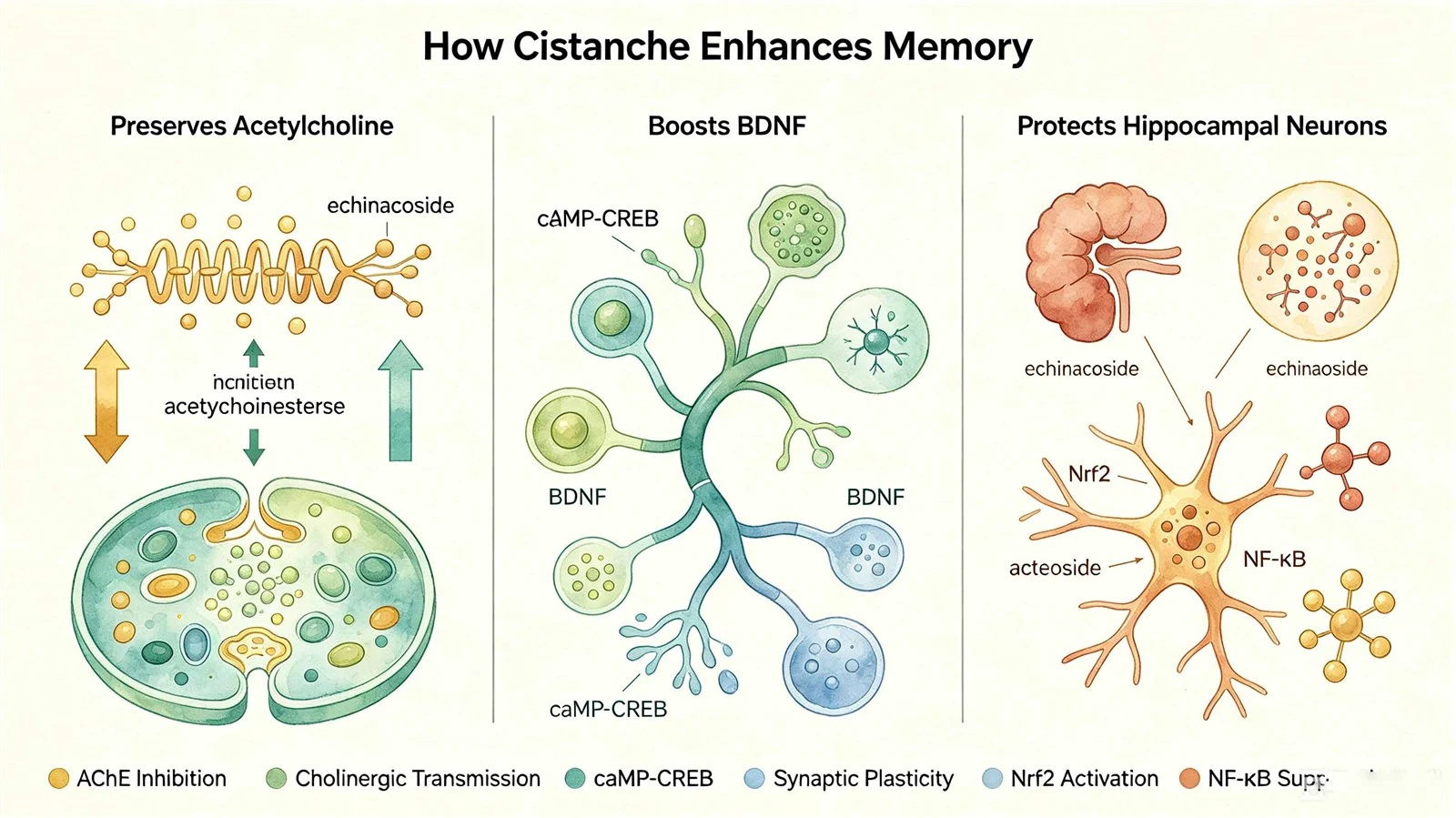
How Cistanche Tubulosa Enhances Memory
1. Preserving Acetylcholine by Inhibiting Acetylcholinesterase
Acetylcholinesterase (AChE) is the enzyme that breaks down acetylcholine in the synaptic cleft, terminating its signal. In the aging brain, AChE activity increases, reducing the availability of acetylcholine for memory encoding. Echinacoside has been shown in multiple preclinical studies to inhibit AChE activity, particularly in the hippocampus. By slowing the enzymatic breakdown of acetylcholine, it extends the neurotransmitter's half-life and enhances cholinergic transmission. This mechanism is directly analogous to that of prescription Alzheimer's drugs like donepezil and rivastigmine, though echinacoside acts with a gentler, modulatory profile.
In animal models of memory impairment-including scopolamine-induced amnesia (which blocks cholinergic signaling) and aged rodents-echinacoside treatment significantly improved performance on the Morris water maze (a test of spatial memory), passive avoidance tests (a measure of associative memory), and novel object recognition (a test of recognition memory). The behavioral improvements were accompanied by reduced AChE activity and preserved acetylcholine levels in the hippocampus, confirming the cholinergic mechanism.
2. Boosting BDNF and Synaptic Plasticity
As detailed in our article on neuroprotection, echinacoside upregulates BDNF expression by activating the cAMP-CREB signaling pathway. This is the same pathway through which exercise, enriched environments, and successful antidepressants enhance cognitive function. Increased BDNF promotes synaptic plasticity-the physical remodeling of synapses that underlies learning-and supports the survival of neurons in the hippocampus, the region that shrinks with age and Alzheimer's disease. A study published in Phytomedicine demonstrated that echinacoside protected hippocampal neurons from corticosterone-induced damage and significantly increased BDNF mRNA expression, directly counteracting the neurotoxic effects of chronic stress on memory circuits.
3. Protecting Hippocampal Neurons from Oxidative and Inflammatory Damage
Memory decline is driven in large part by oxidative stress and neuroinflammation in the hippocampus. Reactive oxygen species (ROS) damage neuronal membranes, impair mitochondrial function, and trigger apoptosis. Microglial cells-the brain's immune cells-become chronically activated with age, releasing pro-inflammatory cytokines (TNF-α, IL-1β, IL-6) that interfere with LTP and promote neurodegeneration.
Echinacoside is a potent Nrf2 activator, upregulating the brain's own antioxidant enzymes-superoxide dismutase, glutathione peroxidase, heme oxygenase-1-that neutralize ROS before they can damage memory circuits. Acteoside, as a potent NF-κB inhibitor, suppresses microglial activation and reduces the inflammatory cytokine load in the hippocampus. Together, these two active ingredients create a protective environment in which neurons can form and maintain memories without the constant erosive pressure of oxidative and inflammatory stress. A comprehensive 2022 review in Frontiers in Pharmacology catalogs these neuroprotective, cholinergic, and anti-inflammatory mechanisms, confirming their relevance to cognitive function and memory. (Frontiers in Pharmacology review on Cistanche tubulosa)
The Active Ingredients Driving Memory Support
The memory-enhancing effects of Cistanche are concentrated in its two signature active ingredients: echinacoside and acteoside (verbascoside). Echinacoside is the primary AChE inhibitor and BDNF activator; acteoside is the primary NF-κB suppressor and anti-inflammatory agent. Both cross the blood-brain barrier and accumulate in brain tissue, particularly the hippocampus. A standardized extract containing 20–40% total phenylethanoid glycosides is necessary to deliver the concentrations that research associates with cognitive benefit. The dosage range supported by evidence is 400–600 mg of such an extract daily, providing approximately 80–240 mg of total phenylethanoid glycosides.
Traditional Roots: Nourishing the "Sea of Marrow"
In classical Chinese medicine, memory and cognitive function are governed by the Kidneys. The brain is referred to as the "Sea of Marrow," and marrow is produced from Kidney essence. When Kidney essence is abundant-as in youth-the Sea of Marrow is full, and memory is sharp, thinking is clear, and learning is effortless. When Kidney essence wanes with age, overwork, or illness, the Sea of Marrow becomes depleted, leading to forgetfulness, dulled thinking, and the cognitive decline of old age.
Cistanche tubulosa has been the premier Kidney essence tonic for over two thousand years, prescribed specifically to "replenish the essence, nourish the marrow, and sharpen the mind." Ancient texts describe its use for "forgetfulness, scattered thoughts, and the inability to concentrate"-symptoms that map directly onto modern complaints of age-related memory decline and brain fog. This traditional framework, once considered purely philosophical, now finds molecular validation in the herb's ability to preserve acetylcholine, boost BDNF, and protect hippocampal neurons-the very "marrow" of memory.
How to Integrate Cistanche for Memory Support
Cognitive protection is a long-term endeavor. Memory formation and synaptic remodeling operate on a timeline of weeks to months, and meaningful, lasting improvements require consistent, sustained support. A daily dose of 400–600 mg of a standardized Cistanche tubulosa extract, taken with breakfast, provides the phenylethanoid glycosides needed to support cholinergic function, synaptic plasticity, and hippocampal health. Unlike stimulant-based cognitive enhancers, Cistanche does not produce an acute "rush" of focus; rather, it works cumulatively, gradually strengthening the neural infrastructure of memory.
The extract pairs well with other evidence-based cognitive support strategies: regular aerobic exercise (which potently boosts BDNF), a Mediterranean or MIND diet rich in polyphenols and omega-3 fatty acids, adequate sleep (during which memory consolidation occurs), and cognitive stimulation through learning, reading, or social engagement. Cistanche is not a replacement for prescribed Alzheimer's medications in diagnosed patients, but it addresses the same cholinergic and neurotrophic pathways through a gentler, botanical mechanism.
Our MemoryGuard Cistanche Extract is sourced from authentic Cistanche tubulosa and standardized for a high concentration of echinacoside and acteoside-the two active ingredients that research links to AChE inhibition, BDNF upregulation, and hippocampal protection. Each batch is third-party tested for purity and potency, ensuring you are providing your neurons with clean, reliable, research-grade support.
Safety and Realistic Expectations
Cistanche tubulosa is well tolerated with a centuries-long history of safe use. It does not cause the gastrointestinal side effects, muscle cramps, or bradycardia associated with prescription cholinesterase inhibitors. It is not habit-forming, does not produce withdrawal symptoms, and can be safely used long-term. However, memory loss that is progressive, severe, or accompanied by significant functional decline warrants a thorough neurological evaluation. This botanical is a supportive, preventive, and complementary tool for age-related memory concerns, not a substitute for medical diagnosis or treatment of dementia. For the millions who worry about the slow fading of names, faces, and facts, this desert root offers a gentle, science-informed path back to mental clarity.
Supportive Service Of Wecistanche-For more details about cooperation
Business contact: goujinsong@wecistanche.com