Cistanche Tubulosa Phenylethanoid Glycosides Induce Apoptosis in Eca‑109 Cells Via The Mitochondria‑dependent Pathway
Mar 06, 2022
Contact: Audrey Hu Whatsapp/hp: 0086 13880143964 Email: audrey.hu@wecistanche.com
CHANGSHUANG FU , JINYU LI , ADILA AIPIRE , LIJIE XIA , YI YANG , QIUYAN CHEN , JIE LV , XINHUI WANG and JINYAO LI
Abstract
Cistanche tubulosa has various biological functions. In the present study, the antitumor effect of water-soluble phenylethanoid glycosides of C. tubulosa (CTPG-W) on esophageal cancer was investigated. Eca-109 cells were treated with CTPG-W and the cell viability was measured by MTT assay. The apoptosis, cell cycle, mitochondrial membrane potential (Δψm), and reactive oxygen species were analyzed by flow cytometry. The levels of proteins in apoptotic pathways were detected by western blot analysis. It was determined that CTPG‑W significantly reduced the viability of Eca-109 cells through the induction of apoptosis and cell cycle arrest. Following CTPG-W treatment, the Δψm of Eca-109 was notably decreased, which is associated with the upregulated levels of B-cell lymphoma-2 (Bcl-2)-associated X and downregulated levels of Bcl-2. Consequently, the levels of cytochrome c and c-Jun NH2-terminal kinase were increased, which upregulated the levels of cleaved-poly (ADP-ribose) polymerase and cleaved-caspase-3, -7 and -9, but not caspase-8. Correspondingly, the levels of reactive oxygen species in Eca-109 cells demonstrated notable changes. These results indicated that CTPG-W induced apoptosis of Eca-109 cells through a mitochondrial-dependent pathway.

Introduction
Esophageal cancer is one of the most common cancer types with the 11th highest morbidity rate and 6th highest mortality rate globally and caused ~439,000 mortalities in 2015 (1). The incidence of esophageal cancer notably varies among different regions, with eastern Asia and eastern and southern Africa exhibiting the highest rates of incidence and western Africa exhibiting the lowest rates in 2012 (1,2). In China, the estimated esophageal cancer cases and mortalities were 477,000 and 375,000, respectively, in 2015 (3). Although the morbidity rate of esophageal cancer has decreased in middle and high-middle sociodemographic index countries between 2005 and 2015, the mortality rate remains high due to the poor prognosis (1,4). The combination of surgical resection with chemotherapy or radiotherapy has been used to treat esophageal cancer, however, it has been reported that between 2003 and 2014 the 5-year survival rate remained <20% in China, the USA, and Europe (4,5). For these reasons, it is urgent to develop novel therapeutic agents to treat esophageal cancer.
Traditional Chinese herbal medicine (CHM) has been used to treat various cancer types, including non-small cell lung cancer (6), colorectal cancer (7), hepatocellular carcinoma (8). Recently, the clinical trials reported that the combination of CHM with chemotherapy or radiotherapy not only demonstrated a number of benefits on the quality of life and alleviating side effects induced by chemotherapy or radiotherapy (9,10), but also improved the survival rate of patients with non-small cell lung, liver, gastric, colorectal, nasopharyngeal or cervical cancer (9). However, there is conflicting evidence regarding the efficacy of CHM treatment on esophageal cancer (10,11). Numerous studies determined that a number of herbal medicines or components could inhibit the growth of esophageal cancer cells in vitro and in vivo, including Andrographis paniculata (12,13), Daikenchuto (14), icariin (15), Rosa Roxburghii Tratt, and Fagopyrum Cymosum (16), Jaridonin (17), Marsdenia tenacissima (18), OP16 (a novel ent-kaurene diterpenoid) (19), Qigesan (20) and Tonglian decoction (21). Cistanche is a type of CHM and exerts various biological functions, including anti‑oxidation, anti‑inflammation, and neuroprotection (22,23). Our previous study demonstrated that Cistanche tubulosa phenylethanoid glycosides (CTPG) could suppress the growth of melanoma B16-F10 cells in vitro and in vivo (24). However, the poor water solubility of CTPG previously used limits the drug development (24). Therefore, water-soluble CTPG (CTPG-W) was used and the antitumor effect on esophageal cancer cells (Eca-109) was investigated. It was determined that CTPG-W could dose-dependently inhibit the viability of Eca-109 cells through the induction of apoptosis via a mitochondrial-dependent pathway.
Materials and methods Animals.
Female C57BL/6 mice (6-8 weeks, ~25 g) were purchased from the Beijing Laboratory Animal Research Center (Beijing, China) and housed in the temperature‑controlled (25˚C), light‑cycled (12/12) Animal Facility of Xinjiang University (Urumqi, China). All animals received pathogen-free water and food.
Cell line and culture. The human esophageal carcinoma cell line (Eca-109) was preserved by the Xinjiang Key Laboratory of Biological Resources and Genetic Engineering (College of Life Science and Technology, Xinjiang University, Urumqi, China) and cultured in RPMI-1640 medium (Gibco; Thermo Fisher Scientific, Inc., Waltham, MA, USA) supplemented with 10% heat-inactivated fetal bovine serum (FBS; MRC, EN MOASAI Biological Technology Co., Ltd, Jiangsu, China), 1% L-glutamine (100 mM), 100 U/ml penicillin and 100 µg/ml streptomycin at 37˚C in a humidified atmosphere containing 5% CO2.
High-performance liquid chromatography (HPLC). CTPG-W (cat. no. SGJG20170410) was purchased from Shanghai Upbio Tech Co., Ltd. (Shanghai, China). The major compounds of CTPG were qualified and quantified by HPLC according to our previous study (24). Briefly, HPLC was conducted on a ZORBAX SB‑C18 Column (250x4.6 mm; 5 µm) at 30˚C and eluted with 0.2% formic acid solution and a gradient of methanol starting at 23%, as 1 ml was added every min for 45 min until reaching 31%. A total of 10 µl sample was injected and detected at 330 nm. The echinacoside standard was purchased from Shanghai Baoban Biotech Co., Ltd. (Shanghai, China), and the acteoside standard was purchased from Sigma-Aldrich (Merck KGaA, Darmstadt, Germany). The standards were used to analyze the components of CTPG-W.
MTT assay. Cell proliferation was measured with an MTT assay. Eca-109 cells were inoculated into 96-well plates at a density of 5x10³ cells in 100 µl RPMI-1640 medium/well and cultured at 37˚C for 24 h, then treated by different concentrations (0, 200, 400, 600, and 800 µg/ml) of CTPG-W or 0.4% dimethyl sulfoxide (DMSO) for 24, 48 and 72 h. DMSO was used as solvent control (800 µg/ml CTPG-W containing 0.4% DMSO). Cisplatin (20 µg/ml) was used as the positive control. Subsequently, the supernatant was discarded following centrifugation at 225 x g for 5 min at room temperature, and 100 µl MTT solution (0.5 mg/ml in RPMI-1640 medium without FBS) was added to each well and incubated at 37˚C for 3 h. The formed formazan crystals were dissolved in 200 µl DMSO. The optical density (OD) values were measured at a wavelength of 490 nm by a 96-well microplate reader (Bio-Rad Laboratories, Inc., Hercules, CA, USA). The relative cell viability was calculated according to the formula: Cell viability (%)=(ODtreated/ODuntreated)x100%. The morphology of Eca‑109 cells was observed with an inverted fluorescence microscope (magnification, x200) (Nikon Eclipse Ti‑E; Nikon Corporation, Tokyo, Japan).
For the proliferation of splenocytes, C57BL/6 mice were euthanized by cervical dislocation, and spleens were isolated. The single-cell suspension was made and splenocytes were seeded into 96-well plates at a density of 1x10⁵ cells/well in 100 µl RPMI-1640 medium, and then treated with different concentrations (0, 200, 400, 600, and 800 µg/ml) of CTPG-W for 24, 48 and 72 h at 37˚C with 5% CO2. The proliferation of splenocytes was measured by MTT assay, according to the aforementioned protocol. Stimulatory index=ODtreated/ODuntreated.
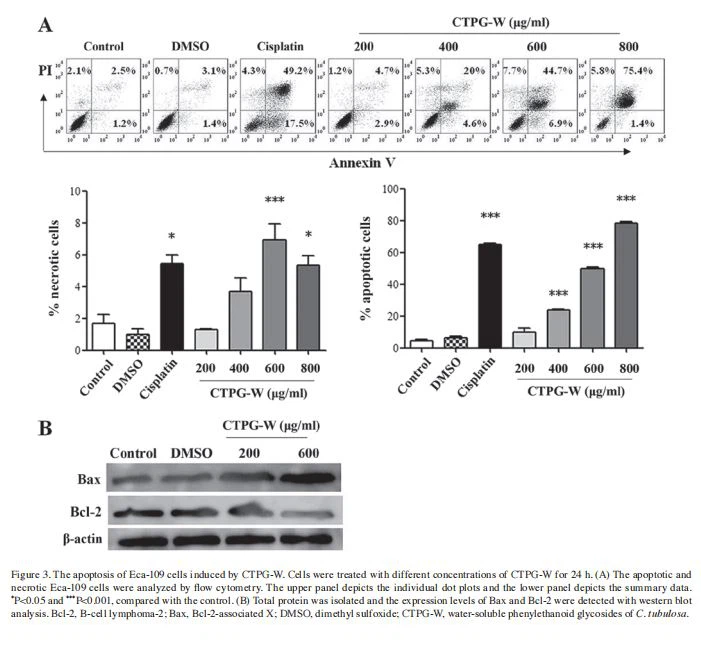
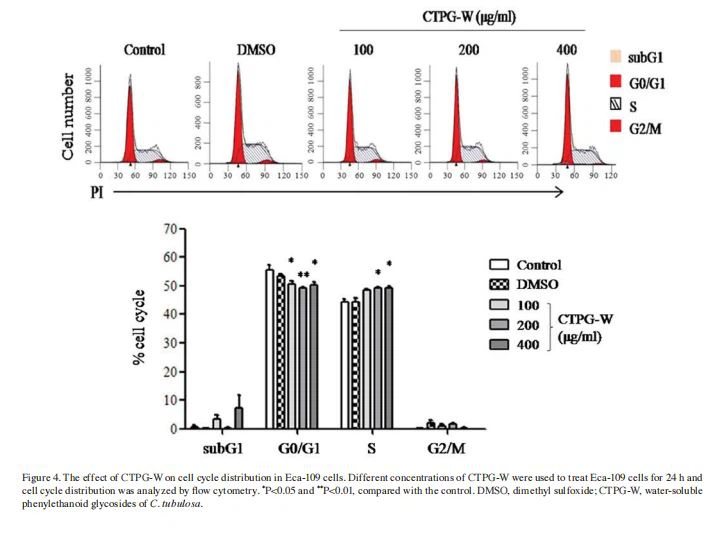
Measurement of apoptosis and the cell cycle. Eca-109 cells were cultured in 60 mm dishes at a density of 2.5x10⁵ cells/dish for 24 h and treated with different concentrations (0, 200, 400, 600, and 800 µg/ml) of CTPG-W or 0.4% DMSO for 24 h at 37˚C with 5% CO2. Cells were collected and stained with an Annexin V‑fluorescein isothiocyanate (FITC)/Propidium iodide (PI) Apoptosis Detection kit (Shanghai Shengsheng Biotechnology Co., Ltd., Shanghai, China), according to the manufacturer's protocols. Samples were collected by flow cytometry (BD FACSCalibur; BD Biosciences, Franklin Lakes, NJ, USA) and analyzed by FlowJo 7.6 (Tree Star, Inc., Ashland, OR, USA). To analyze the effect of CTPG-W on the cell cycle, 2.5x10⁵ Eca-109 cells were seeded in 60 mm culture dishes and treated with CTPG-W (0, 100, 200, and 400 µg/ml) or 0.4% DMSO for 24 h at 37˚C with 5% CO2. All cells were harvested and washed twice with ice-cold PBS (Gibco; Thermo Fisher Scientific, Inc.), then fixed in 70% ice‑cold ethanol at 4˚C for 30 min. Following washing twice with ice-cold PBS, cells were resuspended in 300 µl PI/RNase staining buffer (BD Biosciences, San Jose, CA, USA) for 10 min at room temperature. The cell cycle distribution was analyzed with the ModFit LT 3.0 software by flow cytometry (BD FACSCalibur).
Analysis of mitochondrial membrane potential (Δψm) and reactive oxygen species (ROS). To analyze the Δψm, Eca-109 cells were treated with CTPG-W (0, 400, 600 and 800 µg/ml) or 0.4% DMSO for 24 h at 37˚C with 5% CO2, and stained with the mitochondrial membrane potential assay kit with JC-1 (Beyotime Institute of Biotechnology, Shanghai, China), according to the manufacturer's protocol, for 20 min at 37˚C. Following washing twice with JC-1 washing buffer (Beyotime Institute of Biotechnology), samples were resuspended with 300 µl JC‑1 washing buffer and analyzed by flow cytometry (BD FACSCalibur). The fluorescence of JC‑1 dye in Eca‑109 cells was also observed with an inverted fluorescence microscope (magnification, x200; Nikon Eclipse Ti‑E). For analysis of ROS, Eca-109 cells were treated with CTPG-W (0, 400, 600, and 800 µg/ml) for 2, 4, 6, 12, and 24 h, and stained with Reactive Oxygen Species Assay Kit (Beyotime Institute of Biotechnology), according to the manufacturer's protocol, for 20 min at 37˚C. Following washing three times with ice‑cold PBS, samples were collected by flow cytometry (BD FACSCalibur) and analyzed by FlowJo 7.6 software.
2,2‑diphenyl‑1‑picrylhydrazyl (DPPH) radical scavenging activity. The free radical scavenging activity of CTPG-W was determined with a DPPH free radical assay according to the published protocol with a minor modification, as methanol was substituted with ethanol to dissolve DPPH (25,26). For steady-state measurements, 150 µl DPPH (100 mmol/l) in ethanol was mixed with different concentrations of CTPG-W (25, 50, 75, 100, 250, 300, 400, 500, and 600 µg/ml) in 50 µl PBS, and incubated in the dark for 30 min at room temperature. The absorbance at 517 nm was detected in the presence and absence of CTPG-W. A total of 50 µl of Vitamin C was used as the positive control. The DPPH radical scavenging activity was calculated using the formula: Scavenging (%)=[1-(A sample-Ablank)/A0] x100, where Ablank is the absorbance of the control (without DPPH), A sample is the absorbance of the sample and A0 is the absorbance of PBS with DPPH.
Western blot analysis. Eca-109 cells were treated with CTPG-W (0, 200, 600 µg/ml) or 0.4% DMSO for 24 h at 37˚C with 5% CO2. The following washing twice with PBS, cells were lysed in Radioimmunoprecipitation Assay Lysis buffer (Beijing ComWin Biotech Co., Ltd., Beijing, China) for 20 min on ice. After centrifugation at 10,000 x g for 10 min at 4˚C, the supernatants were collected, and protein concentrations were detected with a bicinchoninic acid kit (Thermo Fisher Scientific, Inc.) according to the manufacturer's protocols. Western blot analysis was conducted according to our previous description (24). The antibodies against caspase-7 (cat. no. D120077), caspase-8 (cat. no. D155240), caspase-9 (cat. no. D220078), B-cell lymphoma-2 (Bcl-2)-associated X (Bax) (cat. no. D220073) and Bcl-2 (cat. no. D260117), and anti-mouse IgG-horseradish peroxidase (HRP) (cat. no. D111050) and anti-rabbit IgG-HRP (cat. no. D110058) were purchased from BBI Life Sciences (Shanghai, China). The antibodies against caspase-3 (cat. no. E-AB-10050) and active caspase-3 (cat. no. E-AB-22115) were bought from Elabscience (Wuhan, China). Other antibodies against caspase-7 (cat. no. 9492), poly (ADP-ribose) polymerase (PARP) (cat. no. 9542), cytochrome c (cat. no. AC909), c-Jun NH2-terminal kinase (JNK) (cat. no. 9252S), and β-actin (cat. no. 58169) were obtained from Cell Signaling Technology, Inc. (Danvers, MA, USA). All primary and secondary antibodies were diluted at 1:1,000. The primary antibodies were incubated at 4˚C overnight and the secondary antibodies were incubated at 37˚C for 1 h.
The target proteins were detected using an enhanced chemiluminescence assay kit (Beyotime Institute of Biotechnology), according to the manufacturer's protocol.
Statistical analysis. Statistical significance was calculated by one-way analysis of variance with Tukey's post hoc test and results were analyzed using GraphPad Prism 5.0 software (GraphPad Software, La Jolla, CA, USA) among the treatment and control groups. All data were presented as the mean ± standard deviation. P<0.05 was considered to indicate a statistically significant difference.

Cistanche tubulosa phenylethanoid glycosides (CTPG)
Results
CTPG‑W suppresses the growth of Eca‑109 cells. The components of CTPG-W were qualified and quantified by HPLC (Fig. 1), which were compared with the standards of echinacoside and acteoside. According to the peak retention times and the peak areas, CTPG-W contained 39.16% of echinacoside and 2.44% of acteoside. Firstly, the effect of CTPG-W on the viability of Eca-109 cells was determined with an MTT assay. CTPG-W was dissolved in DMSO at 200 mg/ml and diluted with RPMI-1640 medium containing 10% heat-inactivated FBS to indicated concentrations. Eca-109 cells were treated with CTPG-W and cell viability was analyzed with an MTT assay at the indicated time points. CTPG‑W treatment significantly reduced the viability of Eca-109 cells in a dose- and time-dependent manner (P<0.001; Fig. 2A). The morphology of Eca-109 cells was observed with an inverted fluorescence microscope (magnification, x200) following CTPG‑W treatment for 24 h, which changed notably in a dose-dependent manner, with the cells shrinking and becoming round following CTPG-W treatment (Fig. 2B). These results indicate that CTPG-W suppresses the growth of Eca-109 cells. The effect of CTPG-W on the proliferation of splenocytes was also detected with an MTT assay. CTPG-W significantly promoted the proliferation of splenocytes in a dose-dependent manner (Fig. 2C), indicating that it has no cytotoxic effect on splenocytes.
CTPG‑W induces apoptosis in Eca‑109 cells. To investigate whether CTPG-W suppressed the growth of Eca-109 cells through the induction of apoptosis or necrosis, cells were treated with different concentrations of CTPG-W. After 24 h, the apoptosis and necrosis of Eca-109 cells were detected with Annexin V/PI staining. As depicted in Fig. 3A, Annexin V-/PI+ cells were gated as necrotic cells, and Annexin V+/PI+ and Annexin V+/PI- cells were gated as apoptotic cells. CTPG-W primarily induced the apoptosis of Eca-109 cells in a dose-dependent manner, although the necrotic Eca-109 cells also increased significantly under the treatment of 600 and 800 µg/ml CTPG-W (P<0.001 at 600 µg/ml and P<0.05 at 800 µg/ml). Consistently, the levels of pro-apoptotic Bax and anti-apoptotic Bcl-2 in Eca-109 cells were upregulated and downregulated, respectively, upon CTPG-W treatment (Fig. 3B). The results indicated that CTPG-W primarily inhibited the growth of Eca-109 cells through the induction of apoptosis.
CTPG‑W induces cell cycle arrest at the S phase in Eca‑109 cells. Disturbance of the cancer cell cycle will suppress cell growth and promote apoptosis (27). The distribution of the cell cycle in Eca-109 cells was detected with PI staining following CTPG-W treatment for 24 h. It was observed that cells in the S phase increased and cells in the G0/G1 phases indicated an overall significant decrease upon CTPG‑W treatment (P<0.05; Fig. 4), indicating that CTPG-W arrests the Eca-109 cell cycle at the S phase.
CTPG‑W decreases Δψm and induces the release of cytochrome c. Apoptosis can be induced by a mitochondrial-dependent pathway (28,29). The pro-and anti-apoptotic members of the BCL-2 protein family serve important roles in the regulation of mitochondrial membrane integrity (30,31). Following CTPG-W treatment for 24 h, the Δψm was assessed using JC‑1 staining. JC‑1 aggregate (red fluorescence detected in FL‑2) will disintegrate into monomer (green fluorescence detected in FL-1) when Δψm is reducing (32). As depicted in Fig. 5A, the frequencies of FL-1+ FL-2-/+ cells increased significantly in a dose‑dependent manner, indicating that the Δψm of Eca‑109 cells decreased. The fluorescence changes in Eca‑109 cells were also observed with an inverted fluorescence microscope (Fig. 5B). With the increasing concentrations of CTPG‑W, the red fluorescence decreased and the green fluorescence increased, which is consistent with the data from flow cytometry. It was also observed that the level of cytochrome c in the cytosol was notably increased (Fig. 5C), which is a result of a reduction of Δψm. This reinforces the conclusion drawn from the increased count of FL-1+ FL-2-/+ cells that Δψm decreased as a result of CTPG-W treatment. It has been reported that JNK can regulate the activation of the BCL-2 protein family causing the release of cytochrome c (33-35). It was also determined that the level of JNK was notably upregulated following CTPG-W treatment (Fig. 5C). The results indicated that CTPG-W may induce the apoptosis of Eca-109 cells through a mitochondrial-dependent pathway.

The effect of CTPG‑W on intracellular ROS generation. ROS could reduce Δψm to induce apoptosis (36). To investigate whether CTPG-W can increase ROS production, Eca-109 cells were treated with different concentrations of CTPG-W. Cells were collected at the indicated time points and stained with DCFH-DA. The production of intracellular ROS in Eca-109 cells was determined by flow cytometry. As depicted in Fig. 6A, 800 µg/ml CTPG-W significantly increased ROS production from 2-6h and decreased from 12-24 h. Additionally, 400 µg/ml CTPG‑W significantly increased ROS production from 12-24 h. Furthermore, 200 µg/ml CTPG-W did not notably alter ROS production. The dynamic changes of ROS production may be associated with Eca-109 cell apoptosis. It was also determined that CTPG-W had free radical scavenging activity (Fig. 6B), which may be associated with the decreased ROS production in Eca-109 cells treated with 800 µg/ml CTPG-W after 12 h.

CTPG‑W upregulates the activity of caspase‑3, caspase‑7, caspase‑9 and PARP. The release of cytochrome c due to Δψm reduction could activate the caspase proteases to induce apoptosis (29,30,37). Following CTPG-W treatment for 24 h, the activation of caspase-3, 7, 8, 9, and PARP was detected by western blot analysis. Compared with the control, the levels of cleaved-caspase-9, cleaved-caspase-7, cleaved-caspase-3, and cleaved-PARP, but not the levels of cleaved-caspase-8, were upregulated by CTPG treatment in a dose-dependent manner (Fig. 7). These results indicated that CTPG-W reduced Δψm and promoted cytochrome c release to activate caspases that induce the apoptosis of Eca-109 cells.

Cistanche tubulosa extract
Discussion
Traditional CHM could induce apoptosis of esophageal cancer cells through different pathways, including the extrinsic death receptor, intrinsic mitochondrial and endoplasmic reticulum stress pathways (29). Our previous study demonstrated that CTPG, as the major component of C. tubulosa, inhibited the growth of melanoma B16-F10 cells through the induction of apoptosis via a mitochondrial-dependent pathway (24). In the present study, the antitumor effect of CTPG-W on Eca-109 cells was investigated and it was determined that CTPG-W suppressed the growth of Eca-109 cells, induced apoptosis, and cell cycle arrest, reduced Δψm, increased the release of cytochrome c and activated caspases. CTPG and CTPG-W could induce apoptosis and cell cycle arrest in cancer cells. However, the accurate mechanisms are different due to the different components of CTPG (26.64% echinacoside, 10.19% acteoside, and 1.71% isoacteoside) and CTPG-W (39.16% echinacoside and 2.44% acteoside). CTPG arrested B16-F10 cells at the G0/G1 phases, but CTPG-W arrested Eca-109 cells at the S phase (24). ROS production was dose-dependently increased by CTPG, but it indicated a change in a time-dependent manner by a high dose of CTPG‑W, which increased significantly at the beginning of CTPG-W treatment (2-6 h) and decreased significantly after 12 h, compared with the control. A possible reason is that the major component of CTPG-W is echinacoside. A number of studies reported that echinacoside could inhibit ROS production and ROS-induced apoptosis to exert its neuroprotective and anti-aging effects (38-40). Similarly, the free radical scavenging activity was observed in the present study. Therefore, it was speculated that some components, including verbascoside, iso-verbascoside, and salidroside in a high dose of CTPG-W might immediately induce ROS generation to cause apoptosis of Eca-109 cells (41,42), and then ROS was scavenged by echinacoside. Another possible reason for the differences in ROS production by CTPG and CTPG-W is that different cell lines were used in this study and a previous study (24). Dong et al (43) reported that echinacoside could induce the apoptosis of human SW480 colorectal cancer cells through the generation of oxidative DNA damages without increased ROS levels.
CTPG-W treatment reduced Δψm and caused the release of cytochrome c, which promotes the cleavage of caspase-9 (28). Consistently, the levels of cleaved-caspase-9 were upregulated by CTPG-W treatment. Subsequently, the active caspase-9 can activate caspase-3 to induce apoptosis (44). The levels of cleaved-caspase-3 were also upregulated by CTPG-W treatment. However, caspase-8 was not activated by CTPG-W, indicating that the extrinsic death receptor pathway was not involved in the apoptosis induced by CTPG-W. These observations indicate that CTPG-W induces apoptosis of Eca-109 cells through the activation of a mitochondrial-dependent pathway.
PARP serves important roles in genomic stability and can be cleaved by the active caspases, particularly caspase-3 and -7 (45). It was determined that CTPG-W treatment activated caspase-3 and -7, which may cleave PARP to inhibit DNA repair and cause apoptosis.
CTPG-W also dose- and time-dependently suppresses the growth of human hepatocellular carcinoma BEL-7404 cells (unpublished data). Although CTPG-W inhibits the growth of Eca-109 and BEL-7404 cells, it promotes the proliferation of splenocytes, which may be due to the content of polysaccharides (~50%) in CTPG-W (46). Similarly, a number of studies have reported that polysaccharides can promote the proliferation of splenocytes (46-49). In the mouse model, it was determined that CTPG‑W significantly increased the spleen index, compared with the control group, but did not affect the body weight and the other organ indexes including heart, liver, kidney, and lung (unpublished data), indicating that CTPG-W has no cytotoxic effect on normal cells.
Collectively, the data indicated that CTPG-W inhibits the growth of Eca-109 cells by induction of apoptosis via a mitochondrial-dependent pathway.

cistanche benefits: anti-apoptosis
Acknowledgments
The authors would like to thank Dr. Jianhua Yang (Baylor College of Medicine) for polishing the manuscript.
Funding
This study was supported by the 13th Five-Year Plan for Key Discipline Biology Bidding Project (grant no. 17SDKD0202), Xinjiang Normal University and Key Laboratory of Special Environment Biodiversity Application and Regulation in Xinjiang (grant no. XJTSWZ-2017-04) to JL and the Chinese National Natural Science Foundation Grant (grant no. 31760260) to XW.
Availability of data and materials
Data and materials used and analyzed during the present study are available from the corresponding author on reasonable request.
Authors' contributions
CF, AA, YY, and QC performed the experiments. LX, JLv, and XW analyzed the data and the prepared figures. JinyuL and JinyaoL designed the project and wrote the manuscript.
Ethics approval and consent to participate
All animal experiments were approved by the Committee on the Ethics of Animal Experiments of Xinjiang Key Laboratory of Biological Resources and Genetic Engineering (approval, no. BRGE-AE001; Xinjiang University).
Patient consent for publication
Not applicable.
Competing interests
The authors declare that they have no competing interests.
References
Wu CR, Lin HC, and Su MH: Reversal by aqueous extracts of Cistanche tubulosa from behavioral deficits in Alzheimer's disease-like rat model: Relevance for amyloid deposition and central neurotransmitter function. BMC Complement Altern Med 14: 202, 2014.
Li J, Aspire A, Gao L, Huo S, Luo J and Zhang F: Phenylethanoid glycosides from Cistanche tubulosa inhibits the growth of B16-F10 cells both in vitro and in vivo by induction of apoptosis via mitochondria-dependent Pathway. J Cancer 7: 1877-1887, 2016.
Brand-Williams W, Culver ME, and Berset C: Use of a free radical method to evaluate antioxidant activity. LWT-Food Sci Technol 28: 25-30, 1995.