Preparation Method For Cistanche (Rou Cong Rong) Tablet Candy
Oct 28, 2026
Abstract
The present invention discloses a preparation method for Cistanche (Rou Cong Rong) tablet candy, belonging to the technical field of tablet candy manufacturing. Existing Cistanche tablet candies often suffer from a rough mouthfeel and a "sandy/gritty" sensation due to the high fiber content. In addition, the powder is prone to moisture absorption and caking, leading to sticking and punch-sticking during tableting. The key points of the present invention are as follows: Cistanche powder is mixed with fructo-oligosaccharides, resistant starch, and either seabuckthorn powder or olive powder, followed by the addition of persimmon extract (calculated as dry powder), edible glycerin, chitosan, glucono-δ-lactone, and water to obtain a pre-mixture. After standing at room temperature, the pre-mixture is dried at 40–50°C until the moisture content is ≤5%, then pulverized and passed through a 60-mesh sieve to obtain a modified composite powder. The modified composite powder is then granulated and compressed into tablets.
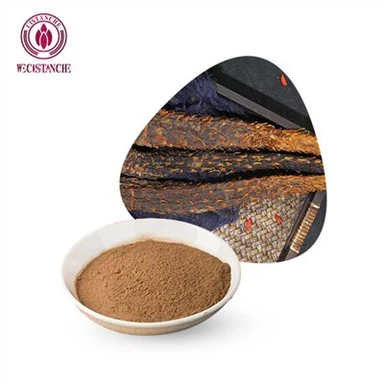
TCM CISTANCHE

Through the synergistic effect of persimmon extract, chitosan, and glucono-δ-lactone, the present invention improves the hygroscopicity and compressibility of Cistanche powder, eliminates the gritty sensation, and avoids sticking/punch-sticking. The invention is mainly used to prepare Cistanche tablet candy with a smooth mouthfeel and good stability.
Blog Article:
How to Upgrade Cistanche Tablet Candy: From "Gritty Mouthfeel" to Smooth, Stable Tablets
1. Why Cistanche tablet candy is popular-and why it's hard to make well
Cistanche (Rou Cong Rong) is the dried fleshy stem of Cistanche deserticola or Cistanche tubulosa (Orobanchaceae). It has a long history of use in traditional medicine. In recent years, as regulations have included desert Cistanche in catalogues of substances that are traditionally both food and medicinal materials, Cistanche has increasingly been used in general foods, where tablet candy is a common dosage form.
Tablet candies are portable, easy to consume, and allow convenient dose control. However, in real production, using simply pulverized Cistanche powder directly for tablet candy often results in a rough mouthfeel.
2. Two core manufacturing problems: "sandy" sensation + sticking during tableting
(1) Sandy/gritty mouthfeel
Cistanche is a fleshy-stem plant tissue. After drying, it contains crude fiber and insoluble dietary fiber. Under conventional milling conditions, the powder still contains larger fiber particles. Once tableted, these larger fiber particles do not fully dissolve or soften during holding/chewing, creating a "fine sand" sensation in the mouth.
Attempts such as longer milling time or finer milling equipment can help, but over-milling may cause ultrafine powder agglomeration, harming mixing uniformity. Purely physical milling is often insufficient to reduce particle size below the sensory threshold. Adding fillers such as microcrystalline cellulose or lactose can dilute the fiber proportion, but it also reduces the effective Cistanche content in the product. Therefore, improving mouthfeel without excessively increasing excipients remains a technical challenge.
(2) Hygroscopicity → caking → sticking/punch-sticking
Cistanche contains polysaccharides that absorb moisture easily, causing the powder to cake. During compression, this triggers sticking/punch-sticking, interrupting continuous production and reducing efficiency. Conventional methods struggle to solve both mouthfeel and sticking issues simultaneously without heavy excipient loading.
Table 1. Sensory Evaluation (Mouthfeel Roughness Score)
| Sample | Mouthfeel Roughness Score (points) |
|---|---|
| Comparative Example 1 | 2.37 |
| Comparative Example 2 | 3.08 |
| Comparative Example 3 | 2.61 |
| Example 1 | 5.63 |
| Example 2 | 6.87 |
The Invention: A Process that "Modifies" Cistanche Powder for Smooth Mouthfeel and Stable Tableting
3. Core concept (easy to understand)
Instead of only milling finer, the method introduces a synergistic modification system:
Persimmon extract (tannins, etc.)
Chitosan
Glucono-δ-lactone (GDL)
Their synergy forms a composite that can:
wrap/coating coarse fiber particles, reducing "bare" fiber perception in the mouth (less grit),
reduce hygroscopicity by shielding hydrophilic sites of polysaccharides,
improve compressibility and reduce sticking during tableting.
On top of this, optional techniques (solid-state fermentation, controlled pH, dry granulation, nitrogen-pressure cycles, sodium ascorbate spray) further enhance stability and active retention.
Claims / Method
Claim 1
A preparation method for Cistanche tablet candy, characterized by comprising the following steps:
Step 1:
Mix Cistanche powder with:
fructo-oligosaccharides in an amount of 0.2–0.4× the total mass of Cistanche powder,
resistant starch in an amount of 1.5–2.5× the total mass of Cistanche powder,
a flavoring auxiliary in an amount of 0.1–0.3× the total mass of Cistanche powder,
to obtain a mixture; wherein the flavoring auxiliary is one of seabuckthorn powder and olive powder.
Step 2:
Add to the mixture:
persimmon extract in an amount of 0.02–0.08× the total mass of Cistanche powder,
edible glycerin in an amount of 0.05–0.1× the total mass of Cistanche powder,
chitosan in an amount of 0.03–0.08× the total mass of Cistanche powder,
glucono-δ-lactone in an amount of 0.01–0.04× the total mass of Cistanche powder, and
water in an amount of 0.2–0.5× the total mass of Cistanche powder,
mix to obtain a pre-mixture; wherein the persimmon extract is calculated as dry powder.
Step 3:
Let the pre-mixture stand at room temperature for 30–120 minutes, then dry at 40–50°C until moisture content is ≤5%; pulverize and pass through a 60-mesh sieve to obtain a modified composite powder.
Step 4:
Granulate and compress the modified composite powder to obtain tablet candy.
Table 2. Moisture Absorption, Sticking Degree, Tablet Hardness, and Disintegration Time
| Sample | Moisture Gain (%) | Sticking Mass (mg) | Tablet Hardness (N) | Disintegration Time (min) |
|---|---|---|---|---|
| Comparative Example 1 | 8.92 | 9.8 | 49.5 | 14.2 |
| Comparative Example 2 | 7.69 | 7.2 | 51.3 | 13.4 |
| Comparative Example 3 | 8.43 | 7.9 | 53.7 | 13.8 |
| Example 1 | 5.54 | 5.8 | 61.2 | 11.2 |
| Example 2 | 5.01 | 4.4 | 66.9 | 10.7 |
| Example 3 | 4.52 | 3.5 | 70.1 | 8.9 |
| Example 4 | 3.48 | 2.4 | 78.9 | 7.3 |
Claim 2
The method according to claim 1, characterized in that the persimmon extract is prepared as follows:
Wash and remove stems from unripe astringent persimmon fruits; crush to particle size ≤5 mm to obtain crushed fruit material. Add an ethanol aqueous solution at 5–10× the persimmon mass, with ethanol volume fraction 60–80%. Perform reflux extraction for 1–2 hours, then filter to obtain an extract. Concentrate under reduced pressure at 50–60°C to recover ethanol and obtain a concentrate. Dilute the concentrate with water to 5–10× its volume to obtain a diluted solution. Pass the diluted solution through a macroporous adsorption resin column; elute first with water at 2–3× column volume, then elute with ethanol aqueous solution (ethanol volume fraction 50–70%) at 3–5× column volume; collect the ethanol eluent. Concentrate the ethanol eluent under reduced pressure at 50–60°C until solid content is ≥20% to obtain a concentrate paste; vacuum-dry the paste to obtain powdered persimmon extract.
Claim 3
The method according to claim 2, characterized in that:
In Step 1, the flavoring auxiliary is olive powder; and the mixture obtained in Step 1 is pretreated by solid-state fermentation as follows:
Evenly spray sterile water onto the mixture at 0.8–1.2× the total mass of Cistanche powder, and inoculate with Lactobacillus plantarum freeze-dried powder at 0.005–0.015× the total mass of Cistanche powder. Mix to obtain a wet material and carry out sealed fermentation at 30–37°C for 8–12 hours.
After fermentation, vacuum-dry the wet material at 50–60°C to moisture content ≤5%, pulverize and pass through a 60-mesh sieve to obtain a solid-state-fermentation-treated mixture, which is then used for Step 2.
Table 3. Accelerated Stability Test Results (Moisture Gain and Hardness Change)
| Sample | Day 0 Moisture Gain (%) | Day 90 Moisture Gain (%) | Day 0 Hardness (N) | Day 90 Hardness (N) | Hardness Retention (%) |
|---|---|---|---|---|---|
| Comparative Example 1 | 8.92 | 12.37 | 49.5 | 34.1 | 68.9 |
| Example 1 | 5.54 | 5.81 | 61.2 | 52.3 | 85.5 |
| Example 2 | 5.01 | 6.13 | 66.9 | 58.9 | 88.1 |
Claim 4
The method according to claim 3, characterized in that the pre-mixture is prepared as follows:
Take the solid-state-fermentation-treated mixture and sequentially add persimmon extract, chitosan, edible glycerin, and water; stir and mix to obtain an initial mixture.
Adjust the pH of the initial mixture to 6.0–6.5 using sodium hydroxide solution.
Add glucono-δ-lactone to the pH-adjusted initial mixture, continue mixing uniformly to obtain an intermediate mixture.
Let the intermediate mixture stand for 10–20 minutes to obtain the pre-mixture.
Claim 5
The method according to claim 4, characterized in that:
Take the modified composite powder obtained in Step 3 and apply dry granulation to obtain base granules.
Sieve the base granules through 20–40 mesh to obtain sized granules.
Add microcrystalline cellulose at 0.1–0.2× the total mass of Cistanche powder into the sized granules, and mix at 20–40 rpm for 5–10 minutes to obtain first mixed granules.
Add sodium stearoyl lactylate at 0.002–0.005× the total mass of Cistanche powder into the first mixed granules, continue mixing at 20–40 rpm for 2–5 minutes to obtain second mixed granules.
Compress the second mixed granules into tablets to obtain tablet candy.
Table 4. Active Ingredient Retention Test Results
| Sample | Echinacoside Retention (%) | Acteoside (Verbascoside) Retention (%) |
|---|---|---|
| Comparative Example 1 | 73.2 | 68.7 |
| Example 1 | 78.6 | 74.3 |
| Example 2 | 81.4 | 78.1 |
Claim 6
The method according to claim 1, characterized in that in Step 3, the room-temperature standing method is:
Place the pre-mixture in a sealed container and perform the following cycle operations three times: open the sealed container to expose the pre-mixture to air for 5–10 minutes; during exposure, turn over the pre-mixture once every 2–3 minutes; then close the container, introduce nitrogen to replace the air; continue introducing nitrogen to maintain the container pressure at 0.11–0.15 MPa, and stand at that pressure for 10–20 minutes.
After nitrogen standing in the last cycle, continue introducing nitrogen to raise the container pressure to 0.16–0.20 MPa, then stop nitrogen input and maintain the pressure for 5–15 minutes.
Claim 7
The method according to claim 6, characterized in that:
During the "open container to expose to air" process in each cycle, after opening the container and before turning over the pre-mixture, uniformly spray sodium ascorbate aqueous solution on the pre-mixture surface. The spraying amount is 0.01–0.02× the total mass of Cistanche powder, and the mass fraction of the sodium ascorbate solution is 5%. After spraying, perform turning-over and air exposure operations.
Cistanche Extract Supplement For Improving Sexual Function

Technical Field
The present invention relates to the technical field of tablet candy preparation, and more specifically relates to a preparation method for Cistanche tablet candy.
Background
Cistanche has a long history in traditional medicine. With its inclusion in lists of substances used traditionally as both food and medicine, Cistanche is used increasingly in general foods, and tablet candy is a common product form. While convenient, tablets made from directly milled Cistanche powder exhibit rough mouthfeel.
Cistanche powder contains crude fiber and insoluble dietary fiber; larger fiber particles remain after conventional milling. After tableting, these particles cause a perceivable grainy texture. Over-milling can lead to powder agglomeration and poor mixing uniformity; physical milling alone cannot reliably bring fiber particles below sensory thresholds. Adding conventional fillers reduces the effective Cistanche content. Therefore, improving mouthfeel at meaningful Cistanche loading is an industry challenge; existing literature has not disclosed a method that solves it effectively.
Another issue is that Cistanche polysaccharides are hygroscopic, causing caking and punch-sticking during compression, reducing productivity. Existing approaches have difficulty improving both problems without heavy excipient addition.
Invention Content (What's new)
To address these problems, the invention provides the method described above (Steps 1–4). Preferably, the persimmon extract preparation, solid-state fermentation, pH-staged addition of GDL, dry granulation, nitrogen-pressure cycling, and sodium ascorbate spraying may be included.
Beneficial Effects
The invention provides at least the following benefits:
Synergistic modification (persimmon extract + chitosan + GDL):
By adding persimmon extract, chitosan, and glucono-δ-lactone simultaneously into Cistanche powder, their synergy forms a complex that can wrap coarse fiber particles, reduce fiber exposure in the mouth, and significantly improve rough mouthfeel. The complex also closes hydrophilic sites of polysaccharides, reducing hygroscopicity and effectively alleviating punch-sticking during tableting. Adding persimmon extract alone, or adding only chitosan and GDL without persimmon extract, cannot achieve the above effect; the three-component synergy is key.
Solid-state fermentation with Lactobacillus plantarum:
By introducing Lactobacillus plantarum for solid-state fermentation, the fiber structure becomes loosened through mild metabolism (the modification remains after drying and milling, aiding adhesion of persimmon extract and chitosan). Fermentation produces lactic acid, which creates a synergistic acidification environment with subsequently added GDL, further promoting uniform binding between chitosan and persimmon tannins. This yields finer mouthfeel and improves the retention of echinacoside and acteoside (verbascoside).
Dry granulation with MCC and sodium stearoyl lactylate:
Dry granulation, plus microcrystalline cellulose and sodium stearoyl lactylate, improves granule flowability and compressibility, further reduces sticking, and produces tablets with smooth surfaces, appropriate hardness, and stable disintegration time.
Room-temperature standing with alternating nitrogen pressurization and air exposure + sodium ascorbate spray:
This promotes release of entrapped gas, uniform moisture distribution, and penetration of effective components. Sodium ascorbate preferentially reacts with dissolved oxygen, preventing oxidative browning of persimmon tannins and Cistanche polysaccharides, improving color uniformity, active retention, and long-term stability.
Persimmon extract preparation method (ethanol reflux + macroporous resin purification):
Effectively removes sugars and small-molecule impurities, yielding an extract with high total tannins and light color. The resulting complex formation with chitosan is more uniform and avoids negative effects on tablet color/flavor and hygroscopicity.
Detailed Embodiments
Example 1
A Cistanche tablet candy preparation method includes:
Step 1: Mix Cistanche powder with:
FOS at 0.3× Cistanche powder mass,
resistant starch at 2× Cistanche powder mass,
flavoring auxiliary at 0.2× Cistanche powder mass; flavoring auxiliary is olive powder.
Step 2: Add into the mixture:
persimmon extract at 0.05×,
edible glycerin at 0.075×,
chitosan at 0.05×,
GDL at 0.02×,
water at 0.35×,
mix for 8 minutes to obtain pre-mixture (persimmon extract calculated as dry powder).
Step 3: Stand at room temperature for 98 minutes (no nitrogen-related operations; pH = 5.5), then dry at 45°C to moisture ≤5%, pulverize and pass 60 mesh to obtain modified composite powder.
Step 4: Granulate and compress to obtain tablet candy.
Persimmon extract preparation in this example: wash, destem, crush to ≤5 mm; add 7× mass of 70% ethanol aqueous solution; reflux 2 hours; filter; concentrate at 55°C under reduced pressure to recover ethanol; dilute to 7× volume; pass through macroporous resin; water elute at 2× column volume, then 60% ethanol elution at 4× column volume; collect ethanol eluent; concentrate at 55°C under reduced pressure to solid content ≥20% to obtain paste; vacuum-dry to obtain powdered persimmon extract.
Example 2
Based on Example 1, the difference is that the mixture from Step 1 is pretreated by solid-state fermentation:
Spray sterile water at 1× Cistanche powder mass; inoculate Lactobacillus plantarum freeze-dried powder at 0.010×; ferment sealed at 33°C for 10 hours. Then vacuum-dry at 55°C to moisture ≤5%, pulverize and pass 60 mesh to obtain fermentation-treated mixture, used in Step 2.
Pre-mixture preparation: add persimmon extract, chitosan, glycerin, water; mix to initial mixture; adjust pH to 6.2 using NaOH solution; add GDL; mix uniformly to intermediate mixture; stand 10 minutes to obtain pre-mixture.
Example 3
Based on Example 2, the difference is dry granulation and post-addition excipients:
Use dry granulation on modified composite powder to base granules; sieve through 20/40 mesh to obtain sized granules; add MCC at 0.15× and mix at 30 rpm for 8 minutes; add sodium stearoyl lactylate at 0.0035× and mix at 20–40 rpm for 2–5 minutes; compress into tablets.
Example 4
Based on Example 3, the difference is the standing method and sodium ascorbate spraying:
Standing method: place pre-mixture in sealed container; cycle three times: open, air exposure 7 minutes, turn every 2–3 minutes; close, nitrogen purge, maintain 0.13 MPa and stand 15 minutes. After the last cycle, increase to 0.18 MPa and hold 10 minutes.
During each cycle, after opening and before turning, spray 5% sodium ascorbate solution; spray amount 0.015× Cistanche powder mass; then turn and perform air exposure.
Comparative Examples
Comparative Example 1
Mix Cistanche powder + FOS 0.3× + resistant starch 2× + olive powder 0.2× → directly granulate and compress (no Step 2/3 modification).
Comparative Example 2
Based on Example 1 but Step 2 only adds persimmon extract 0.05× + water 0.35×; no glycerin, chitosan, or GDL.
Comparative Example 3
Based on Example 4 but Step 3 standing is: nitrogen introduced to maintain 0.13 MPa for 98 minutes (without alternating air exposure cycles described).
Comparative Example 4
Based on Example 1 but Step 2 adds glycerin 0.075× + chitosan 0.05× + GDL 0.02× + water 0.35×; no persimmon extract.
Experimental Characterization (Evaluation)
Prepare tablet candies according to Examples 1–4 and Comparative Examples 1–4. Each group: 3 batches, each batch: 500 tablets (tablet weight 500 mg, diameter 10 mm, round flat punch). Store sealed at 25°C, 45% RH.
1) Mouthfeel roughness scoring
Sensory evaluation: 10 trained food-specialist panelists (5 male, 5 female). Each panelist performs blind evaluation: place one tablet in mouth for 30 seconds, chew 10 times then spit, evaluate whether sandy particles are perceived. Score 1–10: 1 = obvious sandy sensation; 10 = no particle sensation, smooth. Each sample evaluated 3 times, average taken.
Results (as described): Comparative Example 1 had the lowest score (most grit). Comparative Example 3 slightly higher than Comparative Example 1 but still low. Comparative Example 2 improved vs Comparative 1 and 3. Example 1 outperformed all comparative examples.
2) Tableting performance tests
Moisture absorption weight gain: about 2 g sample in constant T/H chamber (25°C, 75% RH), open for 24 h, weigh. Weight gain (%) = (gain / initial) × 100. 3 parallels, average.
Sticking/punch-sticking degree: rotary tablet press (ZP-9), same parameters (pressure 10 kN, speed 20 r/min), continuously compress 100 tablets, stop, remove upper punch, brush off adhered material from punch surface and die ring inner wall, weigh adhered material. 3 repeats, average.
Tablet hardness: tablet hardness tester (YD-1), 10 tablets, radial hardness average, unit N.
Disintegration time: disintegration tester, water medium at 37 ± 1°C, 6 tablets, average time (min).
Results (as described): Comparative Example 1 had highest moisture gain, largest adhered material mass, lowest hardness, and longest disintegration. Comparative Example 3 improved slightly but limited. Comparative Example 2 further reduced moisture gain and sticking and improved hardness/disintegration. Example 1 showed lower moisture gain and sticking than all comparative examples, with clearly improved hardness and disintegration performance.
3) Moisture gain and hardness change (accelerated stability)
Store tablets under accelerated conditions (40°C, 75% RH) sealed for 90 days. Measure moisture gain and hardness at Day 0 and Day 90; calculate hardness retention (%) = (Day 90 hardness / Day 0 hardness) × 100. 3 parallels, average.
Result (as described): After 90 days, Comparative Example 1 showed the greatest increase in moisture gain and lowest hardness retention. Example 1 had smaller moisture gain increase and much higher hardness retention than Comparative 1. Example 2 had slightly higher moisture gain than Example 1 but further improved hardness retention.
4) Active component content (echinacoside & acteoside/verbascoside)
For modified composite powders obtained in Step 3 (or corresponding powders in comparative examples), determine echinacoside and acteoside content by HPLC (C18 column; mobile phase acetonitrile–0.1% formic acid solution; detection wavelength 330 nm). Using untreated original Cistanche powder (only milled/sieved, without Step 2/3) as baseline (100%), calculate retention (%) = (content in sample / content in original powder) × 100. 3 parallels, average.
Result (as described): Comparative Example 1 had the lowest retention. Example 1 retained more than Comparative 1. Example 2 further improved retention compared with Example 1.
Cistanche Extract List
Click to get to the cistanche worldwide shipping shop

Practical Guidance for Herbal Product Developers (Taste Modulation & Process Upgrade)
To turn this patent method into actionable factory guidance for developing "functional" Cistanche herbal products (especially tablet candies), the key takeaways are:
Use a structured "fiber masking + moisture control" system, not only finer milling.
Persimmon tannins + chitosan + GDL are used to build a controlled complex that wraps fiber and reduces hygroscopicity.
Flavor modulation is built into the formula (seabuckthorn or olive powder).
Rather than masking only with sweeteners, this introduces natural botanical notes that can harmonize Cistanche's inherent flavor.
If you need higher quality and active retention, consider fermentation + staged pH strategy.
The sequence of pH adjustment to 6.0–6.5 before adding GDL is designed to avoid rapid precipitation and ensure uniform complex formation.
Choose dry granulation when moisture is a major risk.
Dry granulation avoids extra water input and lowers secondary moisture-uptake risk-critical for hygroscopic botanical powders.
Oxidation control matters for appearance and stability.
Nitrogen cycling/pressurization and sodium ascorbate spray are process-level tools to reduce oxidative browning and help long-term quality consistency.