Cistanche Tubulosa: Which Part Of The Plant Is Most Powerful? Here's What The Science Says
Nov 17, 2026
When you buy a botanical supplement, you probably assume that the whole plant is roughly the same. A leaf is a leaf, a stem is a stem. But with many medicinal plants, that assumption is wrong - and nowhere is it more wrong than with cistanche.
A study of Cistanche tubulosa cultivated in China's Qinghai province found something striking: the plant's active compounds are not spread evenly through its body. Instead, they concentrate heavily in one place - the lower, root-end portion of the fleshy stem. The difference is not small. In some cases, the root end contained nearly seven times more of the key compound than the top.
This matters for more than botanical curiosity. It matters for how cistanche is harvested, how it is tested, and how you should choose a quality product. This article explains, in plain English, what the study found, what it means, and how to use that knowledge.
What Is Cistanche Tubulosa?
Cistanche is a genus of desert plants known for a long history of use in traditional Chinese medicine. The two species most commonly used today are Cistanche deserticola and Cistanche tubulosa. Both are recognized in the Chinese Pharmacopoeia, and both share a similar profile of active compounds.
Cistanche tubulosa is the focus of the study we are looking at here. It goes by several local names in China, including "southern Xinjiang dayun" and "tamarisk dayun," a reference to the plant it depends on for survival. In English, it is usually called simply "tubulosa cistanche" or "desert cistanche."
Unlike C. deserticola, which grows mainly on the roots of saxaul shrubs, Cistanche tubulosa typically parasitizes the roots of tamarisk (Tamarix), a tough, salt-tolerant desert shrub. Tamarisk has a deep, wide root system that pulls up water and nutrients from far underground - and because cistanche is a parasitic plant, it feeds off those roots. This relationship is one reason C. tubulosa is able to accumulate such a rich mix of bioactive compounds.
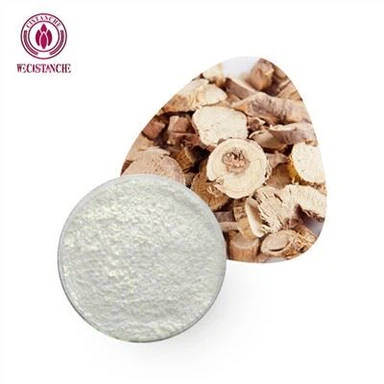
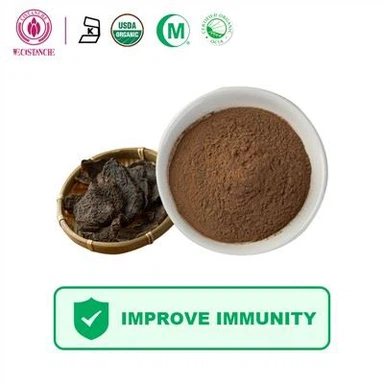
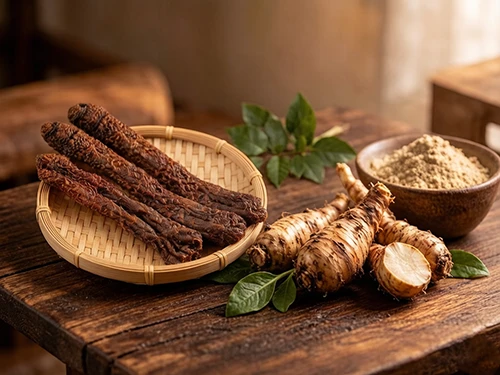
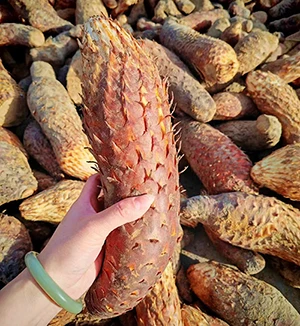
The part of the plant that is harvested and used is the fleshy stem. In dried form, it is a long, woody-fleshy stalk that is typically processed into slices, powders, or extracts for use in supplements and health foods.
The Curious Life of a Parasitic Desert Plant
To understand why "which part" matters, it helps to understand a little about how cistanche grows.
Cistanche cannot perform photosynthesis well enough to survive on its own. Instead, it attaches itself to the roots of a host plant and draws water, sugars, and nutrients from that host. This is an ancient and surprisingly common strategy in the plant world, but it has a particular consequence for cistanche: the quality of the host directly shapes the quality of the cistanche.
Because tamarisk roots run deep and wide, they can supply a steady stream of nutrients, allowing the cistanche to build up generous stores of the compounds it needs - including the phenylethanoid glycosides like echinacoside and verbascoside that make it valuable.
There is also a well-known principle in traditional Chinese medicine that a plant's quality changes with its growing environment - roughly translated as "its nature changes with the land, and its quality changes with the soil." This is why researchers study cistanche grown in different regions, and why the location of cultivation is now considered a meaningful indicator of quality.
Why "Which Part" Matters
Here is the core question the study set out to answer: does every part of a cistanche stem contain the same amount of active compounds?
The short answer is no. And the practical implications are significant.
In the supplement industry, cistanche is often sold as a whole-stem powder or a whole-stem extract, without distinguishing between the lower, middle, and upper portions. If the active compounds are concentrated in one part, then a product made from the "wrong" part - or a product that does not standardize for the key compounds - could vary enormously in quality, even if it looks the same on the shelf.
Understanding this gradient also matters for sourcing and harvesting, standardization, and honest labeling. That is exactly why the researchers behind this study decided to measure each part separately, rather than treating the whole stem as one uniform material.
The Qinghai Study at a Glance
The study examined Cistanche tubulosa cultivated in the Qaidam Basin of Qinghai province in northwestern China - a high-altitude, arid region that has recently emerged as a new growing area for the plant.
The researchers took a batch of dried cistanche stems and divided each one into three equal sections: the root end (bottom), the middle, and the top. They then ground each section into a fine powder and measured a panel of functional compounds, followed by two standard tests of antioxidant activity.
This is a clean, well-designed comparison: same plants, same harvest, same processing - only the position along the stem varies. Any differences found can therefore be attributed to where on the plant the material came from, not to other variables.
The Compounds Researchers Measured (and Why)
To understand the results, you need a quick tour of the compounds the study measured. Don't worry - each one can be explained in a sentence.
Echinacoside and verbascoside: the headline compounds. These two are the most important compounds in cistanche. They belong to a family called phenylethanoid glycosides, widely studied for antioxidant, anti-inflammatory, neuroprotective, and anti-aging effects. They are also the official "marker compounds" for cistanche - the chemical fingerprints used to verify identity and measure quality. Under the 2020 edition of the Chinese Pharmacopoeia, Cistanche tubulosa must contain a combined total of echinacoside and verbascoside of at least 1.5% to be considered genuine and usable. So these two compounds are not just interesting - they are the legal definition of quality.
Total polyphenols. Polyphenols are a huge family of plant compounds found in tea, berries, cocoa, and countless other foods. They are best known for their antioxidant activity - their ability to neutralize harmful free radicals.
Total polysaccharides. Polysaccharides are long chains of sugar molecules. In cistanche, they are associated with immune support and energy, and they are a common feature of medicinal mushrooms and herbs.
Total triterpenes. Triterpenes are another large group of plant compounds with a wide range of studied activities, including anti-inflammatory and antioxidant effects.
Total proanthocyanidins. Proanthocyanidins are the compounds that give many deeply colored fruits and seeds their astringent, antioxidant punch. They are found in cistanche too, though in smaller amounts than in pigment-rich plants like grapes or blueberries.
The Big Finding: A Clear Gradient from Root to Top
The central result of the study was remarkably consistent: for nearly every major compound, the root end contained significantly more than the middle, and the middle contained more than the top.
There is a gradient running the length of the stem. The closer to the host root, the richer the chemistry. The pattern was clear and statistically significant for total polyphenols, total polysaccharides, total triterpenes, echinacoside, and verbascoside.
The one exception was proanthocyanidins, which showed no significant difference between the three parts - a useful reminder that not every compound follows the same pattern.
Why would this be? The plant draws its nutrients up from the host root, so the lower portion - closest to the source - accumulates nutrients first and most abundantly. As the plant directs energy toward reproductive growth further up the stem, the concentration of stored compounds tapers off toward the top.
The Numbers in Detail
Here is what the study found for each part of the stem (expressed per gram of dried material).
Echinacoside - the most dramatic difference:
Root end: about 79 mg/g
Middle: about 28 mg/g
Top: about 12 mg/g
The root end contained roughly 2.9 times the middle and 6.8 times the top - the single most dramatic gap in the study.
Verbascoside:
Root end: about 13 mg/g
Middle: about 5 mg/g
Top: about 3.5 mg/g
Total polyphenols:
Root end: about 37 mg/g
Middle: about 20 mg/g
Top: about 12 mg/g
Total polysaccharides:
Root end: about 28 mg/g
Middle: about 19 mg/g
Top: about 13 mg/g
Total triterpenes:
Root end: about 10.5 mg/g
Middle: about 8 mg/g
Top: about 6.4 mg/g
Total proanthocyanidins - the exception: all three parts came in around 2.6–2.9 mg/g, with no significant difference.
A reassuring quality check: averaged across all three parts, the combined echinacoside + verbascoside content was 4.67% - comfortably above the 1.5% minimum required by the Chinese Pharmacopoeia. This Qinghai-grown material was not only authentic, it was well above the legal quality threshold.

Antioxidant Activity: What ABTS and DPPH Actually Mean
The second half of the study tested how well each part of the plant could neutralize free radicals - unstable molecules that can damage cells and are linked to aging and chronic disease. This is what "antioxidant activity" measures.
Scientists test this using simple, reproducible laboratory assays. The two most common are known by their abbreviations: ABTS (a colored free radical that fades as it is neutralized) and DPPH (another stable free radical, originally purple, that fades as antioxidants quench it).
In each test, researchers measure how much extract is needed to neutralize half of the free radicals present. That "half" point is called the IC50 value - the lower the number, the less extract needed, and therefore the stronger the antioxidant power. Think of it like a price: a lower IC50 is a better deal.
Because a lower IC50 means stronger activity, any factor that raises antioxidant power will lower the IC50. This is why the study reports the relationship as a negative correlation - more active compounds, lower IC50, stronger antioxidant effect. It is easy to misread at first glance, so keep this in mind.
How Strong Is the Root? The IC50 Results
The antioxidant tests told the same story as the chemistry: the root end was the most powerful, followed by the middle, then the top.
表格
| Antioxidant test (IC50, mg/mL) | Root end | Middle | Top |
|---|---|---|---|
| ABTS | 0.91 | 1.59 | 2.32 |
| DPPH | 0.77 | 5.16 | 10.66 |
For the ABTS test, the root end needed only about 40% as much material as the top to do the same job. At a concentration of 10 mg/mL, both the root and middle parts neutralized over 99% of the ABTS radicals - essentially matching the reference standard, vitamin C (ascorbic acid).
For the DPPH test, the gap was even larger: the top needed nearly 14 times more material to reach the same 50% neutralization point. This is a huge, real-world difference, and it makes the root end by far the most desirable part of the plant for antioxidant-focused products.
What the Correlation Analysis Tells Us
The researchers also asked: which compounds are actually driving the antioxidant activity? Using statistical correlation, they found that antioxidant strength tracked closely with the levels of total polyphenols, total triterpenes, total polysaccharides, echinacoside, and verbascoside.
The higher these compounds, the stronger the antioxidant effect. The correlations were strong and mostly statistically significant. The one exception was proanthocyanidins, which showed no meaningful relationship - almost certainly because its levels did not vary much between the three parts.
The practical takeaway is reassuring and clear: the antioxidant benefit of cistanche is not coming from one mysterious compound, but from a combination of its major active ingredients working together. This supports the common view that whole-plant extracts, which preserve this mixture, are often more meaningful than isolated single compounds.
How Qinghai Compares to Xinjiang
For most of recent history, the main growing region for Cistanche tubulosa has been southern Xinjiang. A natural question is: how does the newer Qinghai material compare?
Earlier research on 60 batches of Xinjiang-grown C. tubulosa found echinacoside ranging from about 3 to 87 mg/g (averaging about 29 mg/g), and verbascoside ranging from about 0.7 to 13 mg/g (averaging about 5.4 mg/g).
The Qinghai samples performed very well by comparison. The root end contained about 79 mg/g of echinacoside - near the top of the Xinjiang range - and the three-part averages for both echinacoside (about 39 mg/g) and verbascoside (about 7.2 mg/g) came in above the Xinjiang 60-batch averages.
This is encouraging news for Qinghai as an emerging production region, and it expands the total supply of cultivated material while reducing pressure on wild populations.
What This Means for Choosing a Supplement
The root end is where the value is. High-quality cistanche products should prioritize the lower portion of the stem - or at minimum not discard it during processing.
Standardization is the only honest guarantee. Look for products that state their standardized echinacoside and verbascoside content. This is the single most important thing to look for.
"Whole plant" is not automatically better. The part of the plant, the extract ratio, and the standardized marker compounds matter far more than vague "whole plant" claims.
Look for the pharmacopoeia benchmark. Combined echinacoside + verbascoside should be at least 1.5% - and quality material, like the Qinghai sample at 4.67%, will comfortably exceed that.
Antioxidant testing adds confidence. A root-end extract with a DPPH IC50 below 1 mg/mL is genuinely strong. Reputable brands may publish such test results or third-party lab reports.
Cultivated and traceable is a plus. A brand that can tell you where its cistanche was grown and which part of the plant was used is demonstrating real transparency.

Frequently Asked Questions
What is Cistanche tubulosa? It is one of the two main cistanche species used in traditional Chinese medicine and modern supplements. It typically grows parasitically on tamarisk roots and is valued for compounds like echinacoside and verbascoside.
Why does the root end have more active compounds? The plant draws nutrients up from its host's roots, so the lower portion - nearest the source - accumulates them first and most abundantly. Concentrations then taper off toward the top.
What are echinacoside and verbascoside? They are phenylethanoid glycosides, the signature active compounds of cistanche. They are the official quality markers in the Chinese Pharmacopoeia and are studied for antioxidant, anti-inflammatory, and neuroprotective effects.
What is an IC50 value? It is the concentration of a substance needed to neutralize 50% of the free radicals in a test. A lower IC50 means stronger antioxidant activity.
Which part of cistanche has the strongest antioxidant activity? The root end, followed by the middle, then the top. In the Qinghai study, the root end had a DPPH IC50 of 0.77 mg/mL versus 10.66 mg/mL for the top.
How do I know a cistanche product is high quality? Look for a standardized echinacoside and verbascoside content (ideally with the combined total clearly above the 1.5% pharmacopoeia minimum), transparent sourcing, and ideally third-party or antioxidant test results.
Does "more extract" always mean "more benefit"? Not necessarily. The study found antioxidant activity leveled off at higher concentrations. Standardized, well-characterized extracts are more meaningful than simply "more powder."

Conclusion: The Part Matters More Than You Think
This study delivers a simple but powerful lesson: with cistanche, where the material comes from on the plant is not a minor detail - it is the difference between a strong product and a weak one.
The root end of the stem concentrates the polyphenols, polysaccharides, triterpenes, echinacoside, and verbascoside that give cistanche its value. It showed the strongest antioxidant activity in both ABTS and DPPH testing, in some cases by a wide margin. And the Qinghai-grown material cleared the official quality bar with room to spare.
For anyone who buys, sells, or formulates with cistanche, the implications are clear. Quality is not a vague promise - it is a measurable property, tied to the part of the plant, the growing region, and the standardized content of its marker compounds.
The next time you pick up a cistanche product, don't just ask "is this cistanche?" Ask a better question: "which part of the cistanche, and how much echinacoside and verbascoside does it actually contain?" The answer is the difference between marketing and quality.
Disclaimer: This article is for informational and educational purposes only and is not intended as medical advice, diagnosis, or treatment. It summarizes a published scientific study and related background for a general audience; it does not constitute a product endorsement or a health claim. Statements have not been evaluated by the U.S. Food and Drug Administration or the European Food Safety Authority. Always consult a qualified healthcare professional before beginning any new supplement, especially if you are pregnant, nursing, taking medication, or managing a medical condition.