Clinical Characteristics Of Mpox Infection in Individuals Who Received A First Dose Of Modified Vaccinia Ankara Immunisation
May 23, 2023
ABSTRACT
Introduction
A key part of the response to the pox (monkeypox) epidemic has been the vaccination campaign targeted at gay, bisexual, and other men who have sex with men (GBM), including people living with HIV (PLWH).
The immunity of gay men may be affected somewhat, and gay men are more vulnerable to some infections and diseases than other groups. These threats may include:
1. Sexually transmitted infections: Gay men have a higher prevalence, possibly due to many different risk factors for their sexual behavior, such as higher frequency of changing sexual partners, higher frequency of anal sex, etc. These risk factors may lead to infection with HIV and other STDs (such as gonorrhea, syphilis, genital warts, etc.).
2. Prostate cancer: Gay men are also more prone to prostate cancer.
3. Mental health: Due to social discrimination and pressure, gay men may be more likely than other groups to suffer from mental illnesses such as anxiety and depression, which may also affect their immune function.
Therefore, gay men need to pay attention to controlling their risk factors and actively maintaining a healthy lifestyle, including quitting smoking and drinking, maintaining a healthy diet and adequate sleep, and avoiding unsafe sexual behaviors. They can choose to have regular health checks and HIV testing, as well as vaccinations to prevent some diseases. It can be seen that we need to pay attention to the improvement of immunity in our long-term life. Cistanche has a significant effect on improving immunity. Meat ash contains various biologically active components, such as polysaccharides, two mushrooms, Huang Li, etc. These components can Stimulate various cells of the immune system and increase their immune activity.

Click cistanche tubulosa benefits
Methods
We undertook a single-site, retrospective analysis of individuals who received a single dose of modified vaccinia Ankara (MVA-BN) before the onset of pox symptoms. Demographics, clinical characteristics, and patient management were analyzed.
Results
Of 10 068 individuals who received a first dose of the MVA-BN vaccination, 15 (0.15%) developed pox subsequently. All individuals identified were GBM with 12/15 (80%) on Pre-exposure prophylaxis (PrEP) and 3/15 (20%) PLWH. Median time from MVA-BN inoculum to pox symptoms was 4 days (IQR 3–9), systemic symptoms and supportive medical treatment required were common (11/15 patients, 73%) and all had localizing skin lesions. One individual required hospitalization.
Conclusions
Although the clinical presentation was similar to unvaccinated cohorts, we observed low numbers of pox cases following a first dose of MVABN vaccination. Larger, multicentric studies are needed to further evaluate vaccination failure and immunity duration.
INTRODUCTION
The current global monkeypox (mpox) epidemic caused over 79000 confirmed infections across 110 countries,1 disproportionately affecting gay, bisexual, and other men who have sex with men (GBM) and people living with HIV (PLWH).2 Mpox vaccination campaigns have been held back by supply issues in several countries, with policymakers prioritizing the offer of an initial single-dose vaccination based on previous evidence from immunological data3 and thus maximizing the partial immunization of a wider number of individuals. Vaccine failure seems infrequent,4 and we report clinical features of confirmed pox infections among individuals who previously received one vaccine dose.

METHODS
Clinical characteristics, demographic data, comorbidities, and subsequent management of all individuals with pox infection who received a single dose of modified vaccinia Ankara (MVA-BN) at least 1day before the onset of pox-associated symptoms were collected from electronic patient records. The period between 20 June 2022 (starting date of the pox vaccination campaign within our Trust) and 31 October 2022 (to allow for a minimum of 4 weeks of postvaccination follow-up) was considered for this report.
All patients attended an initial consultation at sexual health clinics part of Chelsea and Westminster Hospital NHS Foundation Trust, in London (UK). Information on overall pox infections and vaccination doses administered within our department was extrapolated using our internal GUMBase sexual health dashboard.
All pox cases were confirmed with laboratory-detected infection, using an in-house pan orthopoxvirus RT-PCR assay with clade-specific PCR of positive results.
RESULTS
In the study period considered, 10068 individuals received a single, subcutaneous MVA-BN dose. Overall, 556 individuals have been diagnosed with pox, of which 15/556 (2.7%) had received MVA-BN at least 1day before the onset of pox symptoms. Mpox symptoms developed with a median time of 4 days (IQR 3–9) from MVA-BN administration, with 5/15 (33%) individuals developing symptoms > 7 days post MVA-BN administration (on days 8, 9, 9, 14, and 30, respectively).
All individuals were GBM, with a median age of 37 years (IQR 32–42 years); 5/15 were UK-born (33%); and 11/15 (73%) were of white ethnicity. While 12/15 (80%) individuals were HIV negative on PrEP, 3/15 (20%) were PLWH. Of these, two were on effective antiretroviral therapy, had a recent undetectable viral load and their last CD4 cell count recorded was above 500/MMC. Immunovirological data for the other person were not available, although they were reported to be on antiretroviral therapy.
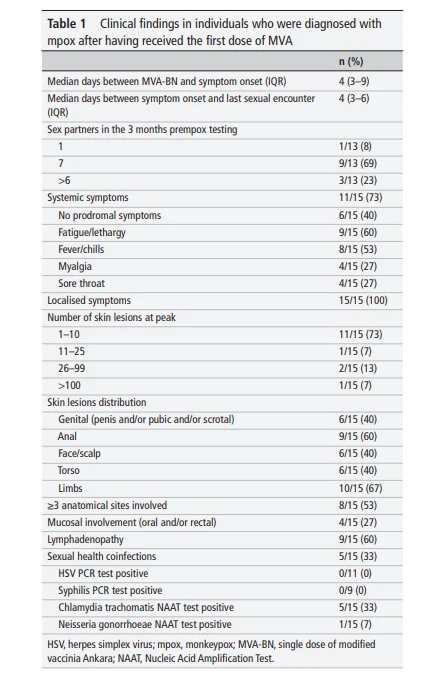
All individuals presented with pox-associated symptoms and skin lesions (data on clinical features are summarised in Table 1). While no one presented with immunosuppression, 3/15 (20%) had other anamnestic comorbidities (urticaria, eczema, and depression), and 11/15 (73%) individuals required further medical management following the pox diagnosis (9 received analgesics, 6 antibiotic treatment for secondary bacterial superinfections, 4 were empirically treated with an antiherpetic agent and 3 were administered laxatives). One individual required hospitalization to manage proctitis associated with severe pain and received treatment with oral Tecovirimat.
CONCLUSIONS
Our data show no clinical differences between the reported clinical findings in those developing pox without prior immunisation5 and those diagnosed following a single MVA-BN dose. We observed similar rates of prodromal symptoms, a low number of skin lesions, anogenital skin distribution of lesions, and the frequent need for further medical management of pox complications.
We observed low numbers of pox breakouts following MVA-BN immunization with a single dose (15/10 068, 0.15%), even when we accounted for the start of symptoms, rather than the pox PCR confirmation date. Figures were similar to those described in large cohort studies.4 6
Considering the short median time interval between inoculum and initial symptoms reported, we can infer that most individuals reported in our cohort may have been incubating pox at the time of vaccination or developed the illness without insufficient neutralized antibodies, rather than having experienced vaccine failure. However, one person developed pox symptoms 30 days after vaccination.
Preliminary data from 32 jurisdictions in the USA showed that unvaccinated individuals were 14 times more likely to contract pox than those vaccinated.4 In our caseload, for each individual diagnosed with pox after a single dose of MVA-BN, there were 37 diagnosed without previous vaccine exposure in the same time frame.
The retrospective nature of our data collection, the small number of patients from a single sexual health department, the potential underestimation of postvaccination pox cases due to individuals who may have been diagnosed with pox in other healthcare facilities, and conversely, having not disclosed previous pox vaccination at other sites before being diagnosed at our clinics represent the main limitations to our report. Multicentric studies are needed to effectively analyze vaccination failure rates and duration of the immune response, although we hope our report can be helpful to add further evidence backing vaccination efficacy, inform public health policymakers, and support those providing counseling to individuals at risk.
Handling editor
Anna Maria Geretti'
Contributors
NG and GGW contributed to the concept ideation, writing, and editing of the manuscript. SA, JM, and FB contributed to data collection, data analysis, and proofreading of the material submitted to the journal.
Funding
The authors have not declared a specific grant for this research from any funding agency in the public, commercial, or not-for-profit sectors.
Competing interests
None declared.
Patient consent for publication
Not applicable.
Ethics approval
This study involves human participants but informed consent was not sought as we are presenting clinical data from routine clinical activity and we are not presenting patient-identifiable data.
Provenance and peer review
Not commissioned; externally peer-reviewed.
This article is made freely available to access and read on the journal website by BMJ’s website terms and conditions for the duration of the monkeypox emergency or until otherwise determined by BMJ. You may download and print the article for personal or non-commercial use provided all copyright notices and trademarks are retained. If you wish to reuse any or all of this article please use the request permissions link.
REFERENCES
1 World Health Organization. 2022 monkeypox outbreak: global trends. Geneva; 2022. https://worldhealthorg.shinyapps.io/mpx_global/ [Accessed 11 Nov 2022].
2 Girometti N, Ogoina D, Tan DHS, et al. Intersecting HIV and pox epidemics: more questions than answers. J Int AIDS Soc 2022;25:e26043.
3 Fine PE, Jezek Z, Grab B, et al. The transmission potential of monkeypox virus in human populations. Int J Epidemiol 1988;17:643–50.
4 Payne AB, Ray LC, Kugeler KJ, et al. Incidence of monkeypox among unvaccinated persons compared with persons receiving ≥1 JYNNEOS vaccine dose - 32 U.S. Jurisdictions, July 31–September 3, 2022. MMWR Morb Mortal Wkly Rep 2022;71:1278–82.
5 Thornhill JP, Barkati S, Walmsley S, et al. Monkeypox virus infection in humans across 16 countries—April-June 2022. N Engl J Med 2022;387:679–91. 6 Hazra A, Rusie L, Hedberg T, et al. Human monkeypox virus infection in the immediate period after receiving the modified vaccinia Ankara vaccine. JAMA 2022;328:2064.
For more information:1950477648nn@gmail.com