Comparative Study On Chemical Constituents And Contents Of Cistanche Tubulosa (Guanhua Roucongrong) And Its Processed Products
Aug 14, 2026
Abstract
Objective: To investigate the variation (patterns of change) in chemical constituent contents of processed products of Cistanche tubulosa (Guanhua Roucongrong).
Methods: Five types of decoction pieces were selected, including raw slices, wine-steamed slices, steamed slices, stir-processed-with-black-beans slices, and black-bean-juice-processed slices. An HPLC fingerprint method was established and combined with similarity evaluation, cluster analysis (CA), and principal component analysis (PCA) to screen and confirm differential components between the raw product and processed products. Chemometric methods and HPLC were employed to determine and compare the differences in the contents of total phenylethanoid glycosides, polysaccharides, total flavonoids, and four phenylethanoid glycosides among the raw and processed samples.
Results: HPLC fingerprints of Cistanche tubulosa and its processed products were established. With Mark peak matching, 9 common peaks were assigned for raw slices, whereas 11 common peaks were assigned for the other four processed products. Peaks No. 2 and No. 7 were differential chromatographic peaks. By comparison with reference standards, four chromatographic peaks were identified as echinacoside, cistanoside A, acteoside, and isoacteoside. Fingerprints of the processed products showed similar profiles with the same number of common peaks; similarity values were all >0.9. Using echinacoside as the reference peak, the RSD of relative retention times of common peaks among different processed products ranged from 0.11% to 0.82%, while the RSD of relative peak areas ranged from 15.46% to 76.07%. When the inter-class distance was set to 10, CA classified raw slices and processed products into three categories. PCA indicated compositional differences between raw and processed samples: the 11 peak variables were reduced to three principal components; different principal components correlated with different chromatographic peaks. Based on the component matrix and linear weighting, comprehensive scores showed that black-bean-juice-processed slices and the yellow-wine-steamed and water-steamed slices ranked higher. The contents in raw and processed samples were as follows: total phenylethanoid glycosides 3.80%–7.07%, total polysaccharides 5.85%–6.70%, total flavonoids 14.16%–24.26%; echinacoside 4.11%–5.99%, acteoside 0.67%–1.34%, cistanoside A 0.06%–0.36%, and isoacteoside 0.25%–1.66%. Considerable differences existed among processed products.
Conclusion: The established HPLC fingerprint method has strong specificity, effectively distinguishes raw slices from processed products of Cistanche tubulosa, and is suitable for qualitative and quantitative analysis of echinacoside, acteoside, cistanoside A, and isoacteoside in the crude drug and processed products. The comparative profiling and of content changes among different samples can provide a scientific basis for identification and quality control of Cistanche tubulosa and its various processed products.
Keywords: Cistanche tubulosa; processing; chemical constituents; fingerprint; high-performance liquid chromatography (HPLC)
1 Introduction
Cistanche tubulosa (Schenk) Wight (Guanhua Roucongrong) is a perennial herb in Orobanchaceae and is an officially listed source of Cistanches Herba in the Pharmacopoeia of the People's Republic of China (hereinafter referred to as the "Chinese Pharmacopoeia"). The medicinal part is the dried fleshy stem with scaly leaves. It is warm in nature, sweet and salty in flavor, and enters the kidney and large intestine meridians, with functions of tonifying kidney yang, benefiting essence and blood, and moistening the intestines to relieve constipation [1]. Modern pharmacological studies have confirmed multiple activities, such as anti-aging, immune enhancement, kidney-tonifying and aphrodisiac effects, laxative effects, and antihypertensive activity.
Cistanche tubulosa is rich in phenylethanoid glycosides, iridoids and their glycosides, lignans, oligosaccharide esters, polyols, polysaccharides, flavonoids, and other constituents [2]. Among these, phenylethanoid glycosides are the major active components and the most abundant compounds; they are also the marker components for content determination in the pharmacopoeia, and exhibit diverse bioactivities such as antioxidant effects, metabolic promotion, improvement of learning and memory, and enhancement of sexual function [3].
Cistanche tubulosa prefers saline-alkali land and Gobi desert regions, parasitizes on roots of Tamarix spp., and is mainly distributed in Inner Mongolia, Xinjiang, and Gansu in China [4]. Wild and cultivated geo-authentic areas include Minfeng County, Yutian, Pishan, and Moyu in Hotan Prefecture, Xinjiang. Its processing is mainly developed into sliced decoction pieces, crude herbal materials, extracts, health products, and functional foods; among these, commercial decoction pieces remain mainstream. However, in the market, different processed products-such as raw slices, wine-processed slices, high-temperature enzyme-inactivated slices, and water-steamed slices-are often mixed and difficult to distinguish.
The processing of Cistanches Herba has evolved over time, from ancient records such as Taiping Shenghui Fang, Zhenglei Bencao, and Puji Fang [5–7] (e.g., washing with wine, stir-frying with wine, steaming/baking with wine, soaking/baking dry with wine, boiling in water, triple steaming, and butter stir-frying) to modern methods such as wine maceration (steaming), single steaming, "four-steaming and four-sunning", and black-bean processing [8]. Different processing methods can affect the content of active constituents, safety, and biological activity. Cai Hong et al. [9] found that enzyme inactivation of fresh material with 70 °C hot water for 6 min resulted in echinacoside and acteoside contents being 7.3-fold and 6.5-fold those of direct sun-drying, respectively. Tie Xiaoyan et al. [10] reported that steaming processing markedly improved the quality of decoction pieces compared with fresh materials. Chen Weijun et al. [11] observed that betaine content decreased after wine-, salt-, and steam-processing compared with fresh products. Zhang Chao et al. [12] showed that during wine-steaming, with longer steaming time, echinacoside, acteoside, cistanoside A, and 2′-acetylacteoside decreased gradually, whereas isoacteoside increased significantly.
The current 2025 edition of the Chinese Pharmacopoeia only sets limits for echinacoside and acteoside in raw slices and wine-steamed slices, but does not specify marker components for other processed products, and lacks effective content control methods. Therefore, analyzing and comparing characteristic constituents and exploring patterns of compositional changes are particularly important for qualitative identification and quantitative control of raw and processed products.
Traditional Chinese medicine (TCM) fingerprinting is a holistic representation of chemical constituents. With advantages of integrity, specificity, and rich information, it is widely used in quality control evaluation of crude drugs and preparations, alignment with international standards, authenticity identification, manufacturing process monitoring, and research on pharmacodynamic substances [13]. Based on HPLC fingerprinting, this study selected echinacoside, acteoside, cistanoside A, and isoacteoside as quality markers, and employed similarity analysis, CA, and PCA combined with content determination to compare chemical constituents and content change patterns among different processed products, providing a scientific basis for identification and quality control.
2 Instruments and Materials
2.1 Instruments
U3000 HPLC system (Thermo Fisher); UPL-111-20R ultrapure water system (Sichuan Youpu); AB 265-S electronic balance (Mettler Toledo); KQ-5200DA ultrasonic extractor/cleaner (Kunshan Ultrasonic); GZX-9240MBE electric drying oven (Shanghai Boxun); UV-2600 UV–Vis spectrophotometer (Shimadzu, China).
2.2 Drugs and Reagents
Fresh Cistanche tubulosa (Batch No. 20241008) was supplied by Xinjiang Congrongtang Biotechnology Co., Ltd. and authenticated by Researcher Wang Guoping (Xinjiang Uygur Autonomous Region Institute of Materia Medica) as the fleshy stem of Cistanche tubulosa (Schenk) Wight (Orobanchaceae).
Reference substances: D-glucose anhydrous (Batch No. 361810, 100.00%, Shenzhen Jinhui Biotechnology Co., Ltd.); echinacoside (Batch No. 111670-201907), rutin (Batch No. 100080-202012), acteoside (Batch No. 11530-202315), cistanoside A (Batch No. 313512), and isoacteoside (Batch No. 313413), with HPLC assay purity ≥91.8%, 92.2%, 97.6%, 98.06%, and 98.09%, respectively, from the National Institutes for Food and Drug Control (China). (Note: one purity line is truncated in the provided text; the above follows the readable portion.)
Yellow rice wine (semi-dry type, alcohol 16%; Zhejiang Guyuelongshan Shaoxing Wine Co., Ltd.); methanol and acetonitrile (HPLC grade, Fisher Scientific, USA). Other reagents were of analytical grade.
3 Methods and Results
3.1 Preparation of Raw Slices and Processed Products of Cistanche tubulosa
The following methods were used to prepare raw slices and processed products, each in 6 batches.
Raw slices: Fresh Cistanche was cut into 3 mm slices and dried at 60 °C.
Steaming method: According to the literature [14], 20 g of clean slices were mixed with 6 mL distilled water in a sealed container, moistened for 4 h [12], steamed over water for 12 h, cooled, and dried at 60 °C.
Wine-processing method: Prepared according to the wine-stewing or wine-steaming method (General Rule 0213, Chinese Pharmacopoeia).
Stir-processing with black beans: Prepared according to Chinese Materia Medica (Zhonghua Bencao) under Cistanches Herba; black beans were added at 1 kg per 10 kg of Cistanche material.
Black-bean-juice processing: Slices were mixed with black bean juice and then processed by the steaming method above; the black bean dosage was the same as above.
3.2 Determination of Inspection Items
Moisture was determined by oven-drying (General Rule 0832, Chinese Pharmacopoeia); total ash by General Rule 2302; alcohol-soluble extractives by the cold maceration method under General Rule 2201. Results are shown in Table 1.
3.3 Comparative Analysis of HPLC Fingerprints of Cistanche tubulosa and Its Processed Products
3.3.1 Chromatographic Conditions
Waters Xterra RP18 column (250 mm × 4.6 mm, 5 µm). Mobile phase: acetonitrile (A)–0.1% formic acid (B) with gradient elution: 0–12 min, 14% A → 17% A; 12–30 min, 17% A → 19% A; 30–35 min, 19% A → 14% A; 35–50 min, 14% A. Flow rate: 1.0 mL·min⁻¹. Column temperature: 30 °C. Detection wavelength: 330 nm. Injection volume: 10 µL.
3.3.2 Preparation of Solutions
Reference solutions: Echinacoside, acteoside, cistanoside A, and isoacteoside reference substances were accurately weighed and dissolved in 50% methanol in 10 mL volumetric flasks to obtain solutions of 1.1301, 0.2294, 0.2255, and 0.2109 mg·mL⁻¹, respectively; filtered to obtain final solutions.
Sample solutions: 0.5 g of 80-mesh powder of raw and processed samples was accurately weighed, extracted with 50% methanol in a 25 mL volumetric flask, ultrasonicated (200 W, 40 kHz) for 40 min, cooled, mixed, allowed to stand, and filtered through a 0.22 µm membrane; the filtrate was used.
3.3.3 Method Validation (Fingerprint)
3.3.3.1 Precision
The same sample solution was injected six consecutive times. Using echinacoside as the reference peak, the RSD of relative retention times of common peaks was <0.48% and the RSD of relative peak areas was <2.86%, indicating good instrumental precision.
3.3.3.2 Repeatability
Six parallel sample solutions were prepared from the same batch (raw slice S1). Using echinacoside as the reference peak, the RSD of relative retention times was <0.07% and the RSD of relative peak areas was <2.77%, indicating good method repeatability.
3.3.3.3 Stability
The same sample solution was analyzed at 0, 3, 6, 9, 12, and 24 h. Using echinacoside as the reference peak, the RSD of relative retention times was <0.11% and the RSD of relative peak areas was <2.33%, indicating stability within 24 h.
3.3.4 Establishment of Fingerprints
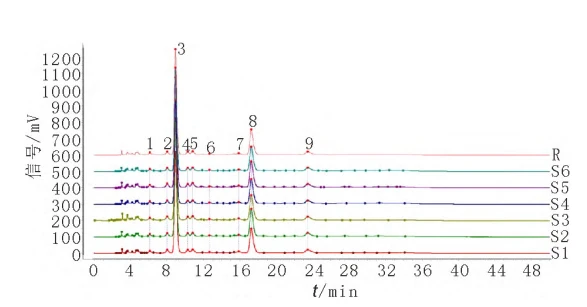
Thirty batches of Cistanche tubulosa and processed products were analyzed. The "Similarity Evaluation System for Chromatographic Fingerprint of Traditional Chinese Medicine" (2012 edition) was used. Raw slice S1 and yellow-wine-steamed slice J1 were used as reference fingerprints; the mean method and a time window width of 0.1 min were applied for multipoint correction and Mark peak matching to generate fingerprints (Figures 1–2), and overlaid chromatograms with mixed reference standards were obtained (Figure 3).
Results showed that the four processed products had fingerprint profiles similar to those of raw slices. Raw slices had 9 common peaks, while wine-steamed, steamed, stir-processed-with-black-beans, and black-bean-juice-processed slices had 11 common peaks. Nine common peaks were shared by both. Peaks No. 2 and No. 7 were characteristic peaks distinguishing raw slices from processed products. Fingerprint profiles among the four processed products were similar, and did not clearly reflect differences among them.
3.3.5 Similarity Analysis
Using J1 as the reference fingerprint, similarity analysis was performed for different processed products (Table 2). Similarities were all >0.9, indicating similar fingerprint characteristics among different processed products.
3.3.6 Identification of Common Peaks
By comparing retention times with mixed reference standards and the raw-slice chromatogram, four chromatographic peaks were identified: Peak 4, echinacoside; Peak 9, cistanoside A; Peak 10, acteoside; Peak 11, isoacteoside (Figure 2). With Peak 4 (echinacoside) as the reference peak, RSD values of relative retention times of common peaks among different batches of the four processed products ranged from 0.11% to 0.82%, and RSD values of relative peak areas ranged from 15.46% to 76.07%.
3.3.7 Cluster Analysis
SPSS 27.0 was used for cluster analysis of raw slices and processed products. Inter-group linkage was applied and squared Euclidean distance was used (Figure 4). When the inter-class distance was <5, water-steamed slices and wine-steamed slices clustered together. When the inter-class distance was 10, raw slices and the four processed products were classified into three categories: raw materials (S1–S6) as one category; black-bean-juice-processed slices (H1–H6) as one category; and wine-steamed slices (J1–J6) together with water-steamed slices (Q1–Q6) and stir-processed-with-black-beans slices (C1–C6) as one category. When the inter-class distance was between 15 and 25, black-bean-juice-processed slices formed a separate cluster from the other samples.
3.3.8 Principal Component Analysis
After standardization of peak areas, PCA was performed using SPSS 27.0. The KMO value was 0.679 and Bartlett's test significance was <0.001, indicating suitability for PCA. With eigenvalues >1, three principal components were extracted with eigenvalues 6.815, 1.987, and 1.105. The variance contribution rates were 61.954%, 18.063%, and 10.047%, respectively, with a cumulative variance contribution rate of 90.064% (Table 3). This indicates that the first principal component is the most important indicator for the comprehensive score.
The component matrix showed that in the first principal component, the absolute coefficients of peak area variables for Peaks 2–9 and Peak 11 were relatively large, suggesting strong influence on F1. The second principal component correlated with the information of Peaks 1 and 10, and the third principal component correlated with Peak 1. The component matrix is shown in Table 4; the scree plot and loading plot are shown in Figures 5 and 6. Using the scores of the three principal components and their variance contribution rates as weights for linear weighting, comprehensive scores were calculated (Table 5), indicating that black-bean-juice-processed slices, water-steamed slices, and wine-steamed slices ranked higher.
3.4 HPLC Determination of Multiple Constituents in Cistanche tubulosa and Its Processed Products
3.4.1 Chromatographic Conditions and Specificity
Chromatographic conditions were the same as those used for fingerprinting. Sample solutions, reference solutions, and negative blank solutions (yellow rice wine, purified water, black bean juice) were each injected (10 µL). Retention times were compared. The negative blank solutions showed no interference with echinacoside, cistanoside A, acteoside, and isoacteoside. [text missing in source]
3.4.2 Linearity
Reference solutions of echinacoside, acteoside, cistanoside A, and isoacteoside at concentrations of 1.1301, 0.2294, 0.2255, and 0.2109 mg·mL⁻¹ were accurately pipetted at 1, 2, 4, 8, 10, and 16 µL and injected. Linear regression was performed with peak area XXX versus injected concentration YYY (mg·mL⁻¹). The linear equations and ranges are shown in Table 6.
3.4.3 Precision
The same sample solution was injected six consecutive times. RSD values of contents for the four analytes (echinacoside, cistanoside A, acteoside, isoacteoside) were 0.23%, 2.71%, 0.53%, and 2.08%, respectively (Table 7), all <3%, indicating good instrumental precision.
3.4.4 Repeatability
Six parallel sample solutions were prepared from the same batch (raw slice S1). RSD values of contents for the four analytes were 0.22%, 2.46%, 0.50%, and 2.46%, respectively (Table 7), all <3%, indicating good repeatability.
3.4.5 Stability (Intra-day)
The same sample solution was analyzed at 0, 3, 6, 9, 12, and 24 h. RSD values of contents for the four analytes were 0.80%, 1.62%, 1.72%, and 1.49%, respectively (Table 7), all <2.0%, indicating stability within 24 h.
3.4.6 Stability (Inter-day)
The same sample solution was analyzed for five consecutive days. RSD values of contents for the four analytes over five days were 2.80%, 2.53%, 3.53%, and 2.88%, respectively (Table 7), indicating stability within five days.
3.4.7 Recovery
An appropriate amount of Cistanche tubulosa sample was weighed, and reference standards of echinacoside, acteoside, cistanoside A, and isoacteoside were spiked at a 1:1 ratio. Six parallel sample solutions were prepared and analyzed (10 µL injection). Mean recoveries were 99.29%, 98.75%, 99.45%, and 96.13% (n=6), with RSD values of 2.51%, 0.38%, 1.71%, and 0.49%, respectively.
3.4.8 Determination Results
For each sample, 0.5 g of powder was accurately weighed; 10 µL was injected to determine and calculate the percentage contents of the four constituents. Results are shown in Figures 7–10.
3.5 Determination of Total Phenylethanoid Glycosides, Total Polysaccharides, and Total Flavonoids
3.5.1 Determination of Total Phenylethanoid Glycosides
3.5.1.1 Preparation of Reference Solution
An appropriate amount of echinacoside reference substance was accurately weighed and dissolved in methanol in a 10 mL volumetric flask to obtain a solution with a concentration of 0.32 mg·mL⁻¹. According to the literature [15], 0.1, 0.2, 0.4, 0.6, 0.8, 1.0, and 1.2 mL of the reference solution were pipetted, diluted to 10 mL with methanol, and absorbance (A) was measured at 333 nm. The fitted standard curve equation was Y=24.7596X+0.0147Y = 24.7596X + 0.0147Y=24.7596X+0.0147, R2=0.9995R^2 = 0.9995R2=0.9995, with a linear range of 0.0029–0.0359 mg·mL⁻¹.
3.5.1.2 Preparation of Sample Solution
100 mg of sample powder (passed through a 100-mesh sieve) was accurately weighed, extracted ultrasonically with methanol for 30 min (200 W, 40 kHz), diluted to 10 mL, and filtered through a 0.22 µm membrane. Then 0.2 mL of filtrate was further diluted to 10 mL with methanol and mixed for analysis.
3.5.1.3 Determination
For each sample, 100 mg of powder was used to prepare the sample solution. Absorbance was measured at 333 nm and the percentage content of total phenylethanoid glycosides was calculated (Table 9).
Equation (1):
Content (%) =C×V×Dm×100%= \dfrac{C \times V \times D}{m} \times 100\%=mC×V×D×100%
where CCC is the concentration of the analyte in the sample solution, VVV is the dilution volume, DDD is the dilution factor, and mmm is the sample mass (mg).
3.5.2 Determination of Total Polysaccharides
3.5.2.1 Preparation of Reference Solution
An appropriate amount of D-glucose anhydrous reference substance was accurately weighed, dissolved in purified water, and diluted to 10 mL to obtain a solution of 0.190 mg·mL⁻¹. After mixing and filtration (0.22 µm), 0.2, 0.4, 0.6, 0.8, and 1.0 mL were pipetted. Color development was performed by the anthrone–sulfuric acid method [16]. Absorbance was measured at 625 nm. The fitted standard curve equation was Y=35.1316X−0.0079Y = 35.1316X - 0.0079Y=35.1316X−0.0079, R2=0.9957R^2 = 0.9957R2=0.9957, with a linear range of 0.0038–0.0190 mg·mL⁻¹.
3.5.2.2 Preparation of Sample Solution
40 mg of sample powder was accurately weighed, ultrasonically dissolved in purified water for 30 min (200 W, 40 kHz), diluted to 10 mL, and filtered through a 0.22 µm membrane.
3.5.2.3 Determination
For each sample, 40 mg was used to prepare the sample solution. Then 0.1 mL of filtrate was pipetted and supplemented with purified water to 2.00 mL. After color development by the anthrone–sulfuric acid method, absorbance was measured and the percentage content of total polysaccharides was calculated (Table 8).
3.5.3 Determination of Total Flavonoids
3.5.3.1 Preparation of Reference Solution
An appropriate amount of rutin reference substance was accurately weighed, dissolved in 70% ethanol, and diluted to 25 mL; filtered through a 0.22 µm membrane. Then 0.5, 1.0, 2.0, 3.0, and 4.0 mL were pipetted. Color development was performed using the sodium nitrite–aluminum nitrate–sodium hydroxide method [17]. Absorbance was measured at 510 nm. The fitted standard curve equation was Y=11.5699X+0.0684Y = 11.5699X + 0.0684Y=11.5699X+0.0684, R2=0.9989R^2 = 0.9989R2=0.9989, with a linear range of 0.0097–0.07386 mg·mL⁻¹.
3.5.3.2 Preparation of Sample Solution
50 mg of powder was accurately weighed, ultrasonically dissolved in 70% ethanol for 30 min (200 W, 40 kHz), diluted to 10 mL, and filtered through a 0.22 µm membrane.
3.5.3.3 Determination
For each sample, 50 mg was used to prepare the sample solution. Then 0.5 mL of filtrate was transferred into a 10 mL volumetric flask and color reagents were added in sequence as above. Purified water served as the blank. Absorbance was measured and the percentage content of total flavonoids was calculated (Table 8).
4 Discussion
In this study, HPLC fingerprints of Cistanche tubulosa and its various processed products were established. Peak matching across different batches confirmed 9 common peaks in raw slices and 11 common peaks in processed products. By comparison with reference standards, four common peaks were identified as echinacoside, cistanoside A, acteoside, and isoacteoside. Similarity analysis showed that similarity values among four processed products were all >0.9, and the overall fingerprint profiles were similar, indicating that their constituent types were close. However, the large differences in RSD of relative peak areas suggest notable differences in constituent contents.
Compared with raw slices, the four processed products exhibited two additional peaks (Peaks 2 and 7), indicating that chemical constituents changed after wine-steaming, water-steaming, or black-bean processing. These newly generated peaks are presumed to be formed during processing; their component characterization will be addressed in subsequent studies.
CA results showed that when the inter-class distance was <5, wine-steamed and water-steamed slices clustered together, suggesting similar chemical composition and content. At an inter-class distance of 10, raw slices could be separated from black-bean-juice-processed slices, stir-processed-with-black-beans slices, and wine/water-steamed slices. At inter-class distances of 15–25, differences between black-bean-juice-processed slices and other samples became more prominent. PCA results indicated that three principal components had substantial influence on comprehensive evaluation.
Different processing methods directly affected the levels of various constituents. Based on chemometric determination, the total phenylethanoid glycosides ranked as: black-bean-juice-processed > raw slices > water-steamed > wine-steamed > stir-processed-with-black-beans. Total polysaccharides ranked as: water-steamed > wine-steamed > stir-processed-with-black-beans > black-bean-juice-processed > raw slices. Total flavonoids ranked as: black-bean-juice-processed > water-steamed > stir-processed-with-black-beans > wine-steamed > raw slices. Compared with raw slices, black-bean-juice processing increased total phenylethanoid glycosides, whereas other processing methods decreased it; all four processing methods significantly increased total polysaccharides and total flavonoids. Between the two black-bean methods, black-bean-juice processing produced larger increases in total phenylethanoid glycosides and total flavonoids than stir-processing with black beans, with statistical differences.
Table 8. Determination results of total phenylethanoid glycosides, total polysaccharides, and total flavonoids in Cistanche tubulosa and its processed products
| Processed product (decoction pieces) | Total phenylethanoid glycosides (%) | Total polysaccharides (%) | Total flavonoids (%) |
|---|---|---|---|
| Raw slices | 6.81 ± 0.06 | 5.85 ± 0.10 | 14.16 ± 0.24 |
| Wine-steamed slices | 5.10 ± 0.05*** | 6.61 ± 0.05*** | 20.84 ± 0.33*** |
| Water-steamed slices | 5.23 ± 0.05*** | 6.70 ± 0.15*** | 21.59 ± 0.37*** |
| Stir-processed with black beans slices | 3.80 ± 0.02*** | 6.56 ± 0.09*** | 21.02 ± 0.35*** |
| Black-bean-juice-processed slices | 7.07 ± 0.09**** | 6.09 ± 0.03**** | 24.26 ± 0.18**** |
Notes: Compared with raw slices: *P < 0.05, **P < 0.01, ***P < 0.001; compared with stir-processed-with-black-beans slices: *P < 0.05, **P < 0.01, ***P < 0.001.
Echinacoside, acteoside, cistanoside A, and isoacteoside are key phenylethanoid glycosides contributing to the kidney-tonifying and essence-benefiting effects of Cistanche tubulosa. HPLC comparison of these four constituents showed that peak-area differences among common peaks could serve as a basis to distinguish different processed products. Compared with raw slices, echinacoside, cistanoside A, and isoacteoside increased to varying degrees in processed products, with more pronounced increases in black-bean-juice products. Acteoside decreased in three processed products but increased in stir-processed-with-black-beans products. This may relate to the inherent stability of acteoside: as a phenylethanoid diglycoside with a caffeoyl moiety, it may undergo ester bond cleavage under changes in heating temperature, time, and pH to generate caffeic acid, and partially isomerize to isoacteoside. The observed decrease in acteoside and increase in isoacteoside in the four processed products may be associated with high-temperature steaming, consistent with patterns reported for Rehmanniae Radix processing [18].
Echinacoside increased after wine/water steaming and black-bean processing in this study, which is contrary to Zhang Chao et al. [12]. Comparing stir-processing with black beans and black-bean-juice processing, the latter showed significantly higher contents of echinacoside and cistanoside A and a more pronounced conversion trend from acteoside to isoacteoside. Overall, this study reveals compositional and content changes after various processing methods and verifies the change规律 between acteoside and isoacteoside. The HPLC fingerprints provide a scientific method to identify raw slices and processed products, and offer a reference for establishing quality-control standards and for qualitative and quantitative analyses.
Conflict of Interest
The authors declare no conflict of interest.
Author Contributions
XU Xiaoqin: project support, study design, experimental determination, and manuscript writing;
QING Degang: overall coordination and collection of medicinal materials;
ZHANG Juan and ZHAO Peng'an: constituent determination and data analysis;
WANG Guoping: authentication of medicinal materials.
Cistanche Sample Factory:
https://www.xjcistanche.com/about-us
References
[1] Pharmacopoeia Commission of the Ministry of Health of the People's Republic of China. Pharmacopoeia of the People's Republic of China [M]. Beijing: Chemical Industry Press, 2025.
[2] Jia Xiaoguang, Ni Hui, Zhang Juan, et al. Research and industrial development status of Cistanche tubulosa [J]. Journal of Xinjiang Medical University, 2012, 35(7): 876–880.
[3] Liu Yuewen. Research progress on phenylethanoid glycosides in Cistanche tubulosa [J]. Contemporary Agricultural Machinery, 2020(11): 60–62.
[4] Tu Pengfei. Re-examination of the herbal textual evidence for Cistanches Herba [J]. China Journal of Chinese Materia Medica, 2022, 47(20): 5670–5679.
[5] Zhu Su, Teng Shuo, Liu Chun. Puji Fang [M]. Beijing: People's Medical Publishing House, 1959.
[6] Wang Huaiyin. Taiping Shenghui Fang [M]. Beijing: People's Medical Publishing House, 1959.
[7] Tang Shenwei. Chongxiu Zhenghe Jingshi Zhenglei Beiyong Bencao [M]. Beijing: People's Medical Publishing House, 1957.
[8] Zhang Yong, Wu Huan. Historical evolution of processing methods for Cistanches Herba [J]. China Journal of Chinese Materia Medica, 1992, 17(4): 213–214.
[9] Cai Hong, Bao Zhong, Jiang Yong. Processing technology for fresh Cistanche tubulosa [J]. China Journal of Chinese Materia Medica, 2007, 32(13): 1289–1291.
[10] Tie Xiaoyan, Feng Yinping, Ma Dongni. Effect of origin-area steaming processing on the quality of desert Cistanches Herba [J]. Journal of Traditional Chinese Veterinary Medicine, 2021, 40(2): 54–56.
[11] Chen Weijun, Jia Cuiyu, Li Lianjiang. Effects of different processing methods on betaine content in Xinjiang Cistanche tubulosa [J]. Agricultural Reclamation Medicine, 2009, 31(5): 400–402.
[12] Zhang Chao, Hua Yue, Lian Jing, et al. Study on content variation规律 of phenylethanoid glycosides during processing of Cistanches Herba [J]. Chinese Journal of Information on Traditional Chinese Medicine, 2022, 29(4): 92–97.
[13] Wu Chunxing, Yang Yang, Meng Mei, et al. Research status and trend analysis of TCM fingerprinting in the past decade [J]. Journal of Minzu University of China (Natural Sciences Edition), 2024, 33(4): 63–72.
[14] Jiang Yong, Bao Zhong, Sun Yongqiang. Study on processing technology of Cistanches Herba slices [J]. Chinese Pharmaceutical Journal, 2011, 46(14): 1074–1076.
[15] Zhang Leihong, Du Niansheng, Wang Qing. Determination of phenylethanoid glycosides in Cistanches Herba total glycoside capsules by UV spectrophotometry [J]. Journal of Xinjiang Medical University, 2002, 25(4): 407–408.
[16] Ailadan·Maimaiti Aili, Yang Ting, Yuan Jie. Extraction process and in vitro antioxidant activity of polysaccharides from residues of Cistanche tubulosa [J]. Chemical and Biochemical Engineering Quarterly (translated journal name based on Chinese), 2020, 37(2): 36–41.
[17] Luo Yan. Optimization of extraction process of total flavonoids from Cistanche tubulosa [D]. Shihezi: Shihezi University, 2015.
[18] Shan Guoshun, Zhao Qimiao, Li Rui, et al. Dynamic study of acteoside content during processing of Rehmannia glutinosa [J]. Asia-Pacific Traditional Medicine, 2019, 15(3): 37–39.