Competition Between Desired Competitive Result, Tolerable Homeostatic Disturbance, And Psychophysiological Interpretation Determines Pacing Strategy Part 2
Sep 26, 2023
Cistanche can act as an anti-fatigue and stamina enhancer, and experimental studies have shown that the decoction of Cistanche tubulosa could effectively protect the liver hepatocytes and endothelial cells damaged in weight-bearing swimming mice, upregulate the expression of NOS3, and promote hepatic glycogen synthesis, thus exerting anti-fatigue efficacy. Phenylethanoid glycoside-rich Cistanche tubulosa extract could significantly reduce the serum creatine kinase, lactate dehydrogenase, and lactate levels, and increase the hemoglobin (HB) and glucose levels in ICR mice, and this could play an anti-fatigue role by decreasing the muscle damage and delaying the lactic acid enrichment for energy storage in mice. Compound Cistanche Tubulosa Tablets significantly prolonged the weight-bearing swimming time, increased the hepatic glycogen reserve, and decreased the serum urea level after exercise in mice, showing its anti-fatigue effect. The decoction of Cistanchis can improve endurance and accelerate the elimination of fatigue in exercising mice, and can also reduce the elevation of serum creatine kinase after load exercise and keep the ultrastructure of skeletal muscle of mice normal after exercise, which indicates that it has the effects of enhancing physical strength and anti-fatigue. Cistanchis also significantly prolonged the survival time of nitrite-poisoned mice and enhanced the tolerance against hypoxia and fatigue.

Click on extreme fatigue
【For more info:george.deng@wecistanche.com / WhatsApp:8613632399501】
Since the paper by Paavolainen et al,122 it is well accepted that “muscle power factors” contribute to performance. The contribution of neuromuscular factors to pacing in endurance events has been scarcely addressed. Damasceno et al123 documented that improvements in strength influenced the last 2.8 of 10-km races. This finding agrees with cross-sectional studies reporting positive influences of diverse neuromuscular performances on pacing in endurance athletes. Intervention studies have suggested potentiation effects of strength exercises during warming up on the first laps of short time trials in runners,124–127 cyclists,128 and rowers,129 without improving overall performance. Conversely, impaired neuromuscular function after static stretching130 reduced the starting speed of 3km running trials without affecting the final time. Therefore, current evidence suggests that neuromuscular function and postactivation performance enhancement would allow optimal pacing behaviors while counteracting the effects of fatigue.131
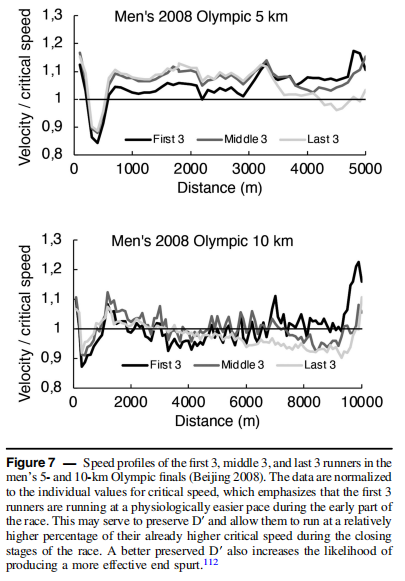

One of the most consistent and striking findings in the pacing literature is the near-universal presence of the end-spurt in events of >2- to 3-minute duration, particularly in head-to-head competition. Presumably, this evidence of “reserve” in the pattern of energetic expenditure is hard-wired into exercise patterns by evolutionary history as hunter-gatherers, who needed to preserve reserve until “closing in for the kill.”132 It can be argued that the interaction of muscle fiber type, lactate accumulation, and preservation of anaerobic reserve (D′) can act to define pacing. Athletes with higher %type II motor units are predisposed to have more top-end power or speed.133,134 However, since higher %type II motor units have a lower muscle respiratory capacity and lactate threshold (a surrogate of CS135), it is likely that the consistent pattern of runners with a higher %type I fibers attempt to “burn off” lesser runners 104 is representative of the need to remove the inherently better sprinters before the competitively critical moment of the race. Certainly, the best evidence is that the athletes winning in the final sprint are those who have best preserved their anaerobic capacity (D′).108 Thus, the essential pacing decision within an event is whether natural sprinters (high %type II motor units, high D′) can remain in contact with more endurance-oriented athletes (high %type I motor units, high muscle respiratory capacity, high CS).
Practical Applications
Pacing, the way an athlete expends energy during a competition, depends on several factors. Although the term pacing strategy is widely used, the term is probably too broad, as “strategy” encompasses the overall race plan, the tactics used to accomplish the strategy, and the highly responsive pattern of energy expenditure, which are all designed to achieve competitive outcomes. The first is the competitive result (best performance vs. defeating competitors). This will lead to whether the pattern of energetic output is smooth and based on the time–distance characteristics of the event or stochastic, where energetic output is focused on “dropping” competitors or preserving energy for the end-spurt. To accomplish these goals, an athlete needs to have a sense of their capacity and be able to interpret internal feedback indicating the magnitude of homeostatic disturbances. They also need to have a good sense of their competitor’s capabilities and be able to interpret signals from their competitors, to vary their tactics. Thus, while the pacing strategy is not likely to discriminate between athletes of widely varying abilities, it may be critical to achieving a desired competitive result in a tolerable physiological state.
Conclusion
Pacing strategies have been of interest to exercise physiologists for at least the last 30 years. Several models have emerged through the years attempting to predict the optimal pattern to finish an event without excess fatigue or excess remaining energy at the finish. These models have shown that pacing reflects a complex relationship between environmental stressors, physiological feedback, and psychological drive with a default pattern of a relatively “even” pacing strategy with a brief “fast start” to optimize time-centric versus head-to-head competition. These templates are robust even in the face of conditions that predictably would change them (hypoxia, glycogen depletion, etc.). Athletes revert to the baseline template unless there is a conscious effort to change for tactical reasons. However, templates may have progressive modifications through repeated performances. Once an “ideal” pacing template is achieved, the athlete may use the “concept of affordances” to modify pacing based on events occurring within an event. Although progressive growth of RPE is characteristic of pacing, more subtle psychodynamic factors such as effect (valence) appear to be more discriminatory than RPE on whether an athlete remains with competitors or “let's go” partway through an event.

References
1. Ulmer H-V. Concept of an extracellular regulation of muscular metabolic rate during heavy exercise in humans by psychophysiological feedback. Experienta. 1996;52(5):416–420.
2. Smits B, Pepping GJ, Hettinga FJ. Pacing and decision-making in sport and exercise: on the roles of perception and action in the regulation of exercise intensity. Sports Med. 2014;44(6):763–775.
3. Enoka RM, Duchateau J. Translating fatigue to human performance. Med Sci Sports Exerc. 2016;48:2222–2238.
4. Marcora SM, Staiano W. The limit to exercise tolerance in humans: mind over muscle? Eur J Appl Physiol. 2010;109(4):763–770.
5. Marcora SM. Do we need a central governor to explain brain regulation of exercise performance? Eur J Appl Physiol. 2008;104(5): 929–931.
6. Edwards AM, Polman RCJ. Pacing and awareness: brain regulation of physical activity. Sports Med. 2013;43(11):1057–1064.
7. Triplett N. The dynamogenic factors on pacemaking and competition. Am J Psychol. 1898;9(4):507–533.
8. Vanhatalo A, Jones AM, Burnley M. Application of critical power in sport. Int J Sports Physiol Perform. 2011;6(1):128–136.
9. Pugh LG. The influence of wind resistance in running and walking and the mechanical efficiency of work against horizontal or vertical forces. J Physiol. 1971;213(2):255–276.
10. Konings MJ, Hettinga FJ. Pacing decision making in sport and the effects of interpersonal competition: a critical review. Sports Med. 2018;48(8):1829–1843.
11. Kennelly AE. An approximate law of fatigue in the speeds of racing animals. Proc Am Acad Arts Sci. 1906;42(15):275–331.
12. Hill AV. The physiological basis of athletic records. Lancet. 1925; 206:481–486.
13. Robinson S, Robinson DL, Mountjoy RJ, Bullard RW. Influence of fatigue on the efficiency of men during exhausting runs. J Appl Physiol. 1958;12(2):197–201.
14. Van Ingen Schenau GJ, de Koning JJ, de Groot G. The distribution of anaerobic energy in 1000 and 4000 metre cycling bouts. Int J Sports Med. 1992;13(6):447–451.
15. Foster C, Snyder AC, Thompson NN, Green MA, Foley M, Schrager M. Effect of pacing strategy on cycle time trial performance. Med Sci Sports Exerc. 1993;25:383–388. PubMed ID: 8455455
16. Foster C, Schrager M, Snyder AC, Thompson NN. Pacing strategy and athletic performance. Sports Med. 1994;17(2):77–85.
17. De Koning JJ, Bobbert MF, Foster C. Determination of optimal pacing strategy in track cycling with an energy flow model. J Sci Med Sport. 1999;2(3):266–277.
18. De Koning JJ, de Groot G, van Ingen Schenau GJ. A power equation for the sprint in speed skating. J Biomech. 1992;25(6):573–580.
19. Van Ingen Schenau GJ, de Koning JJ, de Groot G. A simulation of speed skating performances based on a power equation. Med Sci Sports Exerc. 1990;22(5):718–728.
20. Roelands B, de Koning JJ, Foster C, et al. Neurophysiological determinants of theoretical concepts and mechanisms of pacing. Sports Med. 2013;43(5):301–311.
21. Foster C, de Koning JJ, Hettinga F, et al. The pattern of energy expenditure during simulated competition. Med Sci Sports Exerc. 2003;35(5): 826–831.
22. Foster C, Hoyos J, Earnest C, Lucia A. Regulation of energy expenditure during prolonged athletic competition. Med Sci Sports Exerc. 2005;37(4):670–675.
23. Noakes TD, Lambert MI, Hauman R. Which lap is the slowest? An analysis of 32 world record performances. Br J Sports Med. 2009;43(10):760–764.
24. Foster C, de Koning JJ, Thiel C. Evolutionary patterns of improved 1-mile running performance. Int J Sports Physiol Perform. 2014; 9(4):715–719.
25. Foster C, de Koning JJ, Thiel C, et al. Beating yourself: how do runners improve their records? Int J Sports Physiol Perform. 2020;15:437–440. doi:10.1123/ijspp.2019-0261
26. Foster C, de Koning JJ, Hettinga F, et al. Effect of competitive distance on energy expenditure during simulated competition. Int J Sports Med. 2004;25(3):198–204.
27. De Jong J, van der Meijden L, Hamby S, et al. Pacing strategy in short cycling time trials. Int J Sports Physiol Perform. 2015;10(8):1015– 1022.
28. Joseph T, Johnson B, Battista RA, et al. Perception of fatigue during simulated competition. Med Sci Sports Exerc. 2008;40(2):381–386.
29. Foster C, de Koning JJ, Bischel S, et al. Pacing strategies for endurance performance. In: Mujika I, ed. Endurance Training: Science and Practice. Victoria Gasteiz; 2012.
30. Halperin I, Aboodarda SV, Basset FA, et al. Pacing strategies during repeated maximal voluntary contractions. Eur J Appl Physiol. 2014; 114(7):1413–1420.
31. Noakes TD. Fatigue is a brain-derived emotion that regulates exercise behavior to ensure the protection of whole-body homeostasis. Front Physiol. 2012;3:82.
32. Karlsson J, Saltin B. Lactate, ATP and CP in working muscle during exhaustive exercise in man. J Appl Physiol. 1970;29(5):598–602.
33. Jones AM, Wilkerson DP, Di Menna F, Fulford J, Poole DC. Muscle metabolic responses to exercise above and below the “critical power” assessed using 31P MRS. Am J Physiol Regul Intergr Comp Physiol. 2008;294(2):R585–R593.
34. Vanhatalo A, Fulford J, Di Menna FJ, Jones AM. Influence of hyperoxia on muscle metabolic responses and the power-duration relationship during severe-intensity exercise in humans: a 31P magnetic resonance spectroscopy study. Exp Physiol. 2010;95(4):528– 540.
35. Laurenco TF, Nunes LAS, Martins LEB, Brenzikovfer R, Macedo PV. The performance in 10km races depends on blood buffering capacity. J Athl Enhanc. 2019;8:1–7.
36. Black MI, Jones AM, Blackwell JR, et al. Muscle metabolic and neuromuscular determinants of fatigue during cycling in different intensity domains. J Appl Physiol. 2017;122(3):446–459.
37. Vanhatalo A, Doust JH, Burnley M. Determination of critical power using a 3-min all-out cycling test. Med Sci Sports Exerc. 2007;39(3): 548–555.
38. St Clair Gibson A, Noakes TD. Evidence for complex system integration and dynamic neural regulation of skeletal muscle recruitment during exercise in humans. Br J Sports Med. 2004;38(6):797– 806.
39. Lambert EV, St Clair Gibson A, Noakes TD. Complex systems model of fatigue: integrative homeostatic control of peripheral physiological systems during exercise in humans. Br J Sports Med. 2005;39(1):52– 62.
40. Noakes TD, St Clair Gibson A, Lambert EV. From catastrophe to complexity: a novel model of integrative central neural regulation of effort and fatigue during exercise in humans: summary and conclusions. Br J Sports Med. 2005;39(2):120–124
41. St Clair Gibson A, Foster C. The role of self-talk in the awareness of physiological state and physical performance. Sports Med. 2007; 37(12):1029–1044.
42. St Clair Gibson A, de Koning JJ, Thompson KG, et al. Crawling to the finish line: why do endurance runners collapse? Sports Med. 2013;43(6):413–424.
43. Amann M. Central and peripheral fatigue: interaction during cycling exercise in humans. Med Sci Sports Exerc. 2011;43(11):2039–2045.
4. Burnley M, Doust J, Jones AM. Effects of prior warm-up regime on severe intensity cycling performance. Med Sci Sports Exerc. 2005; 37(5):838–845.
45. Abbiss CR, Laursen PB. Describing and understanding pacing strategies during athletic competition. Sports Med. 2008;38:238– 252.
46. Karlsson J, Saltin B. Diet, muscle glycogen and endurance performance. J Appl Physiol. 1971;31(2):203–206.
47. Bergstrom J, Hermansen L, Hultman E, Saltin B. Diet, muscle glycogen and physical performance. Acta Physiol Scand. 1967;71: 140–150.

48. Rauch GGL, St Clair Gibson A, Lambert EV, Noakes TD. A signaling role for muscle glycogen in the regulation of pace during prolonged exercise. Br J Sports Med. 2005;39(1):34–38.
49. Gonzalez-Alonso J, Teller C, Anderson SL, et al. Influence of body temperature on the development of fatigue during prolonged exercise in the heat. J Appl Physiol. 1999;86:1032–1039.
50. Crew H, Tucker R, Noakes TD. The rate of increase in the rating of perceived exertion predicts the duration of exercise to fatigue at a fixed power output in different environments. Eur J Appl Physiol. 2008;103:569–577.
51. Levels K, de Koning JJ, Broekhuijzen I, et al. Effects of radiant heat exposure on pacing pattern during an 1150km cycling time trial. J Sports Sci. 2014;32(9):845–852.
52. De Koning JJ, Foster C, Lucia A, et al. Using modeling understand how athletes in different disciplines solve the same problem: swimming vs. running vs. speed skating. Int J Sports Physiol Perform. 2011;6(2):276–280.
53. Swart J, Lamberts RP, Lampert MI, et al. Exercising with reserve: exercise regulation by perceived exertion about the duration of exercise and knowledge of endpoint. Br J Sports Med. 2009;43(10): 775–781. doi:10.1136/bjsm.2008.056036
54. Swart J, Lamberts RP, Lambert MI, et al. Exercising with reserve: evidence that the central nervous system regulates prolonged exercise performance. Br J Sports Med. 2009;43(10):782–788.
55. Hettinga FJ, de Koning JJ, Schmidt LJI, Wind NAC, MacIntosh BR, Foster C. Optimal pacing strategy: from theoretical modeling to reality in 1500-m speed skating. Br J Sports Med. 2011;45(1):30– 35.
56. De Koning JJ, Foster C, Lampen J, Hettinga F, Bobbert MF. Experimental evaluation of the power balance model of speed skating. J Appl Physiol. 2005;98(1):227–233.
57. Azevedo RA, Milioni F, Morias JN, Bertucci R, Millet GY. Dynamic changes of performance fatiguability and muscular O2 saturation in a 4-km cycling time trial. Med Sci Sports Exerc. 2021;53(3):613–623.
58. Casado A, Hanley B, Jimenez-Reyes P, Renfree A. Pacing profiles and tactical behavior of elite runners. J Sport Health Sci. 2021; 10(5):537–549.
59. Micklewright D, Kegerreis S, Raglin J, Hettinga FJ. Will the conscious-unconscious pacing quagmire help elucidate the mechanisms of self-paced exercise: new opportunities in dual process theory and process tracing mechanisms? Sports Med. 2017;47(7):1231–1239.
60. Albertus Y, Tucker R, St Clair Gibson A, Lambert EV, Hampson DB, Noakes TD. Effect of distance feedback on pacing strategy and perceived exertion during cycling. Med Sci Sports Exerc. 2005; 37(3):461–468.
61. Jones HS, Williams EL, Bridge CA, et al. Physiological and psychological effects of deception on pacing strategy and performance. Sports Med. 2013;43(12):1243–1257.
62. Stone MR, Thomas K, Wilkerson M, Jones AM, St Clair Gibson A, Thompson KG. Effect of deception on exercise performance: implications for determinants of fatigue in humans. Med Sci Sports Exerc. 2012;44(3):534–541.
63. Stone MR, Thomas K, Stevenson E, St Clair Gibson A, Jones AM, Thompson KG. Exploring the performance reserve: effect of different magnitudes of power output deceptions on 4000-m cycling time-trial performance. PLoS One. 2017;12(3):e0173120.
64. Schallig W, Veneman T, Noordhof DA, et al. The role of rating of perceived exertion template in pacing. Int J Sports Physiol Perform. 2018;13(3):367–373.
65. Do Carmo EC, Renfree A, Vieira CYN, Ferreira DIS, Truffi GA, Barroso R. Effects of different goal orientation and virtual opponents’ performance level on pacing strategy and performance in cycling time trials. Eur J Sports Sci. 2022;22(4):491–498.
66. Do Carmo EC, Barroso R, Renfree A, de Silva R, Gil S, Tricoli V. Affective feelings and perceived exertion during a 10-km time trial and head-to-head running race. Int J Sports Physiol Perform. 2020;11(6):736–741.
67. Konings M, Hettinga FJ. Objectifying tactics: athlete and race variability in elite short track speed skating. Int J Sports Physiol Perform. 2018;13(2):170–175.
68. Hettinga FJ, Konings M, Pepping GJ. Regulation of exercise intensity in head-to-head competition: the science behind racing against opponents. Front Physiol. 2017;8:118.
69. Konings M, Foulsham T, Mickelwright D, Hettinga FJ. Pacing decision making in sports and the effects of interpersonal competition: a review. Sports Med. 2018;48(8):1829–1843.
70. Losnegard T. Energy system contribution during competitive cross country skiing. Eur J Appl Physiol. 2019:119(8):1675–1690.
71. Staunton CA, Colyeo SL, Karlsson O, Swarece M, Ihalanen S, McGawley K. Performance and micro-pacing strategies in a freestyle cross-country skiing distance race. Front Sports Act Living. 2022; 4:834474. doi:10.3389/fspor.2022.834474
72. Do Carmo EC, Barroso R, Renfrree A, Gil S, Tricoli V. Influence of an enforced fast start on 10-km running performance. Int J Sports Physiol Perform. 2016;11:732–741.
73. Venhorst A, Mickelwright DP, Noakes TD. The psychophysiological determinants of pacing behavior and performance during prolonged endurance exercise: a performance level and competition outcome
comparison. Sports Med. 2018;48(10):2387–2400.
74. Konings MSchoelmakens PP, Walker A, Hettinga FJ. The behavior of an opponent aters pacing decisions in 4-km cycling time trials. Physiol Behav. 2016;158:1–5.
75. Venhorst A, Mickelwright DP, Noakes TD. Towards a three-dimensional framework of centrally regulated and goal-directed exercise behavior: a narrative review. Br J Sports Med. 2018; 52(15):957–966.
76. Venhorst A, Mickelwright DP, Noakes TD. Modelling the process of falling behind and its psychophysiological consequences Br J Sports Med. 2018;52(23):1523–1528.
77. Hettinga FJ, de Koning JJ, Foster C. VO2 response in supramaximal cycling time trials of 750–4000m. Med Sci Sports Exerc. 2009; 41(1):230–236.
78. Mulder RCM, Noordhof DA, Malterer KR, et al. Anaerobic work is calculated in cycling time trials of different lengths. Int J Sports Physiol Perform. 2015;10(2):153–159.
79. Faulkner J, Parfitt G, Eston R. The rating of perceived exertion during competing running scales with time. Psychophysiol. 2008;45(6):977– 985.
80. Johnson B, Joseph T, Wright G, et al. The rapidity of responding to a hypoxic challenge during exercise. Eur J Appl Physiol. 2009; 106(4):493–499.
81. Cohen J, Reiner B, Foster C, et al. Breaking away: effects of nonuniform pacing on power output and growth of RPE. Int J Sports Physiol Perform. 2013;8(4):352–357.
82. Baldasaare R, Ieno C, Bonifozi M, Piacentini MF. Pacing and hazard score of elite open water swimmers during a 5-km indoor pool race. Int J Sports Physiol Perform. 2021:16:796–801.
83. Mickelwright D, Papadopoulou E, Swart J, Noakes TD. Previous experience influences pacing during 20-km time trial cycling. Br J Sports Med. 2010;44:952–960.
84. De Ioannon G, Cibelli G, Mignardi S, et al. Pacing and mood changes while crossing Adriatic see from Italy to Albania. Int J Sports Physiol Perform. 2015;10(4):520–523.
85. Konings MJ, Parkinson J, Zijdewind I, Hettinga FJ. Racing an opponent: alterations of pacing, performance, and muscle force but not RPE. Int J Sports Physiol Perform. 2018;13(3):283–289.
86. Swart J, Lindsay TR, Lambert MI, et al. Perceptual cues in the regulation of exercise performance-physical sensations of exercise and awareness of effort interact as separate cues. Br J Sports Med. 2012;46(1):42–48.
87. Veneman T, Schallig W, Eken M, et al. The physiological, neuromuscular, and perceptual response to even and variable-paced 10-km cycling time trials. Int J Sports Physiol Perform. 2021;16:1408–1415.
88. Meyer H, Bruenig J, Cortis C, et al. Evidence that the rating of perceived exertion growth during fatiguing tasks is scalar and independent of exercise mode. Int J Sports Physiol Perform. 2022; 17(5):687–693.
89. Henslin-Harris KB, Foster C, et al. The rapidity of response to hypoxic conditions during exercise. Int J Sports Physiol Perform. 2013; 8:330–335. doi:10.1123/ijspp.8.3.330
90. Nyberg K, Jaime S, Rodriguez-Marroyo JA, et al. Effect of disparities of feedback on pacing in cycle time trials. Proc ECSS. 2012;17:528.
91. Jaime S, Pratt C, Reinschmidt P, et al. Muscle oxygenation patterns during a 20-km time trial with intermediate sprints and recoveries. Proc ACSM. 2019;51:465.
92. St Mary J, Foster C, de Koning JJ, et al. Evidence for the robust nature of the pacing template. Med Sci Sports Exerc. 2015;15:1043–1046.
93. Tucker R, Noakes TD. The physiological regulation of pacing strategy during exercise: a critical review. Br J Sports Med. 2009; 43(6):e1.
94. Tucker R. The anticipatory regulation of performance: the physiological basis for pacing strategies and the development of a perception-based model for exercise performance. Br J Sports Med. 2009;43(6):392–400.
95. De Koning JJ, Foster C, Bakkum A, et al. Regulation of pacing strategy during athletic competition. PLoS One. 2011;6(1):e15863.

96. Binkley S, Foster C, Cortis C, et al. Summated hazard score as a powerful predictor of fatigue about pacing strategy. Int J Environ Res Pub Health. 2021;18(4):1984. 97. Renfree A, West J, Corbett M, et al. Complex interplay between determinants of pacing and performance during 20-km cycle time trials. Int J Sports Physiol Perform. 2012;7(2):121–129.
98. Renfree A, Martin L, Mickelwright D, St Clair Gibson A. Application of decision making theory to the regulation of muscular work rate during self-paced competitive endurance activity. Sports Med. 2014;44(2):147–158.
99. Jones HS, Williams EL, Marchant D, et al. Distance dependent association of effect with pacing strategy in cycling time trials. Med Sci Sports Exerc. 2015;47(4):825–832.
100. Corbett J, Barwood MJ, Onzonuoglou A, et al. Influence of competition on performance and pacing during cycling exercise. Med Sci Sports Exerc. 2012;44(3):509–515.
101. Hulleman M, de Koning JJ, Hettinga FJ, Foster C. The effect of extrinsic motivation on cycle time trial performance. Med Sci Sports Exerc. 2007;39(4):709–715.
102. Amann M, Eldridge MW, Lovering AT, et al. Arterial oxygenation influences central motor output and exercise performance via effects on peripheral locomotor fatigue. J Physiol. 2006;575(3):937–952.
103. Foster C, Hendrickson KJ, Peyer K, et al. The pattern of developing the pacing template. Br J Sports Med. 2009;43(10):765–769.
104. Thiel C, Foster C, Banzer W, de Koning JJ. Pacing in Olympic track races: competition tactics vs. best performance strategy. J Sports Sci. 2012;30(11):1107–1115.
105. Elferink-Gemser M, Hettinga FJ. Pacing and self-regulation: important for talent development in endurance sport. Int J Sports Physiol Perform. 2017;12:830–835.
106. Micklewright D, Augen C, Suddaby J, et al. Pacing strategy in school children differs with age and cognitive development. Med Sci Sports Exerc. 2012;44(2):362–369.
107. Abbiss CR, Menaspa P, Villerius V, Martin DT. Distribution of power output when establishing a breakaway in cycling. Int J Sports Physiol Perform. 2013;8(4):452–455.
108. Kirby BS, Wein BJ, Wilkerson BW, Jones AM. Interaction of exercise bioenergetics with pacing behavior predicts track distance running performance. J Appl Physiol. 2021;131(5):1532–1542.
109. Tucker R, Lambert M, Noakes TD. An analysis of pacing strategies during men’s world record performances in track athletics. Int J Sports Physiol Perform. 2006;1(3):233–245.
110. Hanley B. Pacing profile and pack running at the IAAF World half marathon championships. J Sports Sci. 2015;33(11):1189–1195.
111. Hanley B. Pacing, packing and sex-based differences in Olympic and IAAF world championship marathons. J Sports Sci. 2016;34:1675– 1681.
112. St Clair Gibson A, Swart J, Tucker R. The interaction of psychological and physiological homeostatic drives and role of general control principles in the regulation of physiological systems, exercise, and fatigue processes: the Integrative Governor Theory. Eur J Sports Sci. 2018;18:25–36.
113. Davis A, Hettinga FJ, Beedie C. You don’t need to administer a placebo to elicit a placebo effect: social factors trigger neurobiological pathways to enhance sports performance. Eur J Sports Sci. 2020; 20(3):302–312.
114. Galan-Rioja M, Gonzalez-Maahino F, Poole DC, Gonzalaez-Rave JM. Relative proximity of critical power and metabolic/ventilatory thresholds: systematic review and meta-analyses. Sports Med. 2020;50(10):1771–1783.
115. Skiba PF, Chidnok W, Vanhatalo A, Jones AM. Modeling the expenditure and reconstitution of work capacity above eh critical power. Med Sci Sports Exerc. 2012;44(8):1526–1532.
116. Skiba PF, Clarke D The W’ balance model: mathematical and methodological considerations. Int J Sports Physiol Perform. 2021; 16(11):1561–1572.
117. Foster C, Gregorich H, Barroso R, et al. Pacing strategy in one mile world records as a test of the critical speed/D hypothesis. Med Sci Sports Exerc. 2021;53(suppl 8):46.
118. Foster C, Gregorich H, de Koning JJ, Skiba P. Depletion of D’ in the critical speed/d’ model explains “dropping off “ from the leading pack of elite runners. Med Sci Sports Exerc. 2022;54(suppl 9):609.
119. Joyner MJ, Coyle EF. Endurance exercise performance: the physiology of champions. J Physiol. 2008;586:35–44.
120. Sjodin B, Svedenhag J. Applied physiology of marathon running. Sports Med. 1985;2:83–99.
121. Noordhof DA, de Koning JJ, Foster C. The maximal accumulated oxygen deficit method: a valid and reliable measure of anaerobic capacity? Sports Med. 2010;40(4):285–302.
122. Paavolainen L, Hakkinen K, Hamalainen I, et al. Explosive-strength training improves 5-km running time by improving running economy and muscle power. J Appl Physiol. 1985;86(5):1527–1533.
123. Damasceno MV, Lima-Silva AE, Pasqua LA, et al. Effect of resistance training on neuromuscular characteristics and pacing during 10- -km running time trial. Eur J Appl Physiol. 2015;115(7):1513–1522.
124. Del Rosso S, Barros E, Tonello L, et al. Can pacing be regulated by post-activation potentiation? Insights from a self-paced 30-km trial in half-marathon runners. PLoS One. 2016;11(3):e0150679.
125. Del Rosso S, Souza DP, Munoz E, et al. 10-km performance prediction by metabolic and mechanical variables: influence of performance level and post-submaximal running jump potentiation. J Sports Sci. 2021;39(10):1114–1126.
126. Bertuzzi R, Lima-Silva AE, Pires FO, et al. Pacing strategy determinants during a 10-km running time trial: contributions of perceived effort, physiological and muscular parameters. J Strength Cond Res. 2014;28(6):1688–1696.
127. Boullosa D, Abad CC, Reis VP, et al. Effects of drop jumps on 1000- m performance time and pacing in elite male and female endurance runners. Int J Sports Physiol Perform. 2020;15(7):1043–1046.
128. Silva RAS, Silva-Junior FL, Pinheiro FA, et al. Acute prior heavy strength exercise outs improve the 20-km cycling time trial performance. J Strength Cond Res. 2014;28(9):2513–2520.
129. Feros SA, Young WB, Rice AJ, Talpeg SW. The effect of including a series of isometric conditioning contractions to the rowing warm-up on 1000-m rowing ergometer time trial performance. J Strength Cond Res. 2012;26(12):3326–3334.
130. Damascou MV, Duarte M, Pasqua LA, et al. Static stretching alters neuromuscular function and pacing strategy, but not performance during a 3-km running time trial. PLoS One. 2014;9:e99238.
131. Boullosa D, Del Rosso S, Behm DG, Foster C. Post-activation potentiation in endurance sports: a review. Eur J Sports Sci. 2018;18(5):595–610.
132. Boullosa D, Abreu L, Varela-Sauz A, Mujika I. Do Olympic athletes train as in the Paleolithic era? Sports Med. 2013;43(10):909–917.
133. Costill DL, Fink WJ, Pollock ML. Muscle fiber composition and enzyme activities of elite distance runners. Med Sci Sports Exerc. 1976;8:96–100. PubMed ID: 957938
134. Costill DL, Daniels J, Evans W, et al. Skeletal muscle enzymes and fiber composition in male and female track athletes. J Appl Physiol. 1976;40(2):149–154.
135. Ivy JL, Withers RT, van Handel PJ, Elger DH, Costill DL. Muscle respiratory capacity and fiber types as determinants of the lactate threshold. J Appl Physiol. 1980;48(3):523–527.
【For more info:george.deng@wecistanche.com / WhatsApp:8613632399501】