Component Analysis And Antioxidant Activity Of Polysaccharides From Cistanche Deserticola
Jun 06, 2023
Abstract: in this paper, polysaccharides are extracted from Cistanche deserticola, Cistanche deserticola crude polysaccharide CLP is purified by DEAE cellulose column chromatography, and neutral sugar CLPand acidic sugar CLP2 of Cistanche deserticola are obtained, The content of total sugar, uronic acid and protein in Cistanche deserticola crude polysaccharide CLP, Cistanche deserticola neutral sugar CLPl and Cistanche deserticola acidic sugar CLP2 is determined by UV spectral scanning, and the molecular weight and monosaccharide composition of polysaccharides are determined. At the same time, the DPPH radical scavenging capacity and total antioxidant capacity of Cistanche deserticola crude polysaccharide CLP, Cistanche deserticola neutral sugar CLP1 and Cistanche deserticola acidic sugar Cl.P2 are analyzed. The measured data show that the components of Cistanche deserticola crud polysaccharide CLP, Cistanche deserticola neutral sugar CLP1 and Cistanche deserticola acidic sugarCLP2 are similar, but there are great differences in their content, Multiple elution peaks can be obtained when Cistanche deserticola neutral sugar CLP1 and Cistanche deserticola acidic sugar CLP2are separated and purified by DEAE cellulose chromatographic column, and the molecular weight distribution is 0~10 000 Da, indicating that the main components of Cistanche deserticola polysaccharides are small molecular sugars. The monosaccharide determination results of Cistanche deserticola neutral sugar CLPl show that the monosaccharides in Cistanche deserticola neutral sugar CLP1 are mainly mannose, galacturonic acid, glucose, galactose, and arabinose, The monosaccharide determination results of Cistanche deserticola acidic sugar CLP2 show that the monosaccharides in Cistanchedeserticola acidic sugar ClP2 are mainly rhamnose, galacturonic acid, glucose and galactose, The results of DPPH radical scavenging experiment and total antioxidant capacity experiment of polysaccharides from Cistanche deserticola show that the antioxidant capacity of Cistanche deserticola neutral sugarCLPl is higher than that of Cistanche deserticola crude polysaccharide CLP and Cistanche deserticola acidic sugar CLP2.
Keywords: Cistanche deserticola; polysaccharides; component analysis; antioxidant activity; absorbance.
Get Cistanche Tubulosa Extract For A Targeted Effect
Cistanche is a herbaceous parasitic plant containing a large number of phenolic glycosides, biosynthesis, phenylethanoid glycosides, sugars, and alcohols. The glycans are mainly in the form of polysaccharides. Cistanche polysaccharide has a strong immune activity regulating function [1-2].
As intermediate metabolites in human life activities, free radicals are in an unstable stable state and have high intensity of oxidative activity, which can cause biological macromolecules, therefore, the use of natural antioxidant Therefore, the use of natural antioxidant substances to scavenge free radicals has become the main direction of current food research. The polysaccharide composition of Cistanche has a strong antioxidant ability, which can promote the scavenging of free radicals in the human body. The polysaccharide composition of Cistanches has a strong antioxidant ability and can promote the scavenging of free radicals in the human body [3].
In this paper, the polysaccharides in Cistanche stannic were extracted and classified by high-efficiency gel permeation. The molecular weight of polysaccharides in Cistanche was determined by high-performance gel permeation chromatography. The molecular weight of the polysaccharides of Cistanche was determined by high-performance gel permeation chromatography, and composition of the polysaccharides was also The molecular weight of the polysaccharides of Cistanche was determined by high-performance gel permeation chromatography, and the composition of the polysaccharides was analyzed.
The antioxidant activity of Cistanche was analyzed by determining the free radical scavenging power and total antioxidant capacity of the polysaccharide components. We also determined the free radical scavenging ability and total antioxidant capacity of the polysaccharide components of Cistanch, and provided a theoretical basis for the development and utilization of Cistanche and its added value.

1 Sample preparation and extraction of polysaccharide substances from Cistanche
Weigh 2.5kg of Cistanche, slice it, add 12.5L of distilled water and boil it for 3h. After boiling for 3h, the filtrate was collected by filtration and added to 75% ethanol, and left to stand for 24h. After boiling, the filtrate was collected by filtration, added to 75% ethanol and left to stand for 24h, centrifuged at 4000r/min for 30min, and the precipitate was collected. The precipitate was collected, frozen and dried to obtain Cistanche crude polysaccharide CLP [4]. The precipitate was freeze-dried to obtain the crude polysaccharide CLP of Cistanche [4]. DEAE cellulose was taken, soaked and swollen, degassed It was loaded onto a DEAE cellulose anion exchange column and equilibrated with distilled water and NaCl solution. Water and NaCl solution were used for equilibration. Weighing 100 mg of crude polysaccharide of Cistanche tubulosa CLP was dissolved in 10 mL of distilled water, and the eluate was collected after elution with distilled water.
The eluate was collected after elution with distilled water and freeze-dried by concentration to obtain the neutral sugar CLP1 of Cistanche; The eluate was collected after elution with NaCl solution, and then concentrated and freeze-dried after dialysis to obtain Cistanche acidic sugar CLP1. After elution with NaCl solution, the eluate was collected and concentrated by dialysis and freeze-dried to obtain Cistanche acidic sugar CLP2 [5].
The neutral sugar CLP1 and acidic sugar CLP2 of Cistanche tubulosa were prepared at a concentration of 1 mg/kg, respectively. The polysaccharide solutions were prepared at a concentration of 1 mg/mL, and the polysaccharides were analyzed by UV spectroscopy using a spectrophotometer at 210-600 nm. The UV spectra were scanned using a spectrophotometer at 210-600 nm, and when the peak appeared at 260-280 nm When the peak appeared at 260-280 nm, the solution was proved to contain protein and nucleic acid [6].
2 Determination of polysaccharide substance composition of Cistanche
The phenol-sulfuric acid method was used to determine the total sugar content in Cistanche samples. Glucose solutions of 0.1 mg/mL, 0.2, 0.4, 0.6, 0.8 and 1 mL were measured in glass test tubes, and distilled water was added to fix the volume to 1 mL. Then 0.5 mL of phenol reagent and 2.5 mL of concentrated sulfuric acid with 6% concentration were added to the test tubes, shaken well and cooled to room temperature. The absorbance was measured at 490 nm using a spectrophotometer, and the standard curve was plotted with the sugar content as the horizontal coordinate and absorbance as the vertical coordinate, and the regression equation was calculated [7-8].
The protein content of the Cistanche samples was determined using the Komas Brilliant Blue method. The protein content of the samples was measured by the spectrophotometer at 495 nm and the protein content was calculated according to the standard curve equation [9].
The content of glyoxalate in Cistanche samples was determined using the m-hydroxyphenyl method. Different concentrations of the standard and 0.4 mL of the sample solution with a concentration of 0.1 mg/mL were added to the test tube with 2.5 mL of concentrated sulfuric acid, shaken
The concentration of m-hydroxybiphenyl and 0.5% sodium hydroxide solution were added to the test tube, shaken well and left for 30 min. The absorbance at 525 nm was measured by spectrophotometer, and the amount of glyoxalate in the sample was calculated according to the standard curve equation [10-11]. The relative molecular weight of polysaccharides of Cistanche was determined by high-performance gel chromatography, and the composition of monosaccharides of Cistanche was determined by high performance liquid chromatography. The monosaccharide composition of Cistanche was determined by high-performance liquid chromatography [12].

3 Results and analysis of polysaccharide composition of Cistanche Tubulosa
From Fig. 1, it can be seen that the neutral sugar CLP1 of Cistanche Tubulosa showed an obvious absorption peak at 280nm, while the acidic sugar CLP2 of Cistanche Tubulosa did not have an obvious absorption peak at 260-280nm, but the UV absorption spectrum was higher. Since the tryptophan and tyrosine contained in the proteins had larger absorption values for UV at 280 nm, it could be judged that Cistanche neutral sugar CLP1 contained glycoproteins, but it could not be judged whether Cistanche acidic sugar CLP2 contained nucleic acids and proteins.
It is not possible to determine whether the acidic sugar CLP2 of Cistanche contains nucleic acids and proteins.
DEAE cellulose negative ion exchange chromatography column analysis can adsorb ionic substances and impurities on the column to achieve the separation of polysaccharide substances, and after concentrating and drying the distilled water eluate, a total of 34.68 mg of Cistanche neutral sugar CLP1 was obtained, and after using NaCl solution to elute and concentrate and dry, a total of 16.52 mg of Cistanche acidic sugar CLP2 was obtained. The standard curve equation of total sugar content, protein content and glyoxylate standard curve equation. The measurements of total sugar, protein and glyoxylate of Cistanche were obtained. The total sugar, protein and glucuronic acid contents of Cistanche were measured and shown in Table 1.
The scanning curve of the UV spectrum of the photometer from 210 to 600 nm is shown in Figure 1.
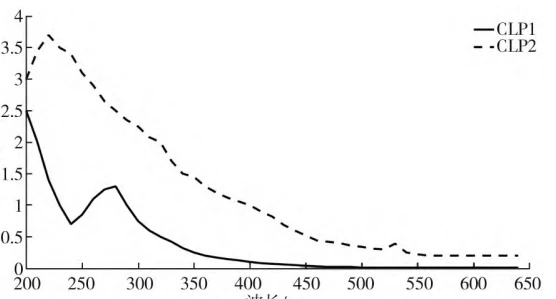
From Fig. 1, it can be seen that Cistanche neutrophilic sugar CLP1 showed a clear absorption peak at 280 nm, while Cistanche acidic sugar CLP2 showed an absorption peak at 260-280 nm. and the acidic sugar CLP2 of Cistanche Tubulosa showed a clear absorption peak at 260-280 nm. Although there was no obvious absorption peak at 260-280 nm, the UV absorption spectrum was higher. Since tryptophan and tyrosine contained in the proteins had a larger absorption value at 280 nm for UV absorption value, it can be judged that Cistanche neutrophilic sugar CLP1 contained glycoproteins, but it was not possible to determine whether Cistanche acidic sugar CLP2 contained nucleic acids and proteins. The presence of nucleic acids and proteins in Cistanche CLP2 could not be determined.
DEAE cellulose negative ion exchange chromatography column analysis can adsorb ionic substances and impurities into the column. The separation of polysaccharide substances was achieved by adsorbing the ionic substances and impurities on the column. The distilled water eluate was concentrated and dried to obtain the neutral sugar of Cistanche After concentrating and drying the distilled water eluate, a total of 34.68 mg of CLP1 was obtained, and after concentrating and drying with NaCl solution, the acidic sugar CLP1 was obtained. The acidic sugar CLP2 of Cistanche was obtained as 16.52 mg. The standard curve equation of total sugar content, protein content and glyoxylate content of Cistanche were obtained. and glyoxylate standard curve equation. The measurements of total sugar, protein and glyoxylate of Cistanche were obtained. The total sugar, protein and glucuronic acid contents of Cistanche were measured and shown in Table 1.
Table 1 Content of total sugar , protein and uronic acid in Cistanche deserticola

The molecular weight and peak area of the standard sample can be determined, and the regression regression equation can be obtained by substituting the light emission signal of the sample to be tested into the regression equation. The molecular weight of the sample to be tested can be obtained. The molecular weight of the samples to be tested can be obtained by substituting the light emission signal values of the samples to be tested into the regression equation. The average molecular weight, average heavy molecular weight and dispersion coefficient of Cistanche Tubulosa CLP1 and Cistanche Tubulosa CLP2 were obtained. Cistanche neutral sugar CLP1 and Cistanche acidulous CLP2 were determined by high-performance gel permeation chromatography. The results of the retention time and molecular weight calculation are shown in Table 2. The ratio of the heavy average molecular weight to the number average molecular weight was used to indicate the width of the molecular distribution. The ratio of heavy average molecular weight to number average molecular weight is used to indicate the width of the molecular distribution.

Ask for more:
Email:wallence.suen@wecistanche.com
Whatsapp/Tel:+86 15292862950