Composition Analysis And Immunological Activities Of The Oligosaccharides Isolated From Cistanche Deserticola
Mar 08, 2022
Contact: emily.li@wecistanche.com
Abstract. An oligosaccharide (CDOS) was obtained from Cistanche deserticola by alkali (pH=10) extraction, ethanol precipitation, and fractionated into two purified fractions (i.e., CDOS-1 and CDOS-2)by Sephadex G-100 and Sephadex G-25 column filtration chromatography. The monosaccharide composition of the CDOS was assayed by high-performance liquid chromatography (HPLC). It was found that CDOS-1 was only composed of sucrose and CDOS-2 was mainly composed of sucrose, rhamnose, and mannitol, with a mole ratio of 1:0.73:3.61. Immunological tests indicated that CDOS presented a significant effect on the mouse spleen index, increasing the phagocytosis activity of macrophages and stimulating antibody-producing cell proliferation. It is hoped that the CDOS will be developed into functional food or medicine.
Keywords: Cistanche deserticola, oligosaccharide, purification, composition, immunological activities.
Cistanche deserticola have many effects, click here to know more
1. Introduction
Cistanche deserticola Y.C.Ma. (Family Orobanchaceae) is a short parasitic plant native in the northwest of China. The whole dried plant (without flowers ) is known as a tonic and is called “Rou Congrong”.In oriental medicine, it is classified as sweet and salty in taste, warm in nature, and attributive to kidney and large intestine channels, with the function of invigorating the kidney and supplementing essence, moisturizing the intestine, and relaxing bowels [1]-[3]. The modern pharmacological study showed that it could prompt the DNA synthesis and delay the process of senility, increase the antioxidative [4] , prevent and treat cardiovascular diseases [3]. In addition, it could also cause analgesic and anti-inflammatory effects [5], enhance learning and memory by inducing nerve growth factors [6]. Some studies indicated that C. deserticola extracts could activate the phagocytic function of intra-abdominal macrophage in mice [7]-[9] and enhance the body's immunity [10]. According to the previous studies, this plant contains multiple active constituents which include phenylethanoid glycosides, iridoids, lignans, saccharides, alkaloid, etc. [11] As the C. deserticola phenylethanoid glycosides and polysaccharides are recognized as the major active components, numerous studies have focused on their structures and bioactivities during the past decades [12]-[17]. As for the valuable oligosaccharides in C. deserticola, the reports are quite limited. Oligosaccharides, a short-chain saccharide containing homo- or hetero-sugars, are well known for their beneficial effects on human life and have been extensively utilized for a long time [18]. Functional oligosaccharides, which have a physiological function such as low cariogenicity and bifidobacteria growth factor [19], improve the health of humans and animals. They have been utilized as a food ingredient. Recently, new functions of oligosaccharides, which have the ability to modulate the immune system in humans, animals, and fish, have been reported [20].In this paper, we report the first part of the results of the research program, the fractionation of the total oligosaccharides obtained from the alkali extract of C. deserticola by a combination of ultrafiltration and gel permeation chromatography, and the composition analysis of them by high-performance liquid chromatography (HPLC). In addition, we also present the immunological activities of the C. deserticola oligosaccharides. To our knowledge, there are few reports published about the immunostimulatory activity studies of C. deserticola oligosaccharides.
2. Experimental
2.1. Materials
The C. deserticola was cultivated and collected from Alxa League (Inner Mongolia, China). Kunming mice (GradeII, six weeks old) were purchased from the Pharmacology Experimental Center of Inner Mongolia University. Sephadex G-100,Sephadex G-25, trifluoroacetic acid (TFA), 1-phenyl-3-methyl-5- pyrazolone(PMP), D-glucose, D-galactose, D-fructose, D-xylose, D-mannose, D-galacturonic acid, D- glucuronic acid, sucrose, rhamnose, mannitol, fucose, rhamnose, were purchased from Sigma (St. Louis, MO, USA). Medium RPMI-1640 was purchased from Gibco Invitrogen Co. (San Diego, CA, USA). All other chemicals were of analytical grade.
2.2. Extraction of oligosaccharides
The dried bodies of C. deserticola were cut into smaller pieces and further ground into powder by a mill were extracted with anhydrous ethanol (3×5000 ml) at 70° for 3 h under atmospheric pressure. A reflux condenser was fixed to remove lipids. The residue left was then extracted with alkali (pH=10) at 60°C for 3 times (2h each time). After centrifugation (2000 g for 15 min, at 20°), the supernatant was concentrated to one-tenth of the volume in a rotary evaporator under reduced pressure at 50°C and filtered. Then the filtrate was deproteinized using the Sevag reagent [21], and decolored with activated carbon.
2.3. Isolation and purification of oligosaccharides
The freeze-dried crude oligosaccharides were dissolved in distilled water, centrifuged, and then the supernatant was purified by a Sephadex G-100 column (1×50 cm), equilibrated with ultrapure water. After loading with the sample, the column was eluted with ultrapure water at a flow rate of 5 ml/min. Different fractions were collected using test tubes. The total carbohydrate content of each tube was measured at 490nm by the phenol-H2SO4 method [22]. The water eluted solution was separated into two fractions CDOS-1 and CDOs-2. Two fractions were respectively purified further on a Sephadex G-25 column (2.7×85 cm) by using ultrapure water (at a flow rate of 1 ml/min). After collecting the purified fraction, it was lyophilized.
2.4. Analysis of monosaccharide composition
The monosaccharide composition of the CDOs was achieved by HPLC analysis. The CDOs (2 mg) were hydrolyzed first with anhydrous methanol containing 2 M HCl at 80°C for 16 h under a nitrogen atmosphere and then with 2 M TFA at 120°C for 1 h. After TFA was removed by evaporation, the hydrolysates were subsequently derivatized with PMP according to the reported method [23] and analyzed by HPLC. HPLC separation was performed on the EF-2002 HPLC system (KNAUER company, Germany). The PMP derivatives were chromatographed using Sugar- PAK volume (6.5×300mm, glasses of water company, America), and the absorbance was measured at 245 nm. The injection volume was 20µL, and the mobile phase, composed of PBS (solvent A) and acetonitrile (solvent B), was used for isocratic elution at the volume ratio of 82% (A) to 18% (B). Total HPLC run time was 40 min, and the flow rate was 0.5 mL/min.
2.5. Immunobiological Activities
2.5.1. Phagocytic function of monocyte-macrophage
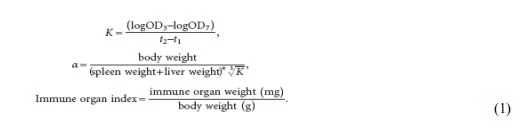
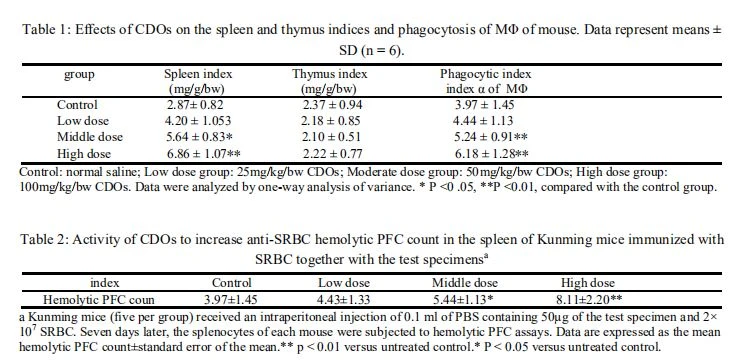
Sixty Kunming mice (GradeII, six weeks old) were purchased from the Pharmacology Experimental Center of Inner Mongolia University and were acclimatized for 1 week prior to use. All mice were randomly divided into four groups, consisting of a saline control group, high CDOs dosage group, moderate dosage group, and low CDOs dosage group. The mice were injected intraperitoneally with 0.5mL oligosaccharides solution once per day for 5 days. The high, moderate, or low CDOs dosage group received 100, 50, or 25 mg/kg/BW CDOs, respectively; and 0.5ml saline was injected in the control group. On the seventh day a carbon particle clearance experiment was carried out, according to Hou [24], and the spleen index and thymus index were measured. Briefly, 0.05 mL/10 g/bw India ink was injected into each mouse through the vena caudalis, then 20μL blood was obtained from the vena orbitalis posterior 3 and 7 minutes after the injection. The blood samples were placed in tubes with 2mL 0.1% Na2CO3, and OD values were measured at 600 nm. The clearance index (K), phagocytic index (α), and immune organ index were calculated as follows(1), t2 and t1 means 7 minutes and 3 minutes respectively.
2.5.2. The antibody-producing cell proliferation
Groups of Kunming mice (five per group) were immunized by intraperitoneal injection of 2 x 10⁷ SRBC in 1.0 ml of PBS added with 50ug of test materials (none in the control). One week later, splenocytes (106 cells per 2 ml per well) from Kunming mice were cultured with or without test materials for 72 h in 10% RPMI 1640 medium under 5% CO2 in the air, in triplicate for each culture. The number of PFC against SRBC per 106 splenocytes was determined [25], [26].
2.6. Statistical analysis
The data were expressed as mean values ±SD. The difference between tested groups and control was analyzed by Student’s t-test. P < 0.05 was considered to be significant.
3. Results and Discussion
3.1. Isolation and purification of oligosaccharides
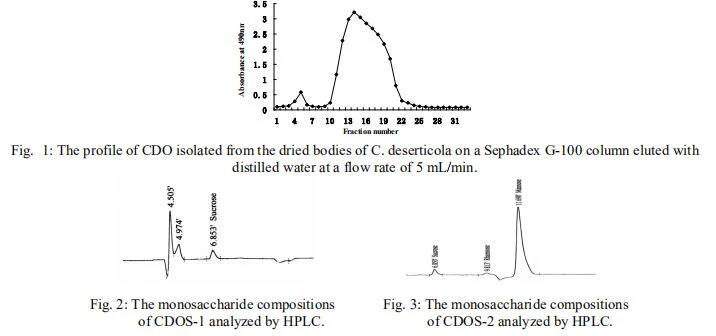
CDOs were isolated from the alkali extract of the dried bodies of C. deserticola by a yield of 3.07%. Two fractions of CDOS-1 and CDOS-2 were isolated from distilled water elute by the Sephadex G-100 column, respectively (Fig.1). The purified fractions of CDOS-1 and CDOS-2 showed a single peak on the Sephadex G-25 column, indicating that no other oligosaccharides were present in the sample. The results of monosaccharide compositions showed that CDOS-1 was only composed of sucrose (Fig.2) and CDOS-2 was mainly composed of sucrose, rhamnose, and mannitol (Fig.3), with a mole ratio of 1:0.73:3.61.
3.2. Immunobiological Activities of CDOs
Much in vivo and in vitro evidence has demonstrated that natural oligosaccharides displayed immunomodulating function by stimulating both cellular and humoral immune responses [27], [28]. In this paper, 100 mg/kg/BW CDOs increased the mouse spleen index, but there were no significant differences in the thymus index between the treated groups and control groups(Table 1). Macrophages are an important component of host defenses against viral infection by inhibiting intracellular replication of viruses and by killing virus-infected cells [29]. When activated, a variety of oxygen or nitrogen intermediates and cytokines are released from macrophages and participate in various important biological functions, such as anti-inflammatory and anti-tumor activities [30]-[32]. Therefore, the phagocytic activity of macrophages is an important indicator of organism immune functions. In this study, the moderate and high doses of CDOs increased the phagocytosis activity of macrophages (Table1). Antibody-producing cell proliferation induced by CDOs was studied by examination of the increase in hemolytic PFC in the spleens of Kunming mice which were immunized with SRBC plus the test specimen. Results indicated that moderate and high doses of CDOs significantly enhance antibody-producing cell proliferation (Table2). High doses of CDOs caused a highly significant increase in PFC count (P < 0.01).
References
[1] J. Li, Y. Jiang, R. Fan. Recognition of Biological Signal Mixed Based on Wavelet Analysis. In: Y. Jiang, et al (eds). Proc. of UK-China Sports Engineering Workshop. Liverpool: World Academic Union. 2007, pp. 1-8.
[2] J. Ouyang, X.D. Wang, B. Zhao, et al. Effects of rare earth elements on the growth of Cistanche deserticola cells and the production of phenylethanoid glycosides. J B io-technol, 2003, 102 (2) : 129-134
[3] Xu Zhaohui, Yang Junshan, Lu Ruimian, et al. A new natural product from Cistanche deserticola Y.C.MA. Journal of Chinese Pharmaceutical Sciences, 1999, 8(2):61-63.
[4] X. Wang, L. Li, Muhuyati, X. Wanag, N. Du. Anti-oxidative action of the glycosides of Cistanche in the tissue of mice. Zhongguo Zhong Yao Za Zhi. 1998, 23(9):554-5.
[5] Lin L.W, Hsieh M.T, Tsai F.H, Wang W.H, Wu C.R.Anti-nociceptive and anti-inflammatory activity caused by Cistanche deserticola in rodents. J Ethnopharmacol. 2002, 83(3):177-82.
[6] Choi, J.G; Moon, M; Jeong, H.U; Kim, M.C; Kim, S.Y; Oh, M.S. Cistanches Herba enhances learning and memory by inducing nerve growth factor. Behavioral Brain Research. 2011, 216 (2): 652–8.
[7] Zong G, He W, Wu G, Chen M, Shen X, Shi M. Comparison between Cistanche deserticola Y. C. Ma and C, tubulosa (Shenk) Wight on some pharmacological actions.Zhongguo Zhong Yao Za Zhi. 1996, 21(7):436-7.
[8] He W, Shu X.F, Zeng G.Z, et al . Study of enhancing sex potency of C. deserticola. J Chin Med.1996, 21(9): 534- 537.
[9] Zeng G.Z, He W, Wu G.L, et al. Comparisons between Cistanche deserticola Y. C. Ma and C.tubulosa weight on some pharmacological actions. J Chin Med. 1996, 21(7): 436-438.
[10] Zeng Q.L, Zheng Y.F, Lu Z.L. Immunomodulatory effects of polysaccharide of Cistanche deserticola Y. C. Ma. J Zhejiang Univ, Med Sci. 2002, 31(4): 284- 287.
[11] Li Yuan,Song Yuanyuan,Zhang Hongquan. Advances in Research of Chemical Constituents and Medicinal Activity of Cistanche. Chinese Wild Plant Resources, 2010, 29(1):7-11.
[12] Du N.S, Wang H, Yi YH. Isolation and identification of phenylethanoid glycosides from Cistanche deserticola. Nat Prod R & D, 1993, 5(4): 5- 8.
[13] Lu N.S, Liu J.L. Determination of phenylethanoid glycosides in Cistanche deserticola by macro reticular resin- spectrophotometry. Nat Prod R & D, 1993, 5(3): 30-33.
[14] Xiong Q.B, Tezuka Y, Kaneko T, et al. Inhibition of nitric oxide by phenylethanoids in activated macrophages.
European Journal of Pharmacology, 2000, 400: 137- 144.
[15] Zhao Wei, Yan Hong, Liang Zhong-Yan, et al. Structural Analysis of Water-soluble Polysaccharide SPA Isolated from the Stem of the Cistanche Deserticola Ma. Chemical Journal of Chinese Universities, 2005, 26(3):461-463.
[16] Wang Xiangyan. Study on the immune pharmacology and absorption character of polysaccharides of Cistanche deserticola. 2011, No.S1, Medicine and Health Sciences, E057-235-1-70.
[17] Xiong Q, Hase K, Tezuka Y, Tani T, Namba T, Kadota S. Hepatoprotective activity of phenylethanoids from Cistanche deserticola. Planta Med. 1998, 64(2):120-5.
[18] Handbook of Amylases and Related Enzymes (ed. by The Amylase Research Society of Japan), Pergamon Press (1988)
[19] Araya, S. (ed.) Proceedings of the 5th Conference on Dental Caries and Coupling Sugar (in Japanese), National Institute of Health, Tokyo (1980)
[20] Kodo Otaka. Functional Oligosaccharide and Its New Aspect as Immune Modulation. J. Biol. Macromol. 2006, 6(1), 3-9.
[21] Navarini L, Gilli R, Gombac V, Abatangelo A, Bosco M, Toffanin R. Polysaccharides from hot water extracts of roasted Coffea arabica beans: Isolation and characterization. Carbohydr. Polym.1999, 40:71–81.
[22] Dubois M, Gilles K.A, Hamilton J.K, Rebers PA, Smith F. Colorimetric method for determination of sugars and related substances. Anal. Chem. 1956, 28:350–356.
[23] Yang X, Zhao Y, Wang Q, Wang H, Mei Q. Analysis of the monosaccharide components in Angelica polysaccharides by high-performance liquid chromatography. Anal Sci. 2005, 21:1177–1180.
[24] Yufang Hou, Yubao Hou, Liu Yanyan, et al. Extraction and Purification of a Lectin from Red Kidney Bean and Preliminary Immune Function Studies of the Lectin and Four Chinese Herbal Polysaccharides. Journal of Biomedicine and Biotechnology, 2010:1-9.
[25] Cunningham, A. J., and A. Szenberg. Further improvements in the plaque technique for detecting single antibody-forming cells. Immunology.1968, 14:599-600.
[26] Haruhiko Takada, Tomohiko Ogawa, Fuminobu Yoshimura, et al. Immunobiological Activities of a Porin Fraction Isolated from Fusobacterium nucleatum ATCC 10953 [J]. Infection and Immunity. 1988, 56(4): 855-863.
[27] Wang M.Q, Guilbert L.J, Ling L, Li J, Wu YQ, Xu S.R, Pang P, Shan J.J. Immunomodulating activity of CVT- E002: a proprietary extract from North American ginseng (Panax quinque folium). J Pharm Pharmacol.2001, 53:1515–1523.
[28] Nergard C.S, Kiyohara H, Reynolds J.C, Thomas-Oates J.E, Matsumoto T, Yamada H, Patel T, Petersen D, Michaelsen TE, Diallo D, Paulsen B.S. Structures and structure-activity relationships of three mitogenic and complement-fixing pectic arabinogalactans from the Malian antiulcer plants Cochlospermum tinctorium A. Rich and Vernonia kotschyana Sch Bip. ex Walp. Biomacromolecules. 2006, 7:71–79.
[29] E.-M. Choi, A.-J. Kim, Y.-O. Kim, and J.-K. Hwang, Immunomodulating activity of Arabinogalactan and Fucoidan in vitro. Journal of Medicinal Food. 2005, 8(4):446–453.
[30] Y. Chen, J.-A. Duan, D. Qian, et al. Assessment and comparison of the immunoregulatory activity of four hydrosoluble fractions of Angelica Sinensis in vitro on the peritoneal macrophages in ICR mice. International Immunopharmacology. 2010, 10:422–430.
[31] Y. S. Lee, O. K. Han, C. W. Park, et al. Pro-inflammatory cytokine gene expression and nitric oxide regulation of aqueous extracted Astragali radix in RAW 264.7 macrophage cells. Journal of Ethnopharmacology. 2005, 100(3): 289–294.
[32] K. Y. Lee and Y. J. Jeon. Polysaccharide isolated from Poria cocos sclerotium induces NF-κB/ Rel activation and iNOS expression in murine macrophages. International Immunopharmacology. 2003, 3(10-11):1353–1362.