Consequences Of Predictable Temporal Structure in Multi-task Situations Part 3
Jan 16, 2024
It should be noted that the response window for the intervening task (relative to memory probe onset) differed in trials with early versus late memory probes.
Although we only analyzed trials in which participants responded within 1500 ms after intervening-task onset, it is possible that RTs to the working-memory task were affected by the recovery time available between the intervening and memory-task responses in early as compared to late trials.
As we age, many people begin to experience a gradual decline in their memory. However, the relationship between late memory and memory performance is not entirely negative. Late memory can have a positive impact on improving memory.
Late memory refers to memories we acquire from early to middle age. These memories are important to us because they help us better understand our past and current life transitions. In addition, these memories can stimulate our imagination and creativity, bringing us more fun and meaning.
Closely related to late memory is self-awareness and emotional resonance. As we grow older, we gradually begin to understand our past, our emotions, and our relationships with others. These understandings can help us think better about our lives and improve our intelligence and cognitive abilities.
Not only that, late memory can also provide us with more knowledge and experience, which is very useful in our daily lives. We can solve problems by recalling and using previous knowledge and can adapt to new environments and changes more easily.
To sum up, late memory and memory are not exactly opposites. On the contrary, these memories can bring many positive effects to our lives and cognitive abilities. We should make full use of our late memories to inject more knowledge, experience, and fun into our lives. It can be seen that we need to improve our memory. Cistanche deserticola can significantly improve memory because Cistanche deserticola is a traditional Chinese medicinal material with many unique effects, one of which is to improve memory. The efficacy of minced meat comes from the various active ingredients it contains, including acid, polysaccharides, flavonoids, etc. These ingredients can promote brain health in various ways.

Click know 10 ways to improve memory
To ensure that our findings could not be attributed to this difference, we reran the pre-processing and analysis while excluding slower responses to the intervening task (RTs > 1000 ms rejected, with 8.42 ± 8.80% trials removed per participant).
The observed benefit of temporal prediction remained the same even when ensuring a minimum recovery time of 500 ms (Supplementary Table 1, Supplementary Fig. 1).
Next to RTs, we additionally considered the influence of temporal predictions on the quality of working memory reports.
To this end, we analyzed the average reproduction error (i.e., the absolute deviation between the reported angle and the true angle of the probed item), for which lower values indicate better performance. We observed a significant effect of block type on reproduction errors (Fig. 2B; F(1,53) = 4.854, p = 0.032, η2 G = 0.002), with smaller errors when the memory probe occurred in a fixed versus a variable block.
In contrast to RTs, however, for errors, we found no systematic difference between early and late probes (F(1,53) = 0.313, p = 0.578, η2 G < 0.001) nor an interaction between block type and delay condition (F(1,53) = 0.865, p = 0.357, η2 G < 0.001).
These data reveal that temporal expectations were employed to anticipate upcoming memory-guided behavior, building on our prior demonstrations of similar effects in the absence of intervening tasks (Jin et al., 2020; van Ede, Niklaus, and Nobre, 2017; Zokaei et al., 2019). The current results show that the benefits of temporal expectation on working memory-guided behavior occur even when an intervening task must be completed during the retention interval.

3.2. Between-task consequences of temporal predictions for intervening task performance
Next, we asked whether temporal expectations regarding the subsequent working memory probe influenced performance on the intervening task. Critically, the intervening task always occurred at the same time after encoding, so any potential performative differences in this task should reflect a between-task consequence of temporal expectation regarding the working-memory task.
Note that we did not divide variable blocks by the subsequent interval for the memory probe since participants could not have known whether the memory items would be probed early or late at the time of the intervening task.
As shown in Fig. 1B, responses to the intervening task were fastest when the memory probe was expected early, slowest when the memory probe was expected late, and intermediate when the memory probe occurred unpredictably.
This pattern of results was supported by a significant main effect (F(2,106) = 18.282, p < 0.001, η2 G = 0.007). Pairwise comparisons showed significantly faster RTs in fixed-early as compared to both the variable (t(53) = − 3.067, Bonferroni = 0.010, d = 0.417) and the fixed-late blocks (t(53) = − 5.427, Bonferroni < 0.001, d = 0.739), as well as significantly faster RTs to variable as compared to fixed-late blocks (t(53) = − 3.443, Bonferroni = 0.003, d = 0.468).
These results show that temporal expectations do not merely influence performance in the task to which they apply (in our case, the working-memory task); they also affect performance in another task that occurs during the period of temporal anticipation – even when this task itself always falls within the same timeframe after memory encoding.
Consistent with the RTs, error rates in the intervening task (Fig. 2A) were numerically smallest in fixed-early and largest in fixed-late blocks. However, for error rates, we did not find a significant difference between conditions (F(2,106) = 1.060, p = 0.350, η2 G = 0.004). This may reflect intervening-task performance being very close to the ceiling (error rates below 3%). Hence, we refrained from further analyzing and interpreting the accuracy of the intervening task.

3.3. Between-task sequential effects of temporal structure
After having demonstrated that temporal expectations affected intervening-task performance in fixed blocks, wherein participants are persistently exposed to the same temporal structure, we asked whether temporal associations over a short timescale can also guide performance.
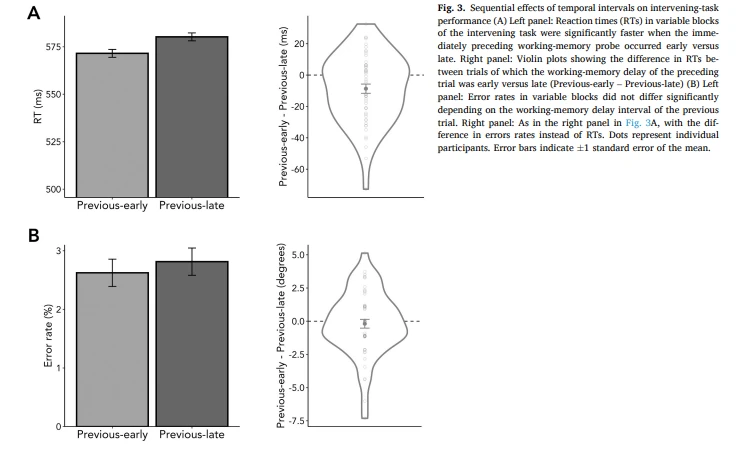
To this end, we analyzed sequential effects in variable blocks by comparing RTs and error rates to the intervening task as a function of the working memory delay in the immediately preceding trial (n-1). In contrast to classical sequential effects examined in simple RT tasks (for a review see: Los, 2010), we here tested for potential sequential effects of the previous working-memory delay on performance in the intervening task.
As shown in Fig. 3A, RTs to the intervening task were faster when the working-memory probe in trial n-1 occurred early as compared to when it occurred late (t(53) = − 2.937, p = 0.005, d = 0.400). The temporal structure associated with the working-memory delay of the previous trial thus had an immediate effect on RTs in the intervening task of the current trial – consequently, demonstrating a sequential-effect influence on the intervening task. Error rates showed a similar numerical pattern (Fig. 3B), though pairwise comparisons did not reach significance (t(53) = − 0.580, p = 0.564, d = 0.079).
Thus, the temporal interval of the working memory task in the preceding trial significantly affected the performance of the intervening task in the current trial. Nevertheless, the effects of blocked temporal predictions were stronger (Supplementary Fig. 2A). The difference in RTs between early versus late trials in fixed blocks was significantly larger than the difference in RTs following trials with early versus late working-memory probes in variable blocks (t(53) = − 3.260, p = 0.002, d= 0.444; Supplementary Fig. 2B).
4. Discussion
By manipulating the predictability of temporal structures within a multi-task context, we made two relevant observations. First, temporal expectations about when to utilize working-memory contents confer significant benefits to memory performance even when other intervening tasks must be performed in the interim. Second, temporal expectations about the later working-memory task also had significant consequences for the performance of the intervening task, even though the temporal prediction manipulation did not apply to this task. Responses to an intervening task were expedited when the requirement for memory-guided behavior was expected to occur early and slowed when the working-memory task was expected late, as compared to when the timing of the working-memory task was unpredictable. Thus, we unmask between-task consequences of predictable temporal structures.
4.1. Between-task consequences of predictable temporal structures
Our work demonstrates the presence of a between-task consequence of predictable temporal structures in a multi-task setting. It invites consideration of what mechanisms account for the effects, and this remains an important direction for future research. At this juncture, we can only speculate regarding the putative mechanisms.
First, the between-task effect may result from more efficient 'scheduling' of both tasks when the timing of either of them is predictable. In line with this, Kushleyeva, Salvucci, and Lee (2005) proposed that, in multi-task scenarios, temporal aspects of each task are used to flexibly schedule when to prioritize one task or the other. Given there was consistently less time between the intervening item and the memory probe in the fixed-early blocks, participants may have opted to complete the intervening task as soon as possible to refocus on the working memory task in time for the probe. In contrast, when the working-memory probe was consistently expected late – yielding less time pressure – participants may have allowed themselves more time for the intervening task, rendering their responses slower.
Another potential interpretation is that an elevated state of preparedness or 'alertness' may have accompanied temporal expectations for an early working-memory probe, whereas a lowered state of alertness may have resulted when the probe was expected late (Shalev & Nobre, 2022; Weinbach & Henik, 2012). The differential overarching state of preparation or alertness may have effectively 'spilled over' to the intervening task.
An alternative spill-over interpretation relates to a suggestion in the time-perception literature that cross-contamination between temporal intervals occurs when more than a single interval is estimated simultaneously (Moon & Anderson, 2013; Taatgen & van Rijn, 2011). Specifically, representations of shorter or longer intervals can shift the representation of an intermediate interval in those respective directions.
Such a contamination effect may also have contributed to our observed between-task effect of predictable temporal structures. For example, in fixed-late trials, the representation of time used for guiding performance in the intervening task may have expanded and thereby slowed responses. Likewise, faster RTs in fixed-early trials may have been mediated through compression of time representation. Future studies should take a more granular, and complementary physiological approach to understand exactly how these factors contribute to the between-task consequence of temporal expectations that we exposed here.
In addition to the scenarios above, it may have been easier to anticipate the intervening task when the working memory task itself was also temporally predictable. However, this is unlikely to account for our results, as this would have led to faster RTs to the intervening task regardless of whether the working memory probe occurred early or late. In contrast, we found that it was not the temporal predictability per se that affected the performance of the intervening task, but rather the time at which the subsequent probe was expected in the fixed blocks (early vs. late). Yet, it remains an interesting question whether we would observe similar results if the intervening task itself had occurred at random moments during the anticipatory period.
4.2. Between-task consequences of temporal structures also occur over the short-term
Aside from the between-task consequences of predictable temporal structure between fixed and variable blocks, we also found between-task short-term effects of temporal structure in variable blocks.

RTs to the intervening task in variable blocks were faster when the previous working memory probe occurred early as opposed to late. Our effects in this multi-task context provide an interesting extension to observations during variable-foreperiod tasks, in which the interval (foreperiod) between a warning signal and an imperative target varies on a trial-by-trial basis (Drazin, 1961; Karlin, 1959; Los, 1996, 2010; Los, Kruijne, & Meeter, 2014; Niemi & Na¨at ¨ anen, ¨ 1981; Steinborn, Rolke, Bratzke, & Ulrich, 2008; Vallesi & Shallice, 2007; Woodrow, 1914).
A typical finding in these variable-foreperiod tasks is the asymmetric sequential effect: RTs for any current foreperiod are relatively insensitive to preceding shorter foreperiods, however increase if the previous foreperiod was longer than the current one (for a review see: Los, 2010). Similarly, in our study, the speed of responses to the intervening task may have been scaled relative to the memory-probe delay of the trial directly prior.
However, direct comparisons between our results and single-task sequential effects are difficult to derive and will require further experimentation. Unlike most single perceptual-motor tasks evaluating temporal preparation, our study comprised a multi-task design engaging both internal and external attention. Moreover, each trial in our experiment contained three important intervals – the interval between encoding offset and intervening-task onset (always 1000 ms), the interval between intervening-item offset and the memory probe (early probe: 1250 ms, late probe: 2500 ms), and the ITI (randomly drawn between 500 ms and 800 ms), rendering it neither a purely fixed nor variable design.
Nevertheless, it is intriguing that we observed a sequential effect on RTs in the intervening task (which always occurred at the same point in time) arising from the delay condition of the working memory task of the previous trial.
At the same time, we note that the existence of sequential effects does not fully account for the performance benefits related to temporal predictability in fixed versus variable blocks. We show a higher difference in RTs between early and late trials in fixed blocks as opposed to previous-early versus previous-late trials in variable blocks. To the extent that implicit temporal associations underpin the effects of temporal expectation or preparation in fixed blocks, our results suggest that strengthening of evidence and learning over longer timescales leads to stronger impacts on performance. The multiple trace theory of temporal preparation (MTP) provides a good candidate mechanism, capturing the ability of temporal associations over multiple timeframes to modulate behavior (Los et al., 2014; Los, Kruijne, & Meeter, 2017; Salet, Kruijne, van Rijn, Los, & Meeter, 2022). In the future, it will be interesting to utilize neural measures to characterize exactly how temporal regularities over the different timescales shape signals guiding temporal expectation and preparation that can operate across tasks.
4.3. The contribution of task relevance and temporal structure in multitask contexts
At first glance, the beneficial consequence of predictable temporal structures in one task on performance in another task may seem to contradict findings related to the selective nature of temporal expectations. For example, previous research has demonstrated that directing attention to a target occurring at one point in time leads to performance benefits at that specific time but simultaneously to impairments earlier and later (Denison et al., 2017, Denison, Carrasco, & Heeger, 2021).
Instead, we show that temporal expectations can facilitate the performance of the task to which they are applied, as well as the intervening task. In reconciling these findings, it is important to note at least two key differences which may help resolve this apparent discrepancy. In Denison et al.'s (2017, 2021) study, participants performed only one task. Stimuli within that task had overlapping sensory properties and action associations, competing for priority in guiding performance. As one of the stimuli was more likely to be irrelevant, a trade-off between prioritizing the likely-relevant stimulus and ignoring the likely-irrelevant stimulus was, therefore, an effective strategy. By contrast, a strategic trade-off would have been counterproductive in our study, as participants completed two separate tasks that were equally relevant. This provides for a scenario wherein both tasks potentially benefitting from temporal expectation would be much more advantageous.
Accordingly, our pattern of results is likely driven by the requirement of having to perform two relevant tasks. An additional intriguing question is whether the cross-task benefits of predictable temporal structure are also contingent on the specific parameters and demands of the two tasks. In our study, a choice-reaction task was embedded within a working-memory task, to which participants had to return upon completion of the intervening task. Participants therefore had to juggle the contents of stimulus representations to perform adequately. Would similar results occur if another perceptual-motor choice-reaction task replaced the working-memory task? Such a finding would suggest that regularities in temporal structure alone could explain performance benefits across tasks, even when the need to maintain mental contents necessary for one task does not overlap the timespan of another. Therefore, in future studies, it will be interesting to examine the extent to which benefits of temporal structure can occur between two independent rather than superimposed tasks. Manipulating the perceptual similarity and motor requirements between tasks would add further insights into the role of overlapping demands in orchestrating behavior across successive tasks.
4.4. Temporal expectations benefit working-memory-guided behavior despite intervening task demands
Beyond providing evidence for a between-task consequence of temporal predictability, our study also yields new insights into the dynamic and prospective nature of working memory. Extending the growing literature showing the benefits of temporal expectation on working memory performance (Boettcher, Gresch, et al., 2021; Gresch et al., 2021; Jin et al., 2020; Olmos-Solis et al., 2017; van Ede, Niklaus and Nobre, 2017; Wilsch, Henry, Herrmann, Herrmann, & Obleser, 2018; Wilsch, Henry, Herrmann, Maess, & Obleser, 2015; Zokaei et al., 2019), our results uniquely demonstrate that performance benefits of temporal expectations during working memory remain robust, even when having to perform an intervening task in the period of probe anticipation.
From the time-perception literature, there is abundant evidence that the ability to track time explicitly can be biased when performed in complex multi-task situations (Block, Hancock, & Zakay, 2010; Brown, 1997, 2006; Brown, Collier, & Night, 2013; Fortin, Champagne, & Poirier, 2007; Hemmes, Brown, & Kladopoulos, 2004; Polti, Martin, & Van Wassenhove, 2018). Potentially, having to engage in the intervening task could have impeded the utilization of temporal regularities regarding the working memory task. Indeed, prior studies have shown that temporal expectation effects can be substantially reduced by performing a concurrent demanding task (Capizzi, Correa, & Sanabria, 2013; Capizzi, Sanabria, & Correa, 2012; van der Mijn and van Rijn, 2021). Yet, a carefully controlled study using dual-task designs has shown that for period effects survive in the face of a simultaneously performed task (van Lambalgen and Los, 2008). In a similar vein, recent work from our lab has revealed that learned (spatial)temporal regularities regarding external events can guide visual search performance even when interacting with temporally unpredictable intervening events (Boettcher, Shalev, Wolfe, & Nobre, 2021). Likewise, temporal expectations affect performance even during dynamic streams that require inhibition of temporally competing distractors (Chauvin, Gillebert, Rohenkohl, Humphreys, & Nobre, 2016; Davranche, Nazarian, Vidal, & Coull, 2011; Zokaei et al., 2021). These results suggest that it is possible to maintain and utilize representations of temporal regularities across other intervening events. The current results extend these findings, by demonstrating that temporal regularities can also be highly effective for facilitating working-memory-guided behavior during multi-task situations.
Nevertheless, our ability to keep track of time might be dependent on the specific demands of the intervening tasks, whereby more cognitively taxing intervening tasks may be more detrimental to the formation of temporal expectations. Moreover, the utilization of temporal expectations for memory-guided behavior may be further affected by the overlap between intervening and memory items. Prior research has found evidence for working memory performance to be most impaired when perceptual distractors are similar to the memory content (Clapp, Rubens, & Gazzaley, 2010; Hermann et al., 2021; Jha, Fabian, & Aguirre, 2004; Sreenivasan & Jha, 2007; Yoon, Curtis, & D'Esposito, 2006). Therefore, a high degree of similarity in the associated objects between tasks may modulate the benefit of temporal expectations. Within our study, additional analyses did not support this idea (Supplementary Results 1, Supplementary Table 2 and 3, Supplementary Fig. 3). Perceptual similarity between intervening and memory items did not affect RTs, and reproduction errors were smaller when the intervening and memory item were more similar than when the angular difference between both items was high. We also observed no interactions between sensory similarity and either block type or delay condition, suggesting the effects of temporal expectation were not dependent on the sensory overlap. Future studies may wish to explore more systematically the possible contribution of sensory and motor overlap, as well as task difficulty between tasks.
Temporal expectations have been reported to benefit performance particularly at short as opposed to long delays. This effect is usually attributed to the hazard rate: once the potential time of the early probe passes, expectations can be updated, and attention can be reoriented towards the longer interval (Coull, 2009; Coull, Frith, Büchel, & Nobre, 2000; Griffin, Miniussi, & Nobre, 2002; Jin et al., 2020; Miniussi, Wilding, Coull, & Nobre, 1999; Nobre, 2001). Thus, even in variable blocks, the late memory probe becomes predictable as soon as the early interval has passed (see also MTP [e.g., Los et al. (2014, 2017); Salet et al. (2022)] for a non-hazard explanation of this effect based on memory traces of past timing experiences). This pattern of RTs has been noted in the foreperiod literature, with shorter RTs occurring with increasing delay duration in variable-foreperiod designs. In contrast, RTs in fixed-for-period situations increase with an increasing delay between warning and target stimulus (Los et al., 2014; Los, Knol, & Boers, 2001; Niemi & N¨ aat ¨ anen, ¨ 1981). In the variable blocks of the current study, RTs in the working-memory task reflected this typical pattern of results – responses to the memory probe were faster when it appeared unpredictably late as compared to unpredictably early. However, we did not find an effect of delay condition on RTs in fixed blocks as would have been predicted by the foreperiod literature.
This was the case even after excluding slow responses to the intervening task, thus, giving time to recover before performing the memory task. Whether this effect is specific to the multi-task context of our study is an interesting avenue for future research.
Interestingly, memory representations were more accurate in fixed as compared to variable trials, that is, even when the memory probe appeared late (see also Chauvin et al., 2016; Cravo, Rohenkohl, Santos, & Nobre, 2017). This is distinct from a previous study conducted in our lab which also examined the role of temporal expectation in working memory (Jin et al., 2020). Critically, however, in this prior study, no intervening task occurred during the working memory delay. The intervening task in the present study may thus be critical for the observed effect of temporal expectations on working-memory performance in the late trials. We recently showed that working memory can be shielded against intervening task demands when the intervening task itself can be temporally predicted (Gresch et al., 2021). Similarly, having temporal expectations about the memory probe may have helped to shield the working-memory representations from the intervening task, yielding higher ensuing memory accuracy in fixed trials, regardless of whether items would subsequently become probed early or late.
5. Conclusion
In the current work, we focussed on the intersection of several lines of research often studied in isolation, including working memory, temporal expectations, and multitasking. We provide evidence (1) that learned temporal expectations regarding task A can be utilized even when having to engage in an intervening task B during the period of anticipation and (2) that temporal expectations regarding task A can affect the performance of intervening task B. Thus, the predictable temporal structure of one task facilitates not only the performance of this task but can affect and improve the performance of multiple tasks in temporally structured multi-task situations.
Acknowledgments
The authors would like to thank Gordon Dodwell for his thoughtful comments on this manuscript. This research was funded by an ERC Starting Grant from the European Research Council (MEMTICIPATION, 850636) to F.v.E. and a Wellcome Trust Senior Investigator Award (104571/Z/14/Z) and a James S. McDonnell Foundation Understanding Human Cognition Collaborative Award (220020448) to A.C.N., and by the NIHR Oxford Health Biomedical Research Centre. The Wellcome Centre for Integrative Neuroimaging is supported by core funding from the Wellcome Trust (203139/Z/16/Z). For open access, the author has applied a CC-BY public copyright license to any Author Accepted Manuscript version arising from this submission.

Author contributions
D.G., S.E.P.B., A.C.N., and F.v.E. designed the research; D.G. programmed the experiment and performed data collection; D.G. and S.E.P. B. performed the main analyses and made the figures; D.G., S.E.P.B., A. C.N., and F.v.E. wrote and revised the manuscript.
References
Block, R. A., Hancock, P. A., & Zakay, D. (2010). How cognitive load affects duration judgments: A meta-analytic review. Acta Psychologica, 134(3), 330–343. https://doi. org/10.1016/j.actpsy.2010.03.006
Boettcher, S. E. P., Gresch, D., Nobre, A. C., & van Ede, F. (2021). Output planning at the input stage in visual working memory. Science Advances, 7(13), 8212–8236. https:// doi.org/10.1126/SCIADV.ABE8212
Boettcher, S. E. P., Shalev, N., Wolfe, J. M., & Nobre, A. C. (2021). Right place, right time: Spatiotemporal predictions guide attention in dynamic visual search. Journal of Experimental Psychology. General. https://doi.org/10.1037/xge0000901
Breska, A., & Deouell, L. Y. (2014). Automatic bias of temporal expectations following temporally regular input independently of high-level temporal expectation. Journal of Cognitive Neuroscience, 26(7), 1555–1571. https://doi.org/10.1162/jocn_a_00564
Brown, S. W. (1997). Attentional resources in timing: Interference effects in concurrent temporal and nontemporal working memory tasks. Perception & Psychophysics, 59(7), 1118–1140. https://doi.org/10.3758/BF03205526
Brown, S. W. (2006). Timing and executive function: Bidirectional interference between concurrent temporal production and randomization tasks. Memory and Cognition, 34 (7), 1464–1471. https://doi.org/10.3758/BF03195911
Brown, S. W., Collier, S. A., & Night, J. C. (2013). Timing and executive resources: Dualtask interference patterns between temporal production and shifting, updating, and inhibition tasks. Journal of Experimental Psychology: Human Perception and Performance, 39(4), 947–963. https://doi.org/10.1037/a0030484
Capizzi, M., Correa, A., ´ & Sanabria, D. (2013). Temporal orienting of attention is interfered with by concurrent working memory updating. Neuropsychologia, 51(2), 326–339. https://doi.org/10.1016/j.neuropsychologia.2012.10.005
For more information:1950477648nn@gmail.com