Cytomegalovirus Immunity, Inflammation And Cognitive Abilities in The Elderly
May 04, 2023
Abstract:
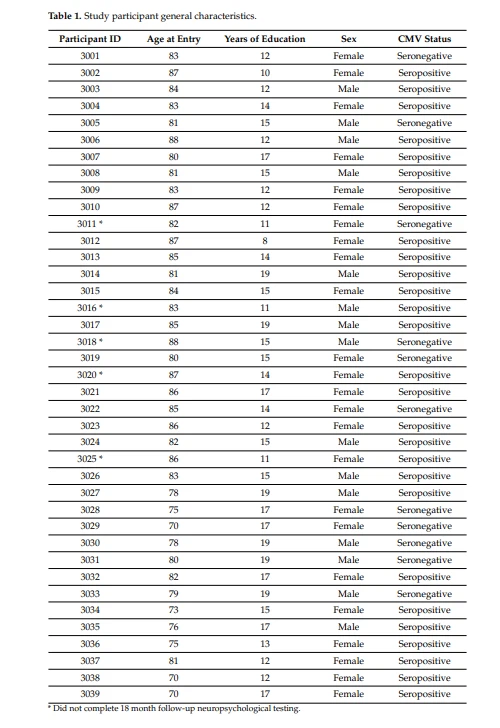
Reducing the socio-economic toll from age-related physical and mental morbidities requires a better understanding of factors affecting healthy aging. While many environmental, lifestyle, and genetic factors affect healthy aging, this study addressed the influence of cytomegalovirus (CMV) infection and immunity on age-related inflammation and cognitive abilities. Healthy adults 70–90 years old were recruited into a prospective study investigating relationships between anti-CMV immunity, markers of inflammation, baseline measures of cognitive ability, and changes in cognitive ability over 18 months. Humoral and cellular responses against CMV, levels of inflammatory markers, and cognitive abilities were measured at study entry, with the measurement of cognitive abilities repeated 18 months later. CMV-seropositive and -seronegative sub-groups were compared, and relationships between anti-CMV immunity, markers of inflammation, and cognitive ability were assessed. Twenty-eight of 39 participants were CMV-seropositive, and two had CMV-specific CD8+ T cell responses indicative of CMV immune memory inflation.
No significant differences for markers of inflammation or measures of cognitive ability were observed between groups, and cognitive scores changed little over 18 months. Significant correlations between markers of inflammation and cognitive scores with interconnection between anti-CMV antibody levels, fractalkine, cognitive ability, and depression scores suggest areas of focus for future studies.
There is a close relationship between inflammatory markers and the human immune system among the groups. Inflammation is a response of the immune system to external stimuli. Immune cells release a variety of inflammatory factors, such as tumor necrosis factor (TNF-α), interleukin (IL-6, IL-1), etc. These inflammatory factors can promote inflammation The reaction proceeds. Inflammatory markers between groups refer to biomolecules involved in the body's inflammatory response, such as C-reactive protein, procalcitonin, and erythrocyte sedimentation rate. The determination of these inflammatory markers can reflect the degree and severity of the inflammatory response and help to evaluate the progress and prognosis of the disease. To sum up, the relationship between inflammatory markers and the human immune system is mutual influence and mutual support, which is of great significance in the prevention, diagnosis, and treatment of diseases. So from this point of view, we must pay attention to the improvement of our immunity in our daily life. Cistanche is one of the items that can improve immunity. Cistanche contains a variety of biologically active ingredients, such as polysaccharides, two mushrooms, and Huang Li. etc. These ingredients can stimulate various cells of the immune system and increase their immune activity.

Click health benefits of cistanche
Keywords:
cytomegalovirus; immunity; inflammation; aging; cognitive decline; fractalkine.
1. Introduction
Healthier aging is an increasingly urgent socioeconomic objective, fueled in large part by the generalized demographic shift towards more elderly populations [1]. Age-related morbidities such as Alzheimer’s disease, cancer, cardiovascular disease, and type II diabetes impose a massive multifaceted burden on individuals, families, the healthcare system, and society [2]. Mental health issues such as depression, anxiety, and cognitive decline present further challenges to healthy aging [3]. While some physiological and cognitive decline with aging may be unavoidable, numerous environmental factors and interactions influence the pace of decline. There is considerable evidence that a worsening background of low-grade chronic inflammation (termed inflammaging) elevates the risk of developing age-related physical and psychological morbidities [4,5].
In this context, the accumulation of senescent cells is linked to age-related deterioration of health [6,7]. Senescent cells arise following extensive cell division or exposure to radiation, oxidative stress, toxins, or other environmental insults. Affected cells acquire a cell type-specific senescence-associated secretory phenotype (SASP), often characterized by the release of proinflammatory cytokines such as interleukin-6 (IL-6) [8]. Aging of the immune system itself may trigger or promote inflammation, both by contributing senescent immune cells and, as its capacity for effective surveillance falls, by being more tolerant of their persistence. Thus, unresolved inflammation can initiate and propagate a vicious cycle of immune system aging and immune cell senescence leading to more inflammation.
One common environmental factor that is recognized to accelerate the aging of the immune system is infection with cytomegalovirus (CMV), a ubiquitous human β-herpes virus [9]. While CMV inevitably establishes chronic infection, it remains predominantly latent and asymptomatic in healthy individuals [10]. However, over a lifetime of infection, a significant fraction of CMV-infected elderly individuals experience abnormal expansions of CD8+ T cells reactive against CMV, which manifest in a characteristic immune phenotype associated with the immune risk profile (IRP) [11]. The characteristic phenotype includes increased frequencies of terminally differentiated (CD57+ ) T cells, inverted CD4+/CD8+ T cell ratios (<1.0), and reduced B cell numbers [12]. The IRP is functionally reflected in lesser mitogen-induced T-cell proliferation in vitro, poor in vivo vaccine responsiveness, and accelerated all-cause mortality [13]. This age-related phenomenon is uniquely associated with CMV infection, prompting a range of studies exploring the relationship between CMV infection and healthy aging [14–19].
Despite the clear relationship between CMV infection and immune system aging, no consensus has emerged as to whether CMV infection is associated with greater inflammation or increasing the risk for earlier or more prominent development of age-related morbidities. As the IRP is defined by features related to the immune response against CMV, we questioned whether certain attributes of anti-CMV immunity itself, rather than acute responses to CMV reactivation, might be associated with inflammation or with an increased or accelerated risk for age-related morbidities. Higher levels of anti-CMV antibodies were associated with impaired health and reduced cognitive function in very old subjects and with reduced cognitive function in non-elderly adults [20,21]. Mechanistic links between antiCMV immunity and cognitive decline remain speculative, but pro-inflammatory anti-CMV effector responses that accumulate through life and persist through periods of viral latency may play a role as reduced cognition and subsequent depression have both previously been tied to inflammation [22].
In this study of individuals over 70 years old, we measured immune responses against CMV and several plasma markers of inflammation at study entry, then administered a set of standardized neuropsychological tests on two occasions 18 months apart to assess cognitive status at entry and changes in cognitive status over 18 months. The aim was to explore possible links between CMV infection, anti-CMV immunity, inflammation, and cognitive decline in an elderly population. Our general hypothesis was that inflationary anti-CMV immunity would be associated with increased inflammation and cognitive deficits.

2. Materials and Methods
2.1. Study Subjects and Sample Processing
The Newfoundland and Labrador Health Research Ethics Authority gave ethical approval for this study. Participants were recruited with invitation letters from the offices of family practitioners serving a high proportion of elderly clients. Exclusion criteria for the study included a diagnosis of dementia, previous history of negative reactions to blood sampling, acute infection, or known current immune disorder. Eligible individuals who responded were contacted by research staff, and if they expressed interest, an initial visit was scheduled.
Informed consent for study participation was obtained during this visit, and psychological testing was carried out by trained personnel. Whole blood samples were collected into 10 mL acid citrate dextrose vacutainers by forearm venipuncture near the time of initial psychological testing. Plasma was collected following centrifugation of whole blood for 10 min at 500× g, and PBMC was isolated from the cellular fraction by Ficoll Hypaque (VWR Scientific, Mississauga, ON, Canada) density gradient separation. Plasma was immediately frozen at −80 ◦C and PBMC was stored in liquid N2 in a freeze medium made up of 90% fetal calf serum (FCS) from Invitrogen, Carlsbad, CA, USA, and 10% dimethyl sulfoxide (DMSO) from Sigma-Aldrich, St. Louis, MO, USA, until use.
2.2. Anti-CMV IgG ELISA
Antibodies against CMV were measured with a validated in-house ELISA as previously described [23] Briefly, plasma was diluted 1:500 with phosphate-buffered saline (PBS) and incubated for 90 min in duplicate wells of Immulon-2 microtiter plates (VWR Scientific) coated with lysate from CMV-infected or uninfected MRC-5 cells (ATCC® CCL-171™). Antibody binding was detected with goat-anti-human IgG-horseradish peroxidase conjugate (Jackson ImmunoResearch Labs, West Grove, PA, USA) followed by tetramethylbenzidine substrate (Sigma-Aldrich) and the difference in optical density (OD) at 405 nm between wells coated with CMV-infected versus uninfected MRC-5 cell lysate was measured on a Biotek synergy HT ELISA reader and recorded.
2.3. Measurement of Inflammatory Markers
Commercial ELISA kits were used to measure the following analytes in plasma as per the manufacturers’ instructions. Kits for measuring IL-1β (range = 2.00–200.00 pg/mL), IL-6 (range = 2.00–200.00 pg/mL), and tumor necrosis factor (TNF)-α (range = 4.00–500.00 pg/mL) were from eBioscience, San Diego, CA, USA. Kits for measuring fractalkine (range = 0.2–10 ng/mL) and C-reactive protein (CRP) (range = 15.60–1000.00 pg/mL) were from R&D Systems, Minneapolis, MN, USA. The sensitivity ranges spanned physiologically relevant levels such that plasma was added neat to the assay, except for the CRP assay where the plasma was diluted 1:10,000 with PBS. All measurements were carried out in duplicate with control wells containing only PBS included in each assay. The OD value in control wells was subtracted from all test values to adjust for background. Absorbance was measured at 450 nm on a Biotek synergy HT ELISA reader and standard curves were generated as specified by the kit manufacturer’s instructions.
2.4. Measurement of CMV-Specific CD8+ T Cell Responses
Study participants were tested for CD8+ T cell responses against CMV pp65 and immediate early-1 (IE-1) proteins using sets of overlapping peptides (Peptivator, Miltenyi Biotec, San Diego, CA, USA). Aliquots of 2 × 10⁶ PBMC in 1 mL lymphocyte medium (RPMI 1640 with 10% FCS, 100 IU/mL penicillin, 100 µg/mL streptomycin, 2 mM L-glutamine, 10 mM HEPES buffer solution, and 2.0 × 10⁻⁵ M 2-mercaptoethanol from Invitrogen, Carlsbad, CA, USA) were stimulated with pooled CMV-pp65 (0.5 µg/mL) and IE-1 (0.5 µg/mL) peptide sets for 60 min at 37 ◦C (5% CO2). Brefeldin A (Sigma-Aldrich) was then added to a final concentration of 10.0 µg/mL and the PBMC was left for an additional 4 h before staining for surface markers and intracellular interferon-gamma (IFN-γ). Cells were washed twice in flow cytometry buffer consisting of PBS with 0.2% NaN3, 5 mM ethylenediaminetetraacetic acid (EDTA, Sigma-Aldrich), and 0.5% FCS, then stained with fluorescein isothiocyanate-conjugated anti-human CD3, clone BW264/56, and peridinin chlorophyll protein-conjugated anti-human CD8, clone BW135/80, (Miltenyi Biotec), for 20 min at 4 ◦C. Samples were kept in the dark, and after another wash with flow buffer, cells were fixed and permeabilized with InsideStain (Miltenyi Biotec) according to manufacturer’s instructions, then stained with allophycocyanin-conjugated anti-human IFN-γ, clone 4S.83 (eBioscience).

2.5. Neuropsychological Testing
The Repeatable Battery for the Assessment of Neuropsychological Status (RBANS) was used to assess baseline cognitive functioning and possibly cognitive decline in study participants [24]. The RBANS is an individually administered battery of tests that allows for the assessment of ability across five cognitive domains including immediate memory, delayed memory, visuospatial/constructional ability, language, and attention. The RBANS was administered at study entry and approximately 18 months afterward. Appropriately trained individuals administered and scored the tests.
2.6. Mood
The Geriatric Depression Scale (GDS) was used to assess participants’ mood symptoms at baseline and 18-month follow-up. The GDS is a self-report measure consisting of 30 yes/no questions (https://doi.org/10.1300/J018v01n01_06 (accessed on 1 June 2021)).
2.7. Statistical Analysis
Statistical analyses were carried out using Prism (GraphPad Software, Inc., La Jolla, CA, USA). The normal distribution of data was assessed by the Shapiro–Wilk test, which showed deviation from normality in most cases. Therefore, data were represented with median ± interquartile range (IQR) and group medians compared by non-parametric Mann–Whitney tests. The correlation was used to assess relationships between variables using Spearman correlation matrices. For Mann–Whitney and Spearman correlation testing, p-values < 0.05 were considered significant. No correction for multiple testing was applied when calculating p-values.
3. Results
3.1. Study Subjects
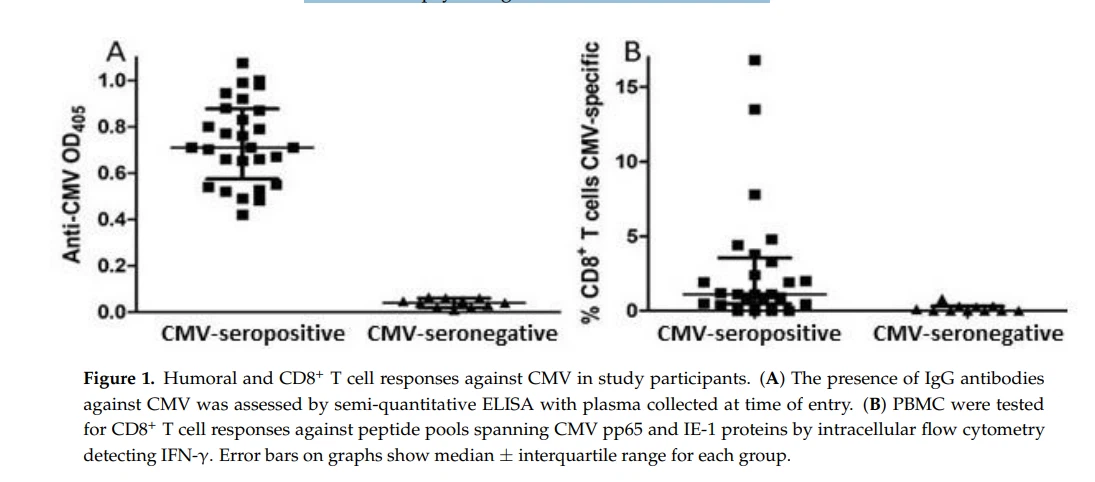
Thirty-nine individuals (15 male, 24 female) between 70 and 90 years of age enrolled in this study (Table 1). A whole blood sample was drawn at the time of enrollment, and plasma antibodies against CMV were measured to determine the CMV infection status of all subjects. Plasma levels of several cytokines and other markers of inflammation were also measured in this baseline sample. Testing for anti-CMV antibodies showed that 28 subjects were CMV-seropositive and 11 (5 males, 6 females) were CMV-seronegative (Figure 1A).
For 36 subjects, including 25 of the 28 CMV-seropositive subjects, CD8+ T cell responses against the immunodominant CMV proteins pp65 and IE-1 were measured. Two of the 25 CMV-seropositive subjects tested, 1 male and 1 female, had CMV-specific CD8+ T cell responses involving >10% of their CD8+ T cell population (Figure 1B), a frequency indicative of CMV T cell immune memory inflation associated with an IRP. Standardized psychological testing was administered near the time of enrollment and approximately 18 months later. Five of the 39 subjects from whom blood samples were collected at study entry (three CMV-seropositive, two CMV-seronegative) were lost to follow-up before the second set of psychological tests could be carried out.
3.2. Plasma Markers of Inflammation
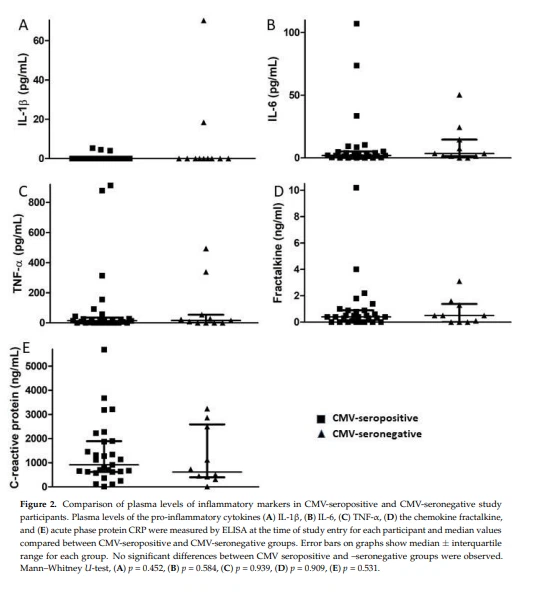
Plasma levels of the pro-inflammatory cytokines IL-1β, IL-6, and TNF-α together with the chemokine fractalkine (CX3CL1) and acute phase protein CRP were measured using commercial ELISA kits. A small fraction of subjects in both the CMV-seropositive and -seronegative groups had levels of these inflammatory markers above the normal range, but there were no significant differences between groups in median levels of any of the inflammatory markers (Figure 2). Thus, in this small group of elderly subjects, we saw no evidence of increased inflammation related to CMV infection or CMV-specific CD8+ T cell memory inflation. There was a significant direct correlation between the magnitude of humoral and CD8+ T cell responses against CMV (p = 0.036), while the magnitude of CMV-specific CD8+ T cell responses negatively correlated with levels of both IL-1β (p = 0.031) and TNF-α (p = 0.049).
When only CMV-seropositive individuals were considered, IL-1β levels directly correlated with TNF-α levels (p = 0.03), and IL-6 levels directly correlated with fractalkine levels (p = 0.001). The magnitude of the CMV-specific humoral immune response directly correlated with levels of fractalkine (p = 0.018), and the magnitude of CMV-specific CD8+ T cell responses negatively correlated with levels of TNF-α (p = 0.011). Levels of CRP did not correlate with any of the other pro-inflammatory markers. These correlations suggest that several independent and interdependent processes, some potentially related to the immune response against CMV, affect the inflammatory milieu in elderly individuals.
3.3. Psychological Testing
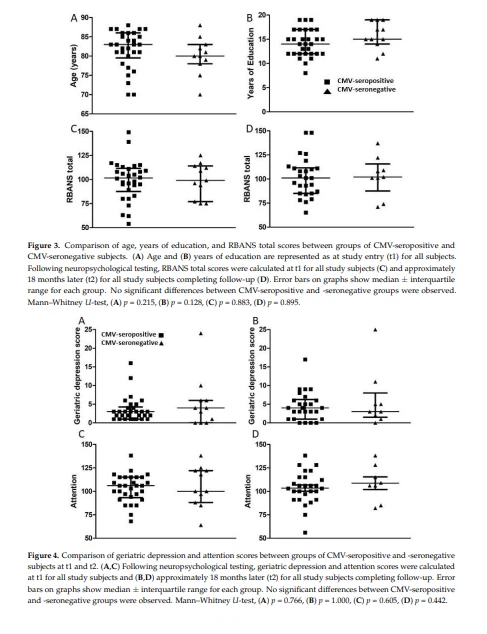
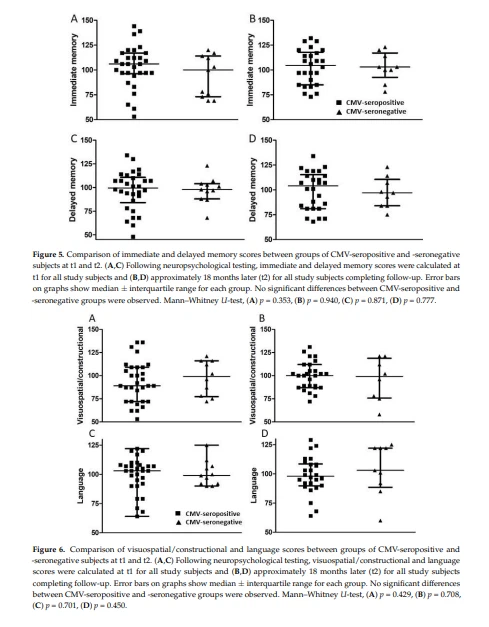
A set of standardized psychological tests, the RBANS, was administered by trained personnel to 39 subjects at or around study entry (t1) and to 34 subjects approximately 18 months after study entry (t2). Scores were collated and medians were compared between groups of CMV seropositive and CMV-seronegative subjects at both time points (Figures 3–6). There were no significant differences detected between groups with scores from any of the neuropsychological tests at either time point. Changes observed over the 18-month follow-up period were generally minor and also similar between groups. As a relationship has been proposed between unhealthy aging and inflammation, we assessed correlations between levels of pro-inflammatory markers and scores obtained in the different categories of standardized testing. Age was inversely correlated with levels of IL-1β (p = 0.01) and TNF-α (p = 0.031) but directly correlated with fractalkine levels (p = 0.0039).
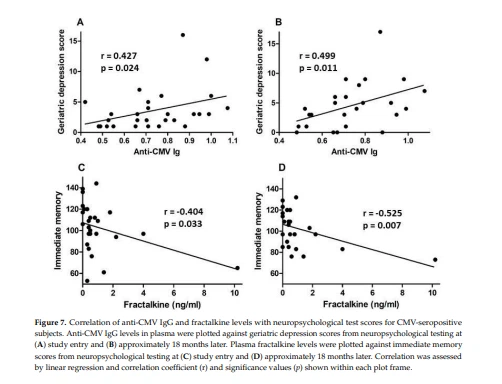
At t1, TNFα levels correlated directly with RBANS total (p = 0.031), immediate memory (ImMem) (p = 0.006), visuospatial/constructional (V/C) (p = 0.022), and delayed memory (DeMem) scores (p = 0.025). In contrast, fractalkine levels correlated inversely with ImMem scores (p = 0.01). At time 2, there were direct correlations of TNF-α levels with RBANS total (p = 0.026), language (p = 0.025), and DeMem scores (p = 0.02). Fractalkine levels correlated inversely with RBANS total (p = 0.0374), ImMem (p = 0.0145), and DeMem scores (p = 0.0196). When only CMV-seropositive subjects were considered, IL-1β levels correlated inversely (p = 0.043), and fractalkine levels correlated directly with age (p = 0.025). TNF-α levels correlated directly with RBANS total (p = 0.049) and ImMem scores (p = 0.005) at t1 and with RBANS total (p = 0.047) and DeMem scores (p = 0.029) at t2. Fractalkine levels correlated inversely with ImMem at t1 (p = 0.033) and t2 (p = 0.007) as well as with RBANS total (p = 0.022) and DeMem scores (p = 0.008) at t2. Fractalkine levels correlated directly with geriatric depression score (GDS) at t2 (p < 0.041). In the CMV-seropositive group of subjects, anti-CMV antibody levels correlated with GDS at t1 (p = 0.024) and t2 (p = 0.011). These data indicate several potential relationships between the immune response against CMV, the inflammatory milieu, and the neuropsychological status of elderly persons (Figure 7A–D).
4. Discussion
In this study of elderly individuals (70-90 years old), we determined CMV serostatus and measured aspects of humoral and cellular immunity against CMV in those who were CMV-seropositive. To assess background levels of inflammation, we also measured various plasma markers of inflammation. Since IL-6 is generally regarded as the major inflammatory driver of age-related pathology, we measured IL-6 along with IL-1P and INF-a, which have several overlapping properties, including induction of the acute phase protein CRP, which was also measured (251. Fractalkine was measured because of its relationship to neural excitotoxicity, and microglial cell regulation, and because of the expression of a functional viral receptor for fractalkine on monocytes latently infected with CMV (26-28). Cognitive ability and its decline were gauged with a series of standardized neuropsychological tests administered at study entry (t1) and repeated 18 months later (t2).
While no significant differences were detected between groups of CMV-seropositive and CMV-seronegative subjects in median levels of markers of inflammation, cognitive test scores, or change in test scores over 18 months, we observed several significant correlations that warrant further investigation in more extensive studies. In terms of relationships between anti-CMV immunity and markers of inflammation, CMVspecific CD8+ T cell responses negatively correlated with levels of both IL-1B and TNF-a. Within the CMV-seropositive group, IL-1B levels directly correlated with TNF-a levels while Il -6 levels directly correlated with fractalkine levels. The magnitude of CMV-specific humoral immune responses also directly correlated with levels of fractalkine.
Surprisingly, CRP levels did not correlate with any of the other pro-inflammatory markers. Interleukin-6 has previously been considered a marker of inflammation [29,30], and in our groups of subjects, levels of the chemokine fractalkine were associated with levels of IL-6 and with levels of anti-CMV humoral immunity. Age inversely correlated with IL-1β and TNF-α levels, but directly correlated with fractalkine levels.
Discordant relationships between scores in the RBANS testing and different markers of inflammation also suggest that all inflammatory pathways are not equally related to cognitive decline, at least not in this small study group. At t1, TNF-α levels correlated directly with RBANS total, immediate memory (ImMem), visuospatial/constructional (V/C), and delayed memory (DeMem) scores.
In contrast, fractalkine levels correlated inversely with ImMem scores. At time 2, TNF-α levels correlated directly with RBANS total, language, and DeMem scores. Again, in direct contrast, fractalkine levels are inversely correlated with RBANS total, ImMem, and DeMem scores. For CMV-seropositive subjects, fractalkine levels correlated directly with age and inversely with ImMem at t1 and t2 as well as with RBANS total and DeMem scores at t2. Fractalkine levels correlated directly with geriatric depression score (GDS) at t2, and in the CMV-seropositive group of subjects, anti-CMV antibody levels also correlated with GDS at t1 and t2.
Relationships suggested by data collected here will require corroboration in extended studies, but potential associations identified between fractalkine levels, anti-CMV humoral immunity, and age-related cognitive decline are of interest and consistent with a proposed role for fractalkine in regulating neuroinflammation. Fractalkine is highly expressed by neurons, and binding to its specific receptor CX3CR1 on glial cells acts to keep them in a quiescent, non-inflammatory state [28]. Monocytes and monocyte precursors latently infected with CMV express a CMV-encoded protein that mimics CX3CR1 and mediates chemotaxis of CMV-infected cells towards areas of higher fractalkine concentrations [27].
While preliminary, the interconnection of anti-CMV antibody levels (perceived as a surrogate marker for CMV reactivation frequency), fractalkine levels, and geriatric depression scores have implications in the context of a potential mechanistic link between depression and inflammation related to chronic CMV infection and recurrent reactivation of CMV throughout life. Relationships between anti-CMV antibody levels and cognitive deficits were previously reported in studies of middle-aged persons living with human immunodeficiency virus infection (PLWH) and in old elderly [20,21,31,32]. In the setting of HIV infection, the effects of CMV on the immune system are both accelerated and exaggerated, highlighting the relevance of CMV infection and anti-CMV immune status to the healthy aging of PLWH [33–35].
One of the difficulties with studies of age-related deterioration is the time required to effectively address the questions posed. We saw little quantitative evidence of cognitive decline over 18 months in our study, which may suggest this is too short a time frame to pose these questions. In contrast to a previous study of over 500 subjects, we did not observe significant differences between CMV-seropositive and -seronegative groups with any of the individual RBANS tests or RBANS total [21]. Measuring global cognitive performance as a continuous measure and classifying cognitive impairment as a dichotomous construct could have reduced the number of comparisons. As this was an exploratory study, we did not correct for multiple testing, which increased the risk of falsely identifying some associations as significant. Some of the nominally significant findings require replication in larger studies. We selected inflammatory markers either previously associated with reduced cognition or with a mechanistic link to neuronal excitotoxicity for investigation [26,36,37]. Mechanisms underlying associations between chronic inflammation and reduced cognition remain speculative, but hippocampal volume loss and microglial activation have been proposed [38,39]. It remains plausible that inflammation affects cognition indirectly through a generalized negative effect on health and psychosocial functioning.
Other issues also limited the power to discriminate effects related to aging and the influence of anti-CMV immunity. As the study design involved the recruitment of subjects responding independently to a written letter distributed at their doctor’s office, an inherent selection bias for highly educated subjects with stable cognitive properties may have been introduced. This also limited overall recruitment, and the loss of five persons to follow-up was significant. It may also have skewed towards recruitment of CMV-seronegative subjects as 11/39 subjects over the age of 75 years being CMV-seronegative is a higher proportion than expected. While meaningful data can be collected in smaller focused studies such as this one, ideally, they should be integrated within the framework of longitudinal studies of healthy aging where the number of participants and potential for long-term data collection is greater.
5. Conclusions
Within this group of elderly subjects, no common pattern of inflammation related to anti-CMV immunity or age-related cognitive decline emerged, indicating that the relationship is complex. The apparent discordance between fractalkine levels and levels of other inflammatory markers, in terms of their relationship to anti-CMV immunity, geriatric depression scores, and cognitive issues in the elderly, may serve to focus aging studies on including the selective relevance of fractalkine levels in their analyses.
Author Contributions:
The study was conceived by M.G. and J.H. All labwork including sample processing, ELISAs, and measurement of CD8+ T cell responses against CMV was carried out by N.F. Psychological testing data were collated and analyzed by J.H., M.G. analyzed all data and drafted the manuscript. All authors have read and agreed to the published version of the manuscript.
Funding:
This work was supported by a research grant from the Newfoundland and Labrador Centre for Applied Health Research #2014-03 to J.H. and M.G.
Institutional Review Board Statement:
This study was approved by the Newfoundland and Labrador Health Research Ethics Authority and carried out by recommendations of the Canadian Tri-Council Policy Statement: Ethical Conduct for Research Involving Humans. By the Declaration of Helsinki, informed consent was obtained for whole blood collection and neuropsychological testing.
Informed Consent Statement:
Informed consent was obtained from all subjects involved in the study.
Data Availability Statement:
The datasets used and/or analyzed during the current study are available from the corresponding author upon reasonable request.

Acknowledgments:
The authors would like to thank all study participants for their willingness to participate in this research study.
Conflicts of Interest:
The authors declare no conflict of interest.
References
1. Kanasi, E.; Ayilavarapu, S.; Jones, J. The aging population: Demographics and the biology of aging. Periodontology 2000 2016, 72, 13–18. [CrossRef]
2. Hazra, N.C.; Rudisill, C.; Gulliford, M. Determinants of health care costs in the senior elderly: Age, comorbidity, impairment, or proximity to death? Eur. J. Heal. Econ. 2017, 19, 831–842. [CrossRef]
3. Borson, S.; Bartels, S.J.; Colenda, C.C.; Gottlieb, G.L.; Meyers, B. Geriatric mental health services research: Strategic Plan for an Aging Population: Report of the Health Services Work Group of the American Association for Geriatric Psychiatry. Am. J. Geriatr. Psychiatry 2001, 9, 191–204. [CrossRef]
4. Baylis, D.; Bartlett, D.B.; Patel, H.P.; Roberts, H.C. Understanding how we age: Insights into inflammaging. Longev. Heal. 2013, 2, 1–8. [CrossRef]
5. Howcroft, T.K.; Campisi, J.; Louis, G.B.; Smith, M.T.; Wise, B.; Wyss-Coray, T.; Augustine, A.D.; McElhaney, J.E.; Kohanski, R.; Sierra, F. The role of inflammation in age-related disease. Aging 2013, 5, 84–93. [CrossRef] [PubMed]
6. Baker, D.J.; Wijshake, T.; Tchkonia, T.; Lebrasseur, N.K.; Childs, B.G.; Van De Sluis, B.; Kirkland, J.L.; Van Deursen, J.M. Clearance of p16Ink4a-positive senescent cells delays aging-associated disorders. Nature 2011, 479, 232–236. [CrossRef]
7. Naylor, R.M.; Baker, D.J.; Van Deursen, J.M. Senescent Cells: A Novel Therapeutic Target for Aging and Age-Related Diseases. Clin. Pharmacol. Ther. 2012, 93, 105–116. [CrossRef] [PubMed]
8. Coppé, J.-P.; Desprez, P.-Y.; Krtolica, A.; Campisi, J. The Senescence-Associated Secretory Phenotype: The Dark Side of Tumor Suppression. Annu. Rev. Pathol. Mech. Dis. 2010, 5, 99–118. [CrossRef]
9. Staras, S.A.S.; Dollard, S.C.; Radford, K.W.; Flanders, W.D.; Pass, R.; Cannon, M.J. Seroprevalence of Cytomegalovirus Infection in the United States, 1988-1994. Clin. Infect. Dis. 2006, 43, 1143–1151. [CrossRef] [PubMed]
10. Emery, V.C.; Cope, A.V.; Bowen, E.F.; Gor, D.; Griffiths, P.D. The Dynamics of Human Cytomegalovirus Replication in Vivo. J. Exp. Med. 1999, 190, 177–182. [CrossRef] 11. van de Berg, P.J.; van Stijn, A.; Ten Berge, I.J.; van Lier, R.A. A fingerprint left by cytomegalovirus infection in the human T cell compartment. J. Clin. Virol. 2008, 41, 213–217. [CrossRef] [PubMed]
12. Wikby, A.; Nilsson, B.O.; Forsey, R.; Thompson, J.; Strindhall, J.; Lofgren, S.; Ernerudh, J.; Ernerudh, G.; Ferguson, F.; Johansson, V. The immune risk phenotype is associated with IL-6 in the terminal decline stage: Findings from the Swedish NONA immune longitudinal study of very late life functioning. Mech. Ageing Dev. 2006, 127, 695–704. [CrossRef] [PubMed]
13. Strindhall, J.; Nilsson, B.O.; Löfgren, S.; Ernerudh, J.; Pawelec, G.; Johansson, B.; Wikby, A. No Immune Risk Profile among individuals who reach 100 years of age: Findings from the Swedish NONA immune longitudinal study. Exp. Gerontol. 2007, 42, 753–761. [CrossRef]
14. Hadrup, S.R.; Strindhall, J.; Kollgaard, T.; Seremet, T.; Johansson, B.; Pawelec, G.; Johansson, B.; Wikby, A. Longitudinal studies of clonally expanded CD8 T cells reveal a repertoire shrinkage predicting mortality and an increased number of dysfunctional customer-filovirus-specific T cells in the very elderly. J. Immunol. 2006, 176, 2645–2653. [CrossRef]
15. van de Berg, P.J.; Heutinck, K.M.; Raabe, R.; Minnee, R.C.; Young, S.L.; van Donselaar-van der Pant, K.A.; Bemelman, F.J.; van Lier Rene, A.; ten Berge, I.J. Human cytomegalovirus induces systemic immune activation characterized by a type 1 cytokine signature. J. Infect. Dis. 2010, 202, 690–699. [CrossRef] [PubMed]
16. Vaes, B.; Pasquet, A.; Wallemacq, P.; Rezzoug, N.; Mekouar, H.; Olivier, P.A.; Legrand, D.; Mathei, C.; Van Pottelbergh, G.; Degryse, J. The BELFRAIL (BFC80+) study: A population-based prospective cohort study of the very elderly in Belgium. BMC Geriatr. 2010, 10, 39. [CrossRef]
17. Roberts, E.T.; Haan, M.N.; Dowd, J.; Aiello, A.E. Cytomegalovirus Antibody Levels, Inflammation, and Mortality Among Elderly Latinos Over 9 Years of Follow-up. Am. J. Epidemiology 2010, 172, 363–371. [CrossRef]
18. Savva, G.M.; Pachnio, A.; Kaul, B.; Morgan, K.; Huppert, F.A.; Brayne, C.; Moss, P.A.H. The Medical Research Council Cognitive Function and Ageing Study Cytomegalovirus infection is associated with increased mortality in the older population. Aging Cell 2013, 12, 381–387. [CrossRef]
19. Spyridopoulos, I.; Martin-Ruiz, C.; Hilkens, C.; Yadegarfar, M.E.; Isaacs, J.; Jagger, C.; Kirkwood, T.B.L.; Von Zglinicki, T. CMV seropositivity and T-cell senescence predict increased cardiovascular mortality in octogenarians: Results from the Newcastle 85+ study. Aging Cell 2015, 15, 389–392. [CrossRef]
20. Vescovini, R.; Biasini, C.; Telera, A.R.; Basaglia, M.; Stella, A.; Magalini, F.; Bucci, L.; Monti, D.; Lazzarotto, T.; Monte, P.D.; et al. Intense Antiextracellular Adaptive Immune Response to Human Cytomegalovirus in Very Old Subjects with Impaired Health and Cognitive and Functional Status. J. Immunol. 2010, 184, 3242–3249. [CrossRef]
21. Dickerson, F.; Stallings, C.; Origoni, A.; Katsafanas, E.; Schweinfurth, L.A.; Savage, C.L.; Yolken, R. Association between cytomegalovirus antibody levels and cognitive functioning in non-elderly adults. PLoS ONE 2014, 9, e95510. [CrossRef]
22. Krogh, J.; Benros, M.E.; Jorgensen, M.B.; Vesterager, L.; Elfving, B.; Nordentoft, M. The association between depressive symptoms, cognitive function, and inflammation in major depression. Brain Behav Immun. 2014, 35, 70–76. [CrossRef] [PubMed]
23. Heath, J.; Newhook, N.; Comeau, E.; Gallant, M.; Fudge, N.; Grant, M. NKG2C+CD57+ Natural Killer Cell Expansion Parallels Cytomegalovirus-Specific CD8+ T Cell Evolution towards Senescence. J. Immunol. Res. 2016, 2016, 1–8. [CrossRef] [PubMed]
24. Randolph, C.; Tierney, M.C.; Mohr, E.; Chase, T.N. The Repeatable Battery for the Assessment of Neuropsychological Status (RBANS): Preliminary Clinical Validity. J. Clin. Exp. Neuropsychol. 1998, 20, 310–319. [CrossRef]
25. Franceschi, C.; Campisi, J. Chronic inflammation (inflammation) and its potential contribution to age-associated diseases. J. Gerontol. A Biol. Sci. Med. Sci. 2014, 69 (Suppl. 1), S4–S9. [CrossRef]
26. Limatola, C.; Lauro, C.; Catalano, M.; Ciotti, M.T.; Bertollini, C.; Di Angelantonio, S.; Ragozzino, D.; Eusebi, F. Chemokine CX3CL1 protects rat hippocampal neurons against glutamate-mediated excitotoxicity. J. Neuroimmunol. 2005, 166, 19–28. [CrossRef]
27. Beisser, P.S.; Laurent, L.; Virelizier, J.-L.; Michelson, S. Human Cytomegalovirus Chemokine Receptor Gene US28 Is Transcribed in Latently Infected THP-1 Monocytes. J. Virol. 2001, 75, 5949–5957. [CrossRef] [PubMed]
28. Finneran, D.J.; Nash, K.R. Neuroinflammation and fractalkine signaling in Alzheimer’s disease. J. Neuroinflammation 2019, 16, 1–8. [CrossRef] [PubMed]
29. Franceschi, C.; Bonafe, M.; Valensin, S.; Olivieri, F.; De Luca, M.; Ottaviani, E.; De Benedictis, G. Inflamm-aging. An evolutionary perspective on immunosenescence. Ann. N. Y. Acad. Sci. 2000, 908, 244–254. [CrossRef]
30. Vasto, S.; Candore, G.; Balistreri, C.R.; Caruso, M.; Colonna-Romano, G.; Grimaldi, M.P.; Listi, F.; Nuzzo, D.; Lio, D.; Caruso, C. Inflammatory networks in aging, age-related diseases, and longevity. Mech. Ageing Dev. 2007, 128, 83–91. [CrossRef]
31. Letendre, S.; Bharti, A.; Perez-Valero, I.; Hanson, B.; Franklin, D.; Woods, S.P.; Gianella, S.; Faria de Oliveira, M.; Heaton, R.K.; Grant, I.; et al. Higher Anti-Cytomegalovirus Immunoglobulin G Concentrations Are Associated With Worse Neurocognitive Performance During Suppressive Antiretroviral Therapy. Clin. Infect. Dis. 2018, 67, 770–777. [CrossRef]
32. Ballegaard, V.; Pedersen, K.K.; Pedersen, M.; Braendstrup, P.; Kirkby, N.; Buus, A.S.; Ryder, L.P.; Gerstoft, J.; Nielsen, S.D. Cytomegalovirus-Specific CD4+ T-cell Responses and CMV-IgG Levels Are Associated With Neurocognitive Impairment in People Living With HIV. J. Acquir. Immune Defic. Syndr. 2018, 79, 117–125. [CrossRef]
33. Naeger, D.; Martin, J.N.; Sinclair, E.; Hunt, P.W.; Bangsberg, D.R.; Hecht, F.; Hsue, P.; McCune, J.M.; Deeks, S.G. CytomegalovirusSpecific T Cells Persist at Very High Levels during Long-Term Antiretroviral Treatment of HIV Disease. PLoS ONE 2010, 5, e8886. [CrossRef] [PubMed]
34. Freeman, M.L.; Mudd, J.C.; Shive, C.L.; Younes, S.-A.; Panigrahi, S.; Sieg, S.F.; Lee, S.A.; Hunt, P.W.; Calabrese, L.H.; Gianella, S.; et al. CD8 T-Cell Expansion and Inflammation Linked to CMV Coinfection in ART-treated HIV Infection. Clin. Infect. Dis. 2015, 62, 392–396. [CrossRef]
35. Barrett, L.; Fudge, N.J.; Heath, J.J.; Grant, M.D. Cytomegalovirus Immunity and Exhaustive CD8+ T Cell Proliferation in Treated Human Immunodeficiency Virus Infection. Clin. Infect. Dis. 2016, 62, 1467–1468. [CrossRef]
36. Donzis, E.J.; Tronson, N.C. Modulation of learning and memory by cytokines: Signaling mechanisms and long term consequences. Neurobiol. Learn. Mem. 2014, 115, 68–77. [CrossRef]
37. Bradburn, S.; Sarginson, J.; Murgatroyd, C. Association of Peripheral Interleukin-6 with Global Cognitive Decline in Nondemented Adults: A Meta-Analysis of Prospective Studies. Front. Aging Neurosci. 2018, 9, 438. [CrossRef]
38. Shah, P.J.; Ebmeier, K.P.; Glabus, M.F.; Goodwin, G.M. Cortical grey matter reductions associated with treatment-resistant chronic unipolar depression. Br. J. Psychiatry 1998, 172, 527–532. [CrossRef] [PubMed]
39. Stertz, L.; Magalhães, P.V.; Kapczinski, F. Is bipolar disorder an inflammatory condition? The relevance of microglial activation. Curr. Opin. Psychiatry 2013, 26, 19–26. [CrossRef] [PubMed]
For more information:1950477648nn@gmail.com