Debriefing Works: Successful Retraction Of Misinformation Following A Fake News Study Part 2
Dec 05, 2023
The present study
In the present study, we report data from a one-week follow-up of participants who engaged in a study of COVID-19 misinformation and were subsequently debriefed. In the original study, described in Greene & Murphy [22], participants were randomly assigned to receive a warning about misinformation or to a control condition and were later exposed to a selection of fabricated news headlines related to the COVID-19 pandemic.
There is a relationship between misinformation and memory, but how should we view this relationship? It is inevitable to make mistakes in life. It may be a stupid mistake or a mistake made because you don't know some details. But we don't need to be depressed or depressed because misinformation can be good for our memory.
First, mistakes stimulate our memory. The relationship between misinformation and memory is reflected in the fact that when we make a mistake, we will remember the consequences and experience of the mistake more deeply. This experience and memory stimulate each other and help us remember things better. On the contrary, if mistakes are never made, it is difficult for our brains to distinguish what needs extra attention and memory.
The second point is that mistakes are a way of learning. Many people are afraid of making mistakes, but making mistakes is a great way to learn. After we make a mistake, we often explore why we made the mistake and then look for a solution to the problem. This is learning. Making mistakes is not terrible. What is terrible is repeating the same mistakes without exploring the reasons. Therefore, misinformation is integral to our learning and growth.
In short, the relationship between misinformation and memory is not a simple relationship destruction, but a construction relationship. Mistakes can stimulate our memory, and by trying our best to avoid mistakes, we can also receive more comprehensive and in-depth learning and improvement. Although making mistakes often makes us feel uneasy or stressed, as long as we have a positive attitude and the right way to view mistakes and avoid them, we can continue to improve ourselves through mistakes. It can be seen that we need to improve our memory. Cistanche deserticola can significantly improve memory, because Cistanche deserticola can also regulate the balance of neurotransmitters, such as increasing the levels of acetylcholine and growth factors. These substances are very important for memory and learning. In addition, meat can also improve blood flow and promote oxygen delivery, which can ensure that the brain receives sufficient nutrients and energy, thus improving brain vitality and endurance.
Click Know to improve short-term memory
Participants were asked to report whether they remembered the events described in the headline, how truthful they believed the story to be, and how likely they were to engage in a series of health behaviors linked with the fabricated stories.
In this follow-up study, we address the following preregistered research questions:
1. Do participants from a previous COVID-19 fake news study continue to report false memories or beliefs one week later, despite having been debriefed after the first study?
2. Does previous exposure to COVID-19 misinformation have persistent effects on planned health behaviors following debriefing?
3. Does previous exposure to a general (non-specific) warning about misinformation moderate the effects of misinformation on memories and planned behaviors after one week?
From a purely experimental perspective, one might wish to compare responses from debriefed and undebriefed participants. However, the timing of this experiment (conducted in mid-2020, at the height of the COVID pandemic and amid an 'infodemic') meant that we were very reluctant to have participants leave the study without correcting misinformation. We, therefore, designed the experiment such that participants were randomly assigned to view half of the fake news items in the original study and the other half at follow-up, permitting a direct comparison of the effect of novel vs. previously seen misinformation.
Materials and methods
Preregistration
The hypotheses and analysis plan for this study were preregistered at https://aspredicted.org/ PMV_N5Q. Ethical approval for this study was granted by the Human Research Ethics Committee at University College Dublin.
Participants
Participants were recruited for the original study [22] via an article in the Irish news website TheJournal.ie in May 2020. Of the 4,228 participants who completed the original study, 2,282 provided a valid email address for follow-up, and 1,738 completed the follow-up study. In line with our preregistration, 191 of these were excluded for failing attention checks or admitting to having used a search engine to look up answers to the questions. The final sample in the follow-up study comprised 1,547 participants with a mean age of 48.48 years (SD = 12.75) and included 474 (30.64%) males, 1,070 (69.17%) females and 3 participants (0.19%) who selected 'other' or preferred not to indicate their gender.
Materials and procedure
A schematic of the experimental procedure is provided in Fig 1.
Original study (Time 1). The materials and procedure for the original study are described in detail in Greene & Murphy [22], and all materials are available at https://osf.io/mfnb4/. Participants provided written consent to participate but were not initially told that the study was investigating misinformation. To manipulate the presence of a warning, participants were first presented with a series of public health messages, similar in format to posters produced by the Irish Health Service Executive (HSE) during the COVID-19 pandemic. Mixed in among messages about social distancing and cough etiquette, half of the participants in the sample were randomly assigned to a warning condition in which they were exposed to a positively or negatively-framed warning about misinformation (positive framing: "Not all news stories we read are accurate.
During the COVID-19 crisis, we all must play our part in society by thinking carefully about the stories we read and share. Think before you share and keep your loved ones safe!". Negative framing: "Not all news stories we read are accurate. Sharing stories that may not be true is irresponsible, and puts us all in danger during the COVID-19 crisis. Think before you share and keep your loved ones safe!"). The remaining participants were either presented with the other public health messages, without the misinformation message or were in a pure control group that received no health messages at all. The warning conditions did not affect any outcome variable in the original study (see [22] for a discussion).
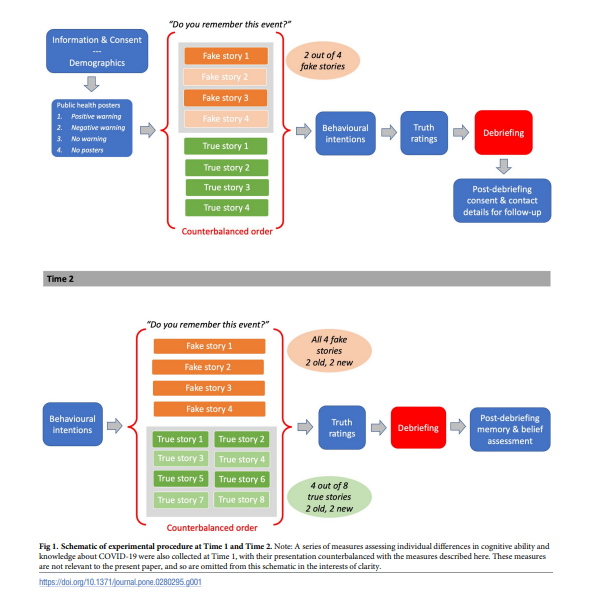
Participants were then presented with six news stories about the COVID-19 pandemic, including four true stories and a randomly selected two out of four fake stories. Each story consisted of a short text description, accompanied by an illustrative but non-probative photograph. The four fake stories were fabricated for this study, and read as follows:
1. "New research from Harvard University shows that the chemical in chili peppers that causes the "hot" sensation in your mouth reduces the replication rate of coronaviruses. The researchers are investigating whether adding more spicy foods to your diet could help combat COVID-19" [Accompanying photograph: a pile of red chili peppers].
2. "A whistleblower report from a leading pharmaceutical company was leaked to the Guardian newspaper in April. The report stated that the coronavirus vaccine being developed by the company causes a high rate of complications, but that these concerns were being disregarded in favor of releasing the vaccine quickly" [Accompanying photograph: a close-up of a hypodermic needle being inserted into a patient's arm].
3. "A study conducted at University College London found that those who drank more than three cups of coffee per day were less likely to suffer from severe Coronavirus symptoms. Researchers said they were conducting follow-up studies better to understand the links between caffeine and the immune system" [Accompanying photograph: a close-up of a steaming cup of coffee].
4. "The programming team who designed the HSE app to support coronavirus contact tracing were found to have previously worked with Cambridge Analytica, raising concerns about citizen's data privacy. The app is designed to monitor people's movements to support the government's contact-tracing initiative" [Accompanying photograph: A close-up of a smartphone with COVID-19 imagery, overlaid on an illustration of the coronavirus organism].
After each story, participants were asked whether they remembered the events described in the story, and could select from the following options: "I have a clear memory of seeing/hearing about this", "I have a vague memory of this event occurring", "I don't have a memory of this, but it feels familiar", "I remember this differently" or "I don't remember this".
In line with our preregistration, participants who selected one of the first two options were deemed to have a memory of the event. Thus, "memory" was defined as either a specific or non-specific memory of the event having occurred. Participants were then asked to indicate the source of their memory from a list (e.g., television, newspaper, radio, online news website, etc.). Finally, participants were asked to indicate how they had felt about the events in the story at the time, via an open text box.
Participants were then asked to reflect on their intention to engage in a series of health behaviors over the next several months and to rate their agreement with statements about the behaviors on a scale from 1 (strongly disagree) to 7 (strongly agree). The four critical statements associated with the fake stories read, "I intend to eat more spicy food", I intend to drink more coffee", "I intend to get a COVID-19 vaccine, once it becomes available" and "I intend to download the HSE contact-tracing app, once available".
Six filler statements were also included and addressed intentions regarding other health behaviors, including the intention to get more sleep, reduce screen time, and get a flu vaccine. The full text of the behavioral intention statements may be seen online.
Finally, participants were informed that some of the stories they had seen may not have been true. They were presented with a thumbnail image of each of the six stories that they had earlier been shown and were asked to rate the truthfulness of each story on a scale from 0 (definitely not true) to 100 (definitely true).
Participants in the original study also completed a series of other measures, assessing individual differences in analytical reasoning as well as knowledge of and engagement with the topic of COVID-19. These measures, the presentation of which was counterbalanced with the other questions described above, are not relevant to the follow-up study and will not be discussed further here. Interested readers may refer to Greene & Murphy [48] for an analysis of the effects of these individual differences on susceptibility to false memories.
Debriefing. Immediately after completion of the study, participants were fully debriefed, following the debriefing procedure described in Murphy et al. [45]. The two fake stories the participant had seen were then presented again, accompanied by an explanation that the story was not true but had been fabricated by the researchers. This message was reinforced with true information about the topic of the fake story (e.g. "This story is not true. There is no known association between the HSE contact tracing app and Cambridge Analytica").
A full debriefing statement was then provided, in which participants were informed about the true purpose of the study and the ease with which false memories and false beliefs may form. Participants were then asked to re-consent to the inclusion of their data in the study and to provide an email address if they were willing to be contacted for a follow-up study.
Follow-up study (Time 2). One week after completion of the original study, participants who had provided an email address were contacted and asked to complete a five-minute follow-up survey via Qualtrics. This study began with a repetition of the ten behavioral intention statements from Time 1, presented in random order. Participants were then presented with eight news stories, presented in random order.
These included the four fake news stories from Time 1 –two of which the participants had previously seen, and two of which were novel to them-and four true stories, including two previously seen stories and two novel ones. After each story, participants were asked to report whether they remembered the events described in the story, using the same options from Time 1, and to indicate where they had previously encountered the story using an open text box. As at Time 1, a false memory was defined as a participant selecting the response, "I have a clear memory of seeing/hearing about this" or "I have a vague memory of this event occurring" for one of the fake stories.
To ensure that participants were not simply reporting having seen the story in part 1 of this study, we reviewed the responses in the open text box. Responses in which the participants indicated that they had previously seen the story at an earlier stage of this study (e.g., "last survey" or "you presented it in the study last week") were not counted as false memories.
Responses in which the participant reported remembering the event and either provided a non-study source or indicated that they did not remember the source were coded as memories; for example, responses such as, "online somewhere", "social media" or "heard a friend talking about it" indicated non-study sources for the fabricated information. These responses are therefore taken to indicate genuine false memories of the events depicted in the fake stories.
For more information:1950477648nn@gmail.com