Desert Ginseng: Cistanche Tubulosa For Fatigue, Weakness, And Cold Intolerance
Oct 23, 2026
You sleep seven or eight hours, but still wake up unrefreshed. By 3 p.m., your brain feels foggy, your lower back feels heavy, your hands and feet stay cold, and the idea of going to the gym sounds impossible. You crave warmth. You avoid air conditioning. Your motivation drops. Your bowels move slowly. Your skin looks dull, your hair looks tired, and your libido is nowhere to be found.

In Traditional Chinese Medicine, this pattern often points to Kidney Yang deficiency with essence-and-blood depletion. And among the many tonic herbs in the Chinese pharmacopeia, one stands out for being warm without being harsh: Cistanche tubulosa, known as Rou Cong Rong in Chinese and affectionately called "Desert Ginseng."
This article explains what Cistanche tubulosa is, why it fits people who are tired, weak, and cold, how modern science views it, how to use it safely, and who should avoid it.
1. What Is Cistanche tubulosa?
Cistanche tubulosa is the dried fleshy stem of Cistanche tubulosa deserticola Y. C. Ma or Cistanche tubulosa tubulosa (Schenk) R. Wight, a parasitic plant in the broomrape family (Orobanchaceae). It grows attached to the roots of desert shrubs such as Haloxylon ammodendron (saxaul) in arid regions of Inner Mongolia, Xinjiang, Gansu, Qinghai, and Ningxia, as well as parts of Mongolia, Iran, and India.
It survives extreme drought, poor soil, intense sunlight, and huge day-night temperature swings. Out of that harsh environment comes a soft, nutrient-rich, reddish-brown stem that Chinese medicine has used for nearly two thousand years.
Because its tonifying value resembles ginseng-but with a gentler, moister, less "fiery" character-it earned the nickname "Ginseng of the Desert."

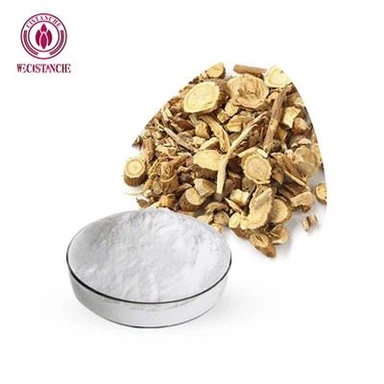
Cistanche tubulosa
Classical texts praise it highly:
Shennong Ben Cao Jing lists it as a superior herb: "treats five fatigues and seven injuries, tonifies the center, nourishes the five viscera, strengthens yin, boosts essence-qi."
Ben Cao Hui Yan describes it as: "warms without heat, tonifies without harshness, heats without dryness, slips without leaking."
That last line is the whole secret of Cistanche tubulosa.
2. Why Do People Feel Tired, Weak, and Cold?
In TCM, fatigue is rarely just "low energy." It usually involves qi, blood, yin, and yang.
If your main complaints are:
constant tiredness that sleep doesn't fix
cold hands and feet
lower back and knee soreness
aversion to cold, preference for warm drinks
low motivation and low libido
frequent nighttime urination
dry, difficult stools
pale or dull complexion
pale tongue with white coating, weak slow pulse
…the pattern is often Kidney Yang deficiency plus essence-blood insufficiency.

Think of Kidney Yang as the body's boiler system. It provides warmth, drive, reproductive function, and the energy to transform food and fluids. When Yang declines, the boiler runs cold. You feel lazy, chilly, weak, and slow.
Essence and blood are the fuel. Overwork, chronic stress, poor sleep, illness, childbirth, surgery, dieting, and aging all consume them. When essence-blood is low, you don't just feel tired-you feel depleted: dry, forgetful, faded, fragile.
Many people then make the mistake of taking strong stimulants or aggressive "yang-fire" herbs. The result: insomnia, mouth ulcers, irritability, nosebleeds, worsened constipation. In TCM terms, they are "deficient yet unable to accept tonification."
Cistanche tubulosa is different. It warms, nourishes, and moistens at the same time.

Effects of Cistanche-Improve kidney function
3. Three Core Actions of Cistanche tubulosa
1. Tonifies Kidney Yang
Kidney Yang deficiency looks like:
cold lower back and knees
cold extremities
low spirit, low drive
frequent urination at night
decreased sexual function
in women: delayed periods, cold womb, fertility difficulty
in men: low libido, erectile weakness due to deficiency
pale tongue, white coat, deep slow pulse
Cistanche tubulosa enters the Kidney channel and warms Yang gently. It is not as violent as aconite or deer antler. It doesn't force the fire; it feeds the embers.

Clinically it is paired with:
Cuscuta seed (Tu Si Zi) for Yang and essence
Eucommia bark (Du Zhong) for sore knees and lower back
Morinda root (Ba Ji Tian) for cold knees and sexual weakness
Goji berry (Gou Qi Zi) for essence-blood
Rehmannia (Shu Di Huang) when Yang and blood-essence both need support
For elderly weakness with cold back, weak knees, and dry constipation, Cistanche tubulosa is almost a signature herb.
2. Nourishes Essence and Blood
Essence governs growth, reproduction, bones, marrow, hair, and brain. Blood governs complexion, menstruation, sleep, and mental clarity.
When essence-blood is depleted, people say things like:
"I'm not sick, but I feel empty."
"After COVID/childbirth / burnout, I never came back."
"My memory is worse, my hair is thinner, my skin is drier."
Cistanche tubulosa does not act like iron pills or hormones. Rather, by warming the Kidney and supporting the body's own production of essence and blood, it helps restore:
post-illness recovery
postpartum depletion
menopausal transition with coldness and dryness
male reproductive weakness from deficiency
elderly frailty
chronic "burnt-out" fatigue
3. Moistens the Intestines and Relieves Constipation
Here is what makes Cistanche tubulosa unusual: most Yang tonics are drying. Cistanche tubulosa is a Yang tonic that also moistens.
It is ideal for:
elderly constipation
postpartum blood-deficiency constipation
chronic illness constipation
people who are too weak for harsh laxatives
constipation together with cold lower back, weak knees, and frequent urination
Classical formula Ji Chuan Jian uses Cistanche tubulosa with angelica, achyranthes, alisma, cimicifuga, and bitter orange to "move the bowels without damaging fluids." That formula exists precisely for people who are deficient, cold, and constipated-not for young people with heat-type constipation.
4. What Modern Research Says

Main Chemical Constituents of Cistanche tubulosa
Cistanche tubulosa is not merely folklore. Its chemistry is well studied.
Key constituents:
phenylethanoid glycosides: echinacoside, acteoside
polysaccharides
iridoids
lignans
betaine
amino acids and minerals
Reported pharmacological activities:
Anti-fatigue
Animal and exercise studies suggest Cistanche tubulosa reduces lactic acid accumulation and supports recovery. For people with chronic fatigue, burnout, or slow post-exercise recovery, this is relevant.
Immune modulation
Polysaccharides appear to support lymphocyte proliferation and macrophage activity. This fits its traditional use in weak, infection-prone, post-illness patients.
Antioxidant and anti-aging
Echinacoside and acteoside scavenge free radicals and modulate antioxidant pathways. This gives a scientific backdrop to the old claim "long intake lightens the body."
Reproductive and endocrine support
Cistanche tubulosa shows sex-hormone-like activity in experimental models. It may support sperm quality, libido, and reproductive function-but human clinical evidence is still limited.
Neuroprotection
Some reviews highlight potential benefits in Alzheimer's and Parkinson's models, mostly through antioxidant and anti-inflammatory pathways. Promising, but not a treatment.
Intestinal function
By increasing moisture and supporting motility, Cistanche tubulosa helps deficient-type constipation without the violence of stimulant laxatives.
Bottom line: Cistanche tubulosa is not a stimulant. It does not "wake you up" like caffeine. It helps the body rebuild baseline warmth, recovery, and resilience.
5. Who Should Try Cistanche tubulosa

Effects of cistanche-Improve Kidney Function
Click here to view Cistanche for Kidney disease products
【Ask for more】 Email:cindy.xue@wecistanche.com / WhatsApp: 0086 18599088692 / WeChat: 18599088692
Good candidates:
people who feel tired even after enough sleep
cold hands and feet, cold lower back and knees
low motivation, low libido
frequent nighttime urination
pale, dull complexion
dry stools from deficiency
elderly people with weakness and constipation
postpartum or post-surgery recovery
menopausal women with coldness, soreness, and fatigue
people who get inflamed by stronger tonics
In short: the "cold, tired, depleted, constipated" type.
6. Who Should Avoid It
Avoid or use only under professional guidance if you have:
Yin deficiency with heat: night sweats, hot palms/soles, dry mouth, red tongue with little coat
Excess heat constipation: hard stools, bad breath, abdominal pain, yellow urine, red tongue with yellow coat
Spleen deficiency with diarrhea: loose stools, poor appetite, bloating
Damp-heat: sticky bitter taste, yellow greasy tongue coat, oily skin, genital dampness
acute cold or flu with fever
pregnancy, breastfeeding, childhood
hypertension, diabetes, heart disease, autoimmune disease, or any condition with regular medication-ask your doctor first
Cistanche tubulosa is safe for many people in correct dosage, but "natural" does not mean "safe for everyone."7. How to Use Cistanche
tubulosa
The Chinese Pharmacopeia commonly lists 6–10 g decocted. Some formulas use 12–20 g, but self-dosing higher is not smarter.
It can be used as:
decoction
powder
soup
porridge
soaked in liquor (common in folk use, but not ideal for everyone)
standardized extract outside China
Recipe 1: Cistanche tubulosa Lamb Congee
Ingredients:
Cistanche tubulosa 10 g
lamb 100–150 g
rice 100 g
ginger, salt
Method:
Decoct Cistanche tubulosa for 20–30 minutes; strain. Cook rice in the decoction. Add blanched lamb slices and ginger. Simmer until soft. Season lightly.
Best for: winter coldness, sore cold knees, pale complexion, deficient constipation.
Skip the lamb version if you are heat-prone; use millet instead.
Recipe 2: Wine-Cistanche tubulosa, Goji, and Chicken Soup
Ingredients:
wine-processed Cistanche tubulosa 10 g
goji berries 12 g
half chicken
ginger 3 slices
Method:
Blanch chicken. Simmer all ingredients for 1.5–2 hours. Light salt only.
Best for: office workers with burnout, weak knees, cold intolerance, post-illness recovery.
Recipe 3: Cistanche tubulosa Millet Porridge

Stewed Cistanche tubulosa soup
Ingredients:
Cistanche tubulosa 6–10 g
millet 100 g
3 red dates
Method:
Decoct Cistanche tubulosa; cook millet and dates in the liquid.
Best for: sensitive stomachs, older adults, women after menstruation, mild deficiency.
Recipe 4: Cistanche tubulosa and Hemp Seed Drink
Ingredients:
Cistanche tubulosa 10 g
hemp seed 10 g, crushed
angelica 6 g
Method:
Simmer for 20–30 minutes.
Best for: dry stools, cold lower back, elderly constipation.
Not for diarrhea or heat constipation.
8. Cistanche tubulosa vs Other Tonics

|
Herb |
Strength |
Best for |
Caution |
|
Ginseng |
powerful qi tonifier |
collapse, shortness of breath, profuse sweating |
can cause agitation, insomnia, hypertension issues |
|
Deer antler |
strong Yang builder |
severe Yang deficiency |
too heating for many people |
|
Goji berry |
nourishes liver/kidney yin-essence |
dry eyes, soreness, mild deficiency |
alone does not fix coldness |
|
Angelica |
builds and moves blood |
blood deficiency, gynecological patterns |
not primarily warming |
|
Cistanche tubulosa |
warms Yang + nourishes essence + moistens intestines |
cold, tired, depleted, constipated |
avoid diarrhea, heat, damp-heat |
Cistanche tubulosa's advantage is balance. It does not dominate the formula. It repairs the foundation slowly.