Desert Symbiosis: The Growth Code Of Cistanche Tubulosa And Salix Matsudana
Apr 13, 2026
In the southern edge of the Taklamakan Desert, deep in the Gobi Desert dunes, and in the extreme environment of yellow sand and huge temperature differences between day and night, there is a precious plant that has coexisted with the desert for thousands of years - Cistanche tubulosa. It has no straight branches or leaves, no emerald green leaves, and even spends most of its growth cycle buried deep underground, silently rooted in the sandy sea with thick and juicy fleshy stems; It lacks independent photosynthetic ability and cannot synthesize nutrients or absorb water on its own, but it has formed a parasitic bond with the red willow in the desert, which is interdependent and mutually beneficial. This seemingly fragile yet incredibly resilient plant, with its unique growth method, writes the most exquisite and touching symbiotic model in desert ecology, and also carries the ecological hope and economic value of desert areas.

Strict desert growth environment: Refining vitality in extreme conditions
The growth of Cistanche tubulosa has never been an easy journey, but an ultimate adaptation and tenacious struggle in the extreme environment. It has extremely strict requirements for its growth environment and prefers soft, sandy land with mild salinization. It mainly roots in desert areas at an altitude of 225-1150 meters and is commonly found in semi-fixed dunes, dry old riverbeds, or low-lying lake basins, which are often "life forbidden zones" where other plants find it difficult to survive. The climate here can be called a 'devil's testing ground', with drought being an eternal theme: annual precipitation often falls below 100 millimeters, with some areas even less than 50 millimeters, while evaporation can reach thousands of millimeters, dozens of times the amount of precipitation. The air humidity is extremely low, and it is constantly enveloped by dry sandstorms. At the same time, the sunshine here is extremely abundant, with a daily sunshine duration of over 8 hours. The strong ultraviolet rays not only test the survival ability of plants, but also provide unique conditions for the accumulation of nutrients in Cistanche tubulosa. What is even more challenging is the huge temperature difference between day and night, which can reach 20 ℃ or even higher. During the day, under the scorching sun, the temperature of the sandy surface can soar above 60 ℃, while at night, the temperature drops sharply below 0 ℃, causing frost to cover the sand. This extreme temperature fluctuation is a severe test for any plant.
In addition to the harsh climate, the soil conditions are also equally harsh. The soil in which Cistanche tubulosa grows is mainly gray-brown desert soil and brown desert soil, with a soil salt content between 0.2% and 1.2%, belonging to mild to moderate salinized soil. The overall soil is extremely poor, with very low organic matter content, but it has the characteristics of looseness and breathability, which provide the necessary conditions for the growth of Cistanche tubulosa fleshy stems and the extension of root systems. The extreme temperature range is its "survival badge". After long-term natural domestication, Cistanche tubulosa can tolerate severe cold of -30 ℃ and extreme heat of 60 ℃, dormant and accumulating energy in severe cold, and steadily growing in extreme heat. The characteristic of "the worse, the tougher" allows Cistanche tubulosa to continuously accumulate unique active nutrients such as echinacoside and verbascoside during its long growth process, making it an indispensable "health treasure" in the desert and praised by ancient people as the "desert ginseng".

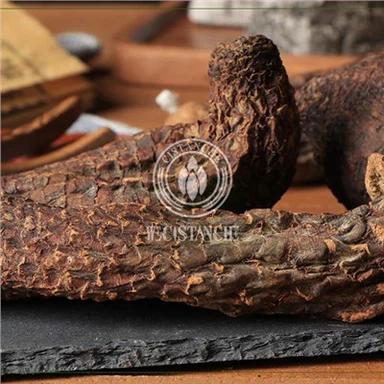
Cistanche tubulosa
The Core of Symbiosis: Parasitic Bond with Red Willow
Cistanche tubulosa is a typical obligate root parasitic plant, which means its survival is completely dependent on the support of its host plant and cannot survive independently in the desert. Red willow (a plant of the genus Tamarix) is its most core and stable "life support". Many people mistakenly believe that the parasitic relationship is a one-sided plunder and being plundered, a dependence of the weak on the strong. However, the relationship between Cistanche tubulosa and Salix matsudana breaks this inherent cognition and becomes a symbiotic model of mutual achievement and empowerment in desert ecology, hiding the simplest and most profound natural wisdom.

1. Red Willow: The "Life Supply Station" of Cistanche tubulosa
Red willow, also known as Chinese tamarisk, is the toughest and most common "sand defender" in the desert, and a "pioneer plant" in desert areas. Its existence provides a solid foundation for the growth of Cistanche tubulosa. The appearance of red willow is tall and flexible, with slender branches and scaly leaves, which can reduce water evaporation and adapt to the strong sunlight environment in the desert. Its root system can be called a 'miracle', with exceptionally developed main roots that can penetrate 5-10 meters underground, even deeper, directly to the groundwater layer, continuously extracting underground water; The lateral roots extend horizontally in all directions, reaching up to 10-20 meters in length, like a huge net that firmly grasps the quicksand underfoot. Each red willow can fix 4-6 square meters of quicksand annually. For a long time, the red willow has built ecological barriers against wind and sand in the desert with its own resilience.
In addition, red willow also has strong salt alkali, drought, and moisture resistance. It can grow tenaciously in severely saline alkali land, and through the glands on its leaves, it excretes excess salt absorbed by its body, forming white salt crystals. This unique physiological characteristic allows it to root and reproduce in saline alkali deserts where other plants cannot survive. For Cistanche tubulosa, red willow is not only a "haven", but also an indispensable "life supply station". The seeds of Cistanche tubulosa are small and hard. Under natural conditions, even if they fall into suitable soil, they cannot germinate on their own. They must rely on the stimulation of phenylpropanoid substances secreted by the root system of Salix to break dormancy and begin germination. After seed germination, a special "suction vessel" (also known as a parasitic disk) will gradually form. This suction vessel will slowly penetrate the root bark of the red willow and closely connect with the vascular bundles of the red willow, like building a "nutrient transport pipeline", directly extracting water, inorganic salts, and organic nutrients from the red willow body. According to relevant research data, over 95% of the nutrients required for the growth of Cistanche tubulosa come from the supply of red willows. Interestingly, during the process of symbiosis with Cistanche tubulosa, the absorption of phosphorus by the red willow can be increased by 2.3 times, and its growth vitality will also be significantly enhanced, which is equivalent to parasitism of Cistanche tubulosa and provides certain assistance for the growth of the red willow.

2. Cistanche tubulosa: the "symbiotic partner" of red willows
Many people mistakenly believe that Cistanche tubulosa is a parasite that "sits back and enjoys its benefits", only plundering the nutrients of red willows blindly, but this is not the case. Although Cistanche tubulosa cannot survive independently, it is not "ungrateful". It uses its unique way to give back the nourishment of the red willow, becoming the most reliable "symbiotic partner" of the red willow. During the growth process, the root system of Cistanche tubulosa secretes active substances such as echinacoside and verbascoside, which can regulate the metabolic activity of the red willow root system and promote the colonization of symbiotic fungi around the red willow root system. And these symbiotic fungi can help the red willow absorb insoluble nutrients such as phosphorus and nitrogen in the soil more efficiently - although desert soil is barren, it still contains a certain amount of insoluble phosphorus and nitrogen, which cannot be directly absorbed by the red willow. Symbiotic fungi can transform it into an absorbable form, thereby enhancing the nutrient supply and stress resistance of the red willow.
This symbiotic relationship of "two-way empowerment" has enabled Cistanche tubulosa and Salix matsudana to form a stable ecological community in the harsh desert environment: Salix matsudana provides Cistanche tubulosa with the necessary water and nutrients for survival, shielding it from wind and sand; Cistanche tubulosa secretes active substances to help red willows better absorb nutrients and enhance their growth vitality. The two are interdependent and mutually beneficial, jointly resisting wind and sand erosion, coping with extreme weather, maintaining the balance and stability of desert ecology, and also allowing this "forbidden zone of life" to bloom with tenacious vitality.

Cultivation of Cistanche tubulosa
Growth cycle: hibernating underground and blooming on the surface
The growth of Cistanche tubulosa is full of "mystery". It spends most of its life quietly underground, and only during a brief reproductive growth stage, it breaks through the sand layer, exposes itself to the surface, and bloom with its own brilliance. This growth characteristic of "underground dormancy and surface blooming" makes Cistanche tubulosa more precious and its growth cycle full of legendary colors.
1. Seed germination: The seeds of Cistanche tubulosa have extremely strong vitality and can remain dormant in desert soil for several years or even decades, waiting for suitable growth conditions. Under natural conditions, the germination of seeds must meet two key conditions: suitable soil moisture and temperature, and stimulation from phenylpropanoid substances secreted by the root system of red willow. Only when these two conditions are met simultaneously can the seeds break dormancy and begin to germinate. This process often takes 3-5 years to establish parasitic relationships and truly begin to grow. With the development of artificial planting technology, this cycle can be shortened to 18-24 months through mycorrhizal pre-inoculation, artificial regulation of the soil environment, and other means. The success rate of parasitism has also increased from 15% in the natural state to over 85%, greatly improving the planting efficiency of Cistanche tubulosa.
2. Underground growth: After seed germination, the suckers formed are closely connected to the root system of the red willow, and begin to absorb nutrients and water from the red willow body, gradually forming fleshy stems. At this stage, the entire growth process of Cistanche tubulosa is completed underground, and the fleshy stem slowly swells and grows in the sand layer, unaffected by external wind and extreme temperatures. Generally speaking, the deeper the fleshy stem is buried, the longer the growth period, the larger the individual plant size, and the richer the accumulation of nutrients. During its underground growth, Cistanche tubulosa continuously stores nutrients to prepare for subsequent surface bolting, flowering, and fruiting. This underground growth stage can range from 1-2 years to several years.
3. Surface bolting: From April to June each year, as temperatures rise and precipitation increases, mature underground Cistanche tubulosa will accumulate enough strength to break through the hard sand layer and extract flower stems up to 1-5 meters high. The flower stem is tall and sturdy, with a smooth surface. The color gradually changes from light brown to dark brown, and a spike-shaped inflorescence of light yellow or light purple will bloom at the top. The inflorescence is dense, and the aroma is light, which can attract bees, butterflies, and other insects in the desert to pollinate. The stage of surface flowering is very short, only 1-2 months, and once pollination is completed, the stems will gradually wither.

Desert living cistanche
4. Harvesting and regeneration: The harvesting of Cistanche tubulosa has strict time requirements. It is generally harvested when the flower stem is extracted and not fully bloomed. At this time, the nutritional content of the fleshy stem is the highest, and the quality is the best. In order to balance ecological protection and industrial benefits, the "minimally invasive harvesting method" is currently widely used, which only cuts off the flower stems and some fleshy stems above the surface during harvesting, while retaining the parasitic substrate and root system about 5 centimeters underground. In this way, the parasitic substrate can continue to connect with the root system of the red willow, absorb nutrients, germinate new fleshy stems, achieve one-time inoculation and multi-year harvesting, and can be harvested twice a year, which not only protects the symbiotic relationship between the red willow and the Cistanche tubulosa, but also continuously obtains economic benefits.
The Gift of the Desert: The Dual Value of Symbiotic Ecology
The coexistence of Cistanche tubulosa and Salix matsudana is not only a unique landscape in desert ecology, but also a precious treasure bestowed upon humanity by nature. Their existence has important ecological and economic values, achieving a win-win situation between ecological protection and economic development.
Ecological value: As the "sand fixing guardian" in the desert, the developed root system of red willow can firmly fix quicksand, reduce wind and sand erosion, curb the spread of land desertification, and improve the ecological environment of desert areas; The symbiosis between Cistanche tubulosa and Salix matsudana can enhance the growth vitality of Salix matsudana, prolong its growth lifespan, and make its sand fixation and prevention effects more significant. At the same time, the growth process of Cistanche tubulosa can improve the physical and chemical properties of soil, increase soil organic matter content, promote the growth of other desert plants, gradually enrich the biodiversity of desert ecosystems, and make the "forbidden zone of life" gradually more vibrant. In addition, the symbiotic community of Cistanche tubulosa and Salix matsudana can regulate local climate, reduce temperature differences between day and night, increase air humidity, provide habitats and foraging grounds for small animals and insects in the desert, and maintain the balance and stability of the desert ecosystem.

cistanche benefits for men
Click here to view Cistanche for Kidney disease products
【Ask for more】 Email:cindy.xue@wecistanche.com / WhatsApp: 0086 18599088692 / Wechat: 18599088692
Economic value: Cistanche tubulosa, as a traditional precious Chinese medicinal herb, has a long history of medicinal use and is known as the "desert ginseng". It is rich in active ingredients such as echinacoside and verbascoside, which have the effects of tonifying kidney yang, nourishing essence and blood, moistening intestines, and promoting bowel movements. It is widely used in the fields of medicine, health products, cosmetics, etc., and has a strong market demand. With the maturity of artificial planting technology, the yield of Cistanche tubulosa has gradually increased, becoming an important industry for increasing income and wealth for people in desert areas. Red willow is not a "useless thing" either. Its branches have a tough texture and can be used to weave handmade crafts such as willow baskets and curtains, as well as used as firewood; At the same time, as an economic plant for windbreak and sand fixation, the red willow can drive the development of local ecological tourism, traditional Chinese medicine planting and other industries, allowing the masses to increase income while controlling desertification, truly achieving the goal of "sand control and wealth for the people".
From struggling to take root in the harsh environment of the desert, to forming a symbiotic bond of life and death with the red willow, the growth history of Cistanche tubulosa, from years of silent dormancy underground to brief brilliant blooms on the surface, is a vivid embodiment of the wisdom of natural symbiosis and the best interpretation of the resilience of life. It teaches us that true strength is never about fighting alone or blindly taking, but about achieving mutual success and overcoming difficulties together. Just like the red willow silently rooting in the sandy sea, supporting a living space for the Cistanche tubulosa, Cistanche grows quietly, using its own strength to give back the nourishment of the red willow. Both accumulate strength in the ordinary and shine brightly in adversity. This symbiotic and win-win wisdom is not only the way for desert plants to survive, but also provides valuable inspiration for us humans to cope with environmental challenges and achieve harmonious coexistence between humans and nature.