Development Of Enriched Oil With Polyphenols Extracted From Olive Mill Wastewater Part 2
Jun 02, 2023
The enrichment of the olive oil sample with the dispersion was then investigated. There was a 42.2% increase in polyphenols (from 60.2 ± 5.6 to 104.1 ± 8.3 mg GAE/Kg after 0.5% enrichment of micellar dispersions). The enriched olive oil is shown in Figure 4, which also shows how the organoleptic characteristics of the olive oil changed. Although a pleasant, fruity odor (aroma) was developed, turbidity was observed without the deposition of sediment.

Glycoside of cistanche can also increase the activity of SOD in heart and liver tissues, and significantly reduce the content of lipofuscin and MDA in each tissue, effectively scavenging various reactive oxygen radicals (OH-, H₂O₂, etc.) and protecting against DNA damage caused by OH-radicals. Cistanche phenylethanoid glycosides have a strong scavenging ability of free radicals, a higher reducing ability than vitamin C, improve the activity of SOD in sperm suspension, reduce the content of MDA, and have a certain protective effect on sperm membrane function. Cistanche polysaccharides can enhance the activity of SOD and GSH-Px in erythrocytes and lung tissues of experimentally senescent mice caused by D-galactose, as well as reduce the content of MDA and collagen in lung and plasma, and increase the content of elastin, have a good scavenging effect on DPPH, prolong the time of hypoxia in senescent mice, improve the activity of SOD in serum, and delay the physiological degeneration of lung in experimentally senescent mice With cellular morphological degeneration, experiments have shown that Cistanche has the good antioxidant ability and has the potential to be a drug to prevent and treat skin aging diseases. At the same time, echinacoside in Cistanche has a significant ability to scavenge DPPH free radicals and can scavenge reactive oxygen species, prevent free radical-induced collagen degradation, and also has a good repair effect on thymine free radical anion damage.
Click on Cistanche Supplement Review
【For more info: david.deng@wecistanche.com / WhatApp:86 13632399501】
Samples of micellar dispersions showed a decrease in free radicals after sonication with increasing concentration (Table 1) by the DPPH method. The highest reductions were observed at the highest concentrations for all samples while the 75-son sample displayed the highest value. The 60-son sample shows lower toxicity than the rest of the samples, while the 90-son sample displays the highest. Statistical analysis, however, showed that there was no significant difference (p > 0.05) between the three sonication duration levels. It should also be noted that the 60-son and 75-son samples show similar mean inhibitory concentration patterns. In general, the repulsive interactions between the ionic head groups of the surfactant molecules were reduced when salts were added to the surfactant solution. As a result, it was encouraged to form micelles, which might have had an impact on DPPH free-radical scavenging activity [29]. The hydroxytyrosol and tyrosol phenolic compounds are the most prevalent ones in the OMW extracts. According to Karadag et al. [30], OMW’s high hydroxytyrosol content is a contributing factor to its strong antioxidant activities. In their investigation on the recovery of phenolic compounds from OMW, Yangui, and Abderrabba [31] concluded that the recovered polyphenols showed strong antioxidant activity and rapid DPPH free-radical scavenging activity.

3.3. Quality Control of Enriched Olive Oils
Olive oil, including both refined and virgin oil, should have an acidity of less than 1%, as specified by Commission Implementing Regulation No 299/2013 [18] (Appendix— Characteristics of Olive Oil). All samples fell within the specified range, as seen in Table 2. At 20 ◦C, the refractive index should range from 1.4677 to 1.4705. The values of L* and a* factors did not change noticeably. After the 75- and 90-son samples were included, factor b* was altered. The specific extinction coefficients were constant with the control olive oil and with the remaining enrichment sample olive oil. The samples of enhanced olive oil had protective factors that were less than a mean value of 1. Each sample demonstrated pro-oxidant activity. However, a 60-son oil sample with an approximate value of 1 was shown to have the highest oxidant efficiency (0.96 ± 0.05).

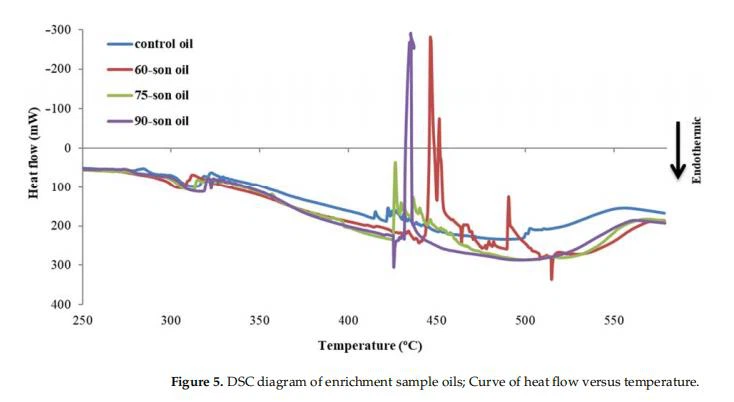
The exothermic peaks of the extracts used in this investigation were measured using DSC (Figure 5). Thermographic curves that reveal the temperature of the extrapolated commencement of the thermo-oxidation process can be used by DSC to derive oxidation kinetic parameters. The highest oxidation peak on the thermographic curve is Tmax. As the sample demonstrates a stronger resistance, the higher the Tmax value. The 60-son oil sample showed the most important antioxidant efficiency.
Due to the preservation of the initial sample (control), a monthly decrease in the total polyphenol content is observed. The initial sample was used for the monthly sampling (Figure 6).

After enrichment, the total polyphenol content increased significantly. The 75-son oil had a significant consistency in polyphenol content, whose growth percentage peaked after four months (Figure 7). The 60-son oil sample was still largely stable after four months, but the 90-son oil sample exhibited significant changes throughout the same period.

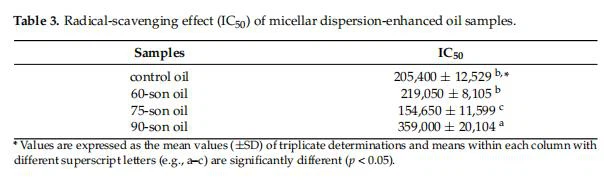
After sonication, the number of free radicals in micellar dispersion‐enhanced samples decreased when the concentration increased (Table 3). The 75‐son oil sample exhibited the greatest reduction in free radicals compared to other samples. The toxicity of the 75‐son sample was lower than that of the other samples. Compared to other samples, the 90‐son oil sample exhibited the highest level of toxicity, although the 60‐son oil and control samples behaved similarly.
Due to its textural and organoleptic properties, negative environmental effects, and management and disposal issues, olive oil wastewater has attracted attention [32]. High amounts of polyphenolic compounds and the organic load of olive oil waste could be the cause of phytotoxicity and changes in soil microbiota [33]. The addition of polyphenols from oil waste to several food matrices has increased both their antioxidant properties and sensory characteristics, although it presents disadvantages as a fertilizer and feed additive. Previous research has shown that a significant quantity of polyphenols remains in the by-products of olive oil production [34–37]. To optimize the reintroduction of polyphenolic compounds into the food chain, increase their value, and improve the waste management of the olive oil industry, the effective recovery of polyphenolic compounds has been the subject of substantial research [38].

4. Conclusions
In our study, the cloud point extraction method, which used lecithin as an emulsifier at a concentration of 3%, produced significant recovery efficiency of micellar dispersions. Micellar dispersion sample sizes decreased following sonication as the concentration increased. The concentration of total polyphenols in olive oil samples rose to 42.2% with the addition of 0.5% micellar dispersions. The 75-son oil sample initially showed stability, but the total polyphenol concentration increased significantly after four months. In addition, a significant reduction in free radicals was observed in this sample compared to other samples. The oil from the 60-son sample demonstrated less toxicity than the other samples in terms of the mean inhibitory concentration in the free radicals. No specific organoleptic characteristics have been noted. The colors of the samples remained unchanged, no sediment was visible, and the aroma of the olive oil was fruity and pleasant. More research is required to optimize the extraction conditions of polyphenolic components from olive mill wastewater. Their use could lead to better waste management in the olive oil industry as well as improvements in the nutritional quality of food products.

Author Contributions: Conceptualization, O.G., I.G.R., S.I.L., and V.A.; methodology, O.G., and V.A.; validation, A.V., V.A., and K.K.; formal analysis, A.V., and V.A.; investigation, A.V., and V.A.; resources, O.G. and S.I.L.; data curation, O.G., I.G.R., S.I.L., and V.A.; writing—original draft preparation, O.G., I.G.R., S.I.L., and V.A.; writing—review and editing, O.G., I.G.R., S.I.L., K.K., and V.A.; visualization, V.A.; supervision, O.G., I.G.R., and S.I.L.; project administration, O.G.; funding acquisition, O.G., and S.I.L. All authors have read and agreed to the published version of the manuscript.
Funding: This research received no external funding.
Data Availability Statement: All the data are contained within the article.

Acknowledgments: Authors would like to thank Spyros Konakis (Konakis Olive Oil & Olives, Neos Oropos, GR-48061, Preveza, Greece) for providing the sample of olive mill wastewater.
Conflicts of Interest: The authors declare no conflict of interest.
References
1. Hanififi, S.; Hadrami, I. El Olive Mill Wastewaters: Diversity of the Fatal Product in Olive Oil Industry and Its Valorisation as Agronomical Amendment of Poor Soils: A Review. J. Agron. 2008, 8, 1–13. [CrossRef]
2. Jarboui, R.; Sellami, F.; Kharroubi, A.; Gharsallah, N.; Ammar, E. Olive Mill Wastewater Stabilization in Open-Air Ponds: Impact on Clay-Sandy Soil. Bioresour. Technol. 2008, 99, 7699–7708. [CrossRef] [PubMed]
3. Russo, E.; Spallarossa, A.; Comite, A.; Pagliero, M.; Guida, P.; Belotti, V.; Caviglia, D.; Schito, A.M. Valorization and Potential Antimicrobial Use of Olive Mill Wastewater (OMW) from Italian Olive Oil Production. Antioxidants 2022, 11, 903. [CrossRef] [PubMed]
4. Saez, L.; Perez, J.; Martinez, J. Low Molecular Weight Phenolics Attenuation during Simulated Treatment of Wastewaters from Olive Oil Mills in Evaporation Ponds. Water Res. 1992, 26, 1261–1266. [CrossRef]
5. Motikar, P.D.; More, P.R.; Arya, S.S. A Novel, Green Environment-Friendly Cloud Point Extraction of Polyphenols from Pomegranate Peels: A Comparative Assessment with Ultrasound and Microwave-Assisted Extraction. Sep. Sci. Technol. 2021, 56, 1014–1025. [CrossRef]
6. Alibade, A.; Batra, G.; Bozinou, E.; Salakidou, C.; Lalas, S. Optimization of the Extraction of Antioxidants from Winery Wastes Using Cloud Point Extraction and a Surfactant of Natural Origin (Lecithin). Chem. Pap. 2020, 74, 4517–4524. [CrossRef]
7. ´Sliwa, P.; ´Sliwa, K. Nanomicellar Extraction of Polyphenols—Methodology and Applications Review. Int. J. Mol. Sci. 2021, 22, 11392. [CrossRef]
8. Leouifoudi, I.; Zyad, A.; Amechrouq, A.; Oukerrou, M.A.; Mouse, H.A.; Mbarki, M. Identification and Characterisation of Phenolic Compounds Extracted from Moroccan Olive Mill Wastewater. Food Sci. Technol. 2014, 34, 249–257. [CrossRef]
9. Servili, M.; Esposto, S.; Fabiani, R.; Urbani, S.; Taticchi, A.; Mariucci, F.; Selvaggini, R.; Montedoro, G.F. Phenolic Compounds in Olive Oil: Antioxidant, Health and Organoleptic Activities According to Their Chemical Structure. Inflflammopharmacology 2009, 17, 76–84. [CrossRef]
10. Visioli, F.; Poli, A.; Galli, C. Antioxidant and Other Biological Activities of Phenols from Olives and Olive Oil. Med. Res. Rev. 2002, 22, 65–75. [CrossRef]
11. Ben Saad, A.; Jerbi, A.; Khlif, I.; Ayedi, M.; Allouche, N. Stabilization of Refined Olive Oil with Phenolic Monomers Fraction and Purifified Hydroxytyrosol from Olive Mill Wastewater. Chem. Afr. 2020, 3, 657–665. [CrossRef]
12. Bravi, E.; Perretti, G.; Falconi, C.; Marconi, O.; Fantozzi, P. Antioxidant Effects of Supercritical Fluid Garlic Extracts in Sunflower Oil. J. Sci. Food Agric. 2017, 97, 102–107. [CrossRef] [PubMed]
13. Hannachi, H.; Elfalleh, W. Enrichment of Olive Oil with Polyphenols from Oleaster Leaves Using Central Composite Design for the Experimental Measurements. Anal. Lett. 2021, 54, 590–607. [CrossRef]
14. Chedea, V.S.; Tomoiagˇa, L.L.; Macovei, ¸S.O.; Mˇagureanu, D.C.; Iliescu, M.L.; Bocsan, I.C.; Buzoianu, A.D.; Vo¸sloban, C.M.; Pop, R.M. Antioxidant/Pro-Oxidant Actions of Polyphenols from Grapevine and Wine By-Products-Base for Complementary Therapy in Ischemic Heart Diseases. Front. Cardiovasc. Med. 2021, 8, 1522. [CrossRef]
15. Chatzilazarou, A.; Katsoyannos, E.; Gortzi, O.; Lalas, S.; Paraskevopoulos, Y.; Dourtoglou, E.; Tsaknis, J. Removal of Polyphenols from Wine Sludge Using Cloud Point Extraction. J. Air Waste Manag. Assoc. 2010, 60, 454–459. [CrossRef] [PubMed]
16. Katsoyannos, E.; Gortzi, O.; Chatzilazarou, A.; Athanasiadis, V.; Tsaknis, J.; Lalas, S. Evaluation of the Suitability of Low Hazard Surfactants for the Separation of Phenols and Carotenoids from Red-Flesh Orange Juice and Olive Mill Wastewater Using Cloud Point Extraction. J. Sep. Sci. 2012, 35, 2665–2670. [CrossRef] [PubMed]
17. Commission Regulation (EEC) No 2568/91 of 11 July 1991 on the Characteristics of Olive Oil and Olive-Residue Oil and the Relevant Methods of Analysis. Off. J. Eur. Communities 1991, L248, 27–28.
18. Commission Implementing Regulation (EU) No 299/2013 of 26 March 2013 Amending Regulation (EEC) No 2568/91 on the Characteristics of Olive Oil and Olive-Residue Oil and the Relevant Methods of Analysis. Off. J. Eur. Union 2013, L90, 55–56.
19. Lalas, S.; Athanasiadis, V.; Gortzi, O.; Bounitsi, M.; Giovanoudis, I.; Tsaknis, J.; Bogiatzis, F. Enrichment of Table Olives with Polyphenols Extracted from Olive Leaves. Food Chem. 2011, 127, 1521–1525. [CrossRef]
20. Pardauil, J.J.R.; Souza, L.K.C.; Molfetta, F.A.; Zamian, J.R.; Rocha Filho, G.N.; Da Costa, C.E.F. Determination of the Oxidative Stability by DSC of Vegetable Oils from the Amazonian Area. Bioresour. Technol. 2011, 102, 5873–5877. [CrossRef]
21. Kalantzakis, G.; Blekas, G.; Pegklidou, K.; Boskou, D. Stability and Radical-Scavenging Activity of Heated Olive Oil and Other Vegetable Oils. Eur. J. Lipid Sci. Technol. 2006, 108, 329–335. [CrossRef]
22. Víctor-Ortega, M.D.; Martins, R.C.; Gando-Ferreira, L.M.; Quinta-Ferreira, R.M. Recovery of Phenolic Compounds from Wastewaters through Micellar Enhanced Ultrafiltration. Colloids Surf. A Physicochem. Eng. Asp. 2017, 531, 18–24. [CrossRef]
23. Sliwa, K.; Sliwa, P. The Accumulated Effect of the Number of Ethylene Oxide Units and/or Carbon Chain Length in Surfactants Structure on the Nano-Micellar Extraction of Flavonoids. J. Funct. Biomater. 2020, 11, 57. [CrossRef] [PubMed]
24. Katsoyannos, E.; Chatzilazarou, A.; Gortzi, O.; Lalas, S.; Konteles, S.; Tataridis, P. Application of Cloud Point Extraction Using Surfactants in the Isolation of Physical Antioxidants (Phenols) from Olive Mill Wastewater. Fresenius Environ. Bull. 2006, 15, 1122–1125.
25. Gortzi, O.; Lalas, S.; Chatzilazarou, A.; Katsoyannos, E.; Papaconstandinou, S.; Dourtoglou, E. Recovery of Natural Antioxidants from Olive Mill Wastewater Using Genapol-X080. J. Am. Oil Chem. Soc. 2008, 85, 133–140. [CrossRef]
26. ´Sliwa, P.; ´Sliwa, K.; Sikora, E.; Ogonowski, J.; Oszmia ´nski, J.; Nowicka, P. Incorporation of Bioflflavonoids from Bidens Tripartite into Micelles of Non-Ionic Surfactants—Experimental and Theoretical Studies. Colloids Surf. B Biointerfaces 2019, 184, 110553. [CrossRef]
27. Xenakis, A.; Papadimitriou, V.; Sotiroudis, T.G. Colloidal Structures in Natural Oils. Curr. Opin. Colloid Interface Sci. 2010, 15, 55–60. [CrossRef]
28. Li, F.; Raza, A.; Wang, Y.-W.; Xu, X.-Q.; Chen, G.-H. Optimization of Surfactant-Mediated, Ultrasonic-Assisted Extraction of Antioxidant Polyphenols from Rattan Tea (Ampelopsis Grossedentata) Using Response Surface Methodology. Pharmacogn. Mag. 2017, 13, 446–453. [CrossRef]
29. Noipa, T.; Srijaranai, S.; Tuntulani, T.; Ngeontae, W. New Approach for Evaluation of the Antioxidant Capacity Based on Scavenging DPPH Free Radical in Micelle Systems. Food Res. Int. 2011, 44, 798–806. [CrossRef]
30. Karadag, A.; Kayacan Cakmakoglu, S.; Metin Yildirim, R.; Karasu, S.; Avci, E.; Ozer, H.; Sagdic, O. Enrichment of Lecithin with Phenolics from Olive Mill Wastewater by Cloud Point Extraction and Its Application in Vegan Salad Dressing. J. Food Process. Preserv. 2022, 46, e16645. [CrossRef]
31. Yangui, A.; Abderrabba, M. Towards a High Yield Recovery of Polyphenols from Olive Mill Wastewater on Activated Carbon Coated with Milk Proteins: Experimental Design and Antioxidant Activity. Food Chem. 2018, 262, 102–109. [CrossRef]
32. Roig, A.; Cayuela, M.L.; Sánchez-Monedero, M.A. An Overview of Olive Mill Wastes and Their Valorisation Methods. Waste Manag. 2006, 26, 960–969. [CrossRef] [PubMed]
33. Kotsou, M.; Mari, I.; Lasaridi, K.; Chatzipavlidis, I.; Balis, C.; Kyriacou, A. The Effect of Olive Oil Mill Wastewater (OMW) on Soil Microbial Communities and Suppressiveness against Rhizoctonia Solani. Appl. Soil Ecol. 2004, 26, 113–121. [CrossRef]
34. Zoidou, E.; Melliou, E.; Gikas, E.; Tsarbopoulos, A.; Magiatis, P.; Skaltsounis, A.L. Identification of Throuba Thassos, a Traditional Greek Table Olive Variety, as a Nutritional Rich Source of Oleuropein. J. Agric. Food Chem. 2010, 58, 46–50. [CrossRef]
35. Rodis, P.S.; Karathanos, V.T.; Mantzavinou, A. Partitioning of Olive Oil Antioxidants between Oil and Water Phases. J. Agric. Food Chem. 2002, 50, 596–601. [CrossRef]
36. Soler-Rivas, C.; Espín, J.C.; Wichers, H.J. Oleuropein, and Related Compounds. J. Sci. Food Agric. 2000, 80, 1013–1023. [CrossRef]
37. Garrido-Fernandez, A.; Fernandez-Diez, M.J.; Adams, M.R. Table Olives: Production and Processing; Chapman & Hall: London, UK, 1997; ISBN 0412718103.
38. Bouaziz, M.; Feki, I.; Ayadi, M.; Jemai, H.; Sayadi, S. Stability of Refifined Olive Oil and Olive-pomace Oil Added by Phenolic Compounds from Olive Leaves. Eur. J. Lipid Sci. Technol. 2010, 112, 894–905. [CrossRef]
Disclaimer/Publisher’s Note: The statements, opinions, and data contained in all publications are solely those of the individual author(s) and contributor(s) and not of MDPI and/or the editor(s). MDPI and/or the editor(s) disclaim responsibility for any injury to people or property resulting from any ideas, methods, instructions, or products referred to in the content.
【For more info: david.deng@wecistanche.com / WhatApp:86 13632399501】