Diverse Yeast Antiviral Systems Prevent Lethal Pathogenesis Caused By The L-A Mycovirus
Dec 01, 2023
Recent studies show that antiviral systems are remarkably conserved from bacteria to mammals, demonstrating that unique insights into these systems can be gained by studying microbial organisms. Unlike in bacteria, however, where phage infection can be lethal, no cytotoxic viral consequence is known in the budding yeast Saccharomyces cerevisiae even though it is chronically infected with a double-stranded RNA mycovirus called L-A. This remains the case despite the previous identification of conserved antiviral systems that limit L-A replication. Here, we show that these systems collaborate to prevent rampant L-A replication, which causes lethality in cells grown at high temperatures. Exploiting this discovery, we use an overexpression screen to identify antiviral functions for the yeast homologs of polyA-binding protein (PABPC1) and the La-domain containing protein Larp1, which are both involved in viral innate immunity in humans. Using a complementary loss of function approach, we identify new antiviral functions for the conserved RNA exonucleases REX2 and MYG1; the SAGA and PAF1 chromatin regulatory complexes; and HSF1, the master transcriptional regulator of the proteostatic stress response. Through investigation of these antiviral systems, we show that L-A pathogenesis is associated with an activated proteostatic stress response and the accumulation of cytotoxic protein aggregates. These findings identify proteotoxic stress as an underlying cause of L-A pathogenesis and further advance yeast as a powerful model system for the discovery and characterization of conserved antiviral systems.
All laboratory strains and most environmental isolates of the budding yeast S. cerevisiae are infected with a double-stranded RNA (dsRNA) virus called L-A (1, 2). L-A belongs to the broadly dispersed Totiviridae family of endogenous dsRNA viruses. Like all viruses of this family, the L-A dsRNA genome is packaged within a virion that shields it from host-mediated digestion. Holes in the virion permit the extrusion of RNA transcripts into the cytosol that encodes the capsid protein, Gag, which comprises most of the particle. The L-A transcript also encodes a Gag-pol fusion protein, produced at much lower levels than the Gag protein, that possesses RNA-dependent RNA polymerase activity. Each virion contains a Gag-pol protein, which accounts for L-A replication and transcription within the particle. Encapsidation of the viral transcripts within nascent particles and synthesis of the negative RNA strand by Gag-pol to form the dsRNA genome completes the L-A replication cycle (2). To produce these proteins, L-A employs features typical of RNA viruses found in humans, including a "cap-snatching" mechanism that furnishes L-A transcripts with a 5′-methyl cap and a ribosomal frameshifting mechanism to produce Gag and Gag-pol fusion proteins from a single transcript (3, 4).

cistanche tubulosa-improve immune system
Recent studies of bacterial antiviral systems have shown that they share remarkable evolutionary conservation with humans, revealing the potential of microbial organisms to provide new insights into viral innate immunity (5–11). Indeed, early studies involving L-A led to the discovery of two antiviral systems that have subsequently been shown to contribute to innate immunity against diverse RNA viruses in mammals (12–17). The first of these antiviral systems involves the SKI2, 3, and 8 genes, which encode subunits of a conserved ribosome-associated complex that opposes the translation of transcripts that lack poly(A) tails like those encoded by L-A (18–23). A separate pathway of L-A attenuation occurs through Xrn1 (also known as SKI1), a 5′-3′ exoribonuclease that degrades uncapped mRNAs (24–26).
We recently found that the mitochondrial DNA/RNA endonuclease Nuc1 represses the accumulation of L-A in sporulating cells, representing a new yeast antiviral pathway (27). Nuc1 is a homolog of endonuclease G (EndoG) found in all eukaryotes and many prokaryotes and is most known for its role in promoting genome fragmentation during mammalian programmed cell death, a prominent last-resort mechanism of viral defense (28, 29). Intriguingly, programmed cell death is intrinsic to yeast sporulation, and Nuc1 fragments the DNA from dying meiotic products during this process in addition to its role in attenuating L-A viral levels that are inherited by the surviving spores (27, 30, 31).
Despite the ubiquitous presence of L-A in lab strains, there has been no fitness consequence attributed to it and thus L-A is largely regarded as a harmless commensal. Here, we show that L-A infection is in fact deadly for yeast and that it must be actively attenuated through viral innate immunity to preserve viability. Specifically, in strains lacking parallel-acting NUC1 and SKI antiviral pathways, the L-A copy number is massively increased, leading to lethality at high temperatures.

cistanche tubulosa-improve immune system
We reasoned that further characterization of L-A and the factors that maintain its replication at a low level could reveal new antiviral systems. Identifying conditions that lead to L-A pathogenesis allowed us to use bioinformatic and forward genetic screening approaches to discover new antiviral genes. Using a screen for overexpressed genes that suppress nuc1∆ ski3∆ conditional lethality, we identify antiviral functions for the yeast homologs of poly(A)-binding protein (PABPC1) and the La-domain containing protein Larp1, which are both involved in viral innate immunity in humans (32, 33). Moreover, loss of function genetic studies identified twelve new antiviral genes. Among these are the highly conserved SAGA transcriptional coactivator complex and several RNA exonucleases including REX2 and MYG1, both of which have distinct but poorly characterized human and bacterial homologs (34–37).
Finally, we characterize L-A pathogenesis using cell biological methods and find that high viral load causes proteostatic stress. As high temperature is well known to exacerbate proteostatic stress, these observations suggest that catastrophic proteostatic stress is the cause of L-A–induced lethality. Consistent with this hypothesis, we show that nuc1∆ ski3∆ mutants exhibit L-A-dependent sensitivity to azetidine-2-carboxylic acid (AZC), a proline analog known to cause orthostatic stress (38). Further, we demonstrate an antiviral function for HSF1, a conserved transcription factor that senses and directs the response to orthostatic stress. Interestingly, human Hsf1 also plays important roles in the replication and/or pathogenicity of diverse viruses including HIV, SARS-Cov-2, and dengue virus, though the mechanisms are unclear (39). These findings provide novel examples of innate immune conservation from microbes to humans and further high light yeast as a powerful model system for the discovery of new antiviral systems.
Results
The NUC1, SKI, and XRN1 Yeast Antiviral Systems Collaborate to Prevent L-A Pathogenesis.
Our previous studies of NUC1 were focused on meiotic cells (27). To investigate NUC1 antiviral function in vegetatively growing yeast, we examined the L-A copy number in mitotic haploid cells in the reference BY4742 strain background. We observed the levels of L-A dsRNA using ethidium bromide staining of electrophoresed RNA and found that a nuc1∆ ski3∆ double mutant showed a large increase in L-A dsRNA (Fig. 1A). We corroborated these findings using immunofluorescence microscopy with a dsRNA antibody used to detect replicating RNA viruses (40, 41). These images showed that L-A dsRNA accumulated in foci, reminiscent of "viral factory" sites of viral replication observed in human cells (Fig. 1B and SI Appendix, Fig. S1) (42). Consistent with previous findings in other strain backgrounds (24, 27, 43), western blotting showed that Gag protein levels were elevated in the nuc1∆ and ski3∆ mutants (Fig. 1C). Furthermore, we showed that a nuc1∆ ski3∆ double mutant accumulated massively elevated Gag levels (Fig. 1C). These data show that NUC1 and SKI3 participate in separate antiviral pathways and that loss of both pathways results in a greatly increased L-A viral load.
To determine if high L-A viral load affects cell fitness, we examined yeast growth using spot test growth assays. Subtle growth defects of nuc1∆ and ski3∆ single mutants were observed at 37 °C when cells were grown with glycerol rather than glucose as the carbon source, a condition under which yeast relies on mitochondrial respiration (Fig. 1D). Remarkably, although nuc1∆ ski3∆ double mutants grew normally at 30 °C, they exhibited conditional lethality at 37 °C regardless of the carbon source (Fig. 1D). As expected, viability at high temperature was restored to a nuc1∆ ski3∆ double mutant by a NUC1-expressing plasmid which elicited a corresponding decrease in Gag levels (Fig. 1 C and D). To confirm that the growth defect of the nuc1∆ ski3∆ double mutant was caused by L-A, we constructed an isogenic strain cured of L-A (L-A0 ) and assayed its growth at high temperatures. We found that the growth defect was completely alleviated, implying that the conditional lethality was a result of unrestricted L-A replication (Fig. 1D). To assess the effects of high L-A copy number on cell fitness under optimal growth conditions, we measured proliferation rates in liquid culture. These studies revealed a reduced growth rate in nuc1∆ ski3∆ double mutants compared to the wild type at 30 °C that was reversed in L-A0 strains, demonstrating that high L-A load is detrimental to fitness even in nonstressed cells (SI Appendix, Fig. S2).
cistanche plant-increasing immune system
Click here to view Cistanche Enhance Immunity products
【Ask for more】 Email:cindy.xue@wecistanche.com / Whats App: 0086 18599088692 / Wechat: 18599088692
To further characterize how NUC1 interacts with known antiviral pathways, we tested its relationship with XRN1. We found that a nuc1∆ xrn1∆ double mutant accumulated greatly elevated levels of Gag compared with either single mutant and exhibited L-A– dependent conditional lethality at high temperature (SI Appendix, Fig. S3 A and B), suggesting that NUC1 and XRN1 act in parallel pathways to attenuate L-A. Reflecting their key nonredundant roles in bulk mRNA regulation, an xrn1∆ ski3∆ double mutant is inviable, even in strains lacking L-A (44). To determine whether XRN1 represents an antiviral system independent of both NUC1 and SKI3, we used a high-copy plasmid to overexpress XRN1 in a nuc1∆ ski3∆ double mutant. Indeed, we observed a substantial decrease in Gag levels and suppression of the nuc1∆ ski3∆ conditional lethality using plasmid-driven XRN1 overexpression (Fig. 1 C and D). We conclude that Nuc1, Ski3, and Xrn1 convergently oppose L-A replication and that massively increased L-A viral load in nuc1∆ ski3∆ or nuc1∆ xrn1∆ mutants caused lethal pathogenesis at high temperatures (Fig. 1E).
A Bioinformatic-Based Genetic Screen Identifies New Antiviral Factors.
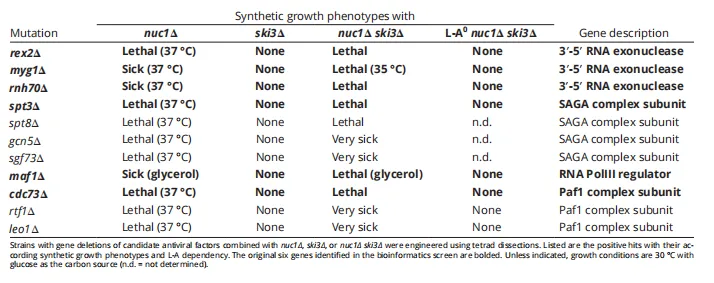
The L-A–dependent conditional lethality of nuc1∆ ski3∆ double mutants raised the possibility that other antiviral factors could be identified through combinatorial mutant studies. To identify new candidate antiviral factors, we searched a curated genetic interaction database for gene deletions that caused a synthetic growth defect when combined with nuc1∆ in at least two high-throughput screening studies (45). In addition to the expected presence of XRN1 and SKI deletions in this data set, we found sixteen additional genes. We used genetic crossing to make triple mutants combining deletions of each of these sixteen genes with nuc1∆ ski3∆ and confirmed six that caused severe growth defects (Table 1). We determined that the synthetic growth phenotypes caused by each of these genes were reversed in L-A0 strains, suggesting that they encode antiviral proteins (Table 1). We describe confirmation of several of these screen hits as new antiviral factors below.
One gene identified in our screen, REX2, encodes a 3′-5′ RNA exonuclease conserved from bacteria to humans (35). Both Rex2 and its human homolog REXO2 localize to the mitochondria and contain an EXOIII domain widely found in prokaryotic and eukaryotic proteins, including the interferon-stimulated antiviral protein ISG20 (36, 37, 46–48). We found that a rex2∆ nuc1∆ double-mutant strain accumulated greatly increased levels of Gag compared to either single mutant and exhibited L-A–dependent growth defects, including lethality at high temperature (Fig. 2 A and B, and SI Appendix, Fig. S2). A rex2∆ single-mutant strain exhibited a slight increase in Gag levels, though this effect was marginal (Fig. 2B). To rigorously scrutinize the consequences of rex2∆ for L-A copy number, we quantified L-A RNA using RT-qPCR. These measurements confirmed that rex2∆ nuc1∆ strains accumulate greatly increased levels of L-A, though they also revealed that a rex2∆ single mutant did not accumulate increased L-A RNA (Fig. 2C). These findings suggest Rex2's antiviral role is apparent only in the absence of NUC1 function. Remarkably, nuc1∆ ski3∆ rex2∆ and nuc1∆ xrn1∆ rex2∆ triple mutants were inviable under all growth conditions, and these defects were reversed in L-A0 strains (Fig. 2D). These findings demonstrate the severe pathogenic potential of the L-A mycovirus and identify a new antiviral role for a highly conserved mitochondrially localized RNA exonuclease.
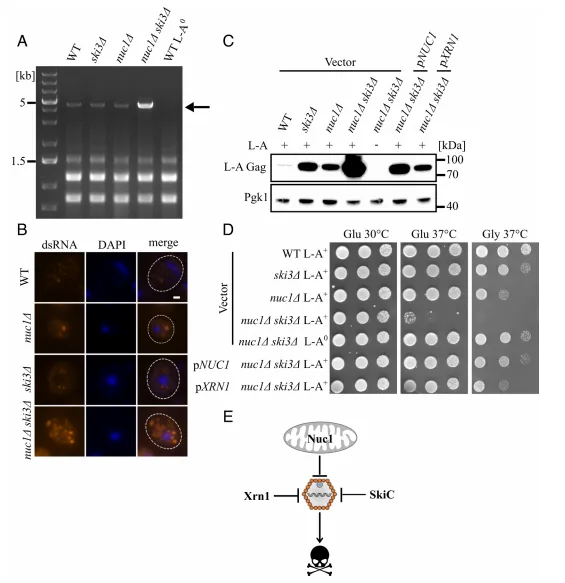
Fig. 1. L-A attenuation protects yeast from lethal pathogenesis. (A) An ethidium bromide-stained gel of total RNA prepared from the indicated strains is shown, with the 4.6 kb L-A dsRNA band indicated with an arrow. (B) Immunofluorescence was used to visualize L-A dsRNA (orange) in cells of the indicated genotypes. These strains were cured of the weakly abundant L-BC dsRNA virus to eliminate background staining (Method Details). DAPI staining of DNA is in blue. (Scale bar, 1 μm.) (C) Western blotting of L-A Gag and 3-phosphoglycerate kinase (Pgk1) protein levels in the indicated strains is shown. Molecular weight markers are indicated on the right. (D) Spot test growth assays of the strains from 1C are shown. Strains were spotted on -Leu media containing either glucose or glycerol and grown at the indicated temperatures. (E) The mitochondrial protein Nuc1 collaborates with the cytosolic proteins Xrn1 and SkiC to regulate L-A protein level and ensure cell fitness.
Another gene identified in our screen was MYG1, the yeast homolog of human MelanocYte proliferation Gene 1, a 3′-5′ RNA exonuclease that has homologs in all taxa (34). Mutant strains combining myg1∆ and nuc1∆ exhibited large increases in Gag protein and L-A RNA compared to the single mutants and displayed severe L-A-dependent growth defects at high temperature and in liquid culture (Fig. 2C and SI Appendix, Figs. S2, S4 A and C). Like with rex2∆, a myg1∆ single mutant strain showed little increase in Gag level and no change in L-A RNA (Fig. 2C and SI Appendix, Fig. S4C). We were able to recover nuc1∆ ski3∆ myg1∆ triple mutants, though they were extremely slow growing at 30 °C and accumulated even higher levels of Gag (SI Appendix, Fig. S4 A and C). These growth defects were also reversed in L-A0 strains (SI Appendix, Fig. S4A). MYG1 thus represents a new antiviral factor, acting in parallel to both NUC1 and the SKI complex.
Table 1. Identification of new candidate antiviral factors using a bioinformatic approach
Mutations leading to overexpression of human MYG1 are associated with the autoimmune disorder vitiligo, suggesting that MYG1 may play some role in human innate immunity (49, 50). We explored this possibility using a plasmid expressing human MYG1 under the control of a constitutive yeast promoter (34) and found that human MYG1 rescued the conditional growth defect of a nuc1∆ myg1∆ mutant (SI Appendix, Fig. S4D). These findings show that the antiviral function of yeast MYG1 can be accomplished by human MYG1, suggesting a potential antiviral function for MYG1 in humans.
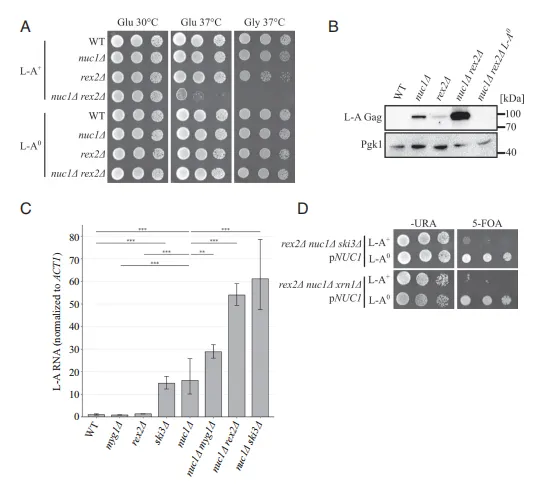
Fig. 2. New antiviral factors are identified by exploiting L-A pathogenesis. (A) Spot analysis of strains defective in NUC1 and REX2 is shown. Strains were spotted on SC media containing either glucose or glycerol and grown at the indicated temperature. (B) Western blotting of L-A Gag and Pgk1 protein levels of strains in Fig. 2A. Molecular weight markers are indicated on the right. (C) L-A RNA was quantified by qPCR and normalized to endogenous ACT1 RNA. Mean RNA level and SD are shown. n = 5. *P < 0.05, **P < 0.01, ***P < 0.001 (unpaired Student's t test). (D) Spot analysis of strains defective in three parallel antiviral pathways containing a plasmid expressing NUC1 is shown. Strains are spotted on -URA media or synthetic complete (SC) media supplemented with 0.1% 5-fluoroorotic acid (5-FOA).
Another gene category identified using our bioinformatic screen was gene expression. CDC73 and SPT3 encode subunits of the conserved chromatin-associated complexes PAF1 and SAGA, respectively. Both cdc73∆ and spt3∆ caused L-A-dependent lethality when combined with nuc1∆ ski3∆ (Table 1). Because SAGA (SptAda-Gcn5-Acetyltransferase) has been shown to upregulate antiviral gene expression in the chestnut blight fungus Cryphonectria parasitica, we investigated this complex further (51). A spt3∆ nuc1∆ double-mutant strain accumulated increased levels of Gag and exhibited L-A–dependent lethality at high temperatures (SI Appendix, Fig. S4 B and C). SAGA is a large protein complex and we confirmed that deletions in several other SAGA subunit-encoding genes had the same phenotypic consequences as spt3∆ (SI Appendix, Table S1, and S4C). Together with the findings from C. parasitica, these results suggest that the SAGA complex controls antiviral gene expression in diverse fungal species.
High Copy Suppression Screening Identifies Yeast Antiviral Factors that Are Also Antiviral in Humans.
Since XRN1 overexpression suppressed the growth defects of a nuc1∆ ski3∆ strain, we hypothesized that overexpression of other antiviral factors would produce a similar effect, which could be used as a screen to identify new antiviral systems. We employed a high-copy plasmid suppression screen to detect genes whose overexpression alleviated the conditional lethality of a nuc1Δ ski3Δ strain (Method Details). Using this screen, we identified SRO9, SLF1, and PAB1 as high-copy suppressors of nuc1∆ ski3∆, all of which encode ribosome-associated RNA binding proteins (Fig. 3A) (52, 53). Sro9 and Slf1 are paralogous lupus-autoantigen (La) domain-containing proteins broadly found in eukaryotes. Notably, their human homolog, Larp1, was recently identified in screens for proteins bound to the SARS-Cov-2 plus strand ssRNA or nucleocapsid (32, 54). Larp1 was a major focus in one of these studies and was shown to attenuate SARS-Cov-2 replication in human cells, though its mechanism is not known (32). PAB1 encodes the highly conserved PolyA-Binding Protein, which is a common target of viral inhibition in humans through diverse mechanisms (33). We found that overexpression of PAB1 or SRO9 markedly reduced Gag levels in a nuc1∆ ski3∆ mutant, explaining their rescuing phenotypes (Fig. 3B). Curiously, even though SLF1 over expression rescued the nuc1∆ ski3∆ growth defect just as well as SRO9, it did not lead to any reduction in Gag levels (Fig. 3 A and B). These findings suggest that PAB1 and SRO9 rescue cells by suppressing L-A replication and that SLF1 protects cells from the pathogenic consequences of elevated viral replication.

cistanche tubulosa-improve immune system
A high L-A Copy Number Leads to Cytotoxic Proteostatic Stress.
To gain insight into the divergent mechanisms of Sro9 and Slf1 antiviral activities, we considered what the physiological consequences of L-A pathogenesis could be and how SRO9/SLF1 might differentially impact them. We noted a previous study in which deletions of NUC1 or of SKI-complex genes led to weak induction of a GFP reporter gene controlled by Hsf1 (55), a conserved transcription factor that senses proteostatic stress and activates the gene expression response (56–58). Using flow cytometry with this reporter (HSE-GFP), we confirmed these results and determined that a nuc1∆ ski3∆ double mutant caused synergistic and L-A–dependent activation of HSE-GFP (Fig. 3C and SI Appendix, Fig. S5). We hypothesized that the massive production of Gag observed in nuc1∆ ski3∆ mutants accounted for this proteostatic stress response. Supporting this, HSE-GFP activation of a nuc1∆ ski3∆ double mutant was reverted by PAB1 or SRO9 overexpression, mirroring these genes' consequences for Gag accumulation (Fig. 3 B and C). Notably, overexpression of the SRO9 paralog SLF1 did not prevent HSE-GFP activation. Evolutionary divergence of the paralogous SRO9 and SLF1 genes has thus resulted in different antiviral mechanisms, with SRO9 suppressing viral protein accumulation and associated proteostatic stress and SLF1 seemingly protecting cells from the toxic consequences of viral-induced proteostatic stress.
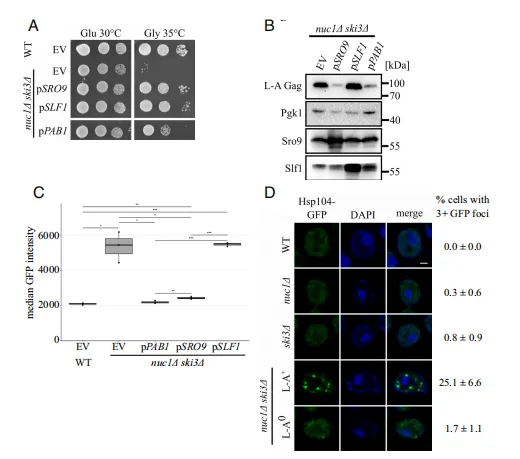
Fig. 3. Overexpression of translation control factors alleviates L-A pathogenesis. (A) Spot test growth assays of the high copy suppressors SRO9, SLF1, and PAB1 are shown. Strains were spotted on –LEU media containing either glucose or glycerol and grown at the indicated temperatures. (B) Western blotting for L-A Gag, Pgk1, Sro9, and Slf1 protein levels in the strains from 3A. Molecular weight markers are indicated on the right. (C) Flow cytometry was used to measure HSE GFP expression in the indicated strains (n = 3). The first and third quartiles are marked by the grey boxes. The median GFP intensity is marked by the black bars within. *P < 0.05, **P < 0.01, ***P < 0.001 (unpaired Student's t test). (D) Fluorescence microscopy of Hsp104-GFP in indicated strains. Cells were stained with DAPI to visualize nuclei. (Scale bar, 1 μm.) The percentage of cells with 3+ GFP foci is shown on the right. n = 3. 75 to 140 cells were counted for each replicate.
Proteostatic stress is often associated with the accumulation of cytotoxic protein aggregates that can be visualized using GFP fused to the protein disaggregase Hsp104, a direct target of Hsf1 transcriptional activation that is known to co-localize with protein aggregates (59, 60). To further explore the proteostatic defects associated with L-A pathogenesis, we used fluorescence microscopy to visualize Hsp104-GFP foci in a variety of strains. As expected, wild-type cells grown at 30 °C rarely accumulated observable Hsp104-GFP foci. While nuc1∆ and ski3∆ single mutants resembled wild type, strikingly, a nuc1∆ ski3∆ double mutant exhibited more than 25% of cells with three or more Hsp104-GFP foci (Fig. 3D). As with all other phenotypes we have observed for nuc1∆ ski3∆, the accumulation of Hsp104-GFP foci was dependent on the presence of L-A (Fig. 3D). These findings show that high viral load caused by deletion of NUC1 and SKI3 led to the accumulation of Hsp104-GFP foci indicative of cytotoxic protein aggregation.
Since L-A pathogenesis was correlated with proteostatic defects, we hypothesized that Hsf1 would function as an antiviral factor. Deletion of HSF1 is lethal, so we utilized the temperature-sensitive allele hsf1-848 sourced from a previously published collection of strains (61). The hsf1-848 allele exhibited an absence of growth at 39 °C, an intermediate growth phenotype at 37 °C, and no apparent growth defect at 35 °C (Fig. 4A). Spot test assays showed that the hsf1-848 growth phenotypes at 35 °C and 37 °C were greatly enhanced when combined with either nuc1∆ or ski3∆ and that these growth defects were reversed in strains lacking the L-A virus (Fig. 4A). As expected, the inviability of all hsf1-848 mutant strains persisted in cells grown at 39 °C regardless of the presence of L-A. Moreover, using tetrad dissections, we showed that hsf1-848 nuc1∆ ski3∆ triple mutants were inviable at the permissive temperature if they were infected with L-A but healthy if they were derived from an L-A0 strain (SI Appendix, Fig. S6). Using western blotting, we found that hsf1-848 nuc1∆ and hsf1-848 ski3∆ accumulated increased amounts of L-A Gag compared to the single mutants (Fig. 4B). Together with our cell biological studies, these findings suggest that the Hsf1-regulated proteostatic stress response functions as an antiviral system in yeast, opposing the pathogenic consequences of rampant L-A replication.
As proteostatic defects are known to be exacerbated and lead to cytotoxicity at high temperatures (59), a simple model attributes the lethal consequences of L-A pathogenesis at high temperatures to catastrophic proteostatic stress. To further test this model, we treated strains with azetidine-2-carboxylic acid (AZC), a proline analog that is incorporated into proteins leading to orthostatic stress (38). These experiments showed that nuc1∆ ski3∆ exhibited strong sensitivity to AZC in a manner dependent on the L-A virus (Fig. 4C and SI Appendix, Fig. S6). Further, we found that nuc1∆ ski3∆ exhibited sensitivity to 5% ethanol, a condition that also causes proteostatic defects, but not to 0.5 M NaCl, which causes osmotic stress (SI Appendix, Fig. S6). These findings suggest that the lethal consequences of L-A pathogenesis are specifically due to overwhelming proteostatic stress.
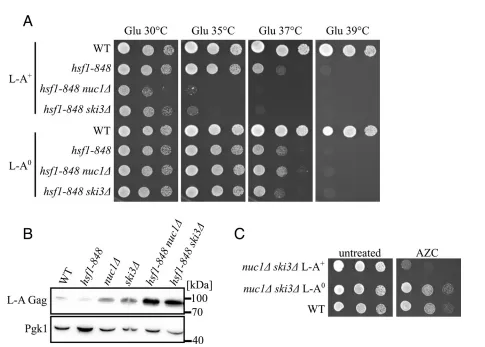
Fig. 4. The heat shock response suppresses L-A pathogenesis. (A) Spot analysis of strains defective in HSF1, NUC1, and SKI3 with or without L-A is shown. Strains were spotted on SC media containing glucose and grown at the indicated temperature. (B) Western blotting for L-A Gag and Pgk1 protein levels of indicated strains. Molecular weight markers are indicated on the right. (C) Spot analysis of strains treated with the proteotoxic proline analog, azetidine-2-carboxylic acid (AZC), is shown. Strains were spotted on SC media containing glucose supplemented with or without 0.1 mg/mL of AZC and grown at 30 °C.
Discussion
Despite its ubiquitous presence in laboratory strains, studies of the L-A dsRNA virus have been limited due to its apparently benign nature. Here, we show that L-A has profound consequences for yeast when its replication is uncontrolled and that diverse innate immune systems maintain L-A replication at a tolerable level. Specifically, we show that, in strains lacking the parallel-acting NUC1 and SKI3 antiviral genes, L-A replication is massively upregulated, leading to orthostatic stress and conditional lethality at high temperatures. Leveraging this new discovery, we used bioinformatic and forward genetic screens to identify new yeast genes that function to restrict L-A replication or protect cells from the pathogenic consequences of unrestrained L-A replication. As these screens were not saturating, the yeast genome likely encodes numerous other antiviral factors. Many insightful studies have been performed in yeast studying the replication of exogenously introduced viral RNAs from other organisms and it will be interesting to determine if the L-A antiviral factors act similarly on these viral RNAs (62, 63).
Given the clear risk of L-A infection, how it nevertheless persists in the face of ever-present antiviral activity is puzzling. An explanation for this paradox may be that L-A provides a counterbalancing benefit. One possible benefit of L-A is that it enables some strains to maintain satellite viruses that encode secreted toxins that kill neighboring uninfected cells. However, L-A is present in many strains that lack "Killer" satellites, so this explanation is insufficient to explain the persistence of L-A infection. We thus speculate that L-A may have some cryptic benefit that counterbalances its deleterious potential.
Our discovery of Rex2 as a viral attenuation factor expands the arsenal of known mitochondrial antiviral factors beyond Nuc1 and suggests that mitochondria are a key antiviral hub in yeast. Indeed, mitochondria serve central roles in viral defense as a programmed cell death regulator and as a platform for antiviral signaling in humans. How do mitochondrial nucleases attenuate a virus that resides in the cytosol in yeast? One possibility is that these enzymes, while targeted to mitochondria, may nevertheless accumulate to low but sufficient levels in the cytosol to accomplish L-A attenuation directly. Consistent with this hypothesis, we showed previously that Nuc1 accumulates in the cytosol of meiotic cells, though our methods could not detect it in the cytosol of mitotic cells (27). Another hypothesis is that some aspect of the L-A replication cycle occurs in intimate association with mitochondria. For instance, L-A transcripts may associate with and possibly traverse the mitochondria, exposing them to Nuc1 and/or Rex2. Our results highlight the potential general importance of mitochondria for viral innate immunity in eukaryotes and position the yeast-L-A system as a powerful model for further studies of this topic.
The antiviral SKI complex associated with translating ribosomes and our identification of Pab1, Sro9, and Slf1 as high copy suppressors of L-A pathogenesis further reveal the translating ribosome as a key hub of yeast antiviral activity. The finding that PAB1 (polyA binding protein) represses L-A is surprising given the absence of polyA tails in L-A transcripts, suggesting that Pab1 does not act on L-A directly. Previous findings showed that L-A transcripts compete with polyA+ yeast mRNAs for the capture of 60S ribosomal subunits to form translating 80S complexes (64). One model explaining our findings is that Pab1 enhances the translation of polyA tail-containing mRNAs, which then depletes the availability of 60S subunits for L-A transcripts for translation. The roles of Sro9 and Slf1 in the translation are less well-understood, but their functions may similarly relate to the competition of L-A transcripts for 60S subunits. Importantly, the homologs of Pab1 and Sro9/ Slf1 are involved in human viral defense and further studies of these genes in yeast will shed light on antiviral mechanisms conserved from yeast to humans.
cistanche plant-increasing immune system
We identified an antiviral role for the conserved transcription factor HSF1 along with an L-A–induced proteostatic stress response involving the accumulation of Hsp104-GFP foci, an HSF1-activated marker of cytotoxic protein aggregates. These results support the model in which L-A pathogenesis is caused by proteotoxic stress. We also discovered antiviral function for the SAGA complex, which has been shown to act as a coactivator of Hsf1 target gene induction following heat shock (65, 66). These observations suggest that high levels of L-A lead to the SAGA-dependent activation of Hsf1 target genes which then carry out the antiviral function, illuminating a potential antiviral gene expression program in budding yeast. This model makes many testable predictions that may be relevant to viral pathogenesis in other organisms. Indeed, human HSF1 also controls the expression of proteolytic regulatory factors. While antiviral functions of human HSF1 have been described, it is unclear what role the orthostatic stress response plays in this (39). Our findings illuminate a powerful system to discern Hsf1's antiviral function with respect to its role in the activation of the proteostatic stress response.
references
1. T. Nakayashiki, C. P. Kurtzman, H. K. Edskes, R. B. Wickner, Yeast prions [URE3] and [PSI+] are diseases. Proc. Natl. Acad. Sci. U.S.A. 102, 10575–10580 (2005).
2. R. B. Wickner, T. Fujimura, R. Esteban, Viruses and prions of Saccharomyces cerevisiae. Adv. Virus Res. 86, 1–36 (2013).
3. T. Fujimura, R. Esteban, Cap-snatching mechanism in yeast L-A double-stranded RNA virus. Proc. Natl. Acad. Sci. U.S.A. 108, 17667–17671 (2011).
4. J. D. Dinman, T. Icho, R. B. Wickner, A -1 ribosomal frameshift in a double-stranded RNA virus of yeast forms a gag-pol fusion protein. Proc. Natl. Acad. Sci. U.S.A. 88, 174–178 (1991).
5. A. Bernheim et al., Prokaryotic viperins produce diverse antiviral molecules. Nature 589, 120–124 (2021).
6. A. Bernheim, R. Sorek, The pan-immune system of bacteria: Antiviral defense as a community resource. Nat. Rev. Microbiol. 18, 113–119 (2020).
7. A. G. Johnson et al., Bacterial masterminds reveal an ancient mechanism of cell death. Science 375, 221–225 (2022).
8. B. R. Morehouse et al., STING cyclic dinucleotide sensing originated in bacteria. Nature 586, 429–433 (2020).
9. G. Ofir et al., Antiviral activity of bacterial TIR domains via immune signaling molecules. Nature 600, 116–120 (2021).
10. K. M. Slavik et al., cGAS-like receptors sense RNA and control 3'2'-cGAMP signaling in Drosophila. Nature 597, 109–113 (2021).
11. A. T. Whiteley et al., Bacterial cGAS-like enzymes synthesize diverse nucleotide signals. Nature 567, 194–199 (2019).
12. H. M. Burgess, I. Mohr, Cellular 5'-3' mRNA exonuclease Xrn1 controls double-stranded RNA accumulation and anti-viral responses. Cell Host Microbe. 17, 332–344 (2015).
13. S. C. Eckard et al., The SKIV2L RNA exosome limits activation of the RIG-I-like receptors. Nat. Immunol. 15, 839–845 (2014).
14. M. Miyashita, H. Oshiumi, M. Matsumoto, T. Seya, DDX60, a DEXD/H box helicase, is a novel antiviral factor promoting RIG-I-like receptor-mediated signaling. Mol. Cell Biol. 31, 3802–3819 (2011).
15. C. S. Ng, D. M. Kasumba, T. Fujita, H. Luo, Spatio-temporal characterization of the antiviral activity of the XRN1-DCP1/2 aggregation against cytoplasmic RNA viruses to prevent cell death. Cell Death Differ 27, 2363–2382 (2020).
16. R. E. Rigby, J. Rehwinkel, RNA degradation in antiviral immunity and autoimmunity. Trends Immunol. 36, 179–188 (2015).
17. F. Shiromoto et al., IL-1beta/ATF3-mediated induction of Ski2 expression enhances hepatitis B virus x mRNA degradation. Biochem. Biophys. Res. Commun. 503, 1854–1860 (2018).
18. J. T. Brown, X. Bai, A. W. Johnson, The yeast antiviral proteins Ski2p, Ski3p, and Ski8p exist as a complex in vivo. RNA 6, 449–457 (2000).
19. D. C. Masison et al., Decoying the cap- mRNA degradation system by a double-stranded RNA virus and poly(A)- mRNA surveillance by a yeast antiviral system. Mol. Cell Biol. 15, 2763–2771 (1995).
20. C. Schmidt et al., The cryo-EM structure of a ribosome-Ski2-Ski3-Ski8 helicase complex. Science 354, 1431–1433 (2016).
21. A. M. Searfoss, R. B. Wickner, 3' poly(A) is dispensable for translation. Proc. Natl. Acad. Sci. U.S.A. 97, 9133–9137 (2000).
22. E. A. Toh, P. Guerry, R. B. Wickner, Chromosomal superkiller mutants of Saccharomyces cerevisiae. J. Bacteriol. 136, 1002–1007 (1978).
23. A. Zinoviev, R. K. Ayupov, I. S. Abaeva, C. U. T. Hellen, T. V. Pestova, Extraction of mRNA from Stalled Ribosomes by the Ski Complex. Mol. Cell 77, 1340–1349 e1346 (2020).
24. S. G. Ball, C. Tirtiaux, R. B. Wickner, Genetic control of L-a and L-(Bc) Dsrna copy number in killer systems of SACCHAROMYCES CEREVISIAE. Genetics 107, 199–217 (1984).
25. R. Esteban, L. Vega, T. Fujimura, 20S RNA narnavirus defies the antiviral activity of SKI1/XRN1 in Saccharomyces cerevisiae. J. Biol. Chem. 283, 25812–25820 (2008).
26. P. A. Rowley, B. Ho, S. Bushong, A. Johnson, S. L. Sawyer, XRN1 is a species-specific virus restriction factor in yeasts. PLoS Pathog. 12, e1005890 (2016).
27. J. Gao et al., Meiotic viral attenuation through an ancestral apoptotic pathway. Proc. Natl. Acad. Sci. U.S.A. 116, 16454–16462 (2019).
28. L. Y. Li, X. Luo, X. Wang, Endonuclease G is an apoptotic DNase when released from mitochondria. Nature 412, 95–99 (2001).
29. B. J. Thomson, Viruses and apoptosis. Int. J. Exp. Pathol. 82, 65–76 (2001).
30. M. D. Eastwood, S. W. Cheung, K. Y. Lee, J. Moffat, M. D. Meneghini, Developmentally programmed nuclear destruction during yeast gametogenesis. Dev. Cell 23, 35–44 (2012).
31. M. D. Eastwood, M. D. Meneghini, Developmental coordination of gamete differentiation with programmed cell death in sporulating yeast. Eukaryot Cell 14, 858–867 (2015).
32. N. Schmidt et al., The SARS-CoV-2 RNA-protein interactome in infected human cells. Nat. Microbiol. 6, 339–353 (2021).
33. R. W. Smith, N. K. Gray, Poly(A)-binding protein (PABP): A common viral target. Biochem. J. 426, 1–12 (2010).
34. R. Grover et al., Myg1 exonuclease couples the nuclear and mitochondrial translational programs through RNA processing. Nucleic Acids Res. 47, 5852–5866 (2019).
35. E. V. Koonin, A conserved ancient domain joins the growing superfamily of 3'-5' exonucleases. Curr. Biol. 7, R604–606 (1997).
36. M. Szewczyk et al., Human REXO2 controls short mitochondrial RNAs generated by mtRNA processing and decay machinery to prevent accumulation of double-stranded RNA. Nucleic Acids Res. 48, 5572–5590 (2020).
37. Y. Zuo, M. P. Deutscher, Exoribonuclease superfamilies: Structural analysis and phylogenetic distribution. Nucleic Acids Res. 29, 1017–1026 (2001).
38. E. W. Trotter, L. Berenfeld, S. A. Krause, G. A. Petsko, J. V. Gray, Protein misfolding and temperature up-shift cause G1 arrest via a common mechanism dependent on heat shock factor in Saccharomyces cerevisiae. Proc. Natl. Acad. Sci. U.S.A. 98, 7313–7318 (2001).
39. A. Reyes, A. J. Navarro, B. Diethelm-Varela, A. M. Kalergis, P. A. Gonzalez, Is there a role for HSF1 in viral infections? FEBS Open Bio 12, 1112–1124 (2022).
40. F. Weber, V. Wagner, S. B. Rasmussen, R. Hartmann, S. R. Paludan, Double-stranded RNA is produced by positive-strand RNA viruses and DNA viruses but not in detectable amounts by negative-strand RNA viruses. J. Virol. 80, 5059–5064 (2006).
41. S. Welsch et al., Composition and three-dimensional architecture of the dengue virus replication and assembly sites. Cell Host Microbe. 5, 365–375 (2009).
42. I. Fernandez de Castro, R. Tenorio, C. Risco, Virus assembly factories in a lipid world. Curr. Opin. Virol. 18, 20–26 (2016).
43. Y. X. Liu, C. L. Dieckmann, Overproduction of yeast viruslike particles by strains deficient in a mitochondrial nuclease. Mol. Cell Biol. 9, 3323–3331 (1989).
44. A. W. Johnson, R. D. Kolodner, Synthetic lethality of sep1 (xrn1) ski2 and sep1 (xrn1) ski3 mutants of Saccharomyces cerevisiae is independent of killer virus and suggests a general role for these genes in translation control. Mol. Cell Biol. 15, 2719–2727 (1995).
45. C. Stark et al., BioGRID: A general repository for interaction datasets. Nucleic Acids Res. 34, D535–539 (2006).
46. L. Espert et al., ISG20, a new interferon-induced RNase specific for single-stranded RNA, defines an alternative antiviral pathway against RNA genomic viruses. J. Biol. Chem. 278, 16151–16158 (2003).
47. T. Hanekamp, P. E. Thorsness, YNT20, a bypass suppressor of yme1 yme2, encodes a putative 3'-5' exonuclease localized in mitochondria of Saccharomyces cerevisiae. Curr. Genet 34, 438–448 (1999).
48. A. van Hoof, P. Lennertz, R. Parker, Three conserved members of the RNase D family have unique and overlapping functions in the processing of 5S, 5.8S, U4, U5, RNase MRP, and RNase P RNAs in yeast. EMBO J. 19, 1357–1365 (2000).
49. M. Dwivedi, N. C. Laddha, R. Begum, Correlation of increased MYG1 expression and its promoter polymorphism with disease progression and higher susceptibility in vitiligo patients. J. Dermatol. Sci. 71, 195–202 (2013).
50. K. Kingo et al., MYG1, a novel melanocyte-related gene, has elevated expression in vitiligo. J. Dermatol. Sci. 44, 119–122 (2006).
51. I. B. Andika, A. Jamal, H. Kondo, N. Suzuki, SAGA complex mediates the transcriptional up-regulation of antiviral RNA silencing. Proc. Natl. Acad. Sci. U.S.A. 114, E3499–E3506 (2017).
52. S. G. Sobel, S. L. Wolin, Two yeast La motif-containing proteins are RNA-binding proteins that associate with polyribosomes. Mol. Biol. Cell 10, 3849–3862 (1999).
53. A. Proweller, J. S. Butler, Ribosomal association of poly(A)-binding protein in poly(A)-deficient Saccharomyces cerevisiae. J. Biol. Chem. 271, 10859–10865 (1996).
54. D. E. Gordon et al., A SARS-CoV-2 protein interaction map reveals targets for drug repurposing. Nature 583, 459–468 (2020).
55. O. Brandman et al., A ribosome-bound quality control complex triggers degradation of nascent peptides and signals translation stress. Cell 151, 1042–1054 (2012).
56. J. Anckar, L. Sistonen, Regulation of HSF1 function in the heat stress response: Implications in aging and disease. Annu. Rev. Biochem. 80, 1089–1115 (2011).
57. J. Li, J. Labbadia, R. I. Morimoto, Rethinking HSF1 in stress, development, and organismal health. Trends Cell Biol. 27, 895–905 (2017).
58. P. K. Sorger, H. R. Pelham, Purification and characterization of a heat-shock element binding protein from yeast. EMBO J. 6, 3035–3041 (1987).
59. E. J. Solis et al., Defining the essential function of yeast Hsf1 reveals a compact transcriptional program for maintaining eukaryotic proteostasis. Mol. Cell 63, 60–71 (2016).
60. J. R. Glover, S. Lindquist, Hsp104, Hsp70, and Hsp40: A novel chaperone system that rescues previously aggregated proteins. Cell 94, 73–82 (1998).
61. Z. Li et al., Systematic exploration of essential yeast gene function with temperature-sensitive mutants. Nat. Biotechnol. 29, 361–367 (2011).
62. R. Y. Zhao, Yeast for virus research. Microb. Cell 4, 311–330 (2017).
63. T. Panavas, E. Serviene, J. Brasher, P. D. Nagy, Yeast genome-wide screen reveals dissimilar sets of host genes affecting replication of RNA viruses. Proc. Natl. Acad. Sci. U.S.A. 102, 7326–7331 (2005).
64. Y. Ohtake, R. B. Wickner, Yeast virus propagation depends critically on free 60S ribosomal subunit concentration. Mol. Cell Biol. 15, 2772–2781 (1995).
65. S. B. Kremer, D. S. Gross, SAGA and Rpd3 chromatin modification complexes dynamically regulate heat shock gene structure and expression. J. Biol. Chem. 284, 32914–32931 (2009).
66. M. D. Leach et al., Hsf1 and Hsp90 orchestrate temperature-dependent global transcriptional remodeling and chromatin architecture in Candida albicans. Nat. Commun. 7, 11704 (2016).
67. C. S. Sitron, J. H. Park, J. M. Giafaglione, O. Brandman, Aggregation of CAT tails blocks their degradation and causes proteotoxicity in S. cerevisiae. PLoS One 15, e0227841 (2020).
68. L. Magtanong et al., Dosage suppression genetic interaction networks enhance functional wiring diagrams of the cell. Nat. Biotechnol. 29, 505–511 (2011).
69. V. Bilanchone et al., Ty3 retrotransposon hijacks mating yeast RNA processing bodies to infect new genomes. PLoS Genet. 11, e1005528 (2015).
70. L. Ruan et al., Cytosolic proteostasis through importing of misfolded proteins into mitochondria. Nature 543, 443–446 (2017).