Effect Of Thermal Oxygen Aging Mode On Rheological Properties And Compatibility Of Lignin-Modified Asphalt Binder By Dynamic Shear Rheometer Part 1
Jun 21, 2023
Abstract: Lignin is abundant in nature. The use of lignin in the asphalt pavement industry can improve pavement performance while effectively optimizing pavement construction costs. The purpose of this paper is to study the effect of lignin on the anti-aging properties of asphalt. Commercial lignin was selected to prepare a lignin-modified asphalt binder. The properties of lignin-modified asphalt were studied by rheological experiments. The high-temperature rheological properties of two kinds of base asphalt and modified asphalt samples with different contents of lignin under three conditions of original, rolling thin film oven (RTFO) aging, and pressure aging vessel (PAV) were tested and analyzed with temperature sweep, frequency sweep, and multiple stress creep recovery (MSCR) tests. By comparing the variation laws of evaluation indicators, such as complex shear modulus G*, phase angle δ, anti-aging index, cumulative strain, and viscous component Gv, we found that lignin could effectively improve the high-temperature stability of base asphalt, but it hurt the compatibility issues of base asphalt. Meanwhile, lignin played a filling role in the base asphalt, and the increase in viscosity was the fundamental reason for improving the high-temperature stability of the base asphalt. The research results indicated that lignin could effectively improve the anti-aging performance of asphalt and play a positive role in prolonging the service life of the pavement.
Glycoside of cistanche can also increase the activity of SOD in heart and liver tissues, and significantly reduce the content of lipofuscin and MDA in each tissue, effectively scavenging various reactive oxygen radicals (OH-, H₂O₂, etc.) and protecting against DNA damage caused by OH-radicals. Cistanche phenylethanoid glycosides have a strong scavenging ability of free radicals, a higher reducing ability than vitamin C, improve the activity of SOD in sperm suspension, reduce the content of MDA, and have a certain protective effect on sperm membrane function. Cistanche polysaccharides can enhance the activity of SOD and GSH-Px in erythrocytes and lung tissues of experimentally senescent mice caused by D-galactose, as well as reduce the content of MDA and collagen in lung and plasma, and increase the content of elastin, have a good scavenging effect on DPPH, prolong the time of hypoxia in senescent mice, improve the activity of SOD in serum, and delay the physiological degeneration of lung in experimentally senescent mice With cellular morphological degeneration, experiments have shown that Cistanche has the good antioxidant ability and has the potential to be a drug to prevent and treat skin aging diseases. At the same time, echinacoside in Cistanche has a significant ability to scavenge DPPH free radicals and can scavenge reactive oxygen species, prevent free radical-induced collagen degradation, and also has a good repair effect on thymine free radical anion damage.

Click on Cistanches Herba
【For more info: david.deng@wecistanche.com / WhatApp:86 13632399501】
1. Introduction
As a viscoelastic material, asphalt comprises a large proportion of high-grade road surfaces in many countries owing to its superior performance and driving comfort. However, asphalt has obvious shortcomings, such as high-temperature sensitivity and easy softening at high temperatures. It easily becomes brittle at low temperatures and may not meet the requirements of high-grade highways. The insufficient high-temperature stability caused by aging is also a concern for the road industry. The adhesion between asphalt and stone and the aging phenomenon of asphalt under the action of heat and oxygen affects the quality and durability of asphalt on roads [1–5]. In the process of high-temperature production, storage, transportation, and processing, asphalt comes easily into contact with oxygen in the air, resulting in short-term aging. The most important type of aging is Thermo oxidative aging. Thermo-oxidative aging can lead to changes in the chemical composition and molecular structure of asphalt, and temperature sensors may also change; moreover, different modified asphalts have different aging effects. Prolonged exposure to elevated temperatures also leads to an increase in the viscosity of the asphalt binder and changes in its viscoelastic characteristics [6]. At present, styrene–butadiene–styrene block copolymer (SBS)-modified asphalt is widely used in China and other countries. SBS can significantly improve the high-temperature performance and anti-aging performance of asphalt and asphalt mixtures [7–9], but SBS-modified asphalt is expensive [10].
Lignin, the second most abundant renewable natural polymer compound in nature after cellulose, is an aromatic polymer containing oxyphenylpropanol or its derivative structural units in its molecular structure [11]. Lignin can not only be used in phenolic resin materials [12–14], epoxy resin materials [15–17], and polyurethane materials [18–20] instead of raw petroleum chemical materials, but it can also be blended with polymer materials to increase the mechanical properties [21], thermal stability [22], anti-aging (oxidation) [23], and flame retardancy [24] of polymer materials. In recent years, it has been widely used in plastics [25], adhesives [26], and other fields. Wu et al. [27] analyzed the lignin-modified asphalt with infrared spectroscopy (FTIR) and differential scanning calorimetry (DSR) and pointed out that the addition of lignin can significantly delay the aging process of the asphalt and increase the thermal degradation of the lignin-modified asphalt after aging. Meanwhile, the stability and low-temperature crack resistance has been improved in the aging process. Gao et al. [28] studied the high-temperature rheological behavior and fatigue properties of lignin-modified asphalt binders. The results indicated that the addition of lignin improved the viscosity and the deformation resistance of asphalt under high temperatures at different rotating speeds. Batista et al. [29] the high-temperature, low-temperature, and aging properties of a lignin-modified asphalt binder. The results demonstrated that lignin was conducive to improving the high-temperature rutting resistance and low-temperature crack resistance of the asphalt binder. Xu et al. [30] studied the rheological properties and anti-aging properties of a lignin-modified asphalt binder. The results showed that the addition of lignin helped to inhibit the formation of carbonyl functional groups in the asphalt binder after the RTFO and PAV aging processes. This indicated that lignin can be used as an antioxidant modifier. However, the addition of lignin hurts the fatigue resistance of the asphalt binder.

In conclusion, lignin can effectively improve the high-temperature stability and antiaging performance of asphalt. However, the high-temperature rheological properties of lignin-modified asphalt under different aging effects should be further studied.
In this paper, the high-temperature rheological properties of two kinds of base asphalt and modified asphalt samples with different lignin contents under the three states of original, short-term aging, and long-term aging were analyzed by dynamic shear rheometer (DSR) temperature sweep, frequency sweep, and repeat creep test. Complex shear modulus G*, phase angle δ, anti-aging index, cumulative strain, viscous component Gv, and other indicators were used to study the aging performance of lignin-modified asphalt.
The detailed plan completed in this paper is shown in Figure 1.

2. Materials and Methods
2.1. Raw Materials
2.1.1. Lignin
The commercial lignin used herein was produced by Jinan Yanghai Chemical Co., Ltd. (Jinan, China). Lignin that passed a 200-mesh sieve was used for testing, and its main technical indicators, molecular weight, and pyrolysis parameters are shown in Table 1. Among them, the lignin indicator was provided by the manufacturer. The molecular weight of lignin was determined by Agilent pl-gpc50 gel chromatography, and the pyrolysis test was conducted with a Mettler Toledo TGA/sdta851 synchronous thermogravimetric analyzer.


2.1.2. Based Asphalt
In this paper, Maoming 70# asphalt and Donghai 90# asphalt were used for related experiments. The test results of various properties are shown in Table 2.

2.2. Preparation of Lignin-Modified Asphalt
The high-speed shear dispersion emulsifying machine (BME 100L) produced by Shanghai Weiyu Co., Ltd. (Shanghai, China), was used to prepare lignin-modified asphalt. The base asphalt was heated to 150 ◦C and kept for some time, and after passing through a 200-mesh sieve, the lignin was uniformly and slowly added to the base asphalt in batches during the low-speed shearing process for preliminary dispersion. Then, the speed of the high-speed shearing machine was gradually increased from low speed to 5000 r/min and then sheared for 1 h. After shearing, the sample container containing the mixture of lignin and matrix asphalt was put into a constant temperature oven at 120 ◦C for 1 h, and the preparation of lignin-modified asphalt was completed. In this experiment, five kinds of lignin-modified asphalts with different lignin contents (3, 6, 9, 12, and 15%) were prepared. The Maoming asphalts were marked as MM-3, MM-6, MM-9, MM-12, MM-15; Donghai Maoming asphalts were marked as DH-3, DH-6, DH-9, DH-12, DH-15; while the base asphalt was marked as MM-0 and DH-0. It was developed at 120 ◦C for 1 h and compared with the base asphalt to study the influence of its high-temperature rheological properties and aging properties.
2.3. Preparation of Aged Samples
According to JTGE 20-2011 “Highway Asphalt and Asphalt Mixture Test Regulations”, the rotating film oven test (T 0610-2011) and the pressure aging container accelerated asphalt aging test (T 0630-2011) were conducted. Firstly, 35 ± 0.5 g pitches were poured into glass bottles, the temperature of RTFOT was kept at 163 ◦C and the time was 85 min. The RTFO-aged samples were prepared for subsequent testing. The sample plate with 50 ± 0.5 g of lignin-modified asphalt was put in the PAV long-term aging box, the temperature was set to 100 ◦C, the holding pressure was 2.1 MPa, and the aging time was 20 h.

2.4. Test Design and Evaluation Index
2.4.1. Temperature Scanning and Frequency Sweep Test
The temperature sweep and frequency sweep tests of asphalt were carried out using a DHR-1 dynamic shear rheometer. The temperature sweep test was adopted through the strain control method with 12% of the target strain value and 10 rad/s of the loading frequency, and the test temperature range was 30~100 ◦C with 2 ◦C between the sampling intervals. The frequency sweep test was used to study the viscoelastic properties of the modified asphalt. The temperature of the frequency sweep was 30 and 60 ◦C, the frequency range was 0.1~100 rad/s, and the strain amplitude was 0.5%. Among them, the original asphalt and the asphalt after aging in the rotary film oven were scanned with a parallel plate with a diameter of 25 mm and a spacing of 1 mm, and the asphalt after pressure aging was scanned with a parallel plate with a diameter of 8 mm and a spacing of 2 mm.
2.4.2. Aging Index Evaluation
The aging performance analysis based on high-temperature rheology was evaluated with the complex shear modulus aging index (G * AI), and the specific calculation formula is shown in Formula (1) [31]. The operating temperature range was 46~82 ◦C, and the sampling interval was 6 ◦C.

2.4.3. Repeat Creep Test
At present, the multi-stress repeated creep recovery test (MSCR) of AASHTO MP19- 10 was adopted to evaluate the high-temperature performance of asphalt and modified asphalt [32]. In this paper, the multi-stress repeated creep recovery test was performed by loading for 1 s, unloading for 9 s, and 100 cycles of creep recovery process were conducted. The test temperature was 64 ◦C, and the test stress was 300 Pa. The viscosity component was obtained with the Burgers model. The Burgers model equation was divided into two equations; one was the stress–relaxation mode equation to input constant strain, and the other was the creep-loading mode equation with constant input stress. Both equations can be computed by inverse transformations and Laplace transforms. In this paper, the creep loading mode equation was adopted, and the Burgers fitting equation was formulated as (2):

Here, ε(t) is the cumulative creep strain of asphalt specimen; σ0 is the loading stress of the asphalt test; η1 and E1 represent the damping coefficient and elastic modulus in Maxwell’s model, respectively; η2 and E2 represent the damping coefficient and elastic modulus in the Kelvin model, respectively; t is the loading time; E1 reflects the elastic recovery ability of asphalt at high temperature; η1 is the viscosity coefficient reflecting the unrecoverable deformation, which is related to the viscosity deformation coefficient of asphalt; E2 and η2 reflect the load action under long-term load and at room temperature, which reflects the ability of asphalt to delay elastic recovery of deformation. In this study, η1 is the viscous part Gv of creep stiffness. The test was adopted to evaluate the high-temperature performance of base asphalt and lignin-modified asphalt.
3. Results and Discussion Results
3.1. Analysis of Rheological Properties of Lignin-Modified Asphalt
The test results of complex modulus G* and phase angle δ for original and different aging asphalt samples are shown in Figure 2.
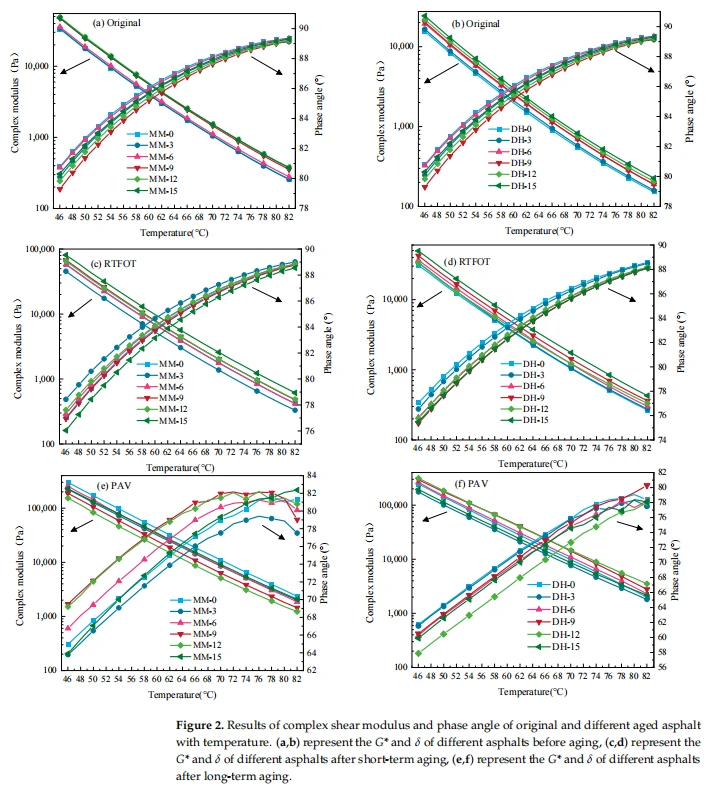
As seen in Figure 2a,b, compared with the original asphalt, the complex modulus of the modified asphalt increased owing to the addition of lignin. The lignin-modified asphalt showed the trend of reducing the complex shear modulus and increasing the phase angle with the increase in temperature, but the changing trend gradually flattened. The increase in lignin improved the high-temperature performance but did not change the temperature sensitivity, so the temperature affected it. As asphalt is a temperature-sensitive material, it exhibited elasticity when the temperature was low, and gradually transformed into a viscous flow state with the increase in temperature.
After comparing the effects of different lignin contents on the rheological parameters of the base asphalt, we found that for Maoming 70# base asphalt, the addition of too much lignin led predominantly to an increase in viscous resistance (internal friction). The increase in viscosity resulted from the decreased complex shear modulus and the increased phase angle. It was shown that the inflection point of the rheological parameters appeared when the lignin content was 9%, indicating that there was an optimal lignin content.
However, for Donghai 90# asphalt, the same trend did not appear, and the complex shear modulus and phase angle of the asphalt binder linearly increased and decreased with the increase in lignin content, respectively.
With the increase in lignin content, although the colloidal structure type of asphalt did not change, the increase in the asphalt colloidal structure composition ratio may have led to the change of its phase structure [33]. Compared with Donghai 90#, Maoming 70# had a higher proportion of asphaltenes [34]. Therefore, the asphaltene content was the fundamental reason that the different rheological parameters of the two base asphalts changed with the lignin content.

It can be seen in Figure 2c,d that the complex modulus and phase angle of each asphalt sample showed different degrees of decrease and increase after RTFO aging.
With the increase in lignin content, the complex modulus of Maoming asphalt first increased and then decreased, which was the same as that before aging. The phase angle was larger than that of the original asphalt except for the content of 15%. Meanwhile, the complex modulus and phase angle of Donghai asphalt increased and decreased with the increase in lignin content, respectively.
In Figure 2e,f, the complex modulus of Maoming asphalt after PAV aging was opposite to that of the base and RTFO aging binder sample and decreased with the increase in lignin content, and the phase angle of Maoming lignin-modified asphalt was larger than that of the base asphalt. The complex modulus of Donghai lignin-modified asphalt was larger than that of the base asphalt except for the asphalt with lignin contents of 3 and 15%, which was consistent with the RTFO aging condition.
3.2. Analysis of PG Classification of Lignin-Modified Asphalt
The rutting factor G*/sinδ was used to evaluate the rutting resistance of the asphalt binder at high temperatures. The larger the rutting factor G*/sinδ, the better the high-temperature resistance and the stronger the permanent deformation resistance of the asphalt binder. Figure 3 shows the results for the rutting factor G*/sinδ of each asphalt sample before and after aging at 58~82 ◦C.
As seen in Figure 3, with the increase in lignin content, the rutting factor G*/sinδ value of the two kinds of asphalts before and after aging increased greatly, and the lignin-modified asphalt sample with 15% lignin content for Maoming asphalt showed the best anti-rutting performance after aging, but the PG high-temperature grade did not change. Donghai asphalt showed the strongest high-temperature rutting resistance when the lignin content was 15% before and after aging, and the high-temperature grade of PG increased by one level at this content.

3.3. Complex Shear Modulus Aging Index of Lignin-Modified Asphalt
To further clarify the aging degree, the complex shear modulus aging index G*AI in different test temperature ranges was calculated. The G*AI values of different binders under the RTFO and PAV aging conditions are shown in Figure 4.
It can be seen in Figure 4a,b that the G*AI of Maoming asphalt under RTFO aging creased first and then increased with the increase in lignin content to values slightly less than that of base asphalt. The G*AI of the lignin-modified asphalt binder with 9% lignin content was the lowest. The RTFO aging index G*AI of the Donghai asphalt binder had no obvious regularity with the increase in lignin content, which may be the change in asphalt composition owing to aging. It can be seen in Figure 4c,d that the index G*AI under PAV aging changed in a parabolic form with the increase in temperature. The index G*AI of Maoming asphalt with the 9% lignin content under PAV aging condition was the lowest, which was consistent with the RTFO aging condition, indicating that the addition of lignin could effectively improve the resistance performance of Maoming asphalt under PAV aging conditions. However, the G*AI index of Donghai asphalt with 12% lignin content was the lowest, which was the same as the index under the RTFO aging condition. However, it did not mean that it had no aging resistance. The reason may be that this method could not be well characterized, and it further indicated that its applicability to asphalt with a high grade was not significant. To sum up, Maoming asphalt with a lignin content of 9% had the best anti-aging effect, and Donghai asphalt with a lignin content of 12% had the best anti-aging effect.

【For more info: david.deng@wecistanche.com / WhatApp:86 13632399501】