Effect Of Thermal Oxygen Aging Mode On Rheological Properties And Compatibility Of Lignin-Modified Asphalt Binder By Dynamic Shear Rheometer Part 2
Jun 21, 2023
3.4. Creep and Recovery Behavior of Lignin-Modified Asphalt
3.4.1. Creep Test Viscous Component
Glycoside of cistanche can also increase the activity of SOD in heart and liver tissues, and significantly reduce the content of lipofuscin and MDA in each tissue, effectively scavenging various reactive oxygen radicals (OH-, H₂O₂, etc.) and protecting against DNA damage caused by OH-radicals. Cistanche phenylethanoid glycosides have a strong scavenging ability of free radicals, a higher reducing ability than vitamin C, improve the activity of SOD in sperm suspension, reduce the content of MDA, and have a certain protective effect on sperm membrane function. Cistanche polysaccharides can enhance the activity of SOD and GSH-Px in erythrocytes and lung tissues of experimentally senescent mice caused by D-galactose, as well as reduce the content of MDA and collagen in lung and plasma, and increase the content of elastin, have a good scavenging effect on DPPH, prolong the time of hypoxia in senescent mice, improve the activity of SOD in serum, and delay the physiological degeneration of lung in experimentally senescent mice With cellular morphological degeneration, experiments have shown that Cistanche has the good antioxidant ability and has the potential to be a drug to prevent and treat skin aging diseases. At the same time, echinacoside in Cistanche has a significant ability to scavenge DPPH free radicals and can scavenge reactive oxygen species, prevent free radical-induced collagen degradation, and also has a good repair effect on thymine free radical anion damage.

Click on Where Can I Buy Cistanche
【For more info: david.deng@wecistanche.com / WhatApp:86 13632399501】
Based on the repeated creep test, the viscosity component GV value of creep stiffness was fitted by Formula (2) as the evaluation index of high-temperature stability performance [35]. The Burgers model was used to fit the curve at the creep loading stage to obtain the viscosity parameter, which was the viscosity part GV of creep stiffness (as seen in Figures 6 and 7). The value of Gv reflected the resistance of the asphalt to permanent deformation. The larger the Gv, the better the rutting ability of the asphalt [36]. The unloading stage mainly reflected the measured viscous deformation and delayed elastic deformation. Figure 5 shows the creep recovery of asphalt with and without lignin for the first 10 cycles of the MM-0, MM-9, DH-0, and DH-12 samples at a stress of 300 Pa.

Under the same stress and temperature, the creep cycle data from the 1st to 100th times were fitted for two asphalts with different aging degrees, with an interval of 10 times. As seen in Figures 6 and 7, the Gv values of the Donghai and Maoming binders had different changes in different aging degrees after adding lignin, which was long-term aging > short-term aging > before aging. This demonstrated that the addition of lignin can significantly improve the high-temperature resistance of asphalt. The G*/sinδ and Gv values were consistent in evaluating the high-temperature performance of lignin-modified asphalt, but there were differences in the evaluation conclusions between different modified asphalts. However, the value of Gv suddenly increased during the PAV aging process of Donghai 90# asphalt after adding lignin, which may have been caused by the difference between the two matrix asphalt components.


3.4.2. Accumulated Strain
As a typical viscoelastic material, asphalt has a certain delayed elasticity, and different kinds of asphalts and asphalts with different lignin contents had different recovery degrees. The delayed elasticity could be separated from permanent deformation by the creep recovery test. The initial strain in the recovery stage, i.e., the instantaneous unloading strain, was denoted by εL. The residual strain at the end of the recovery stage was denoted by εp, and εL/εp was used to denote the permanent deformation accounts for the total deformation, i.e., the proportion of the viscous part of the deformation. Selecting a single temperature level (64 ◦C), the εL/εp values of 10, 20, 30, 40, 50, 60, 70, 80, 90, and 100 loading times according to the abovementioned optimal content of asphalt before aging (MM-0, MM-9, DH-0, DH-12) were calculated. The results are shown in Figure 8.

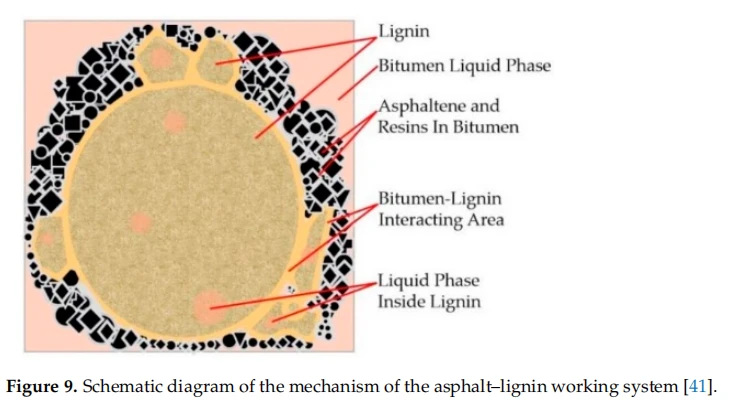
It can be seen in Figure 8 that with the increase in the loading times, the εL/εp values of different lignin-modified asphalts also increased, which reflected the continuous accumulation of the permanent deformation of the asphalt with the increase in the loading times. The εL/εp values were very close, which was not similar to SBS-modified asphalt [37,38] and rubber-modified asphalt [39], indicating that the addition of lignin did not improve the elasticity of the asphalt and was only for filling. The reason may be that the molecular structure of lignin itself is complex. It has a three-dimensional network molecular structure, containing many aromatic groups and high carbon content [40], while the base binder is a mixture of extremely complex high-molecular hydrocarbon and non-metallic derivatives of hydrocarbons. Through the further analysis of the working mechanism in Figure 9, the addition of a lignin modifier led to the absorption of the asphalt liquid phase into the asphalt–lignin interaction area during the mixing process, forming an asphalt–lignin working system and changing the viscoelastic behavior of the asphalt binder [41].
The cumulative strain was reflected in the total residual strain of the asphalt sample after cyclic loading. The smaller the cumulative strain, the better the high-temperature resistance of the asphalt. To further illustrate that lignin had good high-temperature stability, the relationship between the cumulative strain and the number of cycle loadings is shown in Figure 10.

It can be seen in Figure 10 that the cumulative strain of asphalt increased with the increase in loading times, which was consistent with the actual load of the road. Under the same loading times, the cumulative strain of Donghai asphalt and Maoming asphalt before aging or RTFO aging decreased after adding lignin, indicating that the addition of lignin could reduce the temperature sensitivity of asphalt and give it better resistance to high-temperature deformation. It can be seen from the slope of the curve that the performance of each asphalt sample under RTFO aging tended to be consistent with that before aging, while in Figure 10c, it was found that the slope of the curve of MM-9 was significantly higher than that of MM-0, and the curve slope of DH-12 also had an increasing trend, indicating that the addition of lignin could effectively prevent the base asphalt from hardening after PAV aging, to prevent the aging of the base asphalt. Meanwhile, the slope of the MM-0 curve during PAV aging was greater than that of DH-0, indicating that the hardening degree of 70# asphalt was less significant than that of 90# asphalt after PAV aging. The main reason was that the content of heavy components in 90# asphalt increased during the aging process.

3.5. Compatibility Analysis of Lignin and Asphalt
Chang et al. [42,43] studied the rheological properties of compatible and incompatible polymer blends based on viscoelasticity theory and proposed a method to judge the compatibility of blends by taking the double logarithm curve of storage modulus (G 0 ) and loss modulus (G 00 ), also known as the Han curve. Using the Han curve to judge the compatibility of polymers, two basic conditions must be satisfied: (1) The G 0 -G 00 logarithm curves at different temperatures are superimposed; (2) The slope of the curve at the low-frequency end is equal to or close to 2. Through these two requirements, the compatibility between modifiers and asphalt can be judged [44]. To further analyze the compatibility of the blends, the original binder and lignin-modified asphalt were analyzed with a van Gurp–Palmen (VGP) diagram [45]. The VGP diagram is a plot of the phase angle (δ) of asphalt against the corresponding complex shear modulus (G*). The compatibility of the two asphalts and different contents of lignin was analyzed by frequency sweep of the Han curve and VGP map at 30 and 60 ◦C, as shown in Figure 11.

It can be seen in Figure 11 that the Han curves of the two asphalts and the lignin-modified asphalt with different lignin contents were approximately straight lines at high temperatures before aging, and the slope of the Han curve was close to 2, which indicated that the asphalt binder belonged to a homogeneous mixed system at this temperature. The lignin had good compatibility with the matrix asphalt. However, the bifurcation phenomenon occurred in the unaged state at low temperatures, indicating that there was microscopic phase separation at low temperatures. After RTFOT aging, the two original asphalts and the lignin-modified asphalt with different lignin contents appeared to show bifurcation at a low temperature but did not separate at a high temperature, indicating that the compatibility of the original asphalt and lignin-modified asphalt was better at high-temperature conditions. After PAV aging, the base asphalt and modified asphalt both displayed the separation phenomenon at high temperatures, but there was no separation at low temperatures, which indicated that thermal oxygen and pressure aging promoted the decomposition of matrix asphalt and modified asphalt, resulting in large differences in internal molecular weight distribution. In the VGP curve, it was found that the aged Maoming 70# base asphalt and lignin-modified asphalt were superimposed at different temperatures, while the Donghai 90# base binder and lignin-modified asphalt were superimposed only before aging. The dispersion of different aging states could not be superimposed, indicating that the 70# binder was more compatible than the 90# binder.
4. Conclusions
In this paper, the aging properties of asphalt materials improved by a lignin modifier were evaluated in detail based on a rheological test. A series of tests were conducted on untreated and lignin-modified asphalt materials. Based on the test results, the following conclusions can be drawn:

(1) The addition of lignin had a significant effect on the high-temperature resistance of asphalt, but the degree of improvement in the high-temperature performance of the two matrix asphalts was not the same. The results indicated that there was a compatibility problem with lignin in improving the performance of matrix asphalt.
(2) The results of the repeated creep and recovery test indicated that lignin-modified asphalt and base asphalt showed the same behavior, and lignin did not increase the elastic recovery rate of modified polymer binders such as SBS. However, the addition of lignin increased the viscosity resistance of the asphalt binder, which significantly reduced the cumulative strain of the lignin-modified asphalt, and this was also the fundamental reason for improving the high-temperature stability of matrix asphalt.
(3) After long-term aging, the cumulative strain of lignin-modified asphalt was higher than that of base asphalt, and the long-term aging performance was significantly improved. This was owing to the probable depolymerization and molecular weight reduction of lignin during long-term aging.
This study provided a new understanding of the aging properties of lignin-modified asphalt. Future research should focus on the thermal characteristics, field verification, and life cycle assessment of asphalt pavement with different lignin modifiers.
Author Contributions: The authors contributed to this research article as follows: M.C. and C.C; writing—original draft preparation, M.C.; writing—review and editing, literature review and methodology, Y.S.; experimental work and testing, X.H.; investigation and writing—original draft preparation, X.Z., and P.D.; supervision and funding acquisition, C.C. All authors have read and agreed to the published version of the manuscript.
Funding: This research was funded by the Science and Technology Planning Project of Yunnan Science and Technology Department (Joint Agricultural Project), grant number 202101BD070001-060; Science and Technology Project of Gui Zhou Highway Bureau, grant number 2021QLM06; Scientific Research Fund of Yunnan Provincial Department of Education, grant number 2020J0420.

Institutional Review Board Statement: Not applicable.
Informed Consent Statement: Not applicable.
Data Availability Statement: Not applicable.
Conflicts of Interest: The authors declare no conflict of interest.
References
1. Chen, X.P.; Ma, Y.F. Research on performance of crumb rubber modified asphalt. New Chem. Mater. 2010, 38, 118–120.
2. Ouyang, C.; Wang, S.; Zhang, Y.; Zhang, Y. Improving the aging resistance of asphalt by addition of Zinc dialkyl dithiophosphate. Fuel 2006, 85, 1060–1066. [CrossRef]
3. Tian, W.M. On aging performance analysis of SBS modified asphalt. Shanxi Archit. 2012, 38, 139–141.
4. Zhang, Q.C.; Wang, Y.; Xiong, L. Study on the anti-ultraviolet aging ability of nano TiO2 modified asphalt. Roads Mot. 2011, 27, 88–91.
5. Qian, X.O. Study on improving adhesion between Asphalt and acid stone in Qinghai area by an anti-spalling agent. Highway 2011, 56, 141–146.
6. Yadykova, A.Y.; Ilyin, S.O. Rheological and adhesive properties of nanocomposite bitumen binders based on hydrophilic or hydrophobic silica and modified with bio-oil. Constr. Build. Mater. 2022, 342, 127946. [CrossRef]
7. Ilyin, S.O.; Arinina, M.P.; Mamulat, Y.S.; Malkin, A.Y.; Kulichikhin, V.G. Rheological properties of road bitumens modified with polymer and solid nanosized additives. Colloid J. 2014, 76, 425–434. [CrossRef]
8. Zhang, W.; Zou, L.; Wang, Y.; Liu, J.; Yang, C.; Di, J.; Hu, H.; Yang, Z. Influence of High Viscosity Petroleum Resin (HV-PR) on the Intermediate and High-Temperature Performances of Styrene–Butadiene–Styrene Block Copolymer (SBS) Modified Bitumen. Arab. J. Sci. Eng. 2022, 12, 1–13. [CrossRef]
9. Pi, Y.H. Test Research on the Road Performance of Asphalt Mixtures with Bonifibers and SBS Modified. J. Transp. Eng. Inf. 2008, 6, 56–60. [CrossRef]
10. Cheng, Z.S. Demand for Oil Will Exceed Supply After 2007; China Petroleum & Chemical Corporation: Beijing, China, 2005; p. 53.
11. Wen, J.L.; Chen, T.Y.; Sun, R.C. Research progress on separation and structural analysis of lignin in lignocellulosic biomass. J. For. Eng. 2017, 2, 76–84. [CrossRef]
12. Ren, L.F.; He, Q.Q.; Qing, T.T.; Wang, X.C. Activation of enzymatic hydrolysis lignin and used for the preparation of phenol formaldehyde Resin. New Chem. Mater. 2016, 44, 47–49.
13. Ma, Z.M.; Li, S.J.; Yang, D.M. Activation of enzymatic hydrolysis lignin and used for the preparation of phenol-formaldehyde resin. For. Eng. 2017, 33, 64–67.
14. Pinheiro, F.G.C.; Soares, A.K.L.; Santaella, S.T. Optimization of the cytosol extraction of lignin from sugarcane bagasse for phenolic resin production. Ind. Crops Prod. 2017, 96, 80–90. [CrossRef]
15. Li, Y.; Han, Y.M.; Qin, T.F.; Chu, F.X. Research progress of lignin is a synthesis of polyurethane materials. Chem. Ind. Eng. Prog. 2011, 30, 1990–1997.
16. Ferdosian, F.; Yuan, Z.; Anderson, M.; Xu, C.C. Synthesis and characterization of hydrolysis lignin-based epoxy resins. Ind. Crops Prod. 2016, 91, 295–301. [CrossRef]
17. Kumari, S.; Chauhan, G.S.; Monga, S.; Kaushik, A.; Ahn, J.H. New lignin-based polyurethane foam for wastewater treatment. RSC Adv. 2016, 6, 77768–77776. [CrossRef]
18. Feng, P.; Chen, F.G. Application progress of lignin in epoxy resin synthesis. J. Mater. Sci. Technol. 2010, 2, 54–60. [CrossRef]
19. Arshanitsa, A.; Krumina, L.; Telysheva, G.; Dizhbite, T. Exploring the application potential of incompletely soluble organosolv lignin as a macromonomer for polyurethane synthesis. Ind. Crops Prod. 2016, 92, 1–12. [CrossRef]
20. Zhao, Z.; Chen, M.Q.; Wang, Y.S.; Ding, S.S.; Yang, J. Synthesis and property of epoxy resin based on degrading lignin. J. Mater. Sci. Technol. 2017, 3, 46–52. [CrossRef]
21. Li, J.H.; Liu, C.Z.; Li, Q.L. Study on properties of lignin-filled polysulfide sealant. Adhesion 2017, 38, 39–42. [CrossRef]
22. Luiz, F.N.; Scremin, F.R.; Wernicke, E.; Basso, R.L.D.O.; Possan, E.; Bittencourt, P.R.S. Thermal evaluation by DSC and tensile strength of extruded blends from polyethylene terephthalate and kraft lignin. Waste Biomass Valorization 2018, 6, 367–373. [CrossRef]
23. Dizhbite, T.; Telysheva, G.; Jurkjane, V.; Viesturs, U. Characterization of the Radical Scavenging Activity of Lignins-Natural Antioxidants. Bioresour. Technol. 2004, 95, 309–317. [CrossRef] [PubMed]
24. Thakur, V.K.; Thakur, M.K. Recent advances in green hydrogels from lignin: A review. Int. J. Biol. Macromol. 2015, 72, 834–847. [CrossRef]
25. Yu, H.; Zhu, Z.; Zhang, Z.; Yu, J.; Oeser, M.; Wang, D. Recycling waste packaging tape into bituminous mixtures towards enhanced mechanical properties and environmental benefits. J. Clean. Prod. 2019, 229, 22–31. [CrossRef]
26. Sun, Q.N.; Qin, T.F.; Li, G.Y. Progress on activation and application to wood adhesives of lignin. Polym. Bull. 2008, 9, 55–60.
27. Wu, W.J.; Wang, T.; Wu, J.T. Impact of Lignin on Aging Property of Modified Asphalt. Pap. Sci. Technol. 2018, 37, 19–24.
28. Gao, J.; Wang, H.; Liu, C.; Ge, D.; You, Z.; Yu, M. High-temperature rheological behavior and fatigue performance of lignin modified asphalt binder. Constr. Build. Mater. 2020, 230, 117063. [CrossRef]
29. Batista, K.B.; Padilha, R.P.L.; Castro, T.O.; Silva, C.F.S.C.; Araújo, M.F.A.S.; Leite, L.F.M.; Pasa, V.M.D.; Lins, V.F.C. High temperature, low-temperature and weathering aging performance of lignin modified asphalt binders. Ind. Crops Prod. 2018, 111, 107–116. [CrossRef]
30. Xu, G.; Wang, H.; Zhu, H. Rheological properties and anti-aging performance of asphalt binder modified with wood lignin. Constr. Build. Mater. 2017, 151, 801–808. [CrossRef]
31. Zhang, H.L.; Duan, H.H.; Tang, J.C. Effects of Different Anti-stripping Agents on Physical, Rheological and Aging Properties of Asphalt. J. High. Transp. Res. Dev. 2021, 38, 1–9. [CrossRef]
32. Lin, J.T.; Pan, L. High-Temperature Performance Evaluation of Asphalt Based on MSCR Test and Burgers Model Analysis. J. High. Transp. Res. Dev. 2018, 35, 22–29. [CrossRef]
33. Cheng, C.; Tao, G.X.; Wang, Q. Experimental study on the performance of lignin-modified asphalt at high temperatures. China For. Sci. Technol. 2019, 4, 148–154.
34. Chen, P.Q.; Zhang, Y.Y.; Luo, Y.C. Discussion on Formation Mechanism of Epoxy Asphalt by Four-component Analysis. China Build. Waterproofing 2012, 10, 16–19. [CrossRef]
35. Henry, A. Refinement of the Superpave specification parameter for performance grading of asphalt. J. Transp. Eng. 2001, 127, 357–362.
36. Chen, Z.J.; Hao, P.W. High-temperature performance of chemically modified asphalt based on repeated creep and recovery test. J. Jiangsu Univ. Nat. Sci. Ed. 2017, 38, 479–483.
37. Peng, X.L.; Gao, D.H. Research on Elastic Recovery Performance of SBS Modified Asphalt. Guangdong High. Commun. 2018, 44, 1–6. [CrossRef]
38. Yin, H.; Li, K. Grey Correlation Analysis of Zero Shear Viscosity and High-Temperature Rheological Parameters of Asphalt. J. Build. Mater. 2020, 23, 108–113. [CrossRef]
39. Cui, Y.X.; Hao, P.W. High-Temperature Performance of Rubber Modified Asphalt Based on MSCR Test. Road Mach. Constr. Mech. 2019, 36, 47–51. [CrossRef]
40. Zeng, M.Z.; Hu, Y.B. Progress in preparation and application of lignin porous carbon. Chem. Ind. Eng. Prog. 2021, 40, 4573–4586. [CrossRef]
41. Xu, C.; Wang, D.; Zhang, S.; Guo, E.; Luo, H.; Zhang, Z.; Yu, H. Effect of lignin modifier on engineering performance of bituminous binder and mixture. Polymers 2021, 13, 1083. [CrossRef]
42. Han, C.D.; Baek, D.M.; Kim, J.K.; Ogawa, T.; Sakamoto, N.; Hashimoto, T. Effect of volume fraction on the order-disorder transition in low molecular weight polystyrene-block-polyisoprene copolymers. 1. Order-disorder transition temperature determined by rheological measurements. Macromolecules 1995, 28, 5043–5062. [CrossRef]
43. Han, C.D.; Kim, J.; Kim, J.K. Determination of the order-disorder transition temperature of block copolymers. Macromolecules 1989, 22, 383–394. [CrossRef]
44. Zan, X.Y.; Zhang, X.N.; Wang, D.Y. Microstructure of asphalt mastic using dynamic mechanical analysis. J. Jilin Univ. Eng. Technol. Ed. 2009, 39, 916–920.
45. Wang, W.M.; Xie, X.B.; Lan, X. Phase structure analysis of nano-carbon powder–rubber powder–SBS–modified asphalt based on dynamic mechanics. Silic. Bull. 2021, 40, 2444–2453. [CrossRef]
【For more info: david.deng@wecistanche.com / WhatApp:86 13632399501】