Effects Of Cistanche Phenylethanol Total Glycosides On Gentamicin-induced Acute Kidney Injury in Rats Pharmacodynamic Research
Mar 09, 2022
Ma Xiaoqing, Wang Jie, Hu Junping, Yang Jianhua
1 School of Pharmacy, Xinjiang Medical University, Urumqi 830011;
2 Department of Pharmacy, First Affiliated Hospital, Urumqi 830054
Contact: joanna.jia@wecistanche.com / WhatsApp: 008618081934791
Abstract
Objective
To study the protective effect of cistanche phenethyl alcohol glycosides (phGs) on gentamicin-induced acute kidney injury in rats. Methods 54 male SD rats were randomly divided into 10d and 15d blank control group (normal saline 10mL/kg body mass), 10d and 15d model group (normal saline 10mL/kg body mass), 10d, 15dphGs high-dose group (phGs500mg) /Kg body mass), 10d, 15dphGs low-dose group (phGs 250 mg/kg body mass) and 21d simulated clinical treatment group (physiological saline 10mL/kg body mass), each group has 6 animals, except for the 10d and 15d blank control group. Group rats were injected intraperitoneally with gentamicin (75 mg/kg body weight) for 10 consecutive days to establish an acute kidney injury model. After the experiment in each group, the urine of the rats was collected 24 hours and the urine output was recorded. The blood was taken from the abdominal aorta, the bilateral kidneys were taken and the kidney index was calculated. The content of serum creatinine (Scr) and urea nitrogen (BUN) in each group of rats was measured by an automatic biochemical analyzer, and malondialdehyde (MDA) and superoxide dismutase (MDA) and superoxide dismutase ( SOD), catalase (CAT), glutathione peroxidase (GSH-PX) expression levels. Results Compared with the blank control group, the serum Scr, BUN, 24h urine volume and the expression of MDA in the kidney tissues of the rats in the 10d and 15d model groups increased, and the activities of SOD, CAT, and GSH-PX in the kidney tissues all decreased. There is statistical significance (P <0.01). Compared with the model group, the serum Scr, BUN, 24-hour urine volume, and the expression of MDA in the kidney tissues of the rats in the 10d and 15dphGs high and low dose groups decreased, and the activities of SOD, CAT, and GSH-PX enzymes in the kidney tissues all increased. The difference was statistically significant (P <0.05). Conclusion The total glycosides of cistanche phenethyl alcohol have a certain protective effect on gentamicin-induced acute kidney injury in rats.
Keywords: Cistanche; total phenethyl alcohol glycosides; gentamicin; acute kidney injury.

Cistanche tubulosa has many effects, click here to know more
Acute kidney injury (acute kidney injury, AKI) is a clinical syndrome of sudden and rapid decline or loss of renal filtration function caused by various reasons [1]. At present, the incidence of AKI is increasing year by year. Its causes are diverse and can cause a variety of complications, and the intervention methods for clinical treatment are very limited [2,3]. Studies have found that continuous treatment with aminoglycoside antibiotics is an independent risk factor for AKI [4], and its inducing mechanism is related to drug-mediated free radical production, phospholipid deposition, decreased renal blood flow, and local inflammation [5]. Clinically, therapeutic drug monitoring techniques are often used to treat acute renal damage induced by aminoglycoside antibiotics, but the risk of kidney damage caused by such antibiotics cannot be improved or reversed from the root cause [6]. Early intervention of the nephrotoxicity of aminoglycoside antibiotics is a hot spot in the research on the rational application of aminoglycoside antibiotics. The traditional Chinese medicine Cistanche Herba is a dried fleshy stem with scales and leaves of Cistanche Cistanche in Orobanchaceae of the Orobanchaceae family. It has the functions of nourishing the kidney yang and nourishing the essence and blood [7]. Phenyl ethanol total glycosides are the main chemical components in Cistanche, which can increase the activity of serum superoxide dismutase, inhibit the expression of malondialdehyde, enhance the body's ability to scavenge oxygen free radicals, reduce the accumulation of free radicals in the body, and protect the body from excessive stress. Oxidative damage effect [8]. In this study, gentamicin was used to construct a rat model of acute kidney injury to explore the preventive and therapeutic effects of cistanche phenethyl alcohol glycosides on gentamicin-induced acute kidney injury.
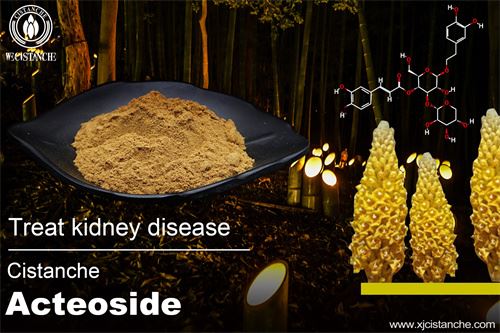
cistanche can treat kidney disease improve renal function
A common serious adverse reaction of aminoglycoside antibiotics is nephrotoxicity [9]. Such drugs are easily filtered through the glomerulus as prototype drugs, and some of the drugs are secreted into the urine, and most of the drugs are selectively accumulated in the renal cortex, making the concentration at this site several times higher than the concentration of the drug in the serum [10 ], the accumulation of this kind of drug inevitably causes cell damage and decreased renal function. For a long time, the clinical treatment of AKI caused by aminoglycoside drugs has always followed the principle of symptomatic and supportive treatment of drug withdrawal and routine rehydration. Waiting for the outcome of kidney disease itself, there are no other drugs that can alleviate the effect of aminoglycoside drugs on renal tissues. damage. Therefore, in this study, a 21d simulated clinical treatment group was established to simulate routine clinical treatment and body rehabilitation as much as possible, so as to further objectively investigate the therapeutic effect of Cistanche phenethyl alcohol glycosides. In clinical treatment, Scr and BUN are often used as indicators to evaluate renal function. The higher the level of Scr and BUN, the more serious the renal function damage is [11]. In this study, the AKI model was established by intraperitoneal injection of gentamicin 75 mg/kg in rats for 10 consecutive days. Compared with the blank control group, the levels of Scr and BUN in the model group increased, suggesting that the model was successful. After 10 days and 15 days of dry pre-treatment with Cistanche phenethyl alcohol glycosides, Scr and BUN of rats in each administration group decreased, indicating that Cistanche phenethyl alcohol glycosides had a good effect on improving AKI induced by gentamicin.

Studies have found that the increase of reactive oxygen species (ROS) plays an important role in the pathological process of renal tubular damage caused by gentamicin [12]. MDA is one of the main substances that reflect the level of ROS in the body [13-14]. The anti-oxidant (antioxidants) defense system that resists ROS in the organism includes SOD, CAT, GSH-PX, and so on. Phenyl ethanol glycosides are the main effective components of Cistanche, which can exert significant antioxidant activity in animals[15]. Cistanche
After the dry prognosis of the total phenethyl alcohol glycosides, the content of MDA in the kidney tissue of the rats in the administration group was significantly reduced, and the activities of SOD, CAT, and GSH-PX were significantly increased.
To sum up, the total glycosides of cistanche phenethyl alcohol have a protective effect on gentamicin-induced acute kidney injury. It exerts antioxidant effects by inhibiting free radical production and activating free radical scavenging enzymes, improving the body's oxidative stress state, and enhancing the body's antioxidant effect. Oxidizing ability, reducing kidney damage.

acteoside in cistanche have good effects on kidney
References
[1] Li Ming, Liu Yongqiang, Ao Hua, et al. Puerarin reduces acute kidney injury in rats induced by gentamicin [J]. Chinese Journal of Experimental Formulas, 2017, 23(17): 177-182.
[2] Lei Ying, Nie Sheng, Sun Danhua, etc. Epidemiological analysis of acute kidney injury in critically ill hospitalized patients in China [J]. Journal of Southern Medical University, 2016, 36(6): 744-750.
[3] Yu Lecheng, He Changlun. The correlation between acute kidney injury (AKI) and mortality and complications in hospitalized patients with liver cirrhosis [J]. Liver, 2013, 18 (11): 42-47.
[4] KISHOREBK, LAMBRICHTP, IBRAHIMS, etal. Inhibi-tionofaminoglycoside-inducednephrotoxicityinratsbypoliya-nionicpeptides[J]. Controls Nephrology, 2015, 83 (83): 1991-201.
[7] Cao Dandan, Yang Jianhua, Hu Junping. Cistanche phenyl ethanol glycoside nanoemulsion for nasal administration Safety evaluation [J]. Journal of Xinjiang Medical University, 2018, 41(11): 1411-1415.
[8] Ju Bowei, Yang Jianhua, Yan Yao, et al. The protective effect of Cistanche phenyl ethanol total glycosides on PC12 cell injury induced by Aβ_(1-42) [J]. Journal of Xinjiang Medical University.