Engineered Nanocomposites in Asphalt Binders
Jul 13, 2022
Please contact oscar.xiao@wecistanche.com for more information
Abstract: Recently, nanotechnology has been effectively used in the field of road pavement. Oxidation and aging of asphalt cause deterioration of road pavements and increase asphalt-related emissions. We propose an anti-aging strategy to interrupt the asphalt deterioration by using engineered clay/fumed silica nanocomposites. In this research, the morphological, chemical, thermal, mechanical, and rheological properties of nano-modified asphalt binders are meticulously analyzed under various conditions. The experiment results proved that this composite efficiently disrupts the chemical oxidation and decomposition in the mixture and reduces the aging rate. Remarkably, asphalt binder rheology experiments revealed that the addition of 0.2-0.3 wt% of nano-reinforced materials maximized their rheological resistance after short-and long-term aging. Moreover, nanoparticles improve the moisture resistance efficiency and in turn, overcome the critical issue of moisture in low production temperatures within
Keywords: nano clay, modified bitumen, thermal oxidation aging, nano-modification, nanocomposites
1 Introduction
Bitumen is generally used as the glue in road asphalt mixtures, due to its appropriate rheological properties [1-3]. However, modification of bitumen has developed an emerging field in road material technology, mainly in connection with re-using reclaimed asphalt paving, with low-energy concepts for asphalt mixture production, and with the increasing wish to at least partially replace the bitumen through more sustainable and bio-based binders. A significant issue when identifying the most appropriate bitumen modifiers is to investigate their aging resistance. As road asphalt materials are exposed not only to hot temperatures during mixture production but also to severe sun radiation, and oxygen and other radicals that promote binder aging during their entire in-service life [4-7], the durability of asphalt binders in terms of aging resistance is an important material property. Binder aging includes ultraviolet, thermal long-term aging, and thermo oxidative short-term aging. To influence asphalt binder performance, a huge variety of different types of additives can be added to bitumen, such as polymers, fibers, recycled materials, and nanomaterials [8,9]. This study focuses on nanomaterials. Among these materials, usually, nanomaterials significantly change chemical binder properties and in consequence mechanical rheological performance properties. Among the most important parameters describing nanoparticles (NPS), which cause the physical properties of nanocomposites unique and different from conventional materials, are their ratio of surface area to volume, shape, chemical composition, and their capability to increase interactions at phase interfaces [10,11]. Metal oxide, inor-ganic, nanofibers, and nanocomposites are the main class of nanomaterials particularly used in asphalt mixture to modify asphaltene binders [12,13]. Metal oxide NPs including zinc oxide (ZnO)and titanium dioxide (TiO)are reported to enhance the asphalt mixture's resistance to rutting and cracking [13,14]. cistanche stem Inorganic NPs such as silica (SiO), carbon nanotubes (CNTs), and nano-clay are seen to have excellent potential in the reinforcement of asphalt materials and improving their durability [15,16]. The rheological performance of bitumen-and consequently the performance of the corresponding asphalt mixture-was successfully improved through the addition of SiO, and NPs. The thermal and mechanical stabilities of the asphalt mixture were also improved by incorporating clay NPs [17,18].To the best of our knowledge, clay and silica families are the most widely used inorganic NPS to improve the binder resistance to aging [19-22]. Clay and silica families were reported to be of excellent inorganic NPs in improving binder aging properties. Based on the results of different reports, nano-silica-modified asphalt binders slightly decreased viscosity and complex modulus, while improving fatigue and rutting resistance after short-term aging [19-21].In addition, some investigations have shown that nano-silica-modified binder has a higher resistance to thermal aging, ultimately leading to increased durability of asphalt pavements [21,22]. SiO and NPs have advantages such as nonphotocatalytic, inorganic shielding, and nontoxic, which are of crucial importance for use in asphalt mixtures [23,24]. However, fumed SiO, and NPs are one class of synthetic nanomaterials that has environmentally friendly and economic justification to use on large scale. Fumed silica is a synthetic amorphous structure nanomaterial with a large surface area and nano-size scale [25]. Therefore, this study focuses on clay/fumed silica nanoparticles(CSNPs).

Please click here to know more
In comparison to the conventional way, warm mix asphalt (WMA) technology works in an efficient eco-friendly manner. In this case, asphalt is produced at a temperature of approximately 30-60℃C, which is lower than usual. This technology reduces the emission of harmful vapors and leads to 20-35 and 35% less greenhouse gas emissions and energy consumption, respectively [13,26]. However, moisture susceptibility is a common disadvantage of WMA technology, leading to a decrease in its performance [27,28].
The objective of this research is to identify the potential impacts of CSNPs on the aging resistance of road asphalt binders that are used for road asphalt mixtures produced by WMA technology. In detail, the morphological, chemical, thermal, rheological, and mechanical properties of CSNP-modified asphalt binders are meticulously analyzed in various conditions. New insights are presented toward a further understanding of potential changes in mechanical and rheological binder properties due to thermal aging. Figure 1 schematically illustrates the experimental techniques applied in this study.
2 Materials and methods
2.1 Materials
The synthesis process of CSNPs was selected according to the author's previous research (as shown in Figure S1)[29]. Nano-fumed silica(Aerosil A300, Degussa Co, Germany), sodium bentonite (Sigma Aldrich Ltd., Germany; see Table S1), and Bitumen 50/70 (Total Co., France) were used in this research. The particle size analysis of materials was performed using a dynamic light scattering (DLS)(Malvern ZEN 3600, UK), while X-ray diffraction (XRD)analysis was conducted using an X-ray powder diffraction(Philips PW 1730, Netherlands; Figure S2).To prepare the WMA mixture, a new formulation of Fischer-Tropsch (FT)wax(Sasol, South Africa; Evonik, Germany; Sigma-Aldrich, Germany) was synthesized in this investigation. Before use, nanocomposites were dried in an oven at110°c for 3h.In the first step, samples were prepared in accordance with prior works procedures [18]. Subsequently, nanocomposites were added to bitumen in different quantities (0.1,2, and 3wt%).In this study, bitumen was modified using a 3% WMA additive. cistanche tubulosa benefits and side effects This value was chosen based on the commonly used wax content used in WMA mixtures reported in the previous study [13].
2.2 Aging process
For the rolling thin film oven test (RTFOT), according to ASTM D1754, samples were kept at 163℃C in the rolling thin-film oven(RTFOT8, model of ISL, France). Based on the pressure aging vessel (PAV) standard procedure, samples were investigated in the PAV after long-term aging (with 300psi and 100℃ for 20 h). We prepared samples in three conditions: S1-S4: unaged samples, S5-S8:short-term aged samples, and S9-S12:long-term aged samples. All the samples are presented in Table S2 (Supplementary materials).
2.3 Characterization methods
A dynamic shear rheometer(DSR) device(Malvern Kinexus Pro+, UK) was applied to evaluate the rheological properties at a frequency of 10 rad/s and temperature between 20 and 70℃C. The phase angle and complex shear modulus (G*) of base asphalt, binder, and aged samples were measured according to the standard AASHTO T 315. This method is generally used for characterizing asphalt binder properties in the linear viscoelastic range. Chemical properties were tested using Fourier transform infrared (FTIR; Thermo scientific Nicolet iS10, USA) and TG/DTA(SDT Q600, TA Ins., USA). A Renishaw inViatM confocal Raman microscope(Renishaw plc, Miskin, Pontyclun, UK) with an argon laser source(633 nm)was used to study chemical bonding and aromatic sheet size, which was equipped with a charge-coupled device detector(4/cm spectral resolution, 90° scattering geometry). The survey spectrums were recorded ranging from 500 to 3,000/cm at room temperature(50× long work distance objective). Atomic force microscope(AFM; Nanowizard, JPK Ins., Germany) with cantilevers in a tapping mode(RTESP, Bruker, USA) and field emission scanning electron microscope (FE-SEM; TE-SCAN, MIRA II, Czech Republic) were used to study the morphology and structures of binder samples in microscales and nanoscales. Roughness and thickness map images at 1-2 frames/s and a set-point z were analyzed, and the results were evaluated using the open-source software Gwyddion [30]. The morphologies were characterized by focusing an electron beam on the surface of the binder samples. A thermal infrared camera (FLIR-T440, US) recorded thermographic images in specific time steps from binder samples. Flexural creep properties at low temperatures were analyzed by using a thermoelectric bending beam rheometer (TE-BBR; Cannon Ins., USA). In this study, we used Petrotest for softening point (PKA5, Germany), automatic penetrometer (PNR 12, Germany), and ductility test (infrared,20-2356, Germany). A summary
of the physical characteristics of the asphalt binder used in this study is presented in Table S3(Supplementary Materials).
3 Results and discussion
3.1 Surface morphology
FE-SEM was conducted to observe the surface morphology of CSNP-modified asphalt binder samples in the asphalt binder matrix(Figure 2a). FE-SEM images display uniform dispersion of CSNPs(average particle size ~45 nm)in the asphalt binder matrix. Unique nanolayer shapes of CSNPs in asphalt binder matrix significantly affect the aging process: like a shield. In this case, CSNPs prevent the upper structure from destruction through radiation [8]and simultaneously trap volatile compounds and prevent evaporation from the asphalt binder.

Cistanche can anti-aging
Due to their large surface area, clay nanolayers and fumed silica NPs coat a wide area. To use this feature, suitable dispersion of CSNPs in asphalt binder is essential. Distribution can be analyzed (see Figure S3)using energy-dispersive spectroscopy (EDS). The elements aluminum, silica, iron, and titanium can be detected and used to identify the distribution of CSNPs in base binders. Clay layers in binders'surfaces are usually detected via titanium dioxide (with 1μm average particle size). The map of titanium elements shows that the distribution of the particles in bitumen is uniform.

The nanostructure formed by CSNPs acts as a nano-shield against oxidation and thermal destruction. Clay layers are of high heat resistivity and avoid decomposition of chemical bonds and thus delay binder aging [8]. Figure 2b and c show the partially uniform cover of CSNPs on asphalt binders (green color) and dense bulks of CSNPs(red color), respectively. Polarity and chemical bonding [31,32] are important parameters that cause nanolayers to adsorb together and create these bulky components in asphalt binders.

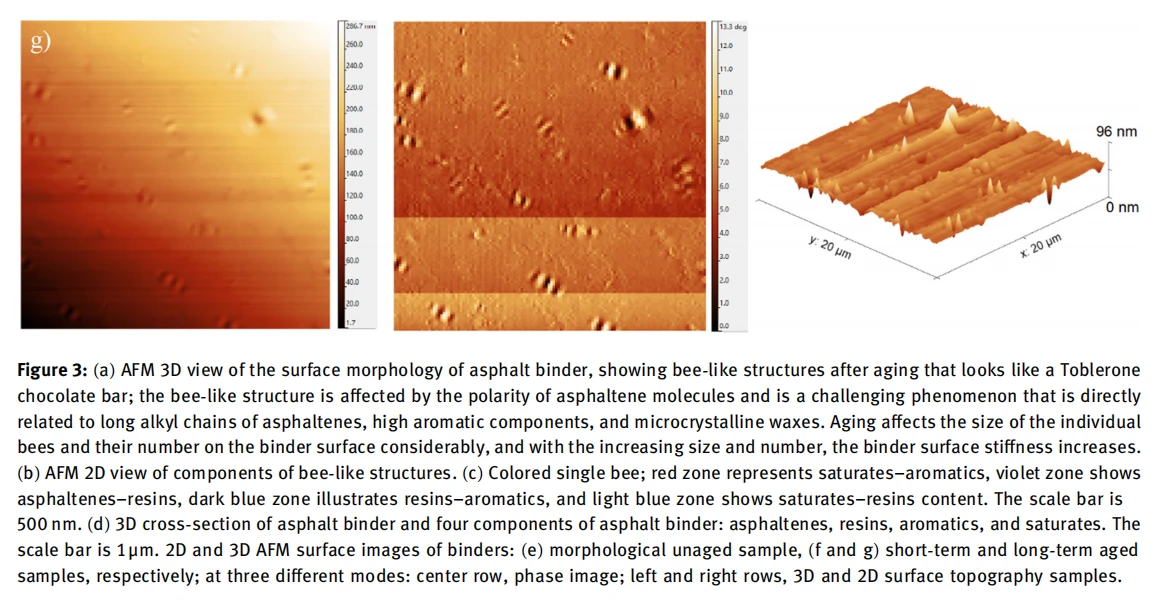
To further understand the effect of CSNPs on the binder, morphological properties were analyzed through the AFM test. The identification of the change of the binder microstructure due to aging is of interest because it shows the changing molecular interactions and chemical compounds [33,34]. cistanche tubulosa extract The microstructures of binder samples modified by CSNPs are shown in Figure 3.
In Figure 3, three phases Catana, Peri, and Para are shown that indicated bee-like structures, dispersed phase, and smooth matrix phase, respectively. The Catana and matrix phases are considered as microstructure characteristics of the binder [35]. Bee-like structures are attributed to the long chains of alkyl in microcrystalline waxes, aromatics structures, and asphaltenes, which crystallize during cooling [36]. cistanche tubulosa reviews Bee-like structures in AFM images indicate the possible presence of asphaltic components (Figure 3b-d). cistanche UK The amount of asphaltenes and colloids is directly related to the size of the bee-like structure in the

asphalt binder; the larger the structure, the higher the number of asphaltenes and colloids [37]. The microstructure morphology and the individual phases of short-and long-term aging binder samples are presented in Figure 3e-g. The comparison of AFM images of long-term aged and virgin samples illustrates the disappearing nanostructure and the increasing formation of bee-like structures. The same process can be observed in Videos 1-3 (see Supplementary Materials), recorded during the AFM measurements, which show the consequential structural change of binder aging. The addition of CSNPs to the asphalt binder leads to significant changes in binder morphology and microstructure. These changes explain the role of CSNPs as a shield to binder aging.
This article is extracted from Nanotechnology Reviews 2022; 11: 1047–1067