Treating Erectile Dysfunction With The “Through” Method: Unblocking The Xuanfu–Shen Luo System
Dec 31, 2025
Overview
Erectile dysfunction arises from multiple interwoven pathologies that disturb the Xuanfu–Shen Luo system (a traditional framework mapping genital function to collateral vessels and "gateway" structures). Core mechanisms include qi stagnation in the collaterals, damp‑heat obstruction, blood stasis, and deficiency/atrophy of the kidney collaterals, which together block the "mysterious gateway" (Xuanfu), impede Shen Luo (kidney collaterals), and ultimately impair erectile function. Guided by the therapeutic principle of tong (to "through," unblock, free the flow), treatment emphasizes restoring patency of the Xuanfu and Shen Luo.

In practice:
When collateral qi stagnates and the Xuanfu loses harmony (leading to failure of erection), soothe the Liver and open the collaterals to "awaken" the gateway, facilitating qi and blood flow.
When damp‑heat obstructs the Xuanfu–Shen Luo and suppresses erectile response, clear heat and drain dampness to "free" the gateway and spread qi dynamics.
When blood stasis arrests in the collaterals and the Xuanfu shuts, use "unblocking the collaterals and transforming stasis" to reopen the gateway so yang‑qi can disperse again.
When kidney collaterals are deficient and the Xuanfu is malnourished, use "tonifying while unblocking to nourish the collaterals" and consolidate the gateway, since long‑standing deficiency resists simple supplementation.

3.1 Soothe the Liver and Open the Collaterals to Awaken the Gateway
Collateral qi stagnation is often the initiating factor in ED, disturbing the open‑close dynamics of the Xuanfu. The aim is to restart the gateway's function and restore its physiological regulation:
Early/external stagnation: use qi‑regulating herbs tailored to cold/heat patterns. Warming, acrid qi‑regulators include Chen Pi (Pericarpium Citri Reticulatae), Mu Xiang (Aucklandia), Xiang Fu (Cyperus); cooling, acrid regulators include Chai Hu (Bupleurum), Bo He (Mentha). Chai Hu and Bo He are frequently used to soothe Liver constraint without harming normal qi, supporting erectile recovery.
Chen Pi is particularly effective at mobilizing constrained qi in the kidney collateral network to "open the gateway." As Li Shizhen noted in Compendium of Materia Medica, "Chenpi's bitterness drains and dries, its acridity disperses and warms; its efficacy broadly lies in regulating qi and drying damp."
As stagnation moves inward, add "qi‑moving" herbs, especially vines that "enter the collaterals," such as Kuan Jin Teng (Cissus), Ji Xue Teng (Spatholobus), and Gou Teng (Uncaria). "All vines can course channels and enter collaterals" (Zhang Bingcheng, Bencao Bian Du).
Ji Xue Teng is widely used clinically to improve penile blood flow and support erectile function restoration; masters like Prof. Wang Qi often deploy vine‑type herbs for ED.

damp‑heat
3.2 Clear Heat and Drain Dampness to Free the Gateway
When damp‑heat accumulates in the lower burner and blocks the Xuanfu–Shen Luo, patients may present with scrotal dampness, pruritus with a fishy odor, testicular heaviness/pain. Treatment focuses on clearing heat, draining damp, regulating qi, and opening collaterals to restore erectile function.
The team frequently uses a modified Chaihu Shengshi Tang (Chai Hu to soothe Liver and lift yang to disperse damp; Huang Bai to clear heat/dry damp; Sheng Ma to move channel qi; Ze Xie to promote urination and drain damp/heat; Dang Gui plus Hong Hua to nourish and invigorate blood and prevent damp‑heat from congealing to stasis; Qiang Huo to dispel damp; Ma Huang Gen to facilitate water; Fang Ji to drain damp; Long Dan Cao to purge damp‑heat from Liver/Gallbladder; Chi Fu Ling to drain damp and calm irritability; Wu Wei Zi to astringe and engender fluids; Sheng Gan Cao to harmonize).
For severe genital itching: add Di Fu Zi (Kochia) and Ku Shen (Sophora) to enhance heat‑clearing, damp‑drying, antipruritic effect.
For pronounced dampness: add Tu Fu Ling (Smilax) and Yi Yi Ren (Coix) to strengthen damp drainage.
Once damp‑heat resolves, reduce harsh bitter‑cold agents to protect normal qi; modestly add kidney‑tonics such as Sha Yuan Ji Li (Astragalus complanatus) and Tu Si Zi (Cuscuta) to consolidate recovery.
Hand Taiyin Lung Meridian
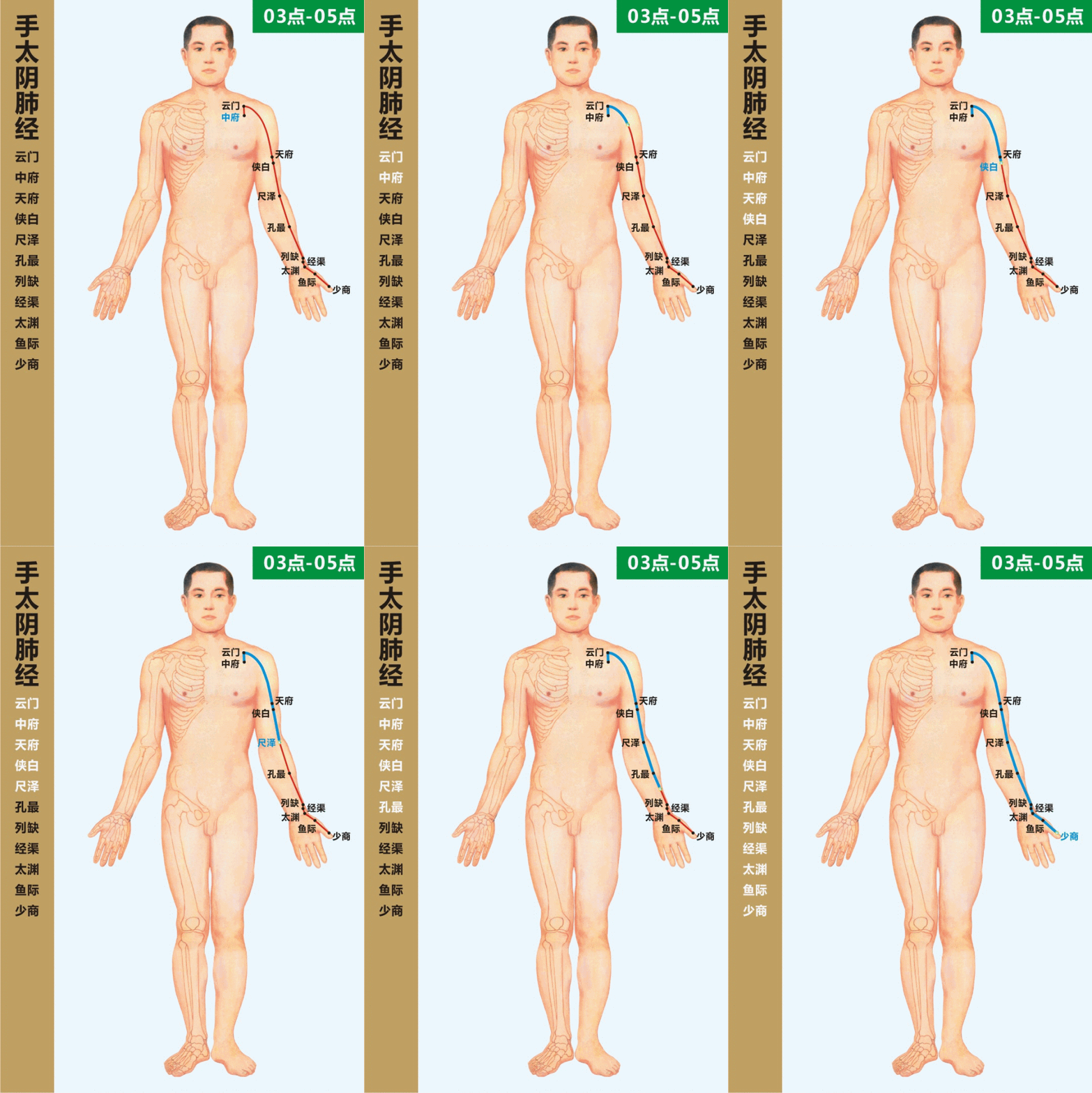
Hand Taiyin Lung Meridian
Queyunmen
Fu Zhongfu
Shan
Xia Bai
Chizawa
Kong Zui
missing
via canal
Taiyuan
thenar
Shaoshang
Cloud Gate
Zhongfu
Tianfu
Xia Bai
Chizawa
Kong Zui
List missing: Jingqu
Taiyuan
thenar
Shaoshang
3.3 Unblock the Collaterals and Transform Stasis to Open the Gateway
Long‑standing qi stagnation, blood stasis, and phlegm congeal, obstructing collaterals and progressively closing the gateway, often with penile pain or petechiae. Here, emphasize "unblocking collaterals through transforming stasis," prioritizing qi movement and blood activation to clear pathological residues lodged in Shen Luo.
Representative formulas/herbs: Xue Fu Zhu Yu Tang; Gui Zhi Fu Ling Wan; Tao Ren, Hong Hua, Chi Shao, Chuan Xiong, Dan Shen for invigorating and moving blood-each with the intent to reopen the gateway.
Modern findings indicate Xue Fu Zhu Yu Tang can improve hemorheology, dilate vessels, and enhance microcirculation, raising perfusion in ischemic tissues.
When stagnation hides deep in the kidney collaterals, insect‑derived medicinals such as Tu Bie Chong (Eupolyphaga), Di Long (Pheretima), and Wu Gong (Scolopendra) may be used to "search and dislodge" entrenched obstructions. Clinical experts sometimes add Shui Zhi (Hirudo), Di Long, and Quan Xie (Buthus) in stubborn or recurrent ED.
Pharmacology: Di Long proteins include collagenase and fibrinolytic enzymes that can dissolve microthrombi in microvessels and significantly improve erectile function in diabetic ED (DMED) rat models.
3.4 Tonify While Unblocking to Nourish the Collaterals and Consolidate the Gateway
In later or chronic ED, kidney collateral deficiency predominates while residual stasis remains secondary. As Ye Tianshi noted, "For collateral deficiency, tonifying through is most suitable." The principle is to tonify qi and blood while gently unblocking.
Common agents: Gou Qi Zi (Lycium), Tu Si Zi (Cuscuta), Rou Cong Rong (Cistanche deserticola/yunnanensis), and other kidney‑tonic, essence‑nourishing herbs that have shown benefits on ED‑related symptoms in clinical observations.
Traditional Chinese medicine extract - Cistanche tubulosa capsules, with an effective ingredient extraction ratio of 40:1.

Wecistanche Factory

Avoid overly hot‑dry tonics that could consume fluids, and avoid indiscriminate bitter‑cold medicinals that could damage yang.
"Flesh‑and‑blood" tonics such as Zi He Che (Placenta), Lu Rong (Deer Antler), Lu Jiao Jiao (Deer Antler Glue), and Gui Ban Jiao (Tortoise Plastron Glue) nourish essence and blood, supporting damaged collaterals.
Region‑specific pairing (Lingnan): Wu Zhi Mao Tao (Ficus hirta, "five‑fingered hairy peach root") plus Niu Da Li (Millettia/different locales) for local damp climates-one strengthens spleen/qi and relaxes sinews; the other dispels wind‑damp and strengthens tendons/collaterals.
Conclusion
ED is the downstream result of multi‑factor disruption of the Xuanfu–Shen Luo system. Based on this framework, the pathomechanisms can be functionally grouped into four patterns and treated under the overarching "through" (tong) method:
Qi stagnation pattern: soothe Liver and open collaterals (external qi, internal qi, and hidden/stuck qi via qi‑regulators and vine herbs).
Damp‑heat pattern: clear heat and drain damp (e.g., modified Chaihu Shengshi Tang).
Blood stasis pattern: unblock collaterals and transform stasis (emphasize qi‑movement and blood activation).
Deficiency pattern: tonify‑through to nourish collaterals and consolidate the gateway (use essence‑ and blood‑nourishing agents, including "flesh‑and‑blood" tonics).
This approach offers a coherent, testable TCM strategy that can be integrated with modern evaluation of vascular, endocrine, and neural contributors to ED.
Reader's note: Herb can really healing erection dysfunction?
Many readers ask whether herbs can truly help ED. Within the TCM framework above, herbal strategies target pattern‑specific mechanisms: improving penile perfusion and microcirculation (blood‑invigorators), reducing inflammatory damp‑heat (heat‑clearing and damp‑draining agents), relieving smooth‑muscle tension and qi constraint (qi‑regulators), and restoring androgen‑axis support/"essence" (kidney tonics). Clinical evidence ranges from classical case series and modern randomized or observational studies to animal models and mechanistic research. Herbs are not a replacement for medical evaluation of cardiovascular risk, diabetes, or medication effects-rather, they may complement evidence‑based care when matched to the right pattern, with professional guidance.
Cistanche benefits (Rou Cong Rong) and ED: a brief, evidence‑aware overview
Traditional role: Cistanche (Rou Cong Rong) is a classic kidney‑yang and essence‑nourishing tonic used for fatigue, low libido, and reproductive weakness. In the "tonify‑through" stage (section 3.4), it often pairs with Gou Qi Zi and Tu Si Zi to replenish essence/blood while gently facilitating flow.
Putative mechanisms discussed in modern literature include modulation of nitric oxide/endothelial function, antioxidation, anti‑inflammation, and potential androgen‑axis support-mechanisms that align with vascular ED pathophysiology.

Reader resource: Cistanche product overview and kidney‑nourishing positioning:
https://www.xjcistanche.com/cistanche-extract-product/cistanche-for-nourishing-kidney.html
Practical takeaway: For individuals exploring botanical support, Cistanche may play a role as part of a pattern‑matched formula, especially in deficiency‑predominant presentations; its use should be supervised by qualified clinicians, particularly if you have hypertension, diabetes, or take PDE5 inhibitors.
References
[1] Burnett AL, Nehra A, Breau RH, et al. Erectile dysfunction: AUA guideline. J Urol. 2018;200(3):633‑641.
[2] Domes T, Najafabadi BT, Roberts M, et al. Canadian Urological Association guideline: erectile dysfunction. Can Urol Assoc J. 2021;15(10):310‑322.
[3] Feng H, Peng W, Deng ZY, et al. Erectile dysfunction and exosome therapy. Front Endocrinol. 2023;14:1123383.
[4] Liu ZX, Zhu PQ, He WM. Ye Tianshi's use of the "through" method in kidney disorders. J Zhejiang Univ Tradit Chin Med. 2024;48(8):991‑995. (Chinese)
[5] Yu HL, Zhang XY, Jiang Y. Xuanfu theory and applications. Chin J Basic Med Tradit Chin Med. 2021;27(9):1512‑1514. (Chinese)
[6] Wang XQ, Bai X, Tang HM. Building an integrative TCM‑Western diagnostic model based on Xuanfu theory. J Tradit Chin Med. 2018;59(3):191‑194. (Chinese)
[7] Xiang SJ, Lu XJ, Zhang FW, et al. Review of Xuanfu theory research. China J Tradit Chin Med Pharm. 2020;35(8):3803‑3807. (Chinese)
[8] Zhu Q, Chen HY. On kidney Xuanfu theory and pungent "wind" herbs in renal disease. J Tradit Chin Med. 2018;59(4):281‑284. (Chinese)
[9] Feng J, Li HS, Sun S, et al. Transcriptomics with network pharmacology on cGMP/PKG pathway‑induced ED. Chin J Androl. 2024;30(9):771‑781. (Chinese)
[10] Wu YL. TCM collateral disease theory and a three‑dimensional network system. J Tradit Chin Med. 2003;44(6):407‑409. (Chinese)
[11] Gao DW, Tang B, Xie C, et al. ED pathogenesis and treatment under collateral disease theory. Chin J Andrology. 2023;37(2):115‑118. (Chinese)
[12] Li X, Gao J, Zheng SJ, et al. Pattern identification of kidney‑collateral masses and clinical use. J Beijing Univ Tradit Chin Med. 2024;47(8):1049‑1054. (Chinese)
[13] Chang CC, Wei C, Wu YL. "Sun‑luo–microvessel" concept and clinical significance. J Tradit Chin Med. 2016;57(1):7‑11. (Chinese)
[14] Ai SN, Wang YX. On the "three‑step method for treating the Xuan (kidney)." China J Tradit Chin Med Pharm. 2024;39(9):4538‑4543. (Chinese)
[15] Hong ZM, Chen ZL, Qiu JF, et al. Treating ED with the "through" principle. Jilin J Tradit Chin Med. 2023;43(7):758‑762. (Chinese)
[16] Wang CH. Understanding "treating ED from the Liver perspective." J Beijing Univ Tradit Chin Med. 1999;22(3):64‑65. (Chinese)
[17] Zhang RX, Shang XJ. Prof. Wang Qi's academic thought and prescribing for secondary ED. Chin J Androl. 2021;27(7):641‑644. (Chinese)
[18] Hu YH, Yang J, Xiu CK, et al. Yiqi Huoxue formulas and diabetic vasculopathy. Chin J Exp Tradit Med Formulae. 2020;26(8):1‑12. (Chinese)
[19] Sun ZX, Li PC. Advances in TCM treatment of ED. Chin J Tradit Chin Med. 2018;36(3):528‑530. (Chinese)
[20] Huo Y, Wei XP, Shi HJ, et al. Xue Fu Zhu Yu Tang for post‑PCI angina: a clinical study. Liaoning J Tradit Chin Med. 2024;51(8):69‑72. (Chinese)
[21] Jiang YH, Lou WJ, Cai YZ, et al. "Three states of kidney collaterals" and the use of insect medicinals in collateral‑bi. China J Tradit Chin Med Pharm. 2022;37(2):828‑831. (Chinese)
[22] Wang H, Zhang JW, Du GC, et al. Prof. Guo Jun's use of insect medicinals for ED. West China J Tradit Chin Med. 2023;36(10):52‑55. (Chinese)
[23] Ji XW, Zhang AP, Liu LM, et al. Effects of earthworm protein on cavernous smooth muscle phenotype and erection in DMED rats. Chin New Drugs Clin Pharmacol. 2024;35(3):325‑333. (Chinese)
[24] Lu DD, Tao CK, Jiao WW, et al. Prof. Wang Qi's andrology thought and applications. Liaoning J Tradit Chin Med. 2023;50(1):31‑33. (Chinese)
[25] Yang SH, Dong QY, Liu XB, et al. Deng Tietao's Lingnan spleen‑stomach approach to hyperuricemia. Chin J TCM Information. 2022;29(10):147‑149. (Chinese)
[26] Lu BW, Sheng W, Ding J, et al. Protective effects of Guilu Erxian Jiao in yang‑deficiency renal disease rats. Shizhen Tradit Chin Med. 2023;34(2):257‑260. (Chinese)
Keywords
erectile dysfunction; TCM; Xuanfu; Shen Luo; qi stagnation; damp‑heat; blood stasis; kidney deficiency; unblocking collaterals; Cistanche benefits; herb can really healing erection dysfunction?
Clinical and safety note
Always evaluate cardiovascular/metabolic risks and medication interactions. Herbal treatment should be individualized by qualified practitioners; PDE5 inhibitors and lifestyle intervention remain standard pillars per AUA/CUA guidelines [1–2].