Expanding The Artificial Planting Technology Of Cistanche Deserticola, Creating A Hotan Model For Sand Control And Prevention
Jul 04, 2023
Turning over the topographic map of China, in the northwest of Southern Xinjiang, a large expanse of khaki area is striking, that is the world-famous Taklimakan Desert. To the south of the desert lies the Kunlun Mountains, known as the "ancestor of mountains". The ancient Hotan Oasis is embedded between the vast sea and the towering mountains. Can Hotan Prefecture, which is in close combat with the Taklamakan Desert, shoulder the heavy task of preventing and controlling desertification in southern Xinjiang, and become the main battlefield to prevent the desert from moving southward? With such questions, let's open a new chapter in sand prevention and fixation in Hotan Prefecture.

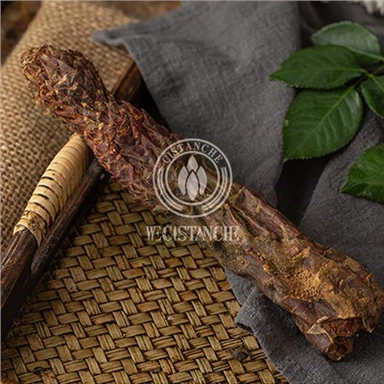
Cistanche deserticola
Hotan Prefecture, located in the hinterland of the Taklamakan Desert, is a typical desert area in China with a dry climate, scarce rainfall, strong sunshine, and large evaporation, which leads to serious vegetation degradation and severe ecological environment situation. To change this situation, the local government first implemented Ecological engineering such as Grain for Green. However, because of the weak foundation, the economic benefits of ecological forests are not obvious, and it is difficult to manage on the edge of the oasis, the standard of Grain for Green has become a bottleneck that shackles the development of Hotan Prefecture. Taking into account its special conditions, Hotan Prefecture began to explore a new way of development, adjusted its industrial structure according to local conditions, vigorously developed the characteristic forest and fruit industry, and developed the idea of "one village, one product", and determined Langan Township, which mainly planted grapes; Oytograk and Arixi Township mainly develop Cistanche tubulosa and walnut; Tuogerigazi Township and Oytograk focusing on pomegranate development; Agrel Township mainly develops roses; Karke Township, Xianbaibaza Township, Siyeke Township, Kekeya Township, Jiayi Township, and Keriya Town mainly develop apricots.
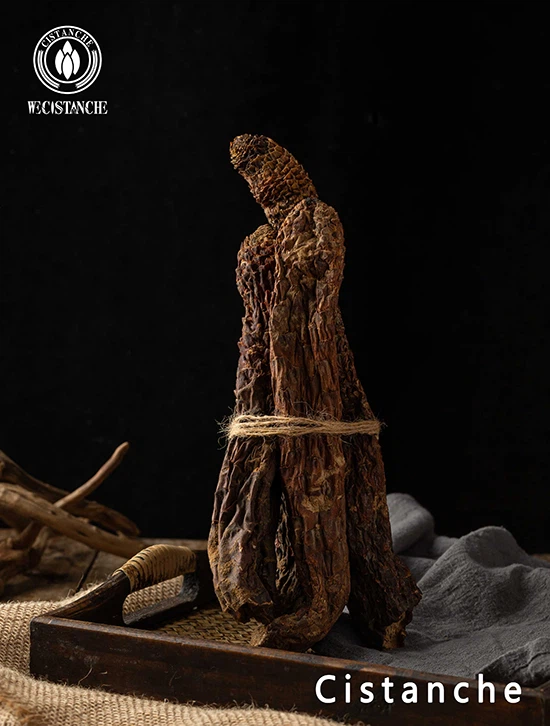
Chinese herb cistanche
As a precious Chinese medicinal material, red willow and large cloud (Cistanche tubulosa) have been used for more than 1800 years in China. The artificial cultivation technology of Cistanche deserticola deserticola in Xinjiang has also become mature.
Cistanche deserticola deserticola deserticola is a perennial parasitic Spermatophyte, which has a certain selectivity to the host, soil, and climatic conditions. The more suitable hosts are Haloxylon ammo dendron, red willow, alkali firewood, etc.

Cistanche deserticola slice
The host can be natural Haloxylon ammo dendron, red willow, etc., or artificial Haloxylon ammo dendron, and red willow can be planted for 2-3 years and then inoculated with Cistanche deserticola. Trenches can be opened on both sides of the plant as a seedbed, and after inoculation, the seedbed can be kept moist to induce the host to extend onto the seedbed. The artificially cultivated Haloxylon ammo dendron and red willow have a plant spacing of 1.5m, a row spacing of 3m, and a density of 140 plants/667m2 or more. Cistanche deserticola is generally inoculated in spring and autumn, and it begins to grow after inoculation. A few are unearthed in the second year, and most of them are unearthed within 2-4 years and blossom and bear fruit.

Cistanche tea
Click here to view Cistanche deserticola tea products
【Ask for more】 Email:cindy.xue@wecistanche.com / Whats App: 0086 18599088692 / Wechat: 18599088692
Hotan Prefecture vigorously implements the green Ecological engineering of sand prevention and control and adheres to the combination of "connotation tapping" and "extension expansion" while taking the road of "multi-industry integration" of sand prevention and control, including afforestation, featured breeding, featured fruit trees, facility agriculture, planting of red willows and big clouds, and desert tourism, while expanding and strengthening the sand industry. The practice and sublimation of the concept of "two sustainability" lies in the transition from sand entering and retreating, to people entering and retreating, and then to the point where sand turns into gold and harmony between people and sand. The expansion of artificial planting technology of Cistanche tubulosa has created the Hetian model of sand prevention and control.

Desert ginseng