Cistanche Tubulosa And Desert Red Willow, A Moving Story Of A Wanderer And A Nurse
Jul 04, 2023
Hotan Prefecture in Xinjiang has a vast territory and rich products. The "old three treasures" of Hotan are jade, silk, and carpet, and the "new three treasures" are Dayun (Cistanche tubulosa), walnuts, and Uygur medicine.

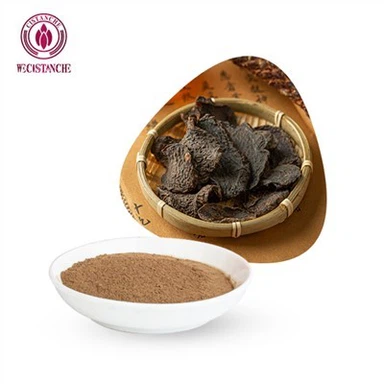
Cistanche deserticola slices
Cistanche tubulosa grows in the desert and is a parasitic plant. Its host plants are Haloxylon ammo dendron, Tamarix plants, etc., which are excellent plants for wind prevention and sand fixation. Red willow is a common shrub plant with excellent drought resistance and sand resistance in the Gobi Desert in Xinjiang. Large-area planting can prevent wind and sand, and prevent the expansion of desert flow. To save the medicinal resources of Cistanche deserticola deserticola and protect the ecological environment in the desert area. The governments at all levels in Hotan Prefecture are actively taking measures to vigorously develop the industry of Hongliu Dayun. The planting area of artificial red willow is constantly expanding, gradually making the red willow and large cloud form a scale, and a large number of Cistanche deserticola can parasitically grow.

Desert ginseng
Click here to view Cistanche products
【Ask for more】 Email:cindy.xue@wecistanche.com / Whats App: 0086 18599088692 / Wechat: 18599088692
However, the Cistanche deserticola seeds themselves cannot move. They must rely on the newborn capillary roots of the host red willow to extend to the Cistanche deserticola seeds, enter from the hilum, release some chemical activating substances, stimulate the seed cell division, and then have a parasitic relationship. Only relying on the nutrition of the host tamarix, can the seeds grow and develop into Cistanche deserticola. A cluster of desert shrubs generally hosts a nest of Cistanche tubulosa, and up to five nests have been found. Usually, there is only one root in each nest parasitizing Cistanche tubulosa.

Chinese herb cistanche
Cistanche tubulosa can be divided into spring Cistanche deserticola tubulosa and autumn Cistanche tubulosa tubulosa by picking time. In spring, the temperature ranges from 20 to 25 ℃, leading to faster growth. Growth begins in early May and blooms from late May to early June. In late July, the seeds mature, and the fruit turns brown when it matures, with the shell shrinking and splitting longitudinally. It takes about 45 days from insemination to fruit ripening, usually from bottom to top to mature and crack, after which the plant withers and completes its life cycle.

Main Chemical Constituents of Cistanche deserticola
In the past, Hotan only purchased Cistanche deserticola, a kind of spring pipe flower. Cistanche deserticola collected from April to early June every year is of the best quality as a medicinal material, but attention should be paid to collecting large and retaining small ones and collecting dense and retaining thin ones. There is also a certain amount of excavation in autumn, but the yield is relatively low, and it should be mainly in spring. The Cistanche deserticola should be removed from the inflorescence or head of the Cistanche deserticola, so as not to consume the nutrients in the stem, and then it should be dried on a clean beach. After more than a month, the cistanche will change from yellow to fleshy brown, which is called the sweet big cloud. After excavation, the meat and ground stems are turned over and dried in the hot summer sun before packaging and transportation. The hollow period of Cistanche tubulosa growing in autumn is from September to October. Its size is slightly smaller than that of Cistanche tubulosa in spring, and its moisture content is the same as that of Cistanche deserticola tubulosa in spring. However, it is difficult to guarantee quality and specification due to weak sunlight, low temperature, and short sunshine time in late autumn and early winter.
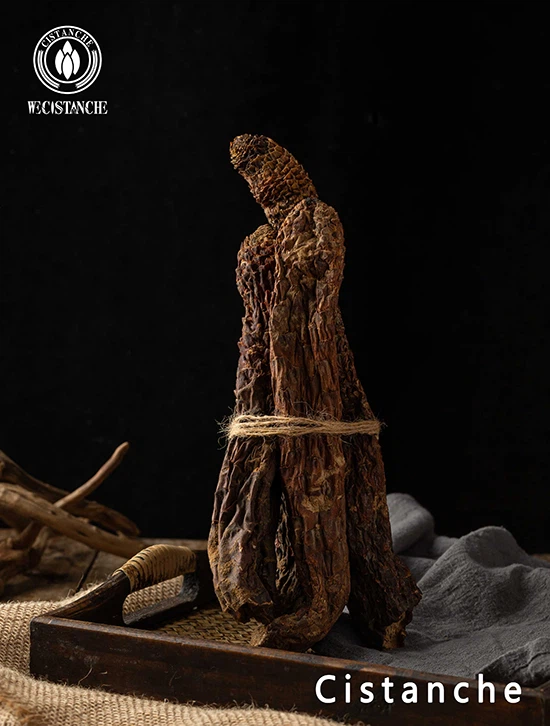
Chinese herb cistanche
A desolate land of quicksand, where other plants generally difficult to survive, only the red willow can tightly grasp the water in the quicksand and retain the clouds. A wanderer in a foreign land will eventually return to his mother's embrace, and the mother will use all her strength to tightly grasp her child.