Extraction, Separation And Chemical Analysis Of Polysaccharides From Cistanche
Mar 15, 2022
Contact: joanna.jia@wecistanche.com / WhatsApp: 008618081934791
Sheng Wei & Gao Leining
Polysaccharides are important biopolymer compounds. Although the research on polysaccharides in my country started relatively late, in recent decades, with the study of membrane theory and immune substances, the importance of polysaccharides in life phenomena has gradually been discovered. , It was discovered that polysaccharides are non-cytotoxic substances and have various biological activities. The research on polysaccharides has been paid more attention. The author has conducted a systematic study on the polysaccharide components of Cistanche in the traditional Chinese medicine Cistanche, hoping to make a contribution to the research of cistanche polysaccharides.

1 Material and equipment
Cistanche: provided by Inner Mongolia Alexa medicinal materials company. Anhydrous glucose reference substance: provided by China National Institute for the Control of Pharmaceutical and Biological Products, infrared spectrophotometer: 599-B PE. Ultraviolet spectrophotometer: UV-260 Shimadzu, vacuum constant temperature drying oven: YB-IA Tianjin.
2 Methods and experimental results
2.1 Extraction, separation and refining
Cut the cistanche, add water, boil for 2 hours, filter. Add water, boil the residue for 2 hours, filter, combine the extracts. Use the Se-wag method to remove protein. After the extract is concentrated, ethanol is added for repeated precipitation, and it is decolorized with H2O2 under the condition of pH=g②2 to obtain an off-white substance. Wash with absolute ethanol and diethyl ether successively, and place in a vacuum desiccator to dry under reduced pressure to obtain an off-white dried product.

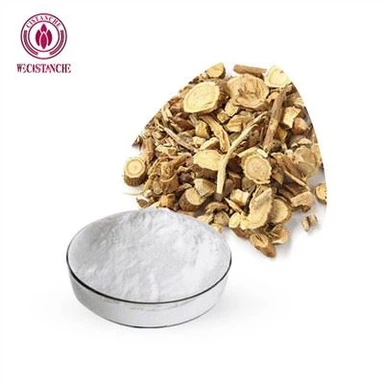
polysaccharide from cistanche
2. 2 physical and chemical analysis
(1) Physicochemical properties: The high-quality cistanche polysaccharides are in the form of off-white powder. It is soluble in water. It is especially soluble in hot water. Insoluble in high-concentration ethanol, acetone, ethyl acetate, chloroform, ether and other organic solvents. The aqueous solution of cistanche polysaccharide is transparent and viscous, the reaction of iodine-potassium iodide is negative, the reaction of ninhydrin is negative, and the reaction of anthrone and mono carbazole sulfate is positive.
(2) Purity identification: use silica gel thin-layer chromatography with concentrated ammonia water: n-butanol; water (40'60'5) to develop, the cistanche polysaccharide has only one spot, paper chromatography uses Xinhua filter paper to develop for about 8 hours, Take it out and blow dry, stain with Q 5% toluidine blue ethanol solution, and then rinse with 95% ethanol until the background is colorless. The result showed a single spot.
(3) Ultraviolet spectroscopy analysis: The Bossica cistanche polysaccharide was prepared into a 500Vg/ml solution and scanned at 200~400m with an ultraviolet spectrophotometer. No characteristic absorption of nucleic acid (260rm) and protein (280nm) was found.
(4) Infrared spectroscopy analysis: Take 2mg of Bossica cistanche polysaccharide, press KB1 tablet, scan infrared spectroscopy, characteristic absorption respectively: 3500m, 3000m, 1600m, 1400cm, 110m, 890m are the characteristic absorption peaks of the β-pyranoside bond.
(5) Determination of content: Using the sulfuric acid-anthrone method J colorimetric, anhydrous glucose as the reference substance, the measured polysaccharide content was 69.64%, and the sulfuric acid-carbazole method measured the glucuronic acid content of 18 12%. The total sugar content is 87.76%, and the rest is water and ash, without protein and nucleic acid.

cistanche polysaccharide
3 Discussion
It reported the off-white polysaccharides extracted from the cistanche and the physical and chemical properties of the polysaccharides. Due to the limited conditions, the purity of the cistanche polysaccharides is not good enough. This will be the direction of the author’s efforts. At the same time, the monosaccharide composition and connection methods of the cistanche polysaccharides Will be the issue that the author continues to pay attention to.
References
1 Journal of Shenyang College of Pharmacy. Vol. 2, No. 3, 1985, 234~240
2 Shanghai Institute of Materia Medica, Chinese Academy of Sciences. Extraction and separation of active ingredients of Chinese herbal medicine. Shanghai Science and Technology Press, 1983415~420
3 Yuan Xiao, etc. Plant Physiology and Biochemistry Experiment. Higher Education Press, 1983
(Received date, February 21, 2000)

polysaccharide extracted from cistanche