Determination Of Five Components in Rehmannia Glutinosa And Establishment Of HPLC Fingerprint
Sep 27, 2024
Abstract: The determination method of the contents of five components in Rehmannia glutinosa, namely, rehmannoside D, leonurin, echinacoside, cistancheside A and verbascoside, was established, and the high performance liquid chromatography (HPLC) fingerprint of Rehmannia glutinosa was established to provide a scientific basis for the quality control of Rehmannia glutinosa. The Shiseido CAPCELL PAK C18 column was used, with acetonitrile-0.1% formic acid solution as the mobile phase, gradient elution, column temperature of 30℃, variable wavelength determination, and flow rate of 1.0 mL/min. The HPLC fingerprint of Rehmannia glutinosa was analyzed by the "Chinese Medicine Chromatographic Fingerprint Similarity Evaluation System (2012 Edition)" software to evaluate its quality consistency. The results showed that according to the established content determination method, the five components had a good linear relationship within their respective concentration ranges (R2>0.999 0), the RSD of precision test, repeatability test and stability test was 0.12%~1.58%, and the average sample recovery rate was 96.5%~98.6%; the established Rehmannia glutinosa HPLC fingerprint identified 23 common peaks, and the similarity between the Rehmannia glutinosa sample and the control fingerprint was 0.904~0.950. The results suggest that the established content determination method and HPLC fingerprint are suitable for the evaluation of Rehmannia glutinosa quality and the identification of raw Rehmannia glutinosa and cooked Rehmannia glutinosa, with high accuracy and good reproducibility, and can provide technical support for the quality control of Rehmannia glutinosa medicinal materials.
Keywords: Rehmannia glutinosa; content determination; fingerprint; quality evaluation
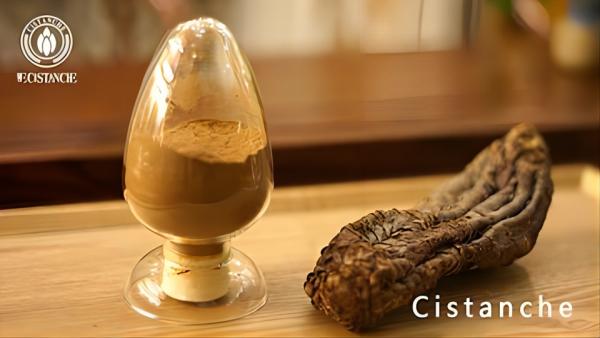
NEW HERB CISTANCHE WITH ECHINACOSIDE, CISTANCHESIDE A AND VERBASCOSIDE
Rehmannia glutinosa is the fresh or dried root tuber of the Scrophulariaceae plant Rehmannia glutinosa Libosch. Due to different processing methods, it is mainly divided into fresh rehmannia, raw rehmannia and cooked rehmannia [1-2]. The main production areas are Henan, Shanxi, Shaanxi, etc. land. Among them, raw rehmannia glutinosa has the effects of clearing away heat and cooling blood, nourishing yin and promoting fluid production, and is mainly used to treat heat in the blood, warm toxins and spots, etc.; cooked rehmannia glutinosa has the effects of nourishing blood and yin, replenishing essence and replenishing marrow, and is mainly used to treat blood deficiency, chlorosis, etc. Palpitations, restlessness, etc.[1-2]. The two have different properties and flavors, but both belong to the liver and kidney meridians. Rehmannia glutinosa contains complex chemical components, mainly including iridoids, ionones, phenylethanol glycosides, flavonoids, etc. [3-5].
After Rehmannia glutinosa is processed by different processing methods, the types, contents and proportions of chemical components in each processed product vary greatly, resulting in significant differences in its pharmacological activity [6-10]. according to
Related studies[11-12] show that in the process of Rehmannia glutinosa changing from "raw" to "cooked", the contents of chemical components such as catalpol, motherwort, stachyose, and amino acids all decreased significantly, and the contents of fructose, 5-hydroxymethylfurfural, etc. The contents of , isorebascoside, etc. were significantly increased. At present, the quality control of raw and cooked rehmannia glutinosa mainly uses the contents of catalpol and rehmanniaside D as evaluation indicators. The evaluation system indicators are relatively single, making it difficult to comprehensively control the quality of rehmannia glutinosa. In addition, studies have shown that the content of rehmannia glutinosa D changes before and after processing. It is small and has poor specificity in characterizing the composition changes after processing and the degree of processing [12-13].
Therefore, in order to evaluate the quality of Rehmannia glutinosa more comprehensively, this study established the relationship between rehmanniaside D and Yimu in Rehmannia glutinosa.
Determination methods for the content of five common components, including glucoside, echinaceaside, cistancheoside A, and verbascoside, and established an HPLC fingerprint of Rehmannia glutinosa to analyze the content of the main components in Rehmannia glutinosa from different production areas and before and after processing, in order to provide information for the quality control of Rehmannia glutinosa. Technical support.

Instruments, reagents and test drugs
Agilent 1260 high performance liquid chromatograph (detector is diode array); variable range electronic analytical balance (METTLER TOLEDO); digital ultrasonic cleaner (Shanghai Ultrasonic Instrument Factory, KH-500DE). Methanol (Sinopharm Group) is analytical grade; acetonitrile (Merck) is chromatographic grade; water is Watsons bottled water. Rehmannia glutinosa D reference substance (batch number RFSD8401909016, purity 98.0%), leonurus glycoside reference substance (batch number RFS-Y22002208010, purity 98.0%), and cistancheside A reference substance (batch number RFS-R05002009014, purity 96.0%) were all purchased from Chengdu Ruifensidedan Biotechnology Co., Ltd.; echinacoside reference substance (batch number 111670-201907, purity 91.8%) and verbascoside reference substance (batch number 11530-201914, purity 95.2%) were all purchased from China Food and Drug Inspection Institutes. Rehmannia samples (SX1~SX4, HN1 and HN2) were collected from different producing areas (see Table 1), of which SX4 and HN2 were steamed by SX1 and HN1 respectively, and SX2 and SX3 were collected from the same producing area. All samples were identified as authentic by Song Pingshun, chief Chinese medicine practitioner of Gansu Provincial Institute of Drug Control.
Table 1 Information of Semen Rehmanniae samples
| Code | Product Type | Source |
|---|---|---|
| SX1 | Raw Yellow | Shanxi Province, Yuncheng County |
| SX2 | Cooked Yellow | Shanxi Province, Yuncheng County |
| SX3 | Cooked Yellow | Shanxi Province, Yuncheng County |
| SX4 | Cooked Yellow | Shanxi Province, Yuncheng County |
| HN1 | Raw Yellow | Henan Province, Wugang County |
| HN2 | Cooked Yellow | Henan Province, Wugang County |
2.1 Chromatographic conditions
The Shiseido CAPCELL PAK C18 (250.0 mm×4.6 mm, 5 μm) column was used, acetonitrile was used as mobile phase A, and 0.1% formic acid solution was used as mobile phase B. The gradient elution conditions were: 0-3 min, 1%A; 3-9 min, 1%A→5%A; 9-24 min, 5%A→35%A; 24-35 min, 35%A→65%A; 35-40 min, 65%A→90%A. Variable wavelength detection (0-24 min, 203 nm; 24-40 min, 330 nm). The injection volume was 15 μL of the reference solution and 20 μL of the sample solution.
2.2 Solution preparation
2.2.1 Reference solution preparation
Take appropriate amounts of the above five reference substances, add 70% methanol to prepare a mixed reference solution with a mass concentration of 0.4 mg/mL.
2.2.2 Test solution preparation
Weigh about 1.0 g of Rehmannia powder (passed through No. 2 sieve), accurately weigh, place in a stoppered conical flask, accurately add 25 mL of 70% methanol, seal, weigh, ultrasonically treat (power 300 W, frequency 50 kHz) for 30 min, let it cool to room temperature, weigh again, make up the lost mass with 70% methanol, filter, and take the filtrate to obtain.

2.3 Methodological investigation
2.3.1 Specificity investigation
Take the mixed reference solution under "2.2.1" and the test solution (sample SX1) under "2.2.2", and inject and measure according to the chromatographic conditions under "2.1". The results show that the chromatogram of the Rehmannia sample presents a chromatographic peak with the same retention time as the reference standards of Rehmannia glutinosa D, Leonurin, Echinacoside, Cistanche deserticola A, and Verbascoside (see Figure 1), indicating that this method has strong specificity.
2.3.2 Linear relationship investigation
Add 70% methanol to the mixed reference solution, dilute 5 times, 10 times, 25 times, 50 times, 100 times, and 250 times respectively, and inject and measure according to the chromatographic conditions under "2.1". The standard curves were drawn with the mass concentration of each reference as the horizontal axis (x) and the corresponding chromatographic peak area as the vertical axis (y). The results are shown in Table 2, indicating that each component has a good linear relationship within the corresponding mass concentration range.

1.rehmannioside D; 2. leonuride; 3. echinacoside; 4. castanoside A; 5. acteoside
Figure 1 Chromatograms of specificity investigation
Table 2 Linear relationship of 5 components in Semen Rehmanniae
| Component | Standard Curve Equation | R² | Linearity Range (µg·mL⁻¹) |
|---|---|---|---|
| Dandelion D | y = 121.323x + 161.550 | 0.999 | 1.69 – 84.52 |
| Yarrow | y = 580.537x + 11.775 | 0.999 | 1.52 – 76.20 |
| Pineapple Fungi | y = 605.279x – 3.465 | 0.999 | 1.46 – 73.22 |
| Meat Yeast A | y = 645.319x – 3.327 | 0.999 | 1.63 – 81.72 |
| Hairy Flower Sugar | y = 739.071x – 6.534 | 0.999 | 1.43 – 71.66 |
2.3.3 Precision investigation
Take the test solution (sample SX1) under "2.2.2", and perform the injection test according to the chromatographic conditions under "2.1". Inject the sample 6 times continuously, record the peak area of each component, and calculate the peak area RSD of rehmannia glutinosa D, motherwort glycoside, echinacea glycoside, cistanche glycoside A, and verbascoside in the test sample to be 0.46%, 0.12%, 0.85%, 0.48%, and 0.82%, respectively, indicating that the instrument has good precision.
2.3.4 Repeatability Study
Six samples of the same Rehmannia root sample (SX1) were prepared in parallel according to the method in "2.2.2" and injected and determined according to the chromatographic conditions in "2.1". The RSDs of the contents of rehmannia root glycoside D, motherwort glycoside, echinacea glycoside, cistanche glycoside A and verbascoside in the six samples were 0.46%, 0.69%, 1.42%, 0.48% and 1.58%, respectively, indicating that the method has good repeatability.
2.3.5 Stability Study
Take the test solution (sample SX1) under "2.2.2" and inject and measure according to the chromatographic conditions under "2.1" at 0 h, 2 h, 4 h, 6 h, 8 h, 10 h, 12 h, 18 h, and 24 h, respectively. The RSD of the peak areas of rehmannia glutinosa D, motherwort glycoside, echinacoside, cistanche glycoside A, and verbascoside were 0.94%, 1.04%, 0.73%, 0.83%, and 0.71%, respectively, indicating that the test solution has good stability within 24 h.

2.3.6 Sample recovery rate
0.5 g of Rehmannia root sample (SX1) with known contents of 5 components was accurately weighed into a stoppered conical flask, and 6 parallel portions were added, and 5 reference solutions of certain concentrations were added respectively. The samples were prepared according to the method under "2.2.2", and the samples were injected and measured according to the chromatographic conditions under "2.1". The recovery rate was calculated, and the results are shown in Table 3. The average sample recovery rate of each component was 96.5%~98.6%, and the RSD was 0.73%~1.52%, indicating that the method has good accuracy.