From Marrow Reduction And Brain Elimination To Multi-target Intervention: Scientific Basis For The Treatment Of Senile Dementia With Cistanche Tubulosa
Mar 24, 2026
Dementia, mainly corresponding to Alzheimer's disease (AD) in modern medicine, is a degenerative disease of the central nervous system characterized by progressive cognitive decline and memory loss. It has become a "hidden killer" threatening the health of middle-aged and elderly people. Although traditional Chinese medicine does not have a clear name for "senile dementia", it has already accurately explained its core pathogenesis through the theory of "marrow reduction, brain elimination, and loss of divine function"; Known as the "desert ginseng", Cistanche tubulosa, as a traditional nourishing Chinese medicine, not only conforms to the treatment concept of "tonifying the kidney and nourishing essence, filling the marrow and strengthening the brain" in traditional Chinese medicine, but also has been proven by modern pharmacological research to have significant effects in multi-target and multi pathway intervention of elderly dementia, providing new ideas and scientific support for the prevention and treatment of this difficult to treat disease.

Benefits of Cistanche tubulosa: Anti-Alzheimer's disease
From the perspective of traditional Chinese medicine, the core pathogenesis of Alzheimer's disease is marrow reduction and brain depletion, with deficiency in the root and excess in the target
Traditional Chinese Medicine believes that the location of senile dementia is in the brain, which is closely related to the dysfunction of the heart, liver, spleen, and kidneys. Its core pathogenesis is "marrow depletion and brain depletion, and loss of divine function". In the book "Yi Lin Gai Cuo", it is clearly recorded that "the spiritual mechanism and memory are in the brain. Those who have no memory in their old age will gradually lose their brain marrow". The "Collection of Medical Prescriptions and Nourishing Agents" also states: "The essence and will of a person are hidden in the kidneys. If the kidney essence is insufficient, the will will decline and cannot reach the heart, so it is confusing and easy to forget". These two paragraphs accurately reveal the core pathogenesis of senile dementia.

Effects of cistanche-Improve Kidney Function
From the perspective of traditional Chinese medicine theory, the kidney is the foundation of innate nature, responsible for storing essence, generating marrow from essence, and connecting marrow to the brain. The brain is known as the "sea of marrow", and the essence and qi in the kidney are the material basis for nourishing the brain and maintaining cognitive function. As people age, their kidney qi gradually declines, their kidney essence is deficient, and they are unable to produce enough brain marrow, resulting in empty brain marrow, loss of brain nourishment, and cognitive impairment such as memory loss, slow response, and dull expression, which are the core manifestations of "marrow depletion and brain depletion". At the same time, the elderly population often presents with problems such as insufficient qi and blood, endogenous phlegm turbidity, and blood stasis obstruction. Phlegm turbidity can obscure the clear orifices and blood stasis can block the brain meridians, further exacerbating the loss of brain marrow nourishment and forming a pathological characteristic of "deficiency of the essence and deficiency of the marrow" - originally caused by kidney essence deficiency and insufficient marrow sea, marked by phlegm turbidity and blood stasis resistance, the two interact with each other, ultimately leading to "dysfunction of the divine mechanism" and developing into senile dementia.
Based on this pathogenesis, the core principle of traditional Chinese medicine treatment for elderly dementia is "tonifying the kidneys and nourishing essence, filling the marrow and strengthening the brain, resolving phlegm and opening the orifices, promoting blood circulation and removing blood stasis", and Cistanche tubulosa perfectly fits this treatment approach. As a traditional Chinese medicine, Cistanche tubulosa has a sweet and salty taste, a warm nature, and is beneficial to the kidneys and large intestine meridians. Its core functions include tonifying kidney yang, nourishing essence and blood, filling marrow, and strengthening the brain. It has been a commonly used medicinal herb by medical practitioners throughout history to improve elderly deficiency and cognitive decline. Its mild properties, nourishing without dryness, are suitable for long-term regulation of the elderly population and provide a solid theoretical basis for the treatment of elderly dementia in traditional Chinese medicine.
Modern Medical Cognition: The Complex Pathogenesis and Treatment Challenges of Elderly Dementia

Benefits of Cistanche tubulosa: Anti-Alzheimer's disease
Modern medical research has shown that the pathogenesis of Alzheimer's disease (AD) is extremely complex, not caused by a single factor, but by the interaction of multiple pathological processes. Its core pathological features include the deposition of β - amyloid protein (Aβ), excessive phosphorylation of tau protein to form neurofibrillary tangles, leading to neuronal damage, decreased synaptic plasticity, and ultimately cognitive decline. In addition, various factors such as oxidative stress, neuroinflammation, immune dysfunction, dysbiosis of gut microbiota, insulin resistance, etc., also participate in the pathogenesis of AD, forming a pathological network with multiple targets and pathways.
At present, Western medicine for the clinical treatment of AD mainly consists of acetylcholinesterase inhibitors and NMDA receptor antagonists. These drugs mostly target a single pathological target and can only temporarily alleviate cognitive impairment symptoms, but cannot prevent or reverse disease progression. Long-term use is prone to adverse reactions and has obvious limitations. Therefore, the search for a drug that can intervene in the pathological process of AD from multiple targets and in all aspects, with high safety and suitable for long-term use, has become a hot topic in current AD prevention and treatment research. As a traditional Chinese medicine, Cistanche tubulosa has the characteristic of "multi-component and multi-target" effects, which perfectly fits the complex pathogenesis of AD and provides a new direction for breaking through this treatment dilemma.
Multi-target scientific basis for the treatment of senile dementia with Cistanche tubulosa

Main Chemical Constituents of Cistanche deserticola
In recent years, with the continuous development of research methods such as network pharmacology, molecular docking, and animal experiments, the scientific mechanism of Cistanche tubulosa in treating senile dementia has gradually been revealed. Research has found that Cistanche tubulosa contains various active ingredients such as phenylethanolic glycosides, Cistanche tubulosa polysaccharides, echinaceae glycosides, and verbascoside. These ingredients work synergistically to intervene in multiple core targets of AD, achieving a "specimen balanced" therapeutic effect. The specific scientific basis is mainly reflected in the following aspects.
(1) Tonifying the kidneys and filling the marrow, improving the emptiness of the brain marrow, in line with modern verification of traditional Chinese medicine pathogenesis
Starting from the theory of "kidney storing essence, generating marrow, and promoting brain function" in traditional Chinese medicine, the core efficacy of Cistanche tubulosa is to tonify the kidneys, nourish essence, nourish the marrow, and strengthen the brain. This efficacy has been confirmed by modern experiments. Animal experiments have shown that the extract of Cistanche tubulosa can significantly improve learning and cognitive dysfunction in rapidly aging mice (SAMP8, AD model mice). Through Nissl staining observation, it was found that it can effectively improve hippocampal neuron damage, reduce neuronal apoptosis, increase the number of nerve cells in the hippocampus, and repair damaged brain nerve tissue. Essentially, it is a modern interpretation of the effect of "filling the marrow and strengthening the brain". At the same time, Cistanche tubulosa can provide nutritional support for the growth and survival of neurons and promote nerve repair by upregulating the cAMP signaling pathway and downstream expression of BDNF (brain-derived neurotrophic factor) protein targets, further confirming its mechanism of "tonifying marrow and strengthening brain" and forming a precise response to the pathogenesis of traditional Chinese medicine's "marrow reduction and brain elimination".

Effects of cistanche-Improve Kidney Function
(2) Antioxidant and anti-inflammatory properties, building a strong "protective shield" for the brain and nerves
Oxidative stress and neuroinflammation are key drivers of AD, and they promote each other, accelerating neuronal damage and cognitive decline. The active ingredients in Cistanche tubulosa, such as phenylethanolic glycosides and pineal glycosides, have strong antioxidant and anti-inflammatory effects, providing "dual protection" for the brain nerves. On the one hand, these components can precisely eliminate excess oxygen free radicals in the body, regulate oxidative stress balance, avoid A β deposition and abnormal phosphorylation of tau protein caused by excessive accumulation of free radicals, and reduce oxidative damage to neurons; On the other hand, it can significantly reduce the levels of inflammatory factors, inhibit neuroinflammatory responses, and alleviate the damage of inflammation to brain networks by downregulating the MAPK and NF - κ B signaling pathways in macrophages, thereby delaying the progression of Alzheimer's disease. In addition, verbascoside in Cistanche tubulosa can regulate autophagy activity, avoid excessive activation or insufficient function, help the brain "clear" abnormal proteins, and maintain neuronal homeostasis.
(3) Protecting neurons and repairing nerve conduction function
Neurons are the core carriers of cognitive function in the brain, and their damage and apoptosis are the direct causes of cognitive decline in AD patients. The various active ingredients in Cistanche tubulosa can protect neurons and repair nerve conduction function through multiple pathways. For example, Cistanche tubulosa polysaccharides (CDPS) can upregulate the expression of Wnt/β - catenin signaling pathway in the substantia nigra of the brain, inhibit GSK-3 β activity, and protect dopamine neurons; Cistanche glycosides (GC) can directly inhibit the neurotoxic effects of amyloid proteins and promote learning and memory function in vascular dementia rats; In vitro experiments have confirmed that CDPS can enhance the vitality of mouse brain neurons, reduce glutamate induced neuronal apoptosis, while phenylethanolic acid can increase acetylcholine expression, restore dopaminergic neuron function in the hippocampus, and restore smooth "information transmission" in the brain, thereby improving memory and cognitive abilities.

Cistanche prevents Alzheimer's disease
Click here to view Cistanche Improving Memory Preventing Alzheimer's Disease products
【Ask for more】 Email:cindy.xue@wecistanche.com / WhatsApp: 0086 18599088692 / Wechat: 18599088692
(4) Multi-dimensional regulation covering the entire process of AD onset
In addition to the core targets mentioned above, Cistanche tubulosa can also intervene in other key aspects of AD pathogenesis through multidimensional regulation, forming a "comprehensive" therapeutic effect. Firstly, regulating immune function: Cistanche tubulosa water extract can induce spleen cell proliferation and T cell activation, upregulate Th related cytokine expression, activate dendritic cells, improve the problem of immune function decline in the elderly population, and reduce the promotion of neurodegenerative processes by immune disorders; Secondly, regulating gut microbiota: Through the "brain gut axis" pathway, polysaccharides from Cistanche tubulosa can promote the growth of beneficial bacteria such as Prevotella, improve the production of short chain fatty acids, restore the balance of the brain gut axis, and thereby alleviate neuroinflammation and cognitive impairment; Third, reduce blood sugar and improve insulin resistance: components such as echinacin and total glycosides of cistanche tubulosa have certain hypoglycemic effects, which can break the vicious circle of "diabetes AD" and reduce the risk of AD in diabetes patients; Fourthly, estrogen like effects: Cistanche tubulosa extract can correct the imbalance of ER/AR levels in perimenopausal model rats, improve neuroendocrine immune function, and reduce the risk of AD in women caused by decreased estrogen levels.
(5) Evidence of Network Pharmacology and Molecular Docking
Network pharmacology research further confirms the multi-target characteristics of Cistanche tubulosa in treating AD. Through screening in the traditional Chinese medicine system pharmacology database, it was found that Cistanche tubulosa contains 8 core active ingredients that can act on 74 AD-related targets, among which it has a high affinity for core targets such as ESR1, BDNF, MAPK1, APP, etc. KEGG pathway enrichment analysis showed that these targets mainly involve pathways closely related to AD pathogenesis, such as the AD pathway and the cAMP signaling pathway. This indicates that Cistanche tubulosa can systematically intervene in the pathological process of AD through the synergistic effect of multiple components, targets, and pathways. This is highly consistent with the concept of "holistic regulation" in traditional Chinese medicine and provides a solid molecular biology basis for its treatment of AD.
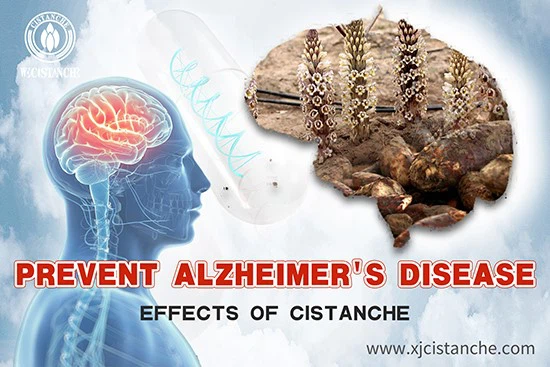
Dragon Herbs Cistanche prevents Alzheimer's disease
The value of Cistanche tubulosa in treating elderly dementia has been fully demonstrated, from the pathogenesis explanation of traditional Chinese medicine's "marrow reduction and brain elimination" to the scientific verification of modern medical multi-target intervention. At the level of traditional Chinese medicine, its effects of tonifying the kidneys and nourishing essence, filling the marrow and strengthening the brain accurately match the pathological characteristics of "deficiency at the root and excess at the target" in elderly dementia, providing theoretical guidance for treatment; At the modern medical level, its various active ingredients intervene in the complex pathological process of AD through multiple pathways such as antioxidant, anti-inflammatory, neuron protection, immune regulation, and improvement of gut microbiota, solving the limitations of single target therapy in Western medicine. Moreover, it has a wide range of sources, high safety, and few adverse reactions, making it suitable for long-term regulation of the elderly population and demonstrating broad application prospects.
At present, although there have been many advances in the treatment of elderly dementia with Cistanche tubulosa, there are still some shortcomings, such as the unclear mechanism of action of the core active ingredients of Cistanche tubulosa, and further optimization of the dosage and compatibility scheme for clinical application. In the future, with the continuous deepening of research, it is necessary to combine various methods such as network pharmacology, molecular biology, and clinical experiments to further explore the active ingredients of Cistanche tubulosa, clarify its targets and molecular mechanisms, optimize the formulation process, promote the standardized application of Cistanche tubulosa in the prevention and treatment of Alzheimer's disease in the elderly, let this "desert ginseng" truly play its value, help more middle-aged and elderly people avoid cognitive decline, and protect brain health.