Insight Into SARS-CoV-2 Omicron Variant Immune Escape Possibility And Variant Independent Potential Therapeutic Opportunities Part 1
May 30, 2023
ABSTRACT
The Omicron, the latest variant of severe acute respiratory syndrome coronavirus 2 (SARS-CoV2), was first detected in November 2021 in Botswana, South Africa. Compared to other variants of SARS-CoV-2, the Omicron is the most highly mutated, with 50 mutations throughout the genome, most of which are in the spike (S) protein. These mutations may help the Omicron to evade host immunity against the vaccine. Epidemiological studies suggest that Omicron is highly infectious and spreads rapidly, but causes significantly less severe disease than the wild-type strain and the other variants of SARS-CoV-2. With the increased transmissibility and a higher rate of reinfection, Omicron has now become a dominant variant worldwide and is predicted to be able to evade vaccine-induced immunity. Several clinical studies using plasma samples from individuals receiving two doses of US Food and Drugs Administration (FDA)-approved COVID-19 vaccines have shown reduced humoral immune response against Omicron infection, but T cell-mediated immunity was well preserved.
Severe acute respiratory syndrome (SARS) is an acute respiratory disease caused by the SARS coronavirus. The SARS virus will attack the human immune system, leading to a decline in the body's immunity, thereby increasing the risk of viral infection, leading to disease progression and serious consequences.
Studies have shown that the SARS virus directly attacks immune cells and triggers an inflammatory response, thereby reducing the body's immunity. After the immunity is weakened, it is difficult for the body to effectively resist the virus, which leads to the progression of the disease and serious consequences. In addition, patients infected with the SARS virus may also have decreased immunity due to long-term antiviral drug treatment.
Therefore, maintaining strong immunity is the key to preventing SARS virus infection. This can be achieved through a healthy lifestyle with good nutrition, adequate sleep, moderate exercise, regular check-ups, etc. During the virus epidemic, more attention should be paid to personal hygiene, washing hands frequently, wearing masks, and other preventive measures to avoid virus infection. So we should understand that we need to improve our immunity. Cistanche can significantly improve immunity. The polysaccharides in the meat can regulate the immune response of the human immune system, improve the stress ability of immune cells, and enhance the immunity of immune cells. Bactericidal effect.
Click health benefits of cistanche
T cell-mediated immunity protects against severe disease, and thus the disease caused by Omicron remains mild. In this review, I surveyed the current status of Omicron variant mutations and mechanisms of immune response in the context of immune escape from COVID-19 vaccines. I also discuss the potential implications of therapeutic opportunities that are independent of SARS-CoV-2 variants, including Omicron. A better understanding of vaccine-induced immune responses and variant-independent therapeutic interventions that include potent antiviral, antioxidant, and anti-cytokine activities may pave the way to reducing Omicron-related COVID-19 complications, severity, and mortality. Collectively, these insights point to potential research gaps and will aid in the development of new-generation COVID-19 vaccines and antiviral drugs to combat Omicron, its sublineages, or upcoming new variants of SARS-CoV-2.
1. Introduction
A deadly ongoing coronavirus disease 2019 (COVID-19) pandemic caused by severe acute respiratory syndrome coronavirus-2 (SARS-CoV-2) presented a devastating global health crisis [1,2]. As of November 2022, COVID-19 has caused more than 640 million infections and 6 million deaths worldwide [3]. Despite an estimated 69% of the world’s population receiving the COVID-19 vaccine (at least one dose), the disease is still being transmitted and the pandemic is far from over [4]. The SARS-CoV-2 virus has mutated over time, evolving into different variants and evading antibodies to infect more people. The fifth and latest variant of SARS-CoV-2, Omicron (B.1.1.529.1 or BA.1) was first identified on November 24, 2021, by the World Health Organization (WHO) from samples collected in Botswana and South Africa on 11 and November 14, 2021 [5]. Before the emergence of this variant, we also experienced Alpha, Beta, Gamma, and Delta variants of SARS-CoV-2, which were sometimes associated with new waves of infections throughout the world [6].
At present, Omicron is the leading and only disseminated variant. It is highly divergent among the five variants of SARS-CoV-2, with a large number of mutations, mostly in the spike (S) protein. Computational and sequencing investigations initially divided the Omicron variant (B.1.1.529.1 or BA.1) into three sublineages, namely BA.1.1 (B.1.1.529.1), BA.2 (B.1.1.529.2), and BA. 3 (B.1.1.529.3) [7]. In the evolutionary lineage of the Omicron variant, the BA.1.1 sublineage evolved first, followed by the BA.2, and BA.3 [8]. BA.1.1 is the first dominant sublineage of Omicron and is believed to be responsible for the Omicron wave [9].
A recent study in South Africa uncovered two more sublineages, designated BA.4 (B.1.1.529.4) and BA.5 (B.1.1.529.5) that are associated with increased risk of re-infection in vaccinated individuals [10]. Moreover, BA.2.12.1 and BA.2.13 are additional developing sublineages. These evolved sublineages are spreading faster than other circulating strains, particularly BA.2, which could lead to another wave of COVID-19 cases due to immune evasion [5].
The S-protein of SARS-CoV-2, including Omicron, is a critical determinant of entry, transmissibility, and interaction points between the virus and the human immune system. Therefore, the S-protein is a prime antigen candidate for vaccine design. S-protein contains S1 and S2 subunits and furin protease cleavage sites [11,12]. The Omicron’s S-proteins include the full-length trimer, with three receptor-binding S1 heads perched on top of a trimeric membrane fusion S2 stalk [13]. The S1 subunit contains an N-terminal domain (NTD) which is connected with a receptor binding domain (RBD) that specifically binds with angiotensin-converting enzyme 2 (ACE2). On the RBD, there is also a specific part that connects to ACE2 which is called the receptor-binding motif (RBM).
On the S2 subunit, there is a specific part, the fusion protein (FP) whose function is to fuse and drill the host cell membrane to facilitate viral particles entering the cells. The S2 cannot perform its function until the S1 is separated. During viral infection, host target cell protease, TMPRSS2 cleaves the S1 and S2, and even within S2 as well [14]. Then, the S1 is dissociated and S2 is opened up and undergoes a dramatic structural change, such that it elongates, sort of twists and turns around and then it fuses with the cell membrane through the fusion protein which is necessary for the virus to enter into the target cells [14].
In the current variant, Omicron (BA.1) harbors more than 32 mutations in their S-protein, the highest number compared to other variants of SARS-CoV-2 [15,16]. Some of the mutations in the Omicron S-protein may be associated with the possibility of escaping the immune response. Concerns about escaping immunity from the vaccine have changed our understanding of the ongoing COVID-19 pandemic ending. The world was misled by the idea that global vaccination alone was sufficient to control the ongoing pandemic. Indeed, the variants of SARS-CoV-2 highlight the importance of variant-independent potential therapeutics with vaccination as well as public health preventive measures in controlling the ongoing pandemic. In this review, I discuss the current status of Omicron variant mutations and mechanisms of immune responses in the context of immune escape from vaccines. I also discuss the potential interventions that are independent of the variants of SARS-CoV-2.

2. Omicron variant mutations and their effects
The genetic sequence of SARS-CoV-2 contains about 29,881 base pairs (bps) encoding 9860 amino acids [17]. Although the virus has a proofreader that keeps it under control, the SARS-CoV-2 virus has mutated over time since the pandemic emerged. There are approximately 22,000 amino acid mutations and more than 13,000 insertions/deletions across the SARS-CoV-2 genome since the onset of the COVID-19 pandemic, which increases viral infectivity, worsens the disease, and reduces therapy or vaccine efficacy [18–20]. Most mutations were in open reading frame 1 ab (ORF1ab) (73%), followed by S-protein (13%) and nucleocapsid (4%) [19,21].
The Omicron variant harbors up to 50 mutations in its genome from its progenitor, the Wuhan type, and more than 32 in the S-protein, including three deletions and one insertion [15,16,22]. Interestingly, scientists have uncovered multiple impacts of the mutations in the Omicron variant or other variants of SARS-CoV-2. In particular, the mutations in the Omicron variant and its sublineages can cause a variety of significant changes in the virus’s properties, such as evasion of vaccine-induced immunity [23–26], increasing the binding capacity of S-protein to ACE receptor [24,27–30], effective proteolytic priming of S1and S2 with TMPRSS2, which significantly improves cell surface entry [27], and increase cellular invasion via the endocytic pathway [31]. However, despite all the consequences associated with the mutation, it is noteworthy that the disease severity caused by the Omicron variant is not significantly increased and the diseases remain mild or moderate [32].
Table 1 depicts S-protein mutations, their distribution, and their effects on the Omicron variant (BA.1) and other variants. There are 32 distinct mutations in the Omicron variant (B.1.1.529.1) S-protein. Of these, twenty-three mutations, including G339D, S371L, S373P, S375F, N440K, G446, S477 N, E484A, Q493R, G496S, Q498R, Y505H, A67V, Δ 143–145, Δ 211, Ins214EPE, T547K, N679K, N764K, D796Y, N856, Q954H, N969K, and L981F, were unique to the variant which had not been documented in any previous variants. The other nine mutations, namely K417 N, T478K, N501Y, Δ 69–70, T95I, G142D, D614G, H655Y, and P681H were found to overlap with previous variants of SARS-CoV-2, including Alpha, Beta, Gamma, and Delta [33].
In the distribution of mutations in S-protein, half of them were in the RBD, such as G339D, S371L, S373P, S375F, N440K, G446, S477 N, T478K, E484A, Q493R, G493S, Y4958, Y4958, Y518, Y508, Y518 which are associated with increased transmissibility of the Omicron variant [34]. Specifically, the S477 N, Q498R, and N501Y mutations were found to be associated with increased binding of the Omicron S-protein to the ACE2 receptor, which may increase transmissibility and infectivity. In earlier variants such as Alpha, Beta, and Gamma, the presence of the critical mutation, N501Y, is associated with an increased binding capacity of the S-protein to the ACE2 receptor [35–37]. In addition, the presence of T478K and E484A mutations in the Omicron variant has been found to increase neutralizing antibody resistance and is associated with immune escape [7,37]. Similarly, the presence of such mutations along with H69/V70 deletion in earlier variants of SARS-CoV-2 has been associated with enhanced immune evasion [35].

The Omicron variant has five mutations in the S1/S2 cleavage site, namely T547K, D614G, H655Y, N679K, and P681H (Table 1). Of these, the last three mutations occur in the furin cleavage site (S1/S2), which may enhance the fusion of virus and host cell membranes, thereby increasing transmissibility and infectivity. Delta spike has a P681R mutation at the furin cleavage site that has been shown to increase the cleavage of full-length S to S1 and S2 by human protease, TMPRSS2, thereby increasing transmissibility (Fig. 2A) [18,38, 39]. However, Omicron appears to be more transmissible than Delta and has the P681H mutation in its furin cleavage site. Note that in Delta, proline was replaced by arginine, while proline was replaced by histidine in Omicron (Fig. 2).
It is worth noting that the charge on arginine and histidine is the same. So, from a charge point of view, the furin cleavage site of Delta and Omicron, both are positively charged, meaning that the electromagnetic force and shape may not change much. This suggests that the Delta and Omicron furin cleavage sites may have a similar function, meaning that the behavior of TMPRSS2 may not be affected. However, two additional mutations in the Omicron S-protein near the furin cleavage site, namely H655Y + N679K, have been shown to accelerate S1/S2 cleavage by the protease and enhance the fusion of virus and host cell membranes, thereby increasing Omicron’s ability to infect and replicate [40,41]. The Omicron S2 site contains six distinct mutations, including N764K, D796Y, N856K, Q954H, N969K, and L981F, which may be associated with viral entry and transmissibility into host cells (Table 1).
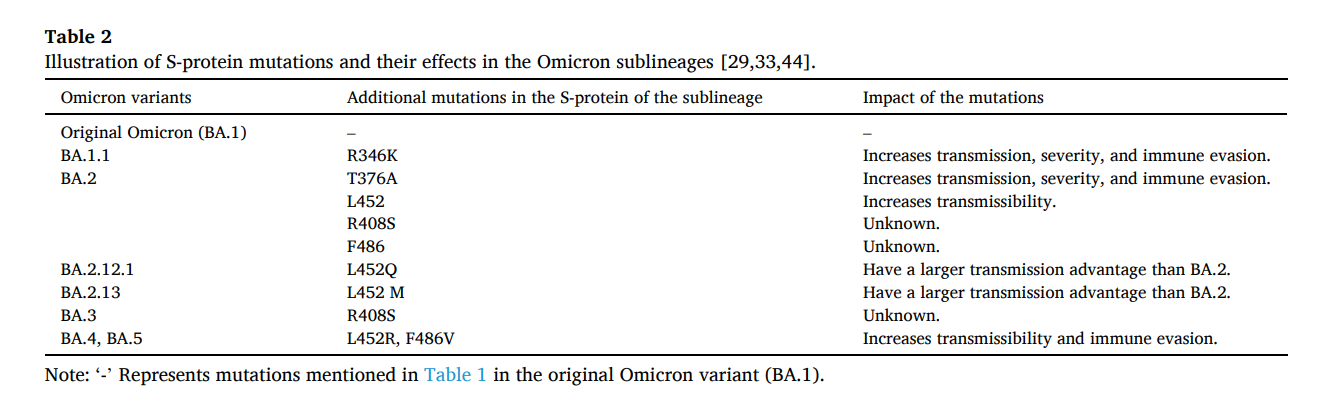
Table 2 depicts S-protein mutations and their effects in the Omicron sublineages. Over the past few months, the Omicron variant has appeared in multiple sublineages that differ from each other in the number of mutations and their level of infectivity [42,43]. BA.1.1 is the first sublineage with a specific mutation, such as R346K in the S-protein that causes immune evasion [29]. BA.2 has new mutations, including T376A, L452, F486, and R408S that also confer immune evasion [32]. BA.2.12.1, and BA.2.13 has L452Q, and L452 M specific mutations, respectively, and all have a more considerable transmission advantage over BA.2 [33]. Both BA.4 and BA.5 have the L452R + F486V mutations [44].
The S-protein mutation at the L452R position is considered to be responsible for increased transmissibility. The Delta variant also had this mutation. The F486V mutation occurs in the S2 of the S-protein region near the attachment site in human cells. It is important to note that this mutation helps the virus dodge our immune system against vaccines. Therefore, these new sublineages of Omicron may be more infectious and able to evade human immunity. Scientists hypothesized that these new sublineages of Omicron have more capacity to infect fully immunized people than the previous variants [33,44,45].
3. Epidemiology and severity of Omicron infection
There is strong epidemiological evidence that Omicron is highly infectious and spreads quickly, but causes milder disease than preceding variants of SARS-CoV-2 [55]. In particular, a South African study estimated that Omicron was 36.5% more transmissible than Delta [56]. Furthermore, studies from South Africa, the United Kingdom, and Denmark suggest that Omicron has a three to four-fold higher risk of infection than Delta and a reproduction number (R0) of 7 or greater, compared with 5 for Delta and 2.8 for the wild SARS-CoV-2 [57,58,59].
Despite having a high rate of COVID-19 cases during Omicron waves, the hospitalization rate was found to be lower (5%) than that of Delta waves (13.7%) [60]. Several preclinical studies have shown that Omicron has lower S-protein cleavage efficiency than its progenitor and Delta [31,61], leading to impaired syncytia formation, which may reduce the pathogenicity [22,62]. Efficient cleavage of the S-protein is important for SARS-CoV-2 virus entry into human cells which is mediated by TMPRSS2, and TMPRSS2-expressing cells are more abundant in the lungs than in the nose, throat, and airways [22]. It is important to note that SARS-CoV-2 has two different routes of entry to host cells; One is mediated by TMPRSS2 (TMPRSS2-dependent mechanism) and the second is mediated by cathepsin L cleavage at the S2 site (TMPRSS2-independent mechanism). TMPRSS2 facilitates viral entry to the plasma membrane since it is present in the cell membrane, whereas cathepsin L is in endosomes, which facilitates the endosomal entry route [63,64]. Previous variants play a potent role in transmission through a TMPRSS2 that induces strong syncytia formation in the lungs and exacerbates the damage from infection [65].
However, interestingly, the Omicron variant prefers the endosomal entry route (TMPRSS2-independent mechanism) to efficiently enter host cells over the plasma membrane entry route [31]. This observation was confirmed in vitro that Omicron replicates 10-fold less efficiently in the human lungs than Delta, resulting in less damage and less severe symptoms [31]. Omicron replicates rapidly in the upper respiratory tract, thus increasing the amount of virus released from the respiratory tract during inhalation [31,66], this may account for the higher transmissibility of Omicron but produces less severe disease than earlier variants [61].
Moreover, alteration in the electrostatic potential of the Omicron RBD and S1/S2 cleavage site was found to be associated with the binding capabilities of S-protein with the ACE2 receptor. A distinct trend of increasing positive electrostatic potential has been observed from the wild virus strain to Delta and the more recent Omicron variant [67]. Recently, it has been demonstrated that the significant increase in positive electrostatic potential at the RBD interface with ACE2 is the main reason for the increased affinity of ACE2 to the RBD in Omicron variants [67,68].

Since ACE2 has a negative electrostatic surface potential patch, it is reasonable to hypothesize that increasing the positive charge on the RBD of the S-protein would increase the viral contact affinity of the S-protein with the ACE2 receptor. Pawlowski et al. stated that the virus uses electrogenic modifications to change the electrostatic force between the RBD and ACE2, and the Coulomb attraction was found to be greater in Omicron than in the wild SARS-CoV-2 virus [68,69]. Therefore, it can be collectively stated that a high number of mutations in the Omicron variant results in a significant change in the electrostatic potential of the Omicron S-protein, which may be a plausible reason for its highly transmissible nature.
For more information:1950477648nn@gmail.com