Isolation And Identification Of Phenylethanol Glycosides From Cistanche Deserticola
Mar 13, 2022
Contact: Audrey Hu Whatsapp/hp: 0086 13880143964 Email: audrey.hu@wecistanche.com
Intro
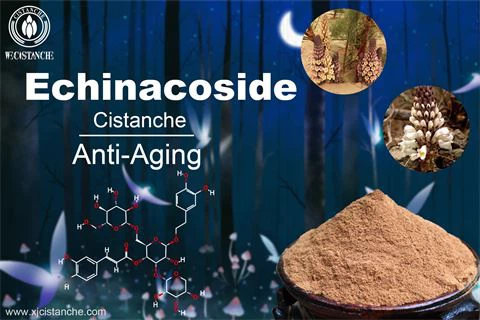
Cistanche deserticola collected in the Chinese pharmacopeia is the dry fleshy stem of Cistanche deserticola, Orobanchaceae plant, which is a commonly used medicine for tonifying the kidney in traditional Chinese medicine. There are many varieties of Cistanche deserticola, and there are many research reports on Cistanche salsa and Cistanche tubulosa in the literature, but there are few studies on the varieties collected in the Pharmacopoeia. Luo Shangfeng and others have obtained mannitol, 8-epigastric acid, and amino acid from Cistanche deserticola. To further develop and study Cistanche, Department of Pharmacy, Xinjiang Medical College extracted and separated its water-soluble components – phenyl ethanol glycosides. The results showed that four components were separated and identified, they are echinacoside, castanoside A, acteoside, and 2‘-Acetylacteoside. The above components have pharmacological effects such as promoting kidney functions and anti-aging.
Experimental part
The experimental medicinal materials were purchased from Urumqi medicinal materials company and produced in Jinghe county. The varieties were identified by Li Jiazheng, associate researcher of Xinjiang Institute of ethnic medicine. The model of macroporous resin was AB-B, which is a chemical product of Nankai University. The silica gel used in the column layer was a product of the Qingdao marine chemical plant, Stephan-dex LH-20 was the product of the Shanghai Changzheng pharmaceutical factory. The model of the UV spectrophotometer was Shimadzu UV-360. The infrared spectrophotometer was Shimadzu IR-440. The models of H-NMR and C-NMR instruments were Bruker MSL-300 (300 megacycles)

1. Extraction and separation
Extracted Cistanche deserticola 10kg three times by the ethanol reflux, combine the extract and concentrate it to paste under reduced pressure, add a small amount of water for suspension, degrease it with ethyl acetate, extract it with n-butanol, combine the extract, concentrated it to dry under reduced pressure, add a small amount of water for dissolution, successively collect and concentrate the methanol part through macroporous resin column and polyamide column (wash with water first and then methanol). The total phenyl ethanol glycosides are obtained by the silica gel column layer. With CHCl3-MeOH (10:3 to 10:5) gradient elution, a total of 78 streams (about 300ml per stream) were collected, of which 16-23 were crude compounds IV (2.1g), 28-42 were crude compounds III (5.4g), 48-61 were crude compounds II (3.2g), 65-78 were crude compounds I (5.1g). The above components were purified by silica gel column chromatography (elution conditions were the same as above) and then purified by the dextran gel column LH-20. Elute with CH3OH: H20 (l:1) and collect the methanol part to obtain monomer compounds IV (1.3g), III (3.5g), II (1.8g), and I (3.5g)
2. Identification
Compound I: light yellow amorphous powder, FeCl3 reaction and α- Naphthol test positive, silica gel thin-layer chromatography Rf value of 0.3 (CHCl3:MeOH:H2O=6:4:1 expansion, 20%H2SO4 spray detection), UV λ (MeOH/nm):244, 292, 333. IR γ (KBr/MAX): cm-1: 3360, 1690, 1625, 1598, 1518. H-NMR (Methanol-d1) δ: 1.08 (3H, D, J=6Hz, CH3), 2.79 (2H, t, J=7Hz, Ar-CH2-CH2-), 4.29, 4.39 (1H, D, J=8Hz, two glucose terminal protons), 5.18 (1H, D, J=1Hz, rhamnosyl terminal protons), 6.28 (1H, J=16Hz, Ar-CH=CH-), 6.5-7.1 (6H, aryl H), 7.59 (1H, D, J=16Hz, Ar-CH=CH-) C-NMR data are shown in Table 1. The above chemical reaction and spectral data are consistent with the report of echinacoside in the literature. Therefore, Compound I is identified as echinacoside.

Compound II: light yellow amorphous powder, FeCl3 reaction, and α- Naphthol test was positive, and silica gel thin-layer chromatography Rf 0.35 (development and detection conditions were the same as above). Its UV and IR spectra were very similar to those of echinacoside, but H-NMR appeared δ 3.84 (3H, s) signal, C-NMR appears δ 56.5 signal, indicating that the structure contains 1 methoxy. UV λ (MeOH/nm):246, 290, 333. IR γ (KBr/MAX)cm-1: 3350, 1655, 1620, 1596, 1508. H-NMR(methanol-d1) δ: 1.08 (3H, d, J=6Hz, methyl group in rhamnose), 2.86 (2H, t, J = 7Hz, Ar-CH2-CH2-), 3.84 (3H, s, OCH3), 4.28, 4.39 (1H, d, J=8Hz, two glucose end group protons), 5.18 (1H, s, end group protons of rhamnose), 6.27 (1H, d, J=16Hz, Ar-CH=CH-), 6.65-7.1 (6H, aryl H), 7.60 (1H, d, J=16Hz, Ar-CH=CH-). See Table1 for C-NMR data, the above spectral data are consistent with the literature value of castanoside A. Therefore, compound II was identified as castanoside ACompound III: light yellow amorphous powder, silica gel thin-layer chromatography Rf value is 0.40 (development and detection conditions are the same as above). Its UV and IR spectra are also similar to those of echinacoside. There is one less glucose terminal proton in H-NMR and one less glucose signal in C-NMR, suggesting that it is a disaccharide. UV λ (MeOH/nm):247, 292, 334. IR γ (KBr/MAX):3350, 1690, 1625, 1600, 1515. H-NMR(methanol-d1) δ: 1.10 (3H, d, J= 6Hz, rhamnose methyl), 2.79 (2H, t, J=7Hz, Ar-CH2-CH2-), 4.38 (1H, d, J=8Hz, glucose terminal proton), 5.19 (1H, d, J=1Hz, rhamnose terminal proton), 6.28 (1H, d, J=16Hz, Ar-CH=CH-), 6.5-7.1 (6H, aryl H), 7.59 (1H, d, J=16Hz, Ar-CH=CH-). The C-NMR data are shown in Table 1. The above spectral data are consistent with the literature values of acteoside, so compound LII is determined to be acteoside.

Compound IV: light yellow amorphous powder. Silica gel thin layer chromatography Rf value is 0.42 (development and detection conditions are the same as above). Its spectral data are very similar to acteoside. There is one more absorption peak of 1735cm-1 in the infrared spectrum, and H-NMR showed signals from the acetyl matrix of δ1.98(3H.S), and C-NMR showed signals from carbon and methyl groups of δ171.5 and 20.9. According to the law of glucosylation displacement, acetylation is located on the 2 'sugar hydroxyl group. λ (MeOH/nm):247, 292, 333. IR γ (KBr/MAX):3430, 1725, 1700, 1630, 1605. 1525. H-NMR(methanol-d1) δ: 1.08 (3H, d, J= 6Hz, rhamnose methyl), 1.98 (3H, s. OAc), 2.70 (2H, t, J=7Hz, Ar-CH2-CH2-), 4.50 (1H, d=8Hz, glucose terminal proton), 5.19 (1H, d, rhamnose terminal proton), 6.28 (1H, d, J=16Hz, Ar-CH=CH-), 6.5-7.1 (6H, aryl H), 7.60 (1H, d, J=16Hz, Ar-CH=CH-). The C-NMR data are shown in Table 1. The above spectral data is consistent with the literature value of 2 '- Acetylacteoside, so compound IV is confirmed to be 2' - Acetylacteoside.