Kidney Deficiency And Constipation Hide This Connection
Aug 27, 2025
Strange 'Combination': Kidney Deficiency and Constipation
Effects of cistanche on constipation
Have you ever had the experience of feeling sore and weak in your waist and knees recently, panting after climbing a few flights of stairs, getting up more frequently at night, and feeling lackluster? You went to see a traditional Chinese medicine doctor, and the doctor said you had some kidney deficiency; However, at the same time, you are also troubled by constipation, with dry and hard stools. You only go to the bathroom once every few days, and it is very difficult to defecate every time. At this point, you may have some doubts in your heart: how could kidney deficiency and constipation, two seemingly unrelated problems, appear in you at the same time? Is there any inherent connection between them? Don't worry, let's delve deeper together next.
Traditional Chinese Medicine Perspective: The Inner Connection between Kidney Deficiency and Constipation
(1) The relationship between the kidney and bowel movements

Effects of cistanche-improve kidney function
In traditional Chinese medicine theory, the function of the kidney is very powerful, and the theory of "the kidney governs the two yin in the front and back" reveals the close relationship between the kidney and the excretion of urine and feces. The Yellow Emperor's Inner Canon once mentioned that "the kidneys open their orifices in the two Yin organs". The anterior Yin is responsible for urination and reproduction, while the posterior Yin is responsible for excreting feces. The essence and qi of the kidneys act as "manipulators" behind the scenes, controlling the normal functioning of the two Yin organs. When the kidney essence is sufficient and the kidney qi is strong, it is like injecting vitality into the two yin organs. They open and close in an orderly manner, and the excretion of urine and feces is smooth. If kidney deficiency occurs, the essence and qi of the kidneys are insufficient, and the two yin organs seem to lose their command, causing dysfunction in opening and closing functions, which may lead to problems such as frequent urination, enuresis, nocturnal emissions, and abnormal bowel movements. This is like a team, where the leader (kidney) has strong abilities and team members (yin) can perform their duties efficiently; Once the leader's ability is insufficient, the team is prone to chaos. From the perspective of the Five Elements theory, the kidneys belong to water, and water plays a crucial role in the metabolic process of the human body. The normal excretion of feces relies on sufficient body fluids to moisten the intestines. The kidneys are responsible for regulating the metabolism and distribution of body fluids. When kidney function is normal, body fluids can be transported to the intestines, ensuring the moistening of stool and facilitating its smooth excretion. Once kidney deficiency occurs, the metabolism of body fluids becomes abnormal, and the intestines do not receive sufficient nourishment from body fluids, which can easily cause constipation.
(2) Kidney Yin Deficiency and Constipation
Kidney yin deficiency is a common type of kidney deficiency, mainly referring to insufficient kidney yin fluid. You can imagine kidney yin as the "lubricant" and "coolant" inside the human body, which nourishes and calms the organs and tissues throughout the body. When the kidney yin is deficient, the "lubricant" and "coolant" decrease, and the intestines become like a dry river, lacking the nourishment of body fluids. The stool naturally becomes dry and difficult to excrete. For example, the fountain pen we usually use, if the ink dries, it will be difficult to write smooth handwriting; The same goes for the intestines, a deficiency of body fluids can lead to constipation. Constipation caused by kidney yin deficiency is often accompanied by other symptoms in addition to typical symptoms such as dry stools resembling sheep feces and difficulty in defecation. For example, patients may feel soreness and weakness in their waist and knees, similar to the soreness and weakness in their muscles after prolonged exercise; Dizziness and tinnitus, sometimes accompanied by insomnia and frequent dreams, making it difficult to fall asleep at night. Even if one falls asleep, they are easily disturbed by various dreams; In addition, there may also be symptoms of dry mouth and throat, as well as five heart restlessness (i.e. fever in both hands and feet, and inner restlessness), especially in the afternoon or at night, where this feeling of restlessness may be more pronounced.

Effects of cistanche on constipation
(3) Kidney Yang Deficiency and Constipation
Kidney yang deficiency means that the yang energy in the kidneys is insufficient. Yang energy in the human body is like the sun, playing a warming and pushing role. When the kidney yang is deficient, it is like the natural world losing the warmth and radiance of the sun, and the peristalsis function of the intestines will also weaken accordingly. The peristalsis of the intestine is like a conveyor belt. If the power is insufficient, the transmission speed of food residues in the intestine will slow down, stay for too long, absorb water excessively, and the stool will become dry, leading to constipation. This type of constipation, caused by kidney yang deficiency, is called yang deficiency constipation. Patients with kidney yang deficiency and constipation usually have other symptoms in addition to constipation. For example, they are particularly afraid of the cold, even in warm seasons, they wear more clothes than ordinary people, and their hands and feet are always cold, just like taking them out of ice water; Cold pain in the waist and knees, this kind of pain is a feeling of cold pain, which will be slightly relieved when exposed to heat, and aggravated when exposed to cold; Some people may also experience frequent nocturia, frequently getting up at night to use the bathroom, which seriously affects their sleep quality; Men may experience sexual dysfunction, while women may experience menstrual irregularities. These symptoms combined are external manifestations of kidney yang deficiency.
Cistanche deserticola: a miraculous herb for nourishing the kidneys and moistening the intestines
(1) Get to know Cistanche deserticola

Chinese herb cistanche
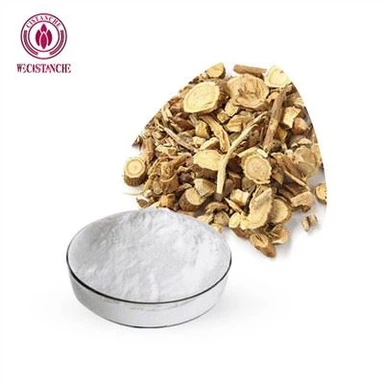
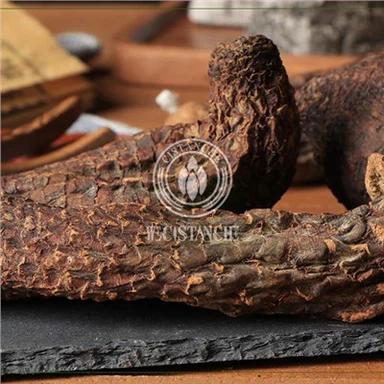
Cistanche deserticola, this magical herb, has a unique growth environment and appearance characteristics. It mainly parasitizes on the roots of the desert plant Salix matsudana, and is commonly found in the deserts and Gobi regions of northwest China, where the climate is extremely dry, the sunshine is strong, the annual precipitation is less than 250mm, the temperature changes dramatically, the wind is strong, the sand is abundant, the soil is poorly developed, mostly medium fine sand, neutral or slightly alkaline, with high salt content and lack of organic matter. But in such a harsh environment, Cistanche grows tenaciously, absorbing nutrients from the red willow and completing its unique life journey. From the appearance, Cistanche deserticola is a perennial parasitic herbaceous plant with a height of 40-160cm. The stem is fleshy and thick, with a single or basal part consisting of 2 or 3 branches. The lower part is wide and thick, and the upper part gradually becomes thinner. Its leaves are mostly scaly, arranged in a spiral pattern, pale yellow white, and have no petioles. The lower leaves are arranged tightly, forming a wide oval or triangular oval shape, while the upper leaves are relatively sparse, forming a linear lanceolate shape. In May and June, Cistanche deserticola will produce spike-shaped inflorescences with yellow, white, or light purple flowers that turn brown when dried. The corolla is cylindrical and bell-shaped, which is very unique. Cistanche deserticola occupies a pivotal position in traditional Chinese medicine and has a long history of use. It is known as the "desert ginseng" and has been regarded as a precious tribute to the imperial court by various countries in the Western Regions throughout history. As early as in the "Shennong Bencao Jing", there is a record of Cistanche deserticola, which is listed as a top grade. The book mentions: "Cistanche deserticola has a sweet taste and a slight warmth. It is known for its five functions and seven injuries, tonifying the middle, removing cold, heat, and pain from the stem, nourishing the five organs, strengthening yin, nourishing essence and qi, having more children, and treating women's ailments. Long-term consumption can lighten the body." After this, medical practitioners throughout history have further elaborated and applied the medicinal value of Cistanche deserticola, and it has gradually become a commonly used medicinal herb in kidney tonifying and intestinal moistening.
(2) The Secret of Tonifying the Kidney with Cistanche deserticola
Cistanche deserticola has significant effects in warming and tonifying kidney yang, as well as nourishing essence and blood. Traditional Chinese Medicine believes that it is sweet, warm, and helps with yang, while salty can enter the kidneys and directly act on them, replenishing yang energy and enhancing kidney function. For people with insufficient kidney yang and deficiency of essence and blood, Cistanche deserticola is a rare good medicine. When the kidney yang in the human body is insufficient, just like the lack of warmth from the sun in nature, a series of discomfort symptoms may occur, such as soreness, weakness, coldness, and pain in the waist and knees. This is because the kidney yang is deficient and cannot warm the waist and knees, just like a house without strong support, becoming unstable; Sexual dysfunction can lead to erectile dysfunction and premature ejaculation in men, and uterine cold infertility in women. This is caused by insufficient kidney yang, which affects reproductive function, just like poor soil that makes it difficult for seeds to sprout and grow. There is also the fear of cold limbs, because the lack of yang energy cannot warm the body, just like in winter without heating, the whole body feels cold. And Cistanche deserticola can warm and nourish kidney yang, inject "yang qi" into the body, and improve these symptoms. The principle of action of Cistanche deserticola in tonifying the kidneys is closely related to its various effective ingredients from the perspective of modern medicine. Cistanche deserticola is rich in phenylethanolic glycosides, polysaccharides, and other components. Phenylethanoid glycosides have the function of regulating the endocrine system, which can regulate the function of the hypothalamic pituitary adrenal axis, promote the secretion of related hormones, and thus improve the body's stress response and immunity. Polysaccharides can enhance the body's immune function, improve resistance, promote cell proliferation and repair, help improve bodily functions, and replenish essence and qi lost due to kidney deficiency. This is like equipping each organ and system of the body with powerful "bodyguards" to protect them from external invasion, while stimulating their vitality and restoring their health.
(3) The mechanism of Cistanche deserticola in moistening the intestines and promoting bowel movements

Effects of cistanche on constipation
Click here to view Cistanche deserticola constipation-relieving products
【Ask for more】 Email:cindy.xue@wecistanche.com / WhatsApp: 0086 18599088692 / Wechat: 18599088692
Cistanche deserticola also has a unique mechanism of action in moisturizing the intestines and promoting bowel movements. Firstly, it contains rich ingredients such as oligosaccharides, mannitol, and betaine, which can increase intestinal osmotic pressure. It is like putting many "small sponges" in the intestine to attract more water into the intestine, increase the water content in the intestine, and make the stool moist. At the same time, it can also inhibit the excessive absorption of water by the large intestine, preventing stool from becoming dry and clumped due to excessive absorption of water. Secondly, the active ingredients in Cistanche deserticola can stimulate intestinal peristalsis, just like installing a "small motor" in the intestine, making intestinal peristalsis more powerful and promoting the transmission of food residues in the intestine, thereby shortening defecation time and allowing feces to be smoothly excreted from the body. For different types of constipation, Cistanche deserticola has a targeted effect on Yang deficiency constipation. Patients with yang deficiency and constipation have slow intestinal peristalsis due to insufficient yang energy in their bodies, like a car without enough power, making it very difficult to drive. Cistanche deserticola not only warms and nourishes kidney yang, providing power for intestinal peristalsis, but also moistens the intestines and promotes bowel movements, solving the problem of constipation. It can be said to be a win-win situation. For example, some elderly people often suffer from constipation due to physical decline and insufficient yang energy. Taking Cistanche deserticola can often provide effective relief. However, it should be noted that although Cistanche deserticola has a good regulating effect on constipation, for other types of constipation, such as heat constipation and yin deficiency constipation, it is necessary to differentiate and treat according to specific symptoms. Cistanche deserticola should not be blindly used. When using Cistanche deserticola, one should also follow the doctor's advice and use medication reasonably to ensure safety and effectiveness.
Application Cases and Usage Suggestions
(1) Real medical case display
In clinical practice of traditional Chinese medicine, cases of Cistanche deserticola treating kidney deficiency and constipation are not uncommon. There was once a 60-year-old male patient who was plagued by soreness in the waist and knees, chills, and suffering from constipation for a long time. He often only had one bowel movement a week, and his stool was dry and clumped like sheep manure. According to traditional Chinese medicine diagnosis, he belongs to the typical constipation of the kidney yang deficiency type. During treatment, doctors mainly use Cistanche deserticola as the main medicine, combined with other herbs that nourish the kidneys, promote yang, moisten the intestines, and promote bowel movements. After a period of adjustment, the patient's constipation gradually improved, their bowel movements became regular, and the symptoms of soreness and weakness in the waist and knees, as well as fear of cold, were significantly reduced. The overall mental state of the person was refreshed. There is also a 45-year-old woman who, due to high work pressure and irregular lifestyle, has experienced symptoms of kidney yin deficiency such as menstrual irregularities, dizziness, tinnitus, insomnia, and frequent dreaming, accompanied by constipation. The doctor added Cistanche deserticola to her prescription to nourish yin and the kidneys, moisten the intestines, and promote bowel movements. With the advancement of treatment, not only has constipation been resolved, but menstruation has also gradually returned to normal, sleep quality has improved, and symptoms such as dizziness and tinnitus have also been alleviated. These real cases fully demonstrate the significant effect of Cistanche deserticola in improving kidney deficiency and constipation.
(2) Usage of Cistanche deserticola
There are various ways to use Cistanche deserticola, making it convenient for people to choose according to their own needs and preferences. Soaking in water is the simplest method. Take 3-5 grams of Cistanche deserticola, slice it thinly, and place it in a cup. Brew it in freshly boiled water for 10-15 minutes before drinking. It can be brewed repeatedly until the water taste becomes lighter. It should be noted that when soaking Cistanche deserticola in water, the water temperature should not be too high to avoid damaging its active ingredients. In addition, the dosage should not be too much each time, as excessive use may cause discomfort to the body. Soup making is also a common way of use. For example, to make chicken soup with Cistanche deserticola, prepare 200 grams of chicken, 15 grams of Cistanche deserticola, 10 grams of goji berries, and 3 slices of ginger. First, wash and cut the chicken into pieces, blanch it in water and set it aside; Wash and slice the Cistanche deserticola. Put all the ingredients into a clay pot, add an appropriate amount of water, bring to a boil over high heat, then simmer over low heat for 1.5-2 hours. Finally, add an appropriate amount of salt to season. This soup has the effects of tonifying kidney yang, nourishing essence and blood, and moistening the intestines and promoting bowel movements. When making soup, pay attention to the amount of Cistanche deserticola used to avoid the soup having a strong flavor. Tonic Diet is also a good choice. For example, Congee with cistanche and mutton, including 15g cistanche, 100gmuttont n, and 100g japonica rice. Wash the Cistanche deserticola, wash and slice the lamb, chop the scallions and ginger into pieces, and set aside for later use. Put Cistanche deserticola into a clay pot, add an appropriate amount of water, boil for 30 minutes, remove the residue, and leave the juice. Add glutinous rice, salt, scallions, and ginger, boil over high heat, then simmer over low heat for 35 minutes until the glutinous rice is fully cookeIt canCan be eaten for breakfast and dinner, can warm kidney yang, replenish essence and blood, and has a certain improvement effect on cold pain in the waist and knees, weak muscles and bones, and constipation. When making the Tonic Diet, it is necessary to ensure the freshness and hygiene of the ingredients, and adjust the collocation and dosage of the ingredients according to individual physique.
(3) Usage taboos and precautions
Although Cistanche deserticola has significant efficacy, it is not suitable for everyone to use. People with yin deficiency and excessive fire should not use Cistanche deserticola. Because people with yin deficiency and excessive fire already have insufficient yin fluid and excessive deficiency fire in their bodies, while Cistanche deserticola has a warm nature and has the effect of warming and tonifying kidney yang. After taking it, it may further aggravate the deficiency fire in the body, leading to symptoms such as dry mouth and tongue, sore throat, gum bleeding, insomnia, etc. Just like adding firewood to an already raging flame, the fire will become even more intense. People with loose stools should not take Cistanche deserticola. Cistanche deserticola has the effect of moistening the intestines and promoting bowel movements. For those with loose stools, taking it may worsen the symptoms of diarrhea and lead to further weakness of the body. This is like a leaking bucket; adding water to it will make the water leak faster. In addition, before using Cistanche deserticola, it is necessary to consult a doctor or a professional Chinese medicine practitioner. Everyone's constitution and condition are different, and doctors can determine whether it is suitable to use Cistanche deserticola based on specific circumstances, as well as determine the appropriate dosage and method of use. Do not blindly self-medicate to avoid adverse effects on the body.