An Instant-Ready Astragalus Compound Chewable Tablet (With Cistanche) And Its Preparation Method
Sep 28, 2026
A functional snack concept designed as a healthier, non-addictive alternative to areca-nut-style chewables
(54) Title of the Invention
An Instant-Ready Astragalus (Huangqi) Compound Chewable Tablet and Its Preparation Method
(57) Abstract
This invention belongs to the technical field of functional foods and snack food processing and specifically discloses an instant-ready Astragalus compound chewable tablet and its preparation method.
The chewable tablet is composed of:
an Astragalus slice (Huangqi slice), and
a thick paste filled into a groove in the Astragalus slice, plus
Goji berries (Lycium barbarum) embedded on the paste surface.
The Astragalus slice is prepared from Astragalus in 40–70 parts by weight. The thick paste is prepared from Codonopsis (Dangshen) 15–25 parts, Cistanche (Rou Cong Rong) 10–20 parts, and corn silk 5–10 parts. The Astragalus slice is a softened, sufficiently thick sheet-like body with a central groove formed after softening. Goji berries are used in 5–12 parts by weight.
The preparation method includes Astragalus slicing, Astragalus slice softening to form a groove, extraction and concentration of the other ingredients to form a thick paste, filling and shaping, low-temperature drying, film coating, sterilization, and packaging.
The product is ready-to-eat upon opening, has a soft and pleasant chewing texture, offers layered flavors, and provides a long shelf life. Without containing addictive components, it offers consumers a healthy and convenient new option in the snack category.
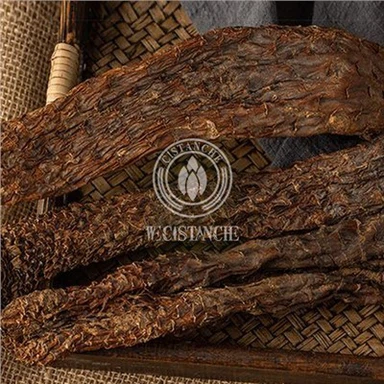
Cistanche (Rou Cong Rong)

1. Technical Field
[0001] This invention belongs to the technical field of functional foods and snack food processing, and specifically relates to an instant-ready Astragalus compound chewable tablet and its preparation method.
2. Background: Why a "herbal chewable snack" is needed
[0002] At present, the market still lacks instant-ready chewable products made from "medicine food homology" botanical ingredients such as Astragalus and Codonopsis. Consumers who want to use such ingredients in daily life typically need to boil or brew them, which is inconvenient and does not meet modern "open-and-eat" needs. In contrast, chewable snack products represented by areca nut have already formed a massive market.
[0003] Areca nut is the mature fruit of an evergreen palm tree. After processing, it becomes a popular chewable snack. According to incomplete statistics, in 2019 the annual output value of edible areca nut enterprises in Hunan exceeded RMB 30 billion, driving a related industrial output value of over RMB 50 billion. However, long-term consumption of areca-nut-style products exposes multiple difficult-to-overcome issues:
[0004] (1) Addictiveness risk: Areca nut contains 0.3%–0.6% alkaloids, mainly arecoline. Arecoline stimulates the central nervous system, producing feelings of pleasure and excitement, while increasing tolerance and dependence-its mechanism is considered similar to nicotine. This can lead to continuous consumption and reduced consumer autonomy.
[0005] (2) Oral health risks: Areca nut fiber is coarse and hard; repeated chewing friction can physically damage oral soft tissues. The World Health Organization has classified areca nut as a Group 1 carcinogen. Epidemiological studies show strong associations between long-term areca nut chewing and oral submucous fibrosis, leukoplakia, and other oral lesions. Approximately one-third of head and neck malignancies globally may be attributable to the use of areca nut and related products. In addition, processed areca products often add alkaline substances such as calcium hydroxide (lime) to brine, further increasing mucosal irritation.
[0006] (3) Poor chewing experience: Even after processing, areca nut fiber retains high hardness and toughness. Chewing is laborious, and long-term use can cause chewing muscle fatigue and excessive tooth wear. Brines often contain lime plus multiple sweeteners and flavors; although they may improve taste, the overall experience remains dominated by coarse, tough fiber-less friendly for older adults or people with weaker chewing ability.
[0007] (4) Short shelf life: To maintain softness, areca products usually have relatively high moisture content; coupled with hygroscopic ingredients (e.g., sugar alcohols) in brine, they are prone to "brine return" (a re-wetting sensation), moisture absorption, and mold at room temperature. Shelf life is often only 2–6 months, harming circulation efficiency and storage convenience.
[0008] (5) Poor compatibility for multi-herb blending: Existing areca products are mostly based on a single raw material. Even with sweeteners and flavors, taste is still dominated by areca itself, lacking a product form that enables synergistic blending among multiple edible medicinal plants for complementary flavor and texture.
[0009] Therefore, the industry urgently needs a new chewable herbal snack that retains the open-and-eat convenience of areca products, while achieving a soft texture, no addictive components, and long shelf life.
Cistanche (Rou Cong Rong)

3. Summary of the Invention
[0010]–[0012] (A) Purpose
The invention aims to fill the market gap by providing an instant-ready chewable product based on edible medicinal plants such as Astragalus. By borrowing the "open-and-eat" format, it avoids the inherent defects of areca products (addictiveness, oral injury, tough texture, short shelf life). It provides a chewable tablet that is soft, flavor-layered, stable, safe, and non-addictive.
[0012]–[0018] (B) Technical Solution (product structure)
The instant-ready Astragalus compound chewable tablet consists of:
an Astragalus slice, and
a thick paste filled into a groove of the Astragalus slice, and
goji berries.
Formulation in parts by weight:
Astragalus slice: Astragalus 40–70
Thick paste: Codonopsis 15–25, Cistanche 10–20, corn silk 5–10
Goji berries: 5–12
The Astragalus slice is a softened slice-like body of certain thickness with a central groove remaining after softening.
4. How the formula is designed for flavor layering (from entry-level to deeper understanding)
[0019] In this formula:
Astragalus (40–70 parts) is the main material. After softening, it forms the structural "carrier" of the chewable tablet and provides a rich, full-bodied base taste.
Codonopsis (15–25 parts) acts as an auxiliary base-note ingredient; its water-soluble components pair with Astragalus to enrich the base flavor.
Goji berry (5–12 parts) and Cistanche (10–20 parts) are "harmonizing" ingredients that contribute a naturally sweet, moist mouthfeel, improving softness and roundness of taste.
Corn silk (5–10 parts) serves as a balancing note with a refreshing profile, helping prevent the overall taste from becoming overly sweet or heavy.
When combined within these ratios, the five-plant blend forms a complete flavor sequence:
"rich and full-bodied → naturally sweet and moist → refreshing finish."
This layered release during chewing improves the overall experience beyond what a single ingredient can offer.
[0020] The document further explains that:
When Astragalus : Codonopsis is approximately 2:1 to 3:1, the base taste becomes well-coordinated (Astragalus provides the main body; Codonopsis provides sweetness and lingering aftertaste), and the total amount of water-soluble polysaccharides is notably higher than when using a single ingredient.
When goji berry : Cistanche is approximately 1:1 to 1:2, the combined dissolution of goji polysaccharides and phenylethanoid glycosides (noted as water-soluble) can enhance sweetness and reduce the need for added sweeteners.
Keeping corn silk at 5–10 parts helps balance possible sweetness and heaviness, creating a complete flavor hierarchy.
5. Preferred ratios (for product optimization)
[0021] Preferably:
Astragalus (slice): 40–50 parts
Thick paste: Codonopsis 15–20, Cistanche 12–18, corn silk 8–10
Goji berries: 8–10 parts
[0022] Within the preferred range, the document states that sensory evaluation total score improves by about 5–8% compared with edge values of the broader range.
[0023] More preferably:
Astragalus: 60 parts
Thick paste: Codonopsis 20, goji berry 10, Cistanche 15, corn silk 5
[0024] Under this "more preferred" ratio, sensory evaluation is reported to reach 90/100, with optimal coordination among natural sweetness, richness, and refreshing aftertaste.
6. Ingredient notes (composition overview)
[0025]–[0030] The document describes key component categories:
Astragalus root contains polysaccharides, saponins, flavonoids, amino acids, etc.
Codonopsis root contains polysaccharides, saponins, alkaloids, trace elements, etc.
Goji berry contains goji polysaccharides, carotenoids, vitamins, amino acids, etc.
Cistanche contains cistanche glycosides, phenylethanoid glycosides, polysaccharides, etc.
Corn silk contains flavonoids, polysaccharides, sterols, etc.
Cistanche Tea (Rou Cong Rong)


Click to visit the cistanche shopping mall
7. Optional food-grade excipients (for texture, processing, and stability)
[0031] The thick paste may further include food-acceptable excipients.
[0032] Such excipients may include one or more of: sweeteners, flavor correctors, fillers, lubricants, binders.
[0033] Technical effects described:
Sweeteners adjust sweetness and palatability.
Fillers raise solids and viscosity for easier filling and shaping.
Lubricants reduce sticking during pressing/shaping for a smooth surface.
Binders improve adhesion between the paste and the Astragalus slice to prevent delamination or falling off during drying/storage.
[0034] Specific options include:
Sweeteners: xylitol, sorbitol, mannitol, erythritol, isomalt, steviol glycosides, mogrosides (luo han guo).
Flavor correctors: honey, fruit powders, ginger, mint, cinnamon, chrysanthemum, osmanthus.
Fillers: microcrystalline cellulose, starch, dextrin.
Lubricants: magnesium stearate, talc.
[0035] The document notes that certain polyols (notably isomalt and erythritol) have very low hygroscopicity, helping prevent "brine return"-like phenomena and extending shelf life; steviol glycosides and mogrosides are high-intensity sweeteners with low calories.
8. Key product specs: moisture and hardness (why it stays soft but stable)
[0036] The chewable tablet preferably has:
Moisture content: 7%–10%
Hardness: 2000–4000 gf
[0037] Effects described:
At 7%–10% moisture, the chewable texture remains soft and moderate while reducing microbial growth risk (water activity lowered below 0.6) and avoiding cracking due to excessive dryness.
Compared with areca products (moisture often 12%–18% and prone to brine return/mold, shelf life 2–6 months), this product uses lower moisture and suitable hardness to extend shelf life to 18 months or more at room temperature.
At 2000–4000 gf, chewing does not cause physical abrasion damage to oral soft tissues, addressing a major pain point of areca products.
9. Claims (as translated, kept complete)
Claim 1
An instant-ready Astragalus compound chewable tablet, characterized in that it is composed of an Astragalus slice, a thick paste filled into a groove of the Astragalus slice, and goji berries;
Astragalus slice: Astragalus 40–70 parts by weight;
Thick paste: Codonopsis 15–25 parts, Cistanche 10–20 parts, corn silk 5–10 parts by weight;
The Astragalus slice is a softened sheet-like body with a central groove and a certain thickness;
Goji berries: 5–12 parts by weight.
Claim 2
The chewable tablet of Claim 1, characterized in that:
Astragalus slice: Astragalus 40–50 parts;
Thick paste: Codonopsis 15–20 parts, Cistanche 12–18 parts, corn silk 8–10 parts;
Goji berries: 8–10 parts.
Claim 3
The chewable tablet of Claim 1 or 2, characterized in that the thick paste further includes food-acceptable excipients.
Claim 4
The chewable tablet of Claim 3, characterized in that the excipients include one or more selected from sweeteners, flavor correctors, fillers, lubricants, and binders.
Claim 5
The chewable tablet of Claim 4, characterized in that:
Sweeteners are selected from at least one of xylitol, sorbitol, mannitol, erythritol, isomalt, steviol glycosides, and mogrosides;
Flavor correctors are selected from at least one of honey, fruit powder, ginger, mint, cinnamon, chrysanthemum, and osmanthus;
Fillers are selected from at least one of microcrystalline cellulose, starch, and dextrin;
Lubricants are selected from at least one of magnesium stearate and talc.
Claim 6
The chewable tablet of Claim 1, 2, 4, or 5, characterized in that the moisture content is 7%–10% and the hardness is 2000–4000 gf.
Claim 7 (Preparation method)
A preparation method for the chewable tablet of Claims 1–6, comprising:
(1) Astragalus slicing: slice Astragalus into individual pieces of certain thickness;
(2) Astragalus slice softening: soften the Astragalus slices and select those with a central groove;
(3) Pretreatment of other materials: slice Codonopsis and Cistanche; use dried whole goji berries; crush corn silk;
(4) Extraction and concentration: mix Codonopsis, Cistanche, and corn silk; add water and decoct for extraction; filter residues; concentrate filtrate into thick paste;
(5) Filling and shaping: fill the thick paste into the groove; place whole goji berries onto the paste surface while it is still viscous so that berries embed into the paste;
(6) Drying: low-temperature drying;
(7) Film coating, sterilization, and packaging.
Claim 8
The method of Claim 7, characterized in that:
Softening in step (2) is either high-pressure steaming at 115–145°C for 15–20 minutes, or enzymatic treatment with 0.05%–0.1% cellulase (based on total raw material weight) at 45–65°C for 1–2 hours;
Extraction and concentration in step (4): add 5–12× water (by weight of total raw materials), decoct at 90–100°C for 1–2 extractions, 1–3 hours each; combine filtrates and concentrate under reduced pressure to form thick paste.
Claim 9
The method of Claim 7, characterized in that step (4) further includes adding at least one flavor-correcting material selected from honey, fruit powder, ginger, mint, cinnamon, chrysanthemum, and osmanthus, mixed with Codonopsis, Cistanche, goji berry, and corn silk for extraction and concentration.
Claim 10
The method of Claim 7, characterized in that packaging in step (7) is either:
nitrogen-flushed aluminum-plastic composite pouch packaging, or
vacuum packaging using nano-antibacterial high-barrier film, or
aluminum-plastic blister packaging.

10. Detailed Description of the Method (manufacturing-friendly, scalable)
10.1 Why softening is essential
[0049] Astragalus slices are naturally dense and tough. High-pressure steaming partially hydrolyzes cellulose/hemicellulose and softens lignin; enzymatic cellulase treatment selectively breaks down cellulose to loosen fiber structure. Both approaches reduce hardness from about 8000–10000 gf to 2000–4000 gf, producing a soft chew that reduces oral friction injury.
10.2 Why water extraction + reduced-pressure concentration
[0050] Water is a food-friendly solvent and matches the solubility characteristics of key components (polysaccharides, flavonoids, glycosides). Extraction at 90–100°C improves diffusion while avoiding localized overheating; 5–12× water ensures a concentration gradient; 1–2 extractions balance yield and efficiency. Reduced-pressure concentration helps protect flavor and heat-sensitive components while forming a paste that is viscous enough for filling and later solidification during drying.
10.3 Flavor variants without synthetic flavors
[0051]–[0052] Honey can contribute mild sweetness and aroma and may aid extraction of flavor compounds. Ginger/mint/cinnamon/chrysanthemum/osmanthus offer distinct profiles (warming spice, cooling freshness, floral notes, etc.), enabling product-line expansion (e.g., ginger flavor, mint flavor, osmanthus flavor) consistent with "natural/clean label" trends.
10.4 Packaging logic for 18+ months stability
[0053]–[0054]
Nitrogen-flushed aluminum-plastic composite pouches reduce oxygen (residual oxygen ≤ 2%), helping suppress aerobic microbes and oxidation, and preventing moisture gain/loss.
Nano-antibacterial high-barrier vacuum packaging removes air and adds antimicrobial barrier effects.
Blister packs isolate each piece to avoid cross-contamination and protect against crushing.
The document cites typical barrier targets (oxygen transmission rate and moisture vapor transmission rate) and explains that combined with 7%–10% moisture, these approaches help maintain quality over an 18-month shelf life.
11. Examples (key parameters preserved)
Example 1 (near lower bound of ratio range)
Formula:
Astragalus slice: Astragalus 40 g
Thick paste: Codonopsis 15 g, Cistanche 10 g, corn silk 5 g
Goji berries: 5 g

Process highlights:
Slice Astragalus: thickness 2–4 mm; width 5–8 mm
High-pressure steaming: 121°C, 0.1 MPa, 15 min; cool; groove forms naturally
Extraction: 8× water; 95°C ± 2°C; 2 h; stir every 30 min
Filter: 200 mesh stainless screen
Second extraction: 6× water; 1.5 h
Concentration endpoint: viscous, pourable paste; slow flow at 45° tilt; sticky to touch; no water ring on filter paper test
Fill groove; control total weight per piece ~1.0 g; embed whole goji on paste surface
Dry: 50°C ± 2°C for 4–6 h; flip hourly; moisture to 8.5%
Film coating (e.g., HPMC), sterilize by 5 kGy Co-60 irradiation, nitrogen-flushed aluminum-plastic pouch; residual oxygen ≤ 2%; 1 piece per bag
Reported product performance:
Moisture 8.5% (GB5009.3)
Hardness 3500 gf (TPA texture analysis)
Total flavonoids 2.10 mg/g (as rutin)
Total polysaccharides 42.5 mg/g (as glucose)
Accelerated stability (40°C/75%RH) 6 months: hardness 3800 gf, moisture 8.9%, flavonoids retention 91%, polysaccharides retention 89%, no cracking/mold/odor; good adhesion; microbial counts within limits
Example 2 (mid-range / preferred)
Astragalus 50 g; thick paste: Codonopsis 18 g, Cistanche 15 g, corn silk 8 g; goji 8 g
Softening by cellulase: 0.08% cellulase, 3× water, pH 4.5–5.0, 50°C ± 1°C, 1.5 h; enzyme inactivation at 90°C for 10 min
Extraction with 10× water then 8×; drying to 8.2% moisture
Packaging: nano-antibacterial high-barrier vacuum packaging
Reported: moisture 8.2%, hardness 3000 gf, flavonoids 2.45 mg/g, polysaccharides 48.7 mg/g; 6-month accelerated stability: flavonoids retention 93%, polysaccharides retention 91%
Example 3 (optimal ratio)
Astragalus 60 g; thick paste: Codonopsis 20 g, Cistanche 15 g, corn silk 5 g; goji 10 g
High-pressure steaming: 121°C, 0.1 MPa, 18 min
Dry to 8.0% moisture
Packaging: aluminum-plastic blister
Reported: moisture 8.0%, hardness 2500 gf, flavonoids 2.68 mg/g, polysaccharides 52.3 mg/g; 6-month accelerated stability: flavonoids retention 94%, polysaccharides retention 92%
Example 4 (near upper bound)
Astragalus 70 g; thick paste: Codonopsis 25 g, Cistanche 20 g, corn silk 10 g; goji 12 g
Steaming 20 min; longer extraction times; dry to 9.0% moisture
Reported: moisture 9.0%, hardness 3200 gf, flavonoids 2.20 mg/g, polysaccharides 44.5 mg/g
Example 5 (ginger flavor variant)
Based on Example 3, add ginger 5 g into extraction; reported richer layered flavor; stability remains good.
Dichen kangka tablets-cistanche, Astragalus, and Ginseng
12. Comparative Examples (what goes wrong if key controls are changed)
Comparative Example 1 (high-temperature drying)
Same formula as Example 3, but dry at 70°C ± 2°C to moisture ≤ 5%
Reported: moisture 4.5%, hardness 6500 gf (brittle/crispy), flavonoids 1.85 mg/g (lower than Example 3), cracking by 3 months and severe breakage by 6 months.
Comparative Example 2 (ordinary packaging, no nitrogen, no irradiation)
Same formula as Example 3, but use ordinary PE bag sealing; no nitrogen flush; no irradiation sterilization
Reported: oxidation discoloration by 3 months; flavonoids and polysaccharides retention drop significantly; rancid odor; microbial count reaches 850 CFU/g at 6 months and exceeds limits.
13. Sensory Evaluation and Stability Verification (as described)
Sensory test
[0168]–[0181] A blind sensory evaluation with 30 trained panelists scored color (20), texture (30), flavor (30), overall acceptance (20). The invention's Examples 1–4 reportedly scored above 80/100, with Example 3 highest at 90/100, outperforming comparative samples. (Specific numeric tables for each sample are not shown in the excerpt.)
Stability test
[0182]–[0194] Accelerated stability at 40°C/75%RH with sampling at 0, 1, 2, 3, 6 months tested moisture, hardness, flavonoids retention, polysaccharides retention, and microbial counts. Examples 1–4 remained stable and within microbial limits; comparative samples failed due to cracking or oxidation/microbial growth. (Detailed table data not shown in the excerpt.)
14. Why this is especially relevant for Cistanche brands and OEM/ODM buyers
This invention uses Cistanche (Rou Cong Rong) as a core paste ingredient (10–20 parts) in a novel "carrier slice + groove filling paste + embedded goji" structure. For a Cistanche factory or brand, it offers a practical blueprint to build:
a non-addictive chewable snack concept (alternative to areca-style chewing),
a soft texture validated by targeted moisture/hardness control,
a long shelf life via barrier packaging and controlled water activity,
an extensible flavor line (ginger, mint, osmanthus, fruit, honey, etc.) without relying on synthetic flavors.
15. Customization options for your Cistanche factory independent site (what we can tailor)
If you want to commercialize or publish this as a brand story + technical capability showcase, you can tailor:
Formula window: stay within the claim ranges, or develop a "preferred ratio" SKU (like Example 3).
Taste system: ginger warming, mint refreshing, osmanthus floral, fruit-forward, honey mellow.
Processing route: high-pressure steaming vs enzymatic softening (different texture and cost profiles).
Packaging solution: nitrogen-flushed pouch vs high-barrier vacuum vs blister (channel-dependent).
Quality targets: moisture 7%–10%, hardness 2000–4000 gf, plus marker specs (flavonoids/polysaccharides) depending on your market.
If you tell me your target market (China domestic / US / EU / MENA), your preferred packaging format, and whether you want the article to read more consumer-friendly or B2B technical, I can refine this English blog into:
a conversion-focused landing page version (800–1200 words), and
a long technical blog/whitepaper version (3000–5000 words),
including compliant "supports…" wording for supplement/food markets.