Male Menopause, Low Energy, Irritability? What Is TCM—and Can Two Classic Herbal Formulas Really Help?
Sep 15, 2026
*A practical, evidence-informed look at how Traditional Chinese Medicine addresses male menopause syndrome (and why 91.7% of patients in one 36-person study improved).*
## You're Not Imaging It
It starts quietly. You used to sleep through the night; now you're awake at 2 a.m. Your temper snaps at small things. Your joints ache. You feel tired even after rest. You've gained a spare tire, your libido has dipped, and your doctor shrugs and says, "It's just aging."
In Western medicine, this constellation of symptoms in men aged 40–60 often goes by names like *late-onset hypogonadism* or *andropause*-and treatments are limited. Testosterone replacement helps some, but it carries real risks and doesn't always touch the mood, sleep, and joint symptoms.
For over two thousand years, Chinese physicians have treated exactly this picture. The system is called **Traditional Chinese Medicine (TCM)**, and two documented herbal formulas have been published in peer-reviewed Chinese medical journals with clinical success rates above 90%.
This guide walks you through:
- **What TCM actually is** (and what it is not)
- How TCM understands "male menopause"
- **Two classical formulas** with their ingredients, dosing, and published outcomes
- Why one of them is built around **cistanche (Rou Cong Rong)**-the herb we grow, process, and supply
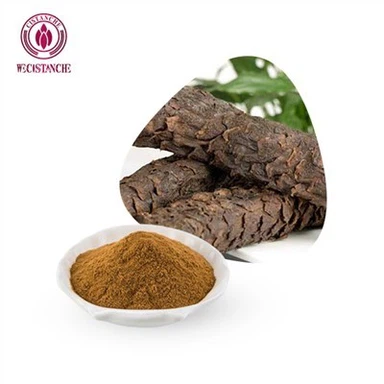
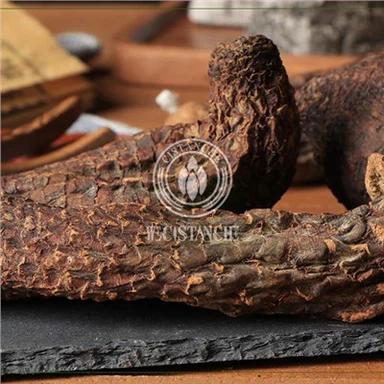
TCM herb Cistanche supplements for prostate problem

## Part 1: What Is TCM, Anyway?
If you've only ever seen TCM as acupuncture needles or mystery powders in a Chinese restaurant, a quick orientation helps.
**Traditional Chinese Medicine is a complete medical system**-not folk remedies. It includes herbal formulas, acupuncture, dietary therapy, tuina (medical massage), qigong, and lifestyle guidance. It evolved over more than two millennia and is practiced today in hospitals across China, Japan, Korea, and increasingly in clinics in the U.S., Europe, and Australia.
Rather than naming a disease, TCM asks: *What pattern of imbalance is showing up in this person?*
Three ideas sit at the core:
1. **Yin and Yang.** Yin is the cooling, moistening, nurturing, structural side of the body. Yang is the warming, activating, moving, protective side. In midlife, both tend to decline. When Yin declines, you get heat signs (hot flashes, night sweats, insomnia, irritability). When Yang declines, you get cold signs (low energy, cold limbs, poor libido, weak knees). Male menopause is, more often than not, **both at once**-a pattern TCM calls *Yin-Yang imbalance*.
2. **The Kidney system.** In TCM, "Kidney" (capitalized to distinguish it from the physical organ) governs growth, aging, reproduction, bone health, and fluid metabolism. It is the root of our Yin and Yang. TCM theory holds that Kidney essence naturally peaks around age 32 and declines gradually after 40-roughly matching the window in which male menopause symptoms appear.
3. **Formula over single herbs.** TCM rarely prescribes one herb alone. A formula combines a chief herb that addresses the root, assistants that guide it, and harmonizers that reduce side effects. The two formulas below follow this logic precisely.
> **A quick reality check:** TCM is complementary, not a replacement for your doctor. If you have chest pain, severe depression, suicidal thoughts, or a new lump, seek conventional medical care first. The formulas below are presented for educational purposes and reflect published Chinese clinical literature; they are not FDA-approved statements.
---
## Part 2: How TCM Labels Male Menopause
In TCM language, the condition is *Nan Xing Geng Nian Qi Zong He Zheng* (男性更年期综合征). The classic presentation combines:
- **Heat signs:** hot flashes, night sweats, a red tip of the tongue, irritability
- **Deficiency signs:** fatigue, low back and knee weakness, poor sleep
- **Leakage signs:** nocturnal emissions, premature ejaculation, loose stools, forgetfulness
- **Phlegm-water signs:** brain fog, mild dizziness, mild edema, a sticky tongue coating
Because symptoms are mixed, a single extreme approach-"just take testosterone" or "just take a cooling herb"-rarely works. The two formulas below are deliberately **balanced**: they clear heat while nurturing Yin, and warm Yang while securing essence. That's what the published results show.
---
## Part 3: Formula One - **Yinqi Guilu Wan** (Yin-Nourishing, Yang-Warming Pill)
**Source:** Fan Shufang, *Sichuan Journal of Traditional Chinese Medicine*, 1987, Issue 10.
This is a concentrated, pill-based formula designed for long-term, convenient use.
### Composition (per batch)
| Herb | Chinese | Amount | TCM Role |
|---|---|---|---|
| Herba Epimedii | Yin Yang Huo (淫羊藿) | 30 g | Warms Kidney Yang, supports libido |
| Fructus Lycii | Gou Qi Zi (枸杞子) | 30 g | Nourishes Kidney/Liver Yin |
| Plastrum Testudinis | Gui Ban (龟板) | 30 g | Nourishes Yin, anchors Yang |
| Colla Cornus Cervi | Lu Jiao Jiao (鹿角胶) | 30 g | Tonifies Yang, secures essence |
| Morinda Officinalis | Ba Ji Tian (巴戟天) | 15 g | Warms Yang, strengthens knees |
| Salt-processed Anemarrhena | Zhi Mu (盐知母) | 15 g | Clears deficient heat |
| Salt-processed Phellodendron | Huang Bai (盐黄柏) | 15 g | Clears deficient heat from lower burner |
| Spine Date Seed | Suan Zao Ren (酸枣仁) | 25 g | Calms the spirit, aids sleep |
| Oyster Shell | Mu Li (牡蛎) | 25 g | Anchors Yang, stops sweating |
| Cornus Fruit | Shan Zhu Yu (山茱萸) | 25 g | Secures essence, nourishes Liver/Kidney |
| Astragali Compl. / Flatstem Milkvetch Seed | Sha Yuan Zi (沙苑子) | 25 g | Tonifies Kidney, improves vision |
| Codonopsis | Dang Shen (党参) | 20 g | Tonifies Qi |
| Eucommia | Du Zhong (杜仲) | 20 g | Strengthens lower back and knees |
| Chinese Yam | Huai Shan Yao (淮山药) | 20 g | Strengthens Spleen, secures essence |
| Psoralea | Bu Gu Zhi (补骨脂) | 20 g | Warms Kidney, secures essence |
| Gordon Euryale Seed | Qian Shi (芡实) | 50 g | Secures essence, stops leakage |
### Preparation & Dosing
Grind all herbs to a fine powder, then honey-bind into pills. Take **12 g three times daily** with warm water.
### Functions (as stated in the original paper)
- Drain fire and nourish Yin
- Anchor Yang and secure leakage
- Regulate the Conception and Penetrating Vessels
### Indications
Male menopause syndrome marked by **hot flashes, night sweats, irritability, insomnia, weak lower back and knees, spontaneous seminal emission, and fatigue**.
### Published outcome
**35 patients treated; all reported satisfactory results.** (The original report did not break down cure/improvement rates, but stated uniformly positive outcomes.)
---
## Part 4: Formula Two - **Gengnian Tang** (Menopause Decoction)
**Source:** Cao Yaozhong, *Hebei Journal of Traditional Chinese Medicine*, 1990, Issue 2.
This is a daily decoction formula with a clearer published efficacy rate-and it is built around **Cistanche (Rou Cong Rong)**, the herb we specialize in.

### Base Composition (daily dose)
| Herb | Chinese | Amount | Notes |
|---|---|---|---|
| Colla Cornus Cervi | Lu Jiao Jiao (鹿角胶) | 10 g | *Melted separately* (烊化) |
| Placenta Hominis | Zi He Che (紫河车) | 10 g | *Mixed into strained decoction* (冲服) |
| **Cistanche** | **Rou Cong Rong (肉苁蓉)** | **15 g** | **Our signature herb-see below** |
| Morinda Officinalis | Ba Ji Tian (巴戟天) | 20 g | |
| Codonopsis | Dang Shen (党参) | 15 g | |
| Poria Fu Ling | Fu Ling (茯苓) | 15 g | |
| Fructus Lycii | Gou Qi Zi (枸杞子) | 15 g | |
| Plantago Seed | Che Qian Zi (车前子) | 15 g | *Wrap in cheesecloth* (包煎) |
| Artemisia / Herba Artemisiae Scopariae | Yin Chen (茵陈) | 15 g | |
| Mulberry Fruit | Sang Shen (桑椹子) | 15 g | |
| Honey-fried Licorice | Zhi Gan Cao (炙甘草) | 15 g | |
| Pinellia (processed) | Qing Ban Xia (清半夏) | 10 g | |
| Herba Epimedii | Yin Yang Huo (淫羊藿) | 25 g | |
| Rehmannia Raw | Sheng Di Huang (生地黄) | 30 g | Nourishes Yin, clears heat |
| Rehmannia Prepared | Shu Di Huang (熟地黄) | 30 g | Nourishes Blood and Kidney |
### Preparation & Dosing
One bag per day, decocted in water. Divide into three doses and drink warm.
### Functions
- Tonify Kidney and calm the Liver
- Promote water metabolism and transform phlegm
### Indications
Male menopause with **mixed Yin-Yang deficiency and deficiency-excess complexity**-fatigue, low mood, mild dizziness, brain fog, and sleep disturbance occurring together.
### Pattern-based modifications (from the original paper)
- **If hallucinations, paranoia, or severe suspicion are prominent:** add raw Dragon Bone (Long Gu) and raw Oyster Shell (Mu Li), 18 g each; fresh Bamboo Sap (Zhu Li) 3 g, taken mixed in; Tortoise Shell Gel (Gui Ban Jiao) 15 g, melted.
- **If erectile dysfunction, premature ejaculation, or nocturnal emissions dominate:** increase Deer Antler Gel and Placenta, and add Fish Maw (Yu Biao) 10 g and Mantis Egg-case (Sang Piao Xiao) 15 g.
### Published outcome
**36 patients treated over a 3-month course:**
- Recovered: **24**
- Markedly improved: **9**
- No improvement: **3**
- **Total effective rate: 91.7%**
---

## Part 5: Why Cistanche Belongs in This Story
If you're reading this on our site, you already know we are a cistanche (Rou Cong Rong) manufacturer. Here's the honest TCM rationale:
Cistanche (typically *Cistanche deserticola* or *Cistanche tubulosa*) is one of the most respected Kidney-Yang tonics in the Chinese materia medica. It is unusual among warming herbs because it is **gentle and moistening rather than harshly drying**-a classical description calls it "a calm, benefiting substance" that tonifies Yang without scorching Yin. That balancing quality is exactly what male menopause needs: you cannot simply blast a 50-year-old body with hot, dry tonics, because the Yin side is already depleted.
Modern phytochemistry has identified phenylethanoid glycosides (notably echinacoside and verbascoside), iridoid glycosides, and polysaccharides in cistanche-compounds widely studied in aging, fatigue, and reproductive-health research. We supply cistanche slices, powder, extracts, and custom formulations with batch-tested active markers; if you are a brand or clinic building a male midlife-support product, this is a formula framework worth reviewing with your formulator.
---
## Part 6: A Few Honest Caveats
1. **These are clinical formulas, not casual supplements.** The doses above reflect a 1980s–1990s Chinese clinical setting, where a trained TCM physician adjusted herbs per patient. Western readers should not self-prescribe. Consult a licensed TCM practitioner (L.Ac. in the U.S., BAcC in the UK, ECGC in Europe) or your physician first.
2. **Interactions matter.** If you take anticoagulants, immunosuppressants, blood-pressure medication, testosterone, antidepressants, or are pregnant or nursing, get individualized advice.
3. **Quality is the variable.** Many of these herbs-Deer Antler Gel, Tortoise Shell Gel, Placenta-must come from ethical, traceable sources. This is precisely why supply-chain transparency matters.
4. **TCM is a process, not a pill.** The Gengnian Tang study ran for **three months**. Expecting results in three days misunderstands how tonic herbs work.
---
## The Bottom Line
So, back to the question: **What is TCM?**
It is a 2,000-year-old system that sees midlife symptoms in men not as a single hormone number to be chased, but as a *pattern*-cooling Yin and warming Yang, anchoring spirit and securing essence-expressed through individualized herbal formulas. The clinical literature, though modest by modern RCT standards, consistently points in the same direction: when the right balanced formula is matched to the right pattern, roughly **9 out of 10 men** improve on the symptoms that testosterone alone often leaves untouched.
We grow, process, and supply cistanche for brands, clinics, and formulators who want to build products that actually work within this tradition. If that's you, we'd love to talk.
---
*This article is for educational purposes and does not constitute medical advice. Always consult a qualified healthcare provider before starting any herbal regimen, especially if you are taking medications or have a diagnosed condition.*
*Keywords: what is TCM, what is traditional Chinese medicine, male menopause, andropause, late-onset hypogonadism, cistanche, Rou Cong Rong, Yinqi Guilu Wan, Gengnian Tang, Chinese herbs for midlife men.*