Malnutrition Patterns in Children With Chronic Kidney Disease Part 1
Oct 23, 2023
Why we will be tired? How can we solve the fatigue problems?
【Contact】Email: george.deng@wecistanche.com / WhatsApp:008613632399501/Wechat:13632399501
Abstract: Malnutrition is frequent in children with chronic kidney disease (CKD). Apart from undernutrition and protein energy wasting (PEW), overnutrition prevalence is rising, resulting in fat mass accumulation. Sedentary behavior and an unbalanced diet are the most important causal factors. Both underweight and obesity are linked to adverse outcomes regarding renal function, cardiometabolic risk, and mortality rate. Muscle wasting is the cornerstone finding of PEW, preceding fat loss, and may lead to fatigue, musculoskeletal decline, and frailty. In addition, clinical data emphasize the growing occurrence of muscle mass and strength deficits in patients with fat mass accumulation, attributed to CKD-related wasting processes, reduced physical activity, and possibly obesity-induced inflammatory diseases, leading to sarcopenic obesity. Moreover, children with CKD are susceptible to abdominal obesity, resulting from high body fat distribution into the visceral abdomen compartment. Both sarcopenia and abdominal obesity are associated with increased cardiometabolic risk. This review analyzes the pathogenetic mechanisms, current trends, and outcomes of malnutrition patterns in pediatric CKD. Moreover, it underlines the importance of body composition assessment for nutritional evaluation and summarizes the advantages and limitations of the currently available techniques. Furthermore, it highlights the benefits of growth hormone therapy and physical activity on malnutrition management.
Cistanche can act as an anti-fatigue and stamina enhancer, and experimental studies have shown that the decoction of Cistanche tubulosa could effectively protect the liver hepatocytes and endothelial cells damaged in weight-bearing swimming mice, upregulate the expression of NOS3, and promote hepatic glycogen synthesis, thus exerting anti-fatigue efficacy. Phenylethanoid glycoside-rich Cistanche tubulosa extract could significantly reduce the serum creatine kinase, lactate dehydrogenase, and lactate levels, and increase the hemoglobin (HB) and glucose levels in ICR mice, and this could play an anti-fatigue role by decreasing the muscle damage and delaying the lactic acid enrichment for energy storage in mice. Compound Cistanche Tubulosa Tablets significantly prolonged the weight-bearing swimming time, increased the hepatic glycogen reserve, and decreased the serum urea level after exercise in mice, showing its anti-fatigue effect. The decoction of Cistanchis can improve endurance and accelerate the elimination of fatigue in exercising mice, and can also reduce the elevation of serum creatine kinase after load exercise and keep the ultrastructure of skeletal muscle of mice normal after exercise, which indicates that it has the effects of enhancing physical strength and anti-fatigue. Cistanchis also significantly prolonged the survival time of nitrite-poisoned mice and enhanced the tolerance against hypoxia and fatigue.

Click on mentally exhausted
Keywords: protein energy wasting; obesity; sarcopenia; sarcopenic obesity; frailty; muscle wasting; muscle strength; abdominal obesity; growth hormone; physical activity
1. Introduction
According to the World Health Organization (WHO), malnutrition describes the imbalance between an individual’s energy and/or nutrient intake and energy requirements and embodies three conditions: undernutrition, micronutrient-related malnutrition, and micronutrient excess. In Western countries, although the prevalence of undernutrition is currently low, affecting less than 3% of the European population, pediatric overweight, and obesity prevalence has dramatically increased from 4% in 1975 to 18% in 2016, affecting over 340 million children and adolescents aged 5–19 years old worldwide [1]. In the latest WHO European Region report, 29% of children aged 6–9 years old were overweight or obese with the highest prevalence observed in southern European countries [1]. Changes in eating behavior patterns, including the increased intake of fast food meals, sweet snacks, and soft drinks, and the reduced consumption of fruits and vegetables are well documented by the WHO European Childhood Obesity Surveillance Initiative [2], and primarily determine the risk of fat mass accumulation, leading to overweight and obesity. Moreover, daily physical activity level remains insufficient in the European adolescent population, mainly due to the increased time spent on-screen activities and mobile devices. High adiposity levels coupled with sedentary behaviors, ultimately result in sarcopenic obesity, which varies from 5.66% to 69.7% in girls and from 7.2% to 81.3% in boys among different pediatric studies and is highly linked to the occurrence of non-communicable diseases, including cardiovascular disease and diabetes in early adulthood [3].
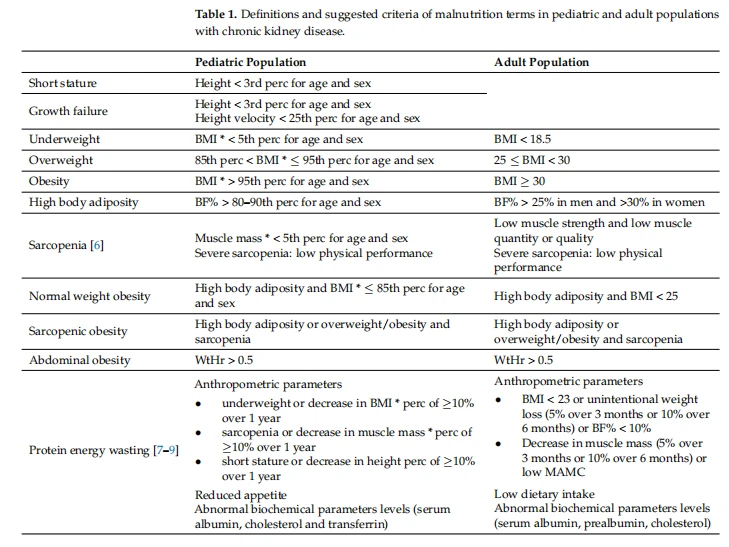
Children with CKD are susceptible to undernutrition and protein energy wasting (PEW) due to the CKD-related nutritional disturbances and inflammation-related wasting process (Table 1) [4]. Nevertheless, in parallel to the general pediatric population, the overweight and obesity prevalence in children with CKD has risen, attributed to the growing adaptation of unhealthy eating habits and high exercise deficit disorder (Table 1) [5]. Both underweight and obesity undermine pediatric health, affecting renal function, cardiovascular risk, and overall quality of life. Cumulative clinical data underline that skeletal muscle mass and strength deficits, which represent the principal finding of PEW and frailty, may also be present in children with high adiposity, due to CKD-related wasting processes, lack of physical activity, and possibly due to obesity-induced inflammatory disease, increasing the risk of sarcopenic obesity (Table 1). Moreover, high adiposity and uremia-related pathogenetic mechanisms may also enhance body fat redistribution from the subcutaneous to the visceral abdomen compartment, resulting in abdominal obesity (Table 1). Growing pediatric clinical studies emphasize that both high adiposity and abdominal obesity are deleterious for the cardiometabolic profile of these patients. This review describes the pathogenetic mechanisms, the current trends, and outcomes of malnutrition patterns in children with CKD, according to recent clinical studies. Moreover, it analyzes the variety of malnutrition patterns according to body composition indices and outlines the advantages and limitations of the currently available body composition techniques. Furthermore, it highlights the importance of integrating growth hormone therapy and physical activity in the malnutrition management of pediatric patients.

2. Malnutrition Patterns and Outcomes in Children with CKD
Undernutrition is a form of malnutrition, where nutrient intake is insufficient to meet the individual’s energy requirements, resulting in being underweight, which is defined as body mass index (BMI), calculated with the following equation: BMI = weight (kg)/height (m)2, <5th percentile for age and sex (Table 1). Pediatric chronic undernutrition affects both weight and height growth, ultimately leading to poor height velocity and short stature; the latter is defined as height < 3rd percentile for age and sex [12]. The term undernutrition was initially used to describe starvation, where weight loss is mainly attributed to fat store depletion [13,14]. Protein-energy malnutrition (PEM) was afterward used for the cases where nutrient deficiency led to both increased protein and fat catabolism [13,14]. Protein-energy wasting (PEW) is used to describe the state of decreased body stores of protein (body muscle) and energy (body fat) fuels in CKD patients and reflect the nutritional disturbances as well as the CKD-related wasting processes (Table 1) [7]. The proposed diagnostic criteria for PEW by Abraham AG et al. in pediatric populations include reduced or loss of body mass and muscle mass, poor height growth, and reduced caloric intake or decreased appetite, combined with abnormal biochemical parameters levels, including serum albumin, cholesterol, and transferrin (Table 1) [8,9]. Nevertheless, definite diagnostic criteria are currently lacking. On the other hand, overnutrition is a form of malnutrition due to excessive nutrient intake, which exceeds the individual's energy requirements. This condition induces abnormal body fat accumulation and ultimately results in increased BMI, clinically presented as overweight and obesity, defined as BMI > 85th percentile to <95th percentile and BMI> 95th percentile for age and sex, respectively.

Both undernutrition and overnutrition are linked to multiple comorbidities in the pediatric CKD population (Figure 1). Weight loss and obesity were associated with faster progression to end-stage CKD [15–17]. Underweight and obesity were associated with higher mortality rates in children on dialysis [18–21] and in kidney transplant recipients [22–24], forming a U-curve between BMI and mortality rate. Additionally, obese kidney-transplanted patients may present a higher risk of allograft rejection dysfunction, allograft failure [23,25], and limited access to kidney transplantation from living donors [26]. Moreover, overweight and obese patients are at higher risk of hypertension, left ventricular hypertrophy and arterial stiffness, deteriorating cardiovascular outcomes [27,28], and are prone to metabolic disorders, including insulin resistance, hyperuricemia, and disturbed lipid profile, augmenting the incidence of metabolic syndrome [29,30]. Nevertheless, the findings are inconsistent regarding the connection of undernutrition with cardiovascular risk and the occurrence of malnutrition–inflammation atherosclerosis syndrome in pediatric patients [28,31]. Although a U-curve correlation was observed between BMI z-score and pulse wave velocity in a single-center study, no association was observed between malnutrition status and carotid intima-media thickness in another study on chronic dialysis children [28,31]. Furthermore, limited adult and pediatric studies suggest that overweight patients with moderate CKD may present secondary hyperparathyroidism earlier in the course of the disease, indicating a link between obesity and mineral bone disorders [32–34]. In the pediatric population, this condition may be more frequent in kidney transplant recipients, where obesity prevalence is higher, as observed in a recent study [35].

3. Trends in Malnutrition Patterns and Risk Factors
The prevalence of underweight is currently low, affecting 8.9% of patients on peritoneal dialysis (PD) according to the International Pediatric Peritoneal Dialysis Network (IPPDN) database [21], 8.7% of kidney transplant recipients according to the USA Organ Procurement and Transplantation Network (OPTN) [23], and only 3.5% of patients on renal replacement therapy according to the European Society for Pediatric Nephrology/European Renal Association-European Dialysis and Transplant Association Registry (ESPD/ERA-EDTA) [5]. Nevertheless, according to the “CKiD” database, which constitutes a multicenter cohort registry of children with mild-to-moderate CKD in North America, the prevalence of PEW varies from 7 to 20%, depending on the applied criteria [9]. The discrepancy between underweight and PEW prevalence may indicate that current strategies for the management of the nutritional problems attributed to poor appetite, vomiting, overhydration, loss of nutrients during dialysis, dietary restrictions, etc., are relatively satisfactory but inflammation-related wasting processes remain insufficiently encountered [4].
Moreover, despite improvement in terms of weight growth, short stature remains high and varies from 7 to 44% in European countries, confirming that nutrition may only in part enhance height growth in children with CKD [36]. In addition, excessive nutritional supplementation disproportion to height gain during infancy and early childhood might ultimately lead to short and overweight children [37,38]. Sienna JL et al. observed that gastrostomy feeding significantly increased weight and BMI but not height in 20 CKD stage 2–5 children [39]. These findings were further confirmed by the last IPPDN study, where gastrostomy feeding was more frequent in overweight and obese PD patients and led to further BMI rise [21]. Monitoring of energy intake to support growth is therefore important to avoid overnutrition situations.
On the other hand, the prevalence of both overweight and obesity in the CKD pediatric population has dramatically risen recently. According to the 2000 National (USA) Center for Health Statistics database, the BMI z-score of CKD pediatric patients referred to a tertiary service significantly increased from a median of +0.20 to +0.32 in two 8.5-year study periods [40]. Overweight and obesity affect 20.8% and 12.5% of patients on renal replacement therapy, according to the ESPN/ERA-EDTA database [5], 10.7% and 22% of patients according to recent “CKiD” data [16], and 19.7% of patients at the start of PD according to IPPDN data [21].
Multiple factors may explain this trend (Figure 1). Dietary pattern changes play a significant role in the globally rising occurrence of obesity in the general pediatric population [1]. High-fat Western diets, irregular meal patterns, reduced vegetable consumption, and inadequate fiber intake determine the risk of pediatric obesity. Energy intake seems to affect fat mass in CKD patients [41] and current literature data suggest a tendency toward an imbalanced diet lifestyle [42]. Although in earlier studies caloric intake appeared reduced in CKD patients [43,44], recent data from the "CKiD" registry indicated that caloric consumption surpassed the recommended intake in all age groups and was comparable to that of healthy populations [45]. In addition, energy intake was mostly derived from fast food products, while fruit and vegetable consumption was limited [46]. Interestingly, low dietary fiber was also reported by El Amouri A et al., especially in the advanced stages [47]. Apart from the global tendency toward a high-fat Western diet, alterations of smell and taste, observed in pediatric CKD patients [48], might also induce the patient's preference for saltier foods high in saturated fats.
Moreover, according to a “CKiD” study, physical activity was lower and screen time exposure higher in CKD adolescents, compared to healthy controls, especially in those with obesity and lower GFRs [49]. Physical performance was also found to be reduced in both pediatric transplant and dialysis patients [50,51]. The pathogenesis of poor exercise tolerance in pediatric CKD is not fully understood [52]. Anemia and cardiac changes have been implicated in its pathogenesis [52,53]. Reduced physical literacy, defined as a lack of confidence and motivation in physical activity due to psychological factors, was observed in the CKD pediatric population [52]. Furthermore, sleep/rest fatigue, mostly observed in dialysis and kidney transplant recipients, was also associated with poor physical functioning [54]. Moreover, daphnia, which will be described in the following sections may also contribute to impaired physical performance.

4. Muscle Wasting and Outcomes in Children with CKD
Muscle wasting generally describes the muscle mass and strength wasting process observed in various chronic diseases, while sarcopenia mostly refers to the loss of muscle mass and strength (daphnia) that occurs with aging and is highly prevalent in elderly individuals [55]. In the CKD pediatric population, both notions may be used to determine the disease-related muscle deficits. Muscle wasting is most frequently observed in large skeletal muscles, and increases with chronicity and progression of the disease, affecting more than 40% of patients on chronic dialysis [8,56,57]. According to the European Working Group on Sarcopenia in Older People (EWGSOP), sarcopenia is defined as the presence of low mass strength and muscle quantity or quality; severe sarcopenia is when physical performance is compromised; and reduced muscle strength is the principal diagnostic parameter [6,58] (Table 1). Nevertheless, there is a lack of established sarcopenia definitions and recommended techniques for muscle mass and function measurements in pediatric populations [59]. Moreover, we currently do not know whether dynapenia concurs with muscle mass loss in children with CKD. Muscle strength was significantly correlated to muscle mass in a recent pediatric study [60], while muscle force relative to muscle size was reduced in a study evaluating muscle torque to calf muscle cross-sectional area [61].
The growing body of clinical evidence in CKD pediatric populations underlines that muscle wasting is associated with general fatigue, deteriorating life quality, and decreased exercise capacity, jeopardizing cardiorespiratory fitness [54,56,62,63]. Moreover, although the muscle–bone unit is impaired in CKD, muscle wasting possibly contributes to bone deficits, resulting in a decline in musculoskeletal health [56,61,64,65]. In clinical studies, reduced muscle strength was correlated to low bone cortical area and section modulus, suggesting that muscle impairment may enhance CKD bone disease [61,65]. The separate unfavorable outcomes of sarcopenia and daphnia in pediatric CKD have not been distinguished yet. In adult studies, daphnia was associated with GFR decline, mortality, and cerebrovascular events, independently of muscle mass loss, highlighting the distinct adverse effects of muscle dysfunction in CKD patients [66–68].
Progression of muscle wasting ultimately develops a frailty phenotype, characterized by an increased vulnerability to adverse health outcomes [10,64]. This clinical syndrome has been thoroughly investigated in adult CKD patients. Several diagnostic tools have been validated; the most common, called the Fried phenotype, includes the following criteria: weight loss, fatigue, weakness, slow walking speed, and reduced physical activity (Table 1) [11]. The frailty phenotype has been recently described in children with CKD by Sgambat K et al. it was associated with a higher hospitalization risk, and the suggested criteria include suboptimal growth/weight, low muscle mass, fatigue, and high C-reactive protein (CRP) levels (Table 1) [10]. Low circulating insulin growth factor 1 (IGF-1) levels were also identified as a risk factor [64]. Further data on the outcomes and biochemical biomarkers of frailty are needed, particularly in children on chronic dialysis, where the prevalence is considerably higher [64].
In clinical practice, muscle wasting may be observed in both undernutrition and overnutrition conditions (Figure 1). In the following, we will present the patterns of malnutrition that may concur with muscle wasting in CKD pediatric patients.
5. Undernutrition/PEW and Muscle Wasting in Children with CKD
Muscle wasting is the cornerstone finding of PEW. According to “CKiD” data, Abraham AG et al. found that reduced mid-arm circumference (MAC) was more prevalent than reduced body mass in all CKD stages, affecting 41% and 25% of patients, respectively, suggesting that muscle wasting precedes underweight occurrence [9]. In the same study, overall poor growth prevalence was 42% and was approximately the same as that of reduced muscle mass in all CKD stages, proving that poor growth and muscle wasting mostly occur concurrently.

Reduced protein intake, principally due to uremic anorexia, may only in part explain sarcopenia [56]. Cachexia is the term used in adult populations to define the muscle wasting process due to the complex metabolic syndrome associated with underlying illness with or without loss of fat mass [69]. In CKD, PEW pathogenic mechanisms, including systemic inflammation, triggered by the accumulation of uremic toxins, immune cell defects, gut dysbiosis, dialysis-related factors, metabolic acidosis, disrupted growth hormone (GH)– IGF-1 axis, insulin resistance, anemia, mineral bone disorders and activation of the renin–angiotensin system have been implicated in the muscle mass and strength wasting process (Figure 1) [56]. These multiple pathways impair the balance between muscle catabolic and anabolic processes, leading to the degradation of muscle proteins, through activation of the ubiquitin–proteasome system (UPS), reduced muscle protein synthesis, inhibited myogenesis, and raised muscular energy expenditure [56]. Current clinical data highlight that apart from muscle quantity, muscle quality is also degraded in CKD, involving muscle fibrosis (myelofibrosis) and intramuscular fat infiltration (myosteatosis) [70]. Experimental and longitudinal clinical adult studies have shown that kidney dysfunction promotes ectopic fat redistribution and progressive fat accumulation in skeletal muscles, inducing structural changes [71,72]. Uremic toxin accumulation, gut dysbiosis, and adipokine imbalance are possible incriminating factors [72]. Myosteatosis contributed to decreased physical functioning and muscle strength in a cohort of pediatric patients on peritoneal dialysis [63] and was associated with poor cardiovascular outcomes in adult patients [72].
Data regarding the prevalence of fat mass loss in CKD pediatric patients are limited. Bioimpedance spectroscopy (BIS)-based body composition assessment revealed that low lean tissue index was observed in 22.6% of patients with moderate CKD and 36.7% of patients with advanced CKD, while fat tissue index was observed in only 10% of patients with advanced CKD in a cross-sectional study on 61 patients [33]. Iyengar et al. found body fat using Dual-energy X-ray absorptiometry (DXA) and bioimpedance analysis (BIA) was reduced in 18% and 12% of children with CKD 2-5D, respectively [73]. Canpolat et al. found that reduced mid-arm muscle circumference (MAMC) and decreased BIA-based fat mass were present in 60% and 21% of patients on chronic dialysis, respectively [31]. These findings support that muscle wasting largely precedes fat loss in the CKD pediatric population [4].
6. Obesity and Muscle Wasting
6.1. General Population
Current literature data indicate that BMI cannot distinguish lean from fat mass, reducing its specificity to detect body lean mass and adiposity [74]. There is a need for prompt diagnosis of fat mass accumulation and early management of associated health consequences to detect two conditions, where high body fat percentage is present in individuals with normal BMI, called normal-weight obesity (NWO), or with concurrent sarcopenia, called sarcopenic obesity (Table 1) [75]. High body fat percentage cut-off points, proposed by the WHO, are established as 25% and 30% for adult men and women, respectively (Table 1). Nevertheless, in pediatric populations, cut-off levels are not globally defined and vary between the 80 and 90 percentile for age and sex among different studies (Table 1). NWO is identified as a risk factor for adverse metabolic and cardiovascular outcomes in pediatric patients and was associated with impaired physical fitness, including reduced hand grip strength, exercise deficit disorder, and decreased motor performance, ultimately leading to sarcopenic obesity [76–79]. Sarcopenic obesity in turn was also linked with impaired cardiometabolic and mental health [3].
Apart from the reduced physical activity frequently observed in patients with high adiposity, obesity per se may also contribute to the occurrence of sarcopenia. Adipose tissue is nowadays considered as an endocrine organ and obesity is considered a chronic low-grade inflammatory disease. There is increasing literature evidence that high adiposity levels induce the secretion of systemic pro-inflammatory cytokines, enhancing protein muscle catabolism, while impairing the GH/IGF-1 axis and inhibiting the repair and regeneration of skeletal muscles [80]. Obesity has been also associated with damaging skeletal muscle contractile function, by inducing a shift from slow to fast muscle fiber types [81]. Furthermore, the alteration of the abundance and diversity of the gut microbiota, induced by unhealthy dietary patterns, coupled with reduced physical activity, may promote insulin resistance, further enhancing muscle wasting [82].
Individuals with a high body fat percentage are also prone to abdominal obesity, describing the state of increased visceral abdominal fat, which is strongly associated with adverse cardiometabolic profiles [83]. Although high central adiposity level has a strong genetic basis, positive energy balance is the primary cause of overflow of subcutaneous fat storage and redistribution of fat into intra-abdominal tissue [83]. Waist circumference (WC) was initially used to describe central adiposity levels in both adult and pediatric populations. Nevertheless, WC is a height-dependent parameter, and its application for the measurement of central adiposity may lead to overestimation and underestimation in taller and shorter individuals, respectively [84]. Adjustment of WC to body size by calculating the waist-to-height ratio (WtHr), with the following equation: WtHr = waist (cm)/height (cm), seems to be a better screening tool for cardiometabolic risk assessment in adults and a cut-off of 0.5 is generally applied for both adult and pediatric populations [84]. Most pediatric studies suggest that WtHr predicts total body fat better than BMI [85,86], and equally to body composition devices, such as DXA [87]. Although literature data regarding the benefits of WtHr measurement in normal-weight pediatric patients are inconsistent [88], WtHr is a strong cardiometabolic risk parameter among overweight and obese children [89,90].
6.2. Children with CKD
Growing clinical data indicate that children with CKD are susceptible to NWO, sarcopenic as well and abdominal obesity. According to a cross-sectional study on 41 patients with CKD 2-5D, NWO, defined as normal BMI and relative fat mass (RFM) > 85th percentile, was present in 17% of patients and 46% of those with high RFM [30]. Moreover, high WtHr was observed in 15% of CKD patients with normal BMI in a study from the “CKiD” registry and accounted for approximately 31% of patients with high adiposity, estimated by either BMI or WtHr [91]. Interestingly, Rashid et al. found a discordant relative high-fat mass and low lean mass in a single-center cohort of 100 kidney transplant and CKD children based on DXA findings with a higher trunk-to-leg fat mass ratio [41]. Foster et al. found reduced DXA-based leg lean mass but increased body fat mass in 143 CKD patients. In further analysis, they observed that trunk but not leg fat mass was significantly higher in all CKD groups [92]. Muscle strength was also found to be impaired in overweight CKD pediatric patients. In kidney transplant recipients, daphnia was more frequent in overweight patients [62,93], while according to the “CKiD” database, hand grip strength was reduced in children with CKD, regardless of BMI status [57]. In further analysis, Hogan et al. observed that among patients with reduced hand grip strength, 34% were overweight or obese and only 1% were underweight [57].
The reduced physical activity frequently observed in CKD pediatric patients, coupled with the CKD and possibly the obesity-induced muscle wasting process may explain these findings. Moreover, a uremic milieu per se may also enhance fat redistribution from the subcutaneous compartment to the visceral compartment principally in the abdomen [94]. Although the causal effects are not well understood, Aguilera et al. suggest that the uremia-induced hyperinsulinemia, disorders of orexigenic and anorexigenic hormones, adipokine imbalance, reduced IGF-1 bioavailability and secondary hyperparathyroidism, which are implicated in muscle wasting and therefore the PEW process, may promote dysregulation of fat distribution and abdominal fat accumulation without an increase in appetite [94]. Further studies are required to elucidate the pathogenetic mechanisms of abdominal obesity in CKD patients. Therefore, a wide range of malnutrition patterns may be observed in children with CKD, based on body composition indices, varying from non-obese sarcopenia to obesity and all malnutrition types may be associated with abdominal obesity (Figure 2).

Cumulative clinical studies support the clinical significance of high total or abdominal adiposity in CKD pediatric patients (Table 2). According to the analysis of the “CKiD” registry, WtHr was more sensitive than BMI in predicting cardiovascular risk in both CKD [91] and kidney transplant patients [95]. Moreover, normal-weight patients with high BIA-based fat-free tissue/fat tissue index [FFTI/FTI] ratios presented lower grades of arterial stiffness [28], while those with BIS-based high RFM were susceptible to insulin resistance and hyperuricemia in two cross-sectional studies [30]. Furthermore, DXA-based fat mass index was significantly associated with hypertension, after adjusting for the presence of obesity in a cohort of 63 CKD pediatric patients [96]. In addition, children with cardiometabolic risk parameters presented a faster decline in kidney function, regardless of BMI status [97]. Nevertheless, a longitudinal study in the “CKiD” registry found that waist circumference (WC) added limited information to BMI for the prediction of metabolic, cardiovascular, and renal outcomes [29]. Further large-scale studies are needed to investigate the prevalence and the cardiometabolic and renal outcomes of high adiposity in CKD pediatric patients with normal BMI and/or concurrent muscle wasting.

【Contact】Email: george.deng@wecistanche.com / WhatsApp:008613632399501/Wechat:13632399501