Maximum Entropy Modeling The Distribution Area Of Morchella Dill. Ex Pers. Species in China Under Changing Climate Part 1
Jun 27, 2023
Simple Summary: Climate change has always been a noticeable factor in the research of species distribution. In recent decades, the habitats of species have been gradually destroyed due to the changing climate. Thus, to predict how climate change will influence the survival and suitable habitats of wild Morchella Dill. ex Pers. species in China, we used a maximum entropy model to simulate the changes in its distribution area from historical periods to future periods. Our results illustrate that precipitation, elevation, and temperature are indispensable factors affecting the presence and suitable habitats of wild Morchella species. Furthermore, this research showed us a promising trend that, regardless of which scenario, the suitable area of the species will increase to a certain scale shortly. Based on these findings, we could explore and design an optimal scheme for the conservation of wild Morchella resources.
Glycoside of cistanche can also increase the activity of SOD in heart and liver tissues, and significantly reduce the content of lipofuscin and MDA in each tissue, effectively scavenging various reactive oxygen radicals (OH-, H₂O₂, etc.) and protecting against DNA damage caused by OH-radicals. Cistanche phenylethanoid glycosides have a strong scavenging ability of free radicals, a higher reducing ability than vitamin C, improve the activity of SOD in sperm suspension, reduce the content of MDA, and have a certain protective effect on sperm membrane function. Cistanche polysaccharides can enhance the activity of SOD and GSH-Px in erythrocytes and lung tissues of experimentally senescent mice caused by D-galactose, as well as reduce the content of MDA and collagen in lung and plasma, and increase the content of elastin, have a good scavenging effect on DPPH, prolong the time of hypoxia in senescent mice, improve the activity of SOD in serum, and delay the physiological degeneration of lung in experimentally senescent mice With cellular morphological degeneration, experiments have shown that Cistanche has the good antioxidant ability and has the potential to be a drug to prevent and treat skin aging diseases. At the same time, echinacoside in Cistanche has a significant ability to scavenge DPPH free radicals and has the ability to scavenge reactive oxygen species and prevent free radical-induced collagen degradation, and also has a good repair effect on thymine free radical anion damage.

Click On Does Cistanche Work for Antioxidant
【For more info:george.deng@wecistanche.com / WhatApp:86 13632399501】
Abstract: Morchella is a kind of precious edible, medicinal fungi with a series of important effects, including anti-tumor and anti-oxidation effects. Based on the data of 18 environmental variables and the distribution sites of wild Morchella species, this study used a maximum entropy (MaxEnt) model to predict the changes in the geographic distribution of Morchella species in different historical periods (the Last Glacial Maximum (LGM), Mid Holocene (MH), current, 2050s and 2070s). The results revealed that the area under the curve (AUC) values of the receiver operating characteristic curves of different periods were all relatively high (>0.83), indicating that the results of the maximum entropy model are good. Species distribution modeling showed that the major factors influencing the geographical distribution of Morchella species were the precipitation of the driest quarter (Bio17), elevation, the mean temperature of the coldest quarter (Bio11), and the annual mean temperature (Bio1). The simulation of geographic distribution suggested that the current suitable habitat of Morchella was mainly located in Yunnan, Sichuan, Gansu, Shaanxi, Xinjiang Uygur Autonomous Region (XUAR), and other provinces in China. Compared with current times, the suitable area in Northwest and Northeast China decreased in the LGM and MH periods. As for the future periods, the suitable habitats all increased under the different scenarios compared with those in contemporary times, showing a trend of expansion to Northeast and Northwest China. These results could provide a theoretical basis for the protection, rational exploitation, and utilization of wild Morchella resources under scenarios of climate change.
1. Introduction
Climate change is an environmental factor that all organisms on Earth have to face all the time. With the changing climate, the spatial geographical distributions and distribution areas of species are also changing. In recent years, global climate change has resulted in shifts in the habitats of various species and even the extinction of some species [1,2]. Research has shown that some species will move to high-latitude and -altitude regions two to three times faster in the future [3]. Thus, scientifically evaluating and predicting the impact of climate change on species distribution and biodiversity have attracted great attention [4]. To understand the changing characteristics of different species under future climate conditions, research on the relationship between species and climate is of great urgency.
A possible solution is to use the species distribution model (SDM). SDM is an important method for the analysis of changes in species distribution ranges, and it is widely used in biogeography studies. In recent years, using species distribution models to predict the real and potential distributions of endangered species [5], rare species [6], and invasive species [7] has become a hotpot in the field of ecology. In the research of species distribution, climate, soil and other factors (such as the migration ability of species) can influence species’ geographical distributions to some extent [8]. Combined with species distribution data and environmental factors, SDM projects these data to a certain geographical spatial range, and it also estimates the species’ suitable regions for survival and their living environment preferences [9–11]. The SDMs that are now available include BIOCLIM, the Ecological Niche Factor Analysis (ENFA), the Generalized Linear Model (GLM), the Bayesian Approach (BA), Genetic Algorithms (GAs), and MaxEnt [12]. Among these, MaxEnt uses the actual presence data of species and the corresponding environmental variables to calculate the ideal state of species distribution under certain niche constraints, that is, the possible distribution of species in the predicted area when the entropy is maximum. This model differs from other models in the requirement of the data of species distribution sites, the setting of model parameters, and the handling of environmental variables [13,14]. Most models need the presence and absence data of species distribution; however, MaxEnt only relies on real existing sites [15]. The probability distribution of MaxEnt has a concise mathematical definition, which is easy to analyze. For instance, as with GLM and GAM, the additivity of the model makes it possible to interpret how each variable relates to suitability in the absence of interactions between variables [16]. At the same time, the prediction accuracy of the MaxEnt model is so high that it can reflect the probability of the occurrence of species correctly to a certain degree under the circumstance of small sample size [17].

Given the superiority of MaxEnt, many scholars have published a series of significant research achievements using MaxEnt, providing a highly valuable theoretical basis to various fields, such as the management of invasive species, the protection of biodiversity, and the selection of species living environmental conditions. Not only can MaxEnt be used for plants and animals, but it can also be used for fungi. Sun et al. used MaxEnt to simulate the suitable habitat of giant pandas and explained the responses of the species to environmental variables at different scales [18]. Liu et al. simulated the distribution of Houttuynia cordata Thunb (Ceercao) under current climate conditions and predicted its potential geographical distribution changes and the results revealed that the area of suitable habitat of Ceercao decreased under three scenarios of greenhouse gas emissions in the 2050s and 2070s [19]. Yuan et al. predicted the potential distribution of Phellinus bauxite Pilát, Phellinus Ignatius (L.) Quél. and Phellinus vaninii Ljub. and found that the accuracy of the results was high [20].
Morchella is a group of important fungi belonging to the Morohellaceae of Ascomycotina, which is widely distributed in the northern hemisphere. Because of its rich nutrition and medicinal values, Morchella species occupy a place in the most precious edible fungi and attract the attention of many mycologists [21]. The natural bioactive components [22], such as polysaccharides, proteins, and lipids, extracted from Morchella play a significant role in disease prevention, including immune regulation [23], anti-tumor activities [24], and anti-oxidation activities [25]. Molecular phylogenetic studies have shown that Morchella can be divided into three main evolutionary clades, namely, Yellow Morchella, Black Morchella, and Red Morchella [26]. East Asia and China are the possible differentiation and diversity centers of Morchella species. At present, more than thirty species of Morchella have been recorded in China [27], which is one of the countries with the most abundant wild Morchella resources.
However, overexploitation and habitat destruction pose a severe threat to the species diversity of wild Morchella [28]; meanwhile, the specific requirements and environmental qualities of Morchella growth have been long discounted in the field of mycology [29]. Additionally, Taheri et al. [2] showed that there were few studies on the geographical range of fungi related to climate change in comparison with those of plants and animals. At present, it is still unclear how climate change will impact the geographical distribution of Morchella species in different periods. This study aims to predict the potential distribution of Morchella species under different scenarios of historical and future climates based on a MaxEnt model. The purpose of this study is to analyze the effect of environmental factors on the formation of Morchella fruiting bodies and to simulate the changes in the potential distribution areas of Morchella in the different periods. It is expected that the results will provide a scientific foundation for the biodiversity and wild resource conservation of Morchella in the future.
2. Materials and Methods
2.1. Source of Species Distribution Data
The occurrence data of Morchella species were acquired from field surveys and published papers; we obtained a total of 288 sites. First, repeated locations were discarded, and then the buffer method was used. The spatial resolution of environmental factors was 2.5 arcminutes and spatially coincident data points within 5 km of each other were discarded, allowing for model overfitting caused by duplicated distribution sites to be avoided. Finally, a total of 180 sites of Morchella were retained (Figure S1 and Table S1).

2.2. Environmental Factor Acquisition and Pretreatment
A total of 19 environmental factors (Bio1–Bio19, Table 1) were downloaded from the World Climate Database, and the spatial distribution rate was 2.5 arcminutes. A total of 2 terrain variables and 7 soil variables (Table 1) were obtained from the Harmonized World Soil Database. Terrain and soil variables were jointly determined by the Food and Agriculture Organization of the United Nations, the International Institute for Applied Systems Analysis, the Institute of Soil Science, the Chinese Academy of Sciences, and the European Commission’s joint research center. The spatial resolution of these data was unified into 2.5 arcminutes, and the data were all transformed into ASCII format using ArcGIS 10.2. The potential distributions of Morchella were assessed over five periods, namely, the Last Glacial Maximum (LGM), Mid Holocene (MH), current, 2050s, and 2070s. Both the past and future climatic data adopt the CCSM4.0 model published in the IPCC Fifth Report; we selected three different scenarios of greenhouse gas emissions for the future periods (Table S2), and these scenarios are defined according to the resulting total radiative forcing in 2100 [30].

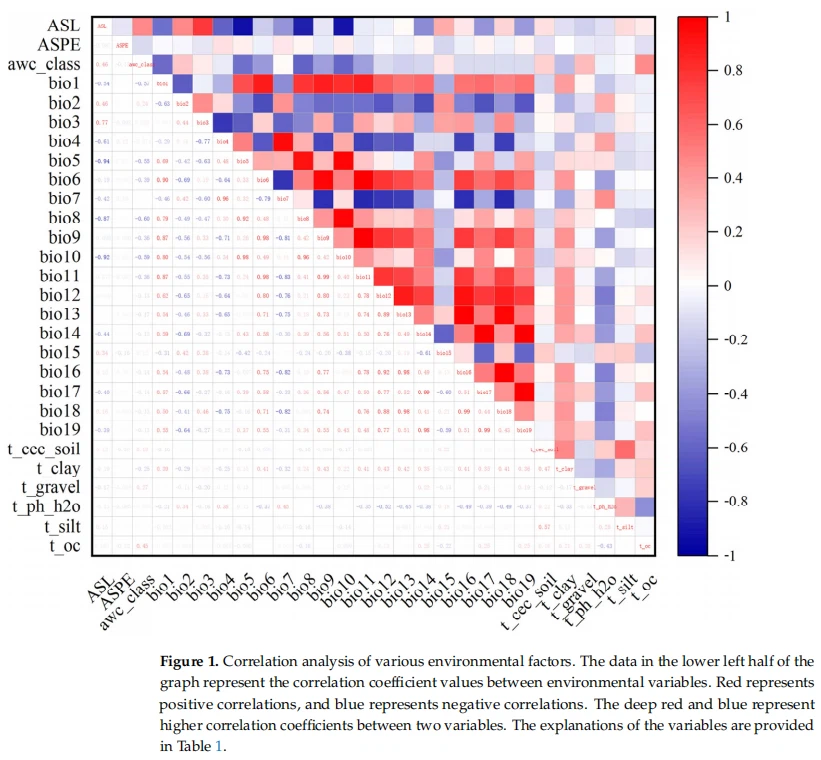
To avoid the overfitting of the results due to the high collinearity of environmental variables [31], environmental variable contribution and correlation analyses were performed based on MaxEnt and SPSS programs. We used the MaxEnt 3.4.1 program to analyze the variables’ contributions based on environmental variables and the distribution sites of Morchella, and we set the repetitions to 10 times. Next, the information on the environmental factors of Morchella was extracted using ArcGIS 10.2, and a Pearson correlation analysis was performed between environmental variables in SPSS 25 (Figure 1). Combined with the contribution of environmental factors, we retained factors with correlation coefficients under 0.8 about the top six factors. A couple of environmental factors had correlation coefficient values greater than |0.8|, and only one variable with a higher contribution was retained and used in the MaxEnt models [32,33]. Finally, 18 environmental factors were used in the modeling (Table 1).
2.3. MaxEnt Model Analysis
2.3.1. Model Parameter Selection
The distribution sites of Morchella species and 18 environmental factors were imported into the MaxEnt3.4.1 program for modeling analysis. A total of 25% of the distribution data were selected randomly as the testing set to examine model accuracy, and the remaining 75% was used as the training set [34]. We ran 10 bootstrap replicates, whose type was Subsample. Apart from this, the threshold selected was maximum training sensitivity plus specificity, the output format was Cloglog, and the other parameters were left as their defaults.
2.3.2. Model and Environmental Variable Evaluation
AUC is a comprehensive criterion that represents the accuracy and specialty of ROC. It was first introduced into the evaluation of species distribution model accuracy in 1997 [35], and since then, it has been used to evaluate models’ performances. The value of AUC ranges from 0.5 to 1. If the value is closer to 1, it means that the predictive precision of the model is higher. An AUC value under 0.7 indicates that the simulation effect of the model is poor; an AUC value between 0.7 and 0.8 indicates that the simulation effect of the model is moderate; an AUC value between 0.8 and 0.9 indicates that the simulation effect of the model is good; and certainly, when the AUC value is higher than 0.9, the simulation effect is excellent [36]. In addition, MaxEnt provides a Jackknife method to analyze the relative contribution and importance of environmental variables on Morchella and to determine the major environmental factors.

2.3.3. Suitable Region Classification
According to the assessment of presence probability in the IPCC Fifth Report [37], we reclassified the suitable habitat of Morchella using the Reclass module in ArcGIS 10.2 with the natural segment method. The habitat of Morchella was divided into four grades using the natural segment method: unsuitable habitat (0 ≤ value ≤ 0.13), low suitable habitat (0.13 < value ≤ 0.35), moderately suitable habitat (0.35 < value ≤ 0.63), and high suitable habitat (0.63 < value ≤1).
2.3.4. Change in the Distribution Center of Morchella
SDM tools is a GIS toolkit used in analyzing the centroid change in suitable distribution regions [38]. In this study, SDM tools and the binary suitable areas of Morchella in different periods were used to calculate the geographical location of its distribution center, thus illustrating the route of the temporal and spatial evolution of Morchella.
3. Results
3.1. Evaluation of the Accuracy of the Model
As shown in the AUC value of the ROC curve operated by MaxEnt, the average AUC value of the training data of the Morchella potential distribution model under past climatic conditions was 0.907, and the mean AUC value of the test data was 0.847; under the current period, the average AUC value of the training data was 0.905, and the mean value of the test data was 0.852; as for the future periods, the average AUC value of the training data was 0.903, and the mean value of the test data was 0.848 (Table 2). According to the evaluation standard of the AUC value, these results are good and reliable.

3.2. Dominant Environmental Factors
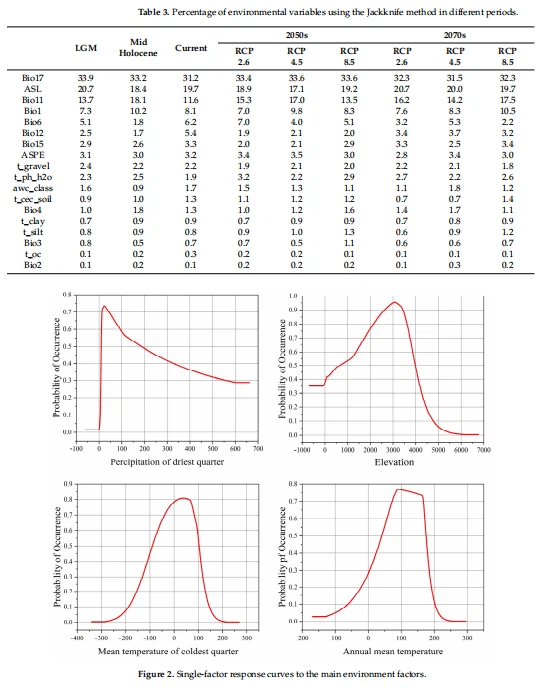
Table 3 shows the relative contribution of modeling environmental factors. Bio17, elevation, Bio11, and Bio1 were the main environmental factors affecting Morchella distribution. In the LGM, MH, current, and future periods (the 2050s and 2070s), the cumulative contribution rates reached 75.8%, 79.9%, 70.6%, 74.6%, 77.5%, 74.6%, 76.8%, 74.0%, and 80.0%. Bio17 affected Morchella the most, and elevation and Bio11 were the second and third most effective factors, respectively, which also had a great impact on the probability of Morchella occurrence.
Based on the single-factor response curves, the influence of dominant factors on Morchella presence probability was analyzed. The highly suitable environmental conditions for the survival of Morchella were as follows: Bio17 was 11.32–77.78 mm, elevation was 1480.78–3827.03 m, Bio11 was −5.98–9.32 ◦C, and Bio1 was 6.16–16.98 ◦C (Figure 2).
3.3. Potential Geographical Distribution and Evaluation of Suitable Areas of Morchella
3.3.1. Suitable Areas in the Past
The suitable habitat in both LGM and MH decreased compared to that of the present age. MaxEnt predicted that the total suitable area of Morchella decreased by 12.43% in LGM and that the high suitable area decreased by 5.07%, which were mainly reflected in the reduction in the suitable area in the southeast of Gansu, the center and south of Shaanxi, and the north of Guizhou in China; the moderate suitable area decreased by 2.48%, which was predicted to mainly occur in XUAR and North China; and the low suitable area decreased by 4.88%, mainly in Northeast China and the northwest of XUAR (Figure S2, and Tables 4 and 5).
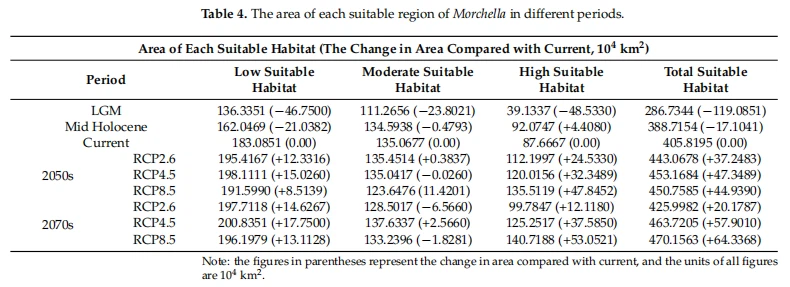
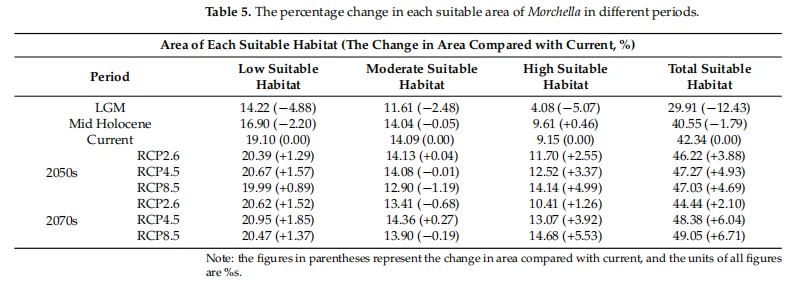
As for MH, the reduction range was smaller than that in LGM. There was a slight disparity in MH and current, which we could not clearly distinguish in the figures (Figures S2 and S3). More details about the distribution area are shown in Tables 4 and 5.
3.3.2. Suitable Areas of Current Times
It can be seen in Figure S3 that the suitable habitat of Morchella is relatively extensive under contemporary climate conditions. The total suitable habitat area was approximately 405.8195 × 10⁴ km2, accounting for 42.34% of China’s territorial area (Tables 4 and 5). It was largely located in Southwest and Northwest China, covering northern Yunnan, southeast Tibet, Sichuan, central and southern Shaanxi, southern Shanxi, northern Guizhou, southeast Gansu, northwest Xinjiang and some parts of Fujian.
【For more info:george.deng@wecistanche.com / WhatApp:86 13632399501】