Melatonin Treatment in Kidney Diseases
Sep 18, 2023
Abstract: Melatonin is a neurohormone that is mainly secreted by the pineal gland. It coordinates the work of the superior biological clock and consequently affects many processes in the human body. Disorders of the waking and sleeping period result in nervous system imbalance and generate metabolic and endocrine derangements. The purpose of this review is to provide information regarding the potential benefits of melatonin use, particularly in kidney diseases. The impact on the cardiovascular system, diabetes, and homeostasis causes melatonin to be indirectly connected to kidney function and quality of life in people with chronic kidney disease. Moreover, there are numerous reports showing that melatonin plays a role as an antioxidant, free radical scavenger and cytoprotective agent. This means that the supplementation of melatonin can be helpful in almost every type of kidney injury because inflammation, apoptosis, and oxidative stress occur, regardless of the mechanism. The administration of melatonin has a renoprotective effect and inhibits the progression of complications connected to renal failure. It is very important that exogenous melatonin supplementation is well tolerated and that the number of side effects caused by this type of treatment is low.
Keywords: melatonin; kidney diseases; renoprotective effect; chronic kidney disease; nephrotoxicity; acute kidney injury

CLICK HERE TO GET 20% CISTANCHE TUBULOSA EXTRACT FOR KIDNEY
1. Introduction
Melatonin, discovered in the late 1950s, is a pleiotropic neurohormone that is mainly produced in the pineal gland. While it is released from different tissues, it acts also as a local regulatory molecule [1]. The elementary role of melatonin is to transmit information concerning the daily cycle of light and darkness to the different parts of the human body, which ultimately affects the functioning of the entire organism [2]. However, there are many reports showing that this is not the only mechanism and function of this particle. It has been proven that melatonin also takes part in antioxidative, anti-inflammatory, antiapoptotic, and immune processes [1,3–13]. Moreover, melatonin participates in the detoxification of free radicals, bone formation, reproduction, and body mass regulation and has an influence on cardiovascular homeostasis [14–17]. The renoprotective effect of melatonin has been the subject of reports in the last decade that have found that melatonin not only ameliorates sleep disorders in patients with chronic kidney disease (CKD) but also has a beneficial effect on blood pressure and provides protection in oxidative stress and inflammation [18–20], which occur in a wide variety of kidney injuries such as CKD, glomerulonephritis, contrast-induced kidney injury, drug-induced nephrotoxicity, and acute ischemia–reperfusion injury. This review summarizes the physiology of action and the final effects of melatonin treatment in different types of kidney injuries.

2. The Biosynthesis and Metabolism of Melatonin
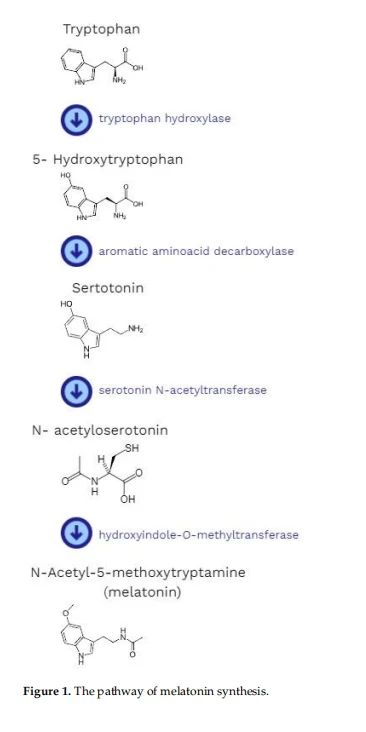
Melatonin is a neurohormone whose main source is the pineal gland [21]. The production of melatonin is dependent on the light/dark cycle. Interestingly, light can either suppress or initiate melatonin synthesis [22,23]. When it is received by the retina, the signal is sent to the suprachiasmatic nuclei of the hypothalamus [24]. Later, it goes through the upper part of the cervical spinal cord, where the synapses, which are connections with preganglionic cell bodies of the superior cervical ganglia, are located. Finally, it reaches the pineal gland. The signal is mainly transmitted by a neuromediator called norepinephrine [22]. It binds with beta-adrenergic receptors and stimulates the pineal gland to produce melatonin [24]. The synthesis starts with the hydroxylation of the amino acid tryptophan (by tryptophan-5-hydroxylase) to 5-hydroxytryptophan, then decarboxylation (by 5-hydroxytryptophan decarboxylase) to serotonin. This is followed by the acetylation of serotonin to form N-acetylserotonin (by arylalkylamine-N-acetyltransferase). The concluding stage is the methylation of N-acetylserotonin by acetylserotonin-O-methyltransferase. After all the above-mentioned reactions, it is possible to obtain the final product, which is melatonin [17] (Figure 1).
The production process of melatonin takes place mostly during the night [22,23]. Both the synthesis and secretion length are directly dependent on the duration of the sleep period. It is a time-based transmitter that conveys information about the round-the-clock cycle of light and darkness to the body [25,26]. However, it is important to emphasize that the pineal gland is not the only place where melatonin is synthesized. It is also produced by retinal photoreceptors [27], the gastrointestinal tract [28,29], bone marrow [30], the liver, the kidneys, the thyroid, the pancreas, the thymus, the spleen, the carotid body, the reproductive tract, and endothelial cells. Human skin is also a place where all enzymes involved in the production process are expressed [10]. There are two G-protein-coupled melatonin receptors: MT1 and MT2 [31]. After their activation, the intracellular level of the second messenger cyclic adenosine monophosphate (cAMP) is decreased. The result is a modification of signaling pathways below protein kinases A and C, and a cAMP reaction with an element-binding protein [10,32]. Melatonin receptors are widespread. Most of them are distributed in the central nervous system, but they are also located in peripheral body parts such as the retina, cerebral and peripheral arteries, the kidneys, the pancreas, the adrenal cortex, the testes, and immune cells [33,34].

3. The Biological Role of Melatonin
3.1. The Nervous System
It is well known that the concentration changes of melatonin take part in sleep–wake cycle disorders, mood disturbances, disabilities of cognitive skills, troubles with learning and memory problems, protection of the nervous system, drug abuse, and cancer processes. Therapies based on pharmacological agonists of melatonin (agomelatine, ramelteon, and tasimelteon), which also affect MT1/MT2 receptors, have been the subject of research interest in recent years [35]. Melatonin can be a potential course of action for novel antidepressants, which affect the concentrations of neurotrophins or neurotransmitters. In addition, they cause a reduction in the proinflammatory cytokine level in the serum [36]. The neuroprotective effect of melatonin is used in the treatment of Alzheimer’s, Parkinson’s, and Huntington’s diseases as well as amyotrophic lateral sclerosis, stroke, and brain trauma [7,37]. Due to its antioxidant properties, melatonin acts as a scavenger of free radicals and regulates numerous reactions at the molecular level, including oxidative stress, inflammation, and apoptosis [38,39]. It has also been documented that melatonin is an inhibitor of calpain, whose activity is significant in the pathogenesis of many central nervous system disorders [40].
3.2. The Immune System
Another important role of melatonin is its ability to immunomodulate and strengthen immune surveillance [41]. It stimulates the production of different lines of cells involved both in humoral and cell-mediated immunity, such as macrophages, natural killer cells, and CD4+ cells, and affects the synthesis of a wide variety of cytokines [42]. The direct anti-viral and anti-bacterial effects of melatonin have been documented [43–45]. During severe infections, the administration of melatonin has been found to have immunomodulatory, antioxidative, and cytoprotective functions [44,46,47]. It has been proven that due to its beneficial pleiotropic effects, the administration of melatonin reduces mortality in both viral and bacterial inflammation [48]. Considering the evidence supporting the role of this hormone in directing oxidative stress and inflammatory processes, as well as the management of immune reactions, examinations involving patients with viral infections caused by Severe Acute Respiratory Syndrome Coronavirus 2 (SARS-CoV-2) have also been conducted. They showed that the administration of melatonin as an adjuvant therapy might be beneficial and that it should be considered during Coronavirus Disease 2019 (COVID-19) [6,49,50].
3.3. The Gastrointestinal Tract
Melatonin in the digestive system, besides its antioxidant effect and ability to stimulate the immune system, reduces the secretion of hydrochloric acid, enhances the regeneration of the epithelium, and increases microcirculation. All of these functions make melatonin one of the therapeutic options for preventing different diseases of the gastrointestinal tract, e.g., colorectal cancer, ulcerative colitis, gastric ulcers, and irritable bowel syndrome. It may also be helpful during treatment [51,52]. It has been documented that melatonin supplementation results in the complete remission of gastroesophageal reflux disease. It has a protective role against acute and chronic irritants that affect the esophagus and stomach. It is also effective in healing ulcers [53]. Moreover, some studies have confirmed that melatonin has strong supporting effects on hepatocytes in the prevention of non-alcoholic steatohepatitis (NASH) [54].
3.4. The Respiratory System
A positive therapeutic potential of melatonin has been also discovered in patients suffering from pulmonary disorders. Melatonin prevents inflammation, eliminates several oxygen-derived reactants, detoxifies nitric oxide, and takes part in apoptosis, including in cancer cells. It also inhibits the proliferation of these malignant cells [55–57]. In a fairly similar mechanism, melatonin influences the restriction of pulmonary fibrosis. It reduces endothelial cell proliferation, invasion, and migration [55,58]. Moreover, it can minimize the gathering of inflammatory cells and reduce the expression of inflammatory mediators, such as cyclooxygenase-2. The amount of proinflammatory cytokines also decreases, which consequently leads to the inhibition of cellular proliferation [59]. The role of melatonin during respiratory tract infections is also important and is discussed in the section regarding the immune system.
3.5. Endocrinology and Gynecology
Clinical trials with melatonin administration have been conducted on animal and human groups. According to contemporary knowledge, melatonin can improve fertility, oocyte quality, maturation, and the number of embryos [14,60]. Moreover, a positive effect during pregnancy has been suggested. The protection of neurogenesis, a supportive impact on the placenta, and a reduction in oxidative stress are mechanisms that increase the reproductive rate and improve embryo–fetal development [60,61]. Reactive oxygen species cause disturbances during pregnancy. They are also responsible for complications in the perinatal period. Melatonin is a scavenger of free radicals. It has also antioxidative and cytoprotective abilities. There is a possibility that it can be crucial for a successful pregnancy. Not only is the role of melatonin in human gendering important, its support is also necessary when neonatal pathologies occur [62,63]. Melatonin is a supervisor during the process of deoxyribonucleic acid (DNA) methylation and histone alteration. In this way, radical changes in gene expression are avoided. The fetus is protected from the occurrence of pathologies. An insufficient concentration of melatonin during pregnancy can leave endocrine disorders in the genetic code during early ontogenesis, which subsequently develop in childhood [64].

3.6. Other Functions
Some additional, very important functions of melatonin in the human body are described in the section about kidney diseases below. The roles of this hormone in different parts of the human body are summarized in Figure 2.

Figure 2. The roles of melatonin in the human body.
Supportive Service:
Email:wallence.suen@wecistanche.com
Whatsapp/Tel:+86 15292862950
Shop:
https://www.xjcistanche.com/cistanche-shop