Nano Milk Protein-Mucilage Complexes: Characterization And Anticancer Effect Part 1
Mar 19, 2022
For more details, contact tina.xiang@wecistanche.com
Abstract: The anticancer activity of natural compounds has recently attracted multidisciplinary research. In this study, the complexation of milk proteins (MP) with Isabgol husk mucilage (IHM)and Ziziphus Spina Christi mucilage (NabM) was investigated. In this context, the physicochemical properties of milk protein mucilage complexes (MPMC) including pH, Carr's index, water solubility, and water absorption indices were measured, and the flow behavior was studied. In addition, the amino acid profile, protein digestibility, and phenolic and flavonoids content of MPMC were explored, and the microstructure of the complexes was visualized using transmission electron microscopy. The antioxidant and anticancer potencies of MPMC against two cancerous cell lines, human liver cancer HEPG-2 and breast cancer MCF-7, in comparison with two normal cell lines, namely, Bj-1 and MCF-12F, were tested using neutral red uptake assay. The results revealed that MPMC had scavenging activity against DPPH, ABTS, and HS radicals. Moreover, MPMC has the potential to prevent DNA damage induced by oxidative stress in Type-Fenton's reaction. The results of the neutral red assay showed significant growth inhibition of both HEPG-2, MCF-7, whereas no significant cytotoxic effect was detected against Bj-1 and MCF-12F. RT-qPCR results indicated MPMC stimulated apoptosis as revealed by the upregulation of the pro-apoptosis gene markers Caspase-3, p53, Bax. Meanwhile, the anti-apoptosis Bcl-2 gene was downregulated. However, no significant difference was observed in normal cell lines treated with MPMC.In conclusion, MPMC can be considered as a promising anticancer entity that can be used in the development of novel cancer therapeutics with comparable activity and minimal side effects compared to conventional cancer chemotherapies.
Keywords: milk proteins; Isabgol husk mucilage; Nabeq mucilage; milk proteins mucilage complexes; anticancer activity

Click to learn more about the products
1. Introduction
Cancer is the primary cause of mortality around the world with approximately 10 million deaths in 2020 [1]. Early diagnosis and the development of novel therapeutics is the only hope to defeat cancer. Conventional cancer treatments such as chemotherapy and radiation are relatively expensive and accompanied by significant side effects.
Therefore, scientific and research interest is tending to the utilization of natural com-pounds(i.e., proteins, polysaccharides, and polyphenols) from their sources that have anticarcinogenic potential as they are considered to have less toxic side effects compared to conventional treatments.
Polysaccharides from plant sources have recently received increasing attention due to their bioactive properties [2,3]. Numerous studies have been interested in isolating bioactive polysaccharides and polyphenols from natural plant sources such as fruits, vegetables, cereals, and herbs due to their beneficial pharmacological effects [4].
Plantago ovata(Psyllium or Isabgol) and Ziziphus Spina-Christi(Nabeg or Sidr) are known sources of bioactive polysaccharides. The IHM and NabM were selected as promising bioactive materials. Previous studies indicated that IHM and NabM complexes with milk proteins improved liver function and diminished the risk of cardiovascular diseases[5]. Isabgol husk has been proven to be effective for the treatment of diarrhea, constipation, ulcerative colitis, irritable bowel syndrome, hypercholesterolemia, and diabetes. Moreover, the anticancer effect of isabgol husk against colorectal cancer was attributed to its fiber content, which acts to decrease its effects by reducing transit time. This will lead to reducing bile metabolism by the gut microflora, dilution of the bile acids by stool bulking, alteration of microbial bile acids metabolism due to fiber fermentation, reduction of the pH and production of short chains fatty acids, or by direct binding to the bile acids and hence preventing their metabolism [6]. The main biologically active components of Ziziphus Spina-Christi are vitamin C, phenolics, flavonoids, and triterpenic acids. Its bioactivities include anticancer, antibacterial, antidiabetic, antiproliferative, and antioxidant activities [7. Isabgol husk and Nabeq fruits are used for the production of Isabgol husk mucilage (IHM)and Nabeq mucilage (NabM), respectively [5].
On the other hand, protein-based therapies for cancer have gained increasing interest due to key features such as low cytotoxicity, strong specificity, and ease of modification [8]. In addition to providing the nutritional needs of essential amino acids, milk proteins are among the biological macromolecules that have many functional properties such as antioxidant, immunomodulatory, antidiabetic, antimicrobial, and anticancer properties [9,10]. For instance, the anticancer activity of dairy-derived peptides(ie.,β-Casomorphins isolated fromβ-casein and α1-casein fragments 90-95 and 90-96[Arg90-Tyr-Leu-Gly-Tyr-Leu95-(Glu96)]) identified in bovine milk support the assumption that milk proteins are not only of nutritious value but also have the potential for cancer prevention and treatment [11,12]
Complexation between milk proteins and polysaccharides, such as milk proteins-chitosan complex, was previously produced as an attempt to enhance the functional properties of their natural components [13]. Due to the availability and ease of preparation, such complexes have the potential to be used in the development of less expensive anticancer therapies. Such therapeutics will be less expensive and show comparable activity to the currently used chemotherapeutics.
Non-covalent binding through hydrophobic and electrostatic interactions are the primary factors in the association of milk proteins with polysaccharides [14]. Moreover, proteins show surprising resilience towards interaction with other components at the range of pH from 2 to 11. At a specific pH, the surface reactivity of protein increases through the unfolding of protein structure [15].
In this context, our group has recently focused on the functional role of milk protein complexes on human health. However, milk protein complexes with IHM or NabM, have exhibited antihyperlipidemic and liver-protective properties [9]. Thus, based on previous studies, it was postulated that milk protein-polysaccharide complexes might have interesting anticancer activity. Additionally, no publications had conducted a study of the anticancer activity of milk proteins complexes with IHM and NabM. Therefore, the main objectives of this study were to characterize the physicochemical properties of the newly produced milk protein mucilage complexes including, the amino acid profile and functional properties of these complexes. In addition, the anticancer activity of milk protein complexes with IHM and NabM mucilage against two human cancerous cells (MCF7 and HEPG2)was investigated in comparison with non-cancerous cell lines (Bi-1 and MCF-12F). We also shed light on the mode of action of the produced milk proteins mucilage complexes.
2. Results and Discussion
2.1. Fourier-Transform Infrared (FTIR) Spectroscopy
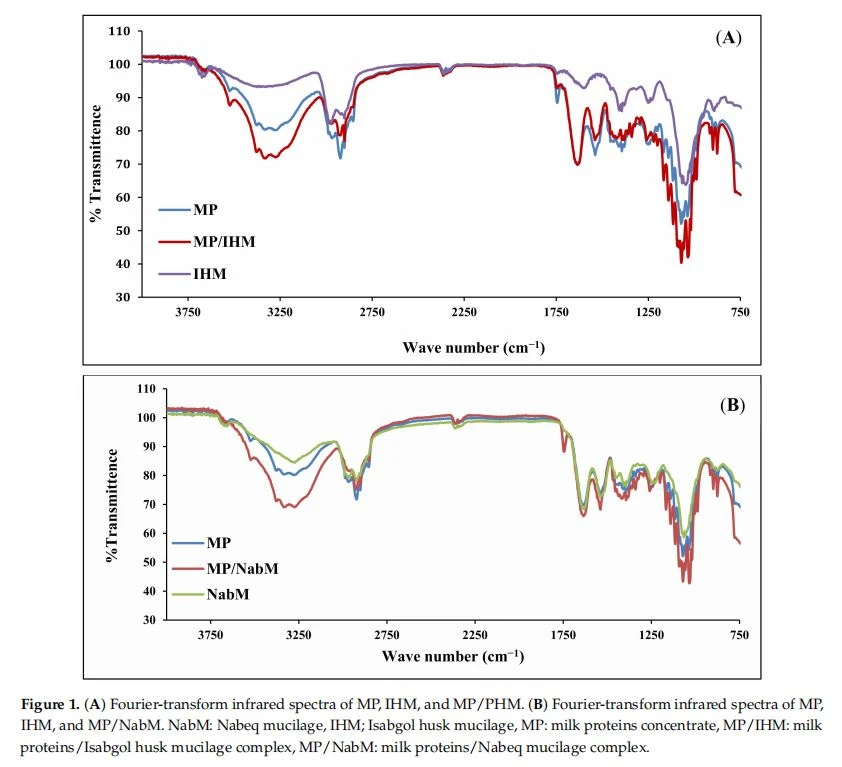
The infrared spectra of IHM, MP, and MP/IHM are illustrated in Figure 1A. The spectrum of IHM showed the characteristic band of arabinoxylans at 100-1200 cm-1 and the bands for the amide I and amide II groups at 1550 and 1650 cm-1, respectively. The MP spectrum shows bands at 1700-1600 and 1200-900 cm-I corresponding to amide I (mainly C=O stretching of proteins) and milk carbohydrates, respectively [16]. The aforementioned peaks of IHM and MP were reserved in the spectrum of the IHM/MP complex. Similarly, the characteristic bands of galacturonic acid in NabM were maintained in the spectrum of the NabM/MP complex(Figure 1B). This would indicate the absence of chemical interaction between polysaccharide mucilage and MP and thus confirm the proposed mechanism of electrostatic attraction between MP and polysaccharides (IHM and NabM). Such observations are in line with those of Vukic et al, who reported the complex formation between whey milk proteins and pectin through electrostatic and hydrophobic interactions which resulted in good consistency of the complex [17].
2.2. Physicochemical and Functional Properties of MP and MPMC
The values of bulk density (BD), tapped density (TD), Carr's Index, and pH measurements are listed in Table 1. BD and TD of MP were higher than IHM, and IHM had the lowest bulk and tapped density of the tested samples. Similarly, MP/IHM complex had significantly (p<0.05) lower bulk and tapped density compared to MP/NabM. The obtained results indicated that the distribution and solubility of MP have been improved by complexation with the IHM. Carr's index is frequently used as an indication of the flowability of powders. The results in Table 1 show that Carr's index of MPMC was significantly lower than IHM which indicated that NabM improved the flowability of MP. This was probably due to the lower Carr's Index value of MP(30.6± 0.10%) compared to IHM and NabM (57.58±0.14 and 53.97±0.11%, respectively)which are vicious.IHM is alkaline (7.79 pH) while MP and the complexes with polysaccharide mucilage were slightly acidic which came in accordance with previously reported results [18].
WSI and WAI are important functional features in food technology. Table 1 shows that WSI and WAI of MP significantly increased after complexation with IHM and NabM. This was most likely because Isabgol-based materials are highly water soluble with a thickening effect following the addition of adequate amounts of water [19]. Additionally, Qaisrani et al. reported that arabinoxylans of Isabgol husk have a water holding capacity up to ten-fold that of their dry weight [20]. Moreover, MP/IHM has higher WSI and WAI than MP/NabM since IHM has higher WSI and WAI than NabM. Additionally, the increase of WSI % for MPMC compared to MP led to an increase in the dispersibility of the target active components when utilizing them in therapeutics issues [21]. This was clear in the anticancer results which demonstrated that these complexes have a cytotoxic effect than MP.

2.3. Bioactive Components
2.3.1. Phenolic Compounds of PHM and NabM
Food contains very important bioactive compounds(i.e., phenolic and flavonoids) which act as antioxidant and anticancer potencies. HPLC analysis confirmed and quantified the presence of many phenolic compounds in Nab and IHM as demonstrated in Figure 2. The results show the high content of various biologically active compounds such as gallic acid (177.96 mg/Kg), catechol(13.87 mg/Kg)p-Hydroxy benzoic acid (24.02 mg/Kg),Catechin (5.93 mg/Kg) and rutin (123.70mg/Kg) in PHM extract and Catechol (410.72mg/Kg) p-Hydroxy benzoic acid (426.71mg/Kg)Chlorgenic (72.05 mg/Kg)Rutin (1750.57 mg/Kg),and rosemarinic(1771.72 mg/Kg) in NabM(Figure 2A,B). The content of these compounds is very important for health benefits. The anticancer effect of phenolic compounds was previously reported. This effect was mainly attributed to the antioxidant effect of these compounds.
2.3.2. Total Phenolic, Flavonoid, and Antioxidant Activity of MP and MPMC
Several reports have indicated that compounds that exhibit antioxidant properties mostly display anticancer activity[22]. Total phenolic(TP) and total flavonoid(TF) content were determined in NabM, IHM, MP, and their complexes(Figure 3A, B). Results indicated that TP and TF were higher in NabM and MP/NabM compared to IHM and MP/IHM. However, TP and TF contents were significantly lower in MP compared to MPC. These results came in agreement with data reported by Singh et al.[23] who found that TP and TF of NabM were 1.6 GAE mg/100 g dry weight and 47 mg CE/100g dry weight, respectively. MP/NabM and MP/IHM complexes showed a significant increase of 309% and 59% in TP and 476% and 123% in TF compared to MP, respectively. Conjugation of MP with IHM and NabM led to the loss of 23% and 36% of TPC corresponding IHM and NabM, respectively. TF was reduced by 44% in IHM and 46% in NabM when complexed with MP. This was most probably due to the low TP and TF of MP.

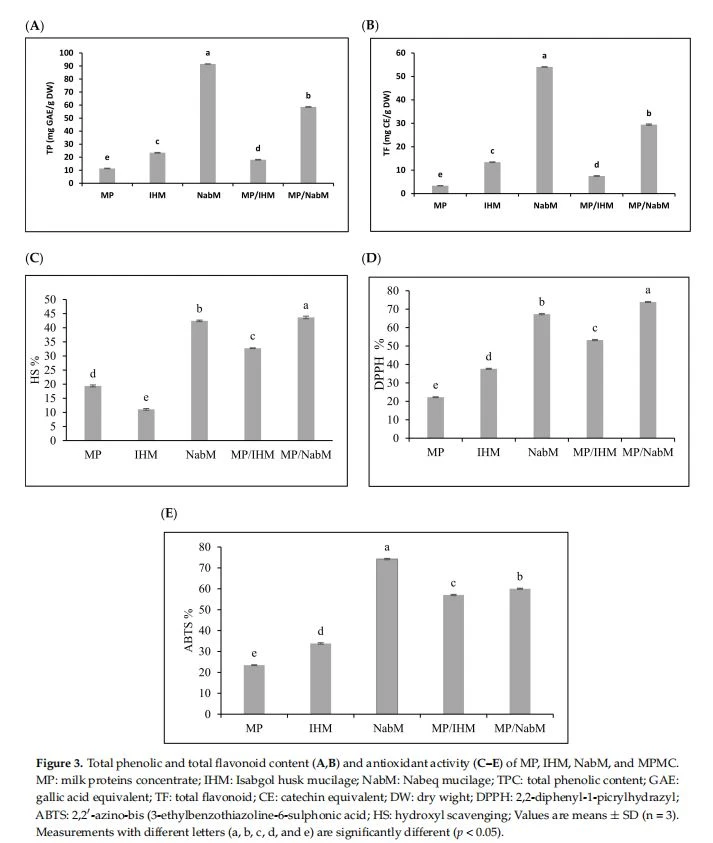
The potential radical scavenging activity of MP/IHM and MP/NabM compared to MP using DPPH, ABTS, and HS is illustrated in Figure 3C-E. The data obtained from the three antioxidants activity had a similar trend indicating that NabM displayed higher antioxidant activity than IHM and this is in the context of the results of phenolics and
flavonoids contents. The antioxidant capacity of MP was increased after complexing with NabM and IHM. With the exception of the ABTS assay, the antioxidant activity of NabM increased by conjugation with MP. The antioxidant activity indicated that MPMC had higher antioxidant activity compared to MP. Our hypothesis points to a possible interaction between MP and polysaccharides that leads to gaining the potential antioxidant activity as described by Li et al. [24]. It has been previously reported that there is a positive correlation between the scavenging capacity and phenolic/flavonoids content 5]. However, we cannot exclude that new bioactive peptides enriched with sulfur-containing amino acids are produced, explaining the high antioxidant activity of MPMCcompared to the uncomplexed components. Moreover, the small peptides are released in whey fractions influencing the high antioxidant properties [4]. Finally, phenolic and flavonoid contents affect different cancer cells. Additionally, during in vitro cell culture assays, these activities and mechanisms were observed. Antioxidant and anticancer activities of phenolics are attributed to double bonds and hydroxyl substitutions on the aromatic rings [25].
2.4.Amino Acid Profile of MP and MPMC
Amino acid profiles of MP, NabM, MP/IHM, and MP/NabMare illustrated in Figure 4. There were no significant differences in amino acid profiles of MP and its complexes with IHM and NabM. This indicated that the non-covalent interaction of MP with polysaccharide mucilage did not change the composition of milk proteins. The results show the high content of glutamic acid in MP and MPMC (Figure 4) [26].

2.5. Rheological Properties of MP and MPMCs
2.5.1.Apparent Viscosity
Figure S1 shows the viscosity of protein samples at different rpm values. IHM and NabM had high viscosity at slow rotation, but the viscosity decreased significantly as the rotation speed increased. These findings were in agreement with Chen and Che who recorded that the apparent viscosity of water-soluble mucilage of green laver (Monostroma iridium) decreased by increasing the shear rate [27].
The results in Figure S1 also demonstrate that the complexation of MP with IHM and NabM resulted in a significant increase (p ≤0.05)in the apparent viscosity of MP. This could be attributed to the unique properties of IHM (hydrocolloid material) which has a viscosity-enhancing effect [28].
2.5.2.Flow Behavior
The flow behavior(shear stress/shear rate curves)of milk proteins and their complexes is illustrated in Figure S2. With the increase in shear rate, shear stress increased. Transforming the shear stress and shear rate data to the power-law equation, the values of the flow consistency index(K) and flow behavior index (n) are shown in Table S1.IHM and MP/IHM had the highest flow consistency index. This might be due to the high viscosity of water-soluble mucilage of IHM due to its high capacity for holding water and gelling in an aqueous medium. The results also demonstrated that IHIM, NabM, and MP/IHM had shear-thinning behavior (non-Newtonian fluids)with a low n value ranging from 0.25 to 0.64. These results came in accordance with Thanatcha and Pranee who studied the physicochemical properties of Ziziphus mauritiana[29]. On the other hand, the n value of MP was approximately 1(0.99) indicating Newtonian flow. Similarly, the n value for the MP/NabM complex was 0.95 as shown in Table S1.
2.6.Differential Scanning Calorimetry of MP and MPMC
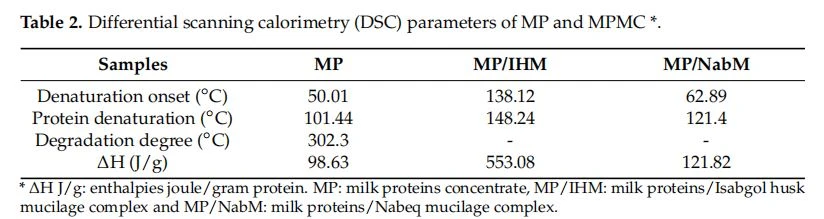
Differential scanning calorimetry was used to investigate the thermal stability of MP and its complexes with IHIM and NabM. The thermograms of MP and MPMC are illustrated in Figure S3, and the DSC parameters are provided in Table 2. It was observed that there was no clear endothermic peak on the MP thermogram, but there was a prominent endothermic peak for MP/IHM and a broad endothermic peak for MP/NabM. This is probably due to the gradual elimination of free water, the melting point of NabM, slow gelation, and protein denaturation [30].
It was also noted that MPMC was more heat-stable than uncomplexed protein as observed by the low denaturation temperature of MP (101.44°C) compared to MP/IHM and MP/NabM (148.24 and 121.4°C, respectively)as shown in Table 2. Moreover, the degradation temperature of MP was recorded to be 302.3°C, whereas no degradation of MPMC was observed with a temperature increase up to 350C. These findings were in agreement with several studies, which found that the thermal stability of milk proteins increased by the interaction with phenolic compounds which prevented protein aggregation [2,31].
The heat that passes into or out of the system during a reaction is the enthalpy (AH). The higher enthalpy of MP/IHM and MP/NabM compared to that of the un-complexed MP could be due to the potential chemical reaction between milk proteins (whey and casein) and between milk proteins and polysaccharides at high temperature (Maillard reaction)[31.
2.7.Transmission Electron Microscopy (TEM) of MP and MPMC
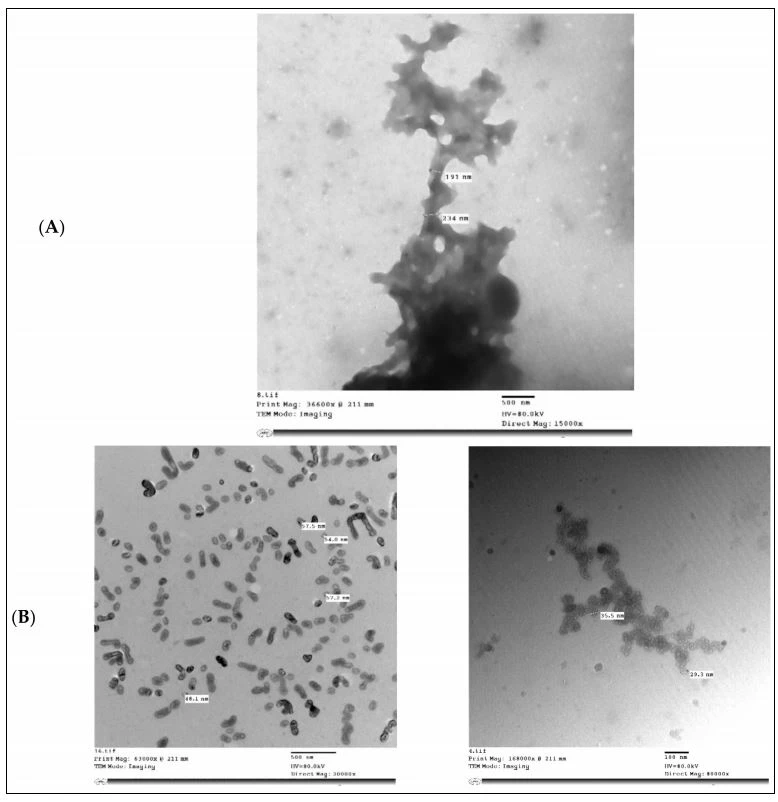
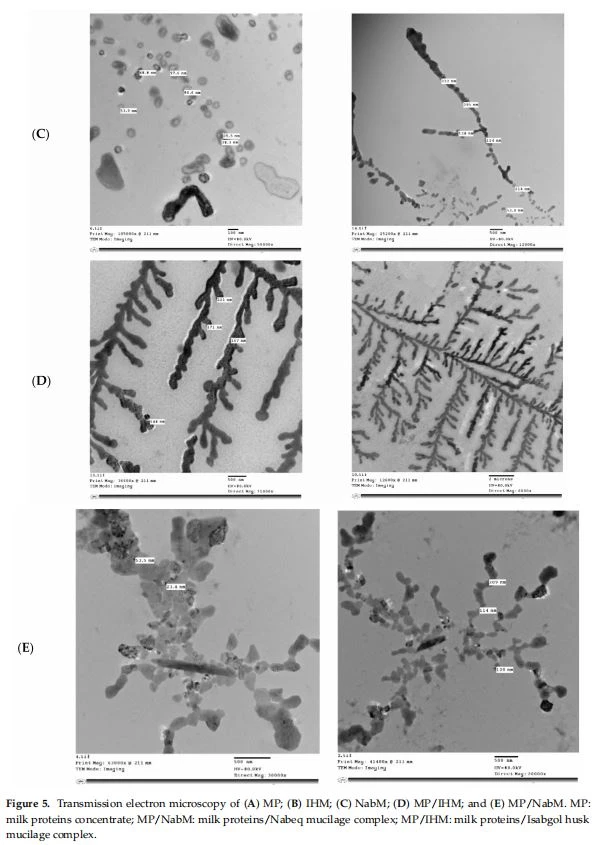
Figure 5 shows the microstructure of IHM, NabM, MP, and MPMC. It was found that the particle size of MPMC was in the nano range(114-250 nm), and it was smaller than the particle size of MP(191-300 nm). Additionally, the TEM of MPMC(Figure 5D, E)revealed the branched pattern of the formed complexes. This could be attributed to the electrostatic attraction between milk proteins and polysaccharides Goh, et al. [32]. Moreover, the larger branched structure of MP/IHM compared to MP/NabM might be responsible for its higher viscosity as shown in Figure S1.
2.8. Biological Studies on MP and MPMC
2.8.1. Anticancer Activity of MP and MPMC
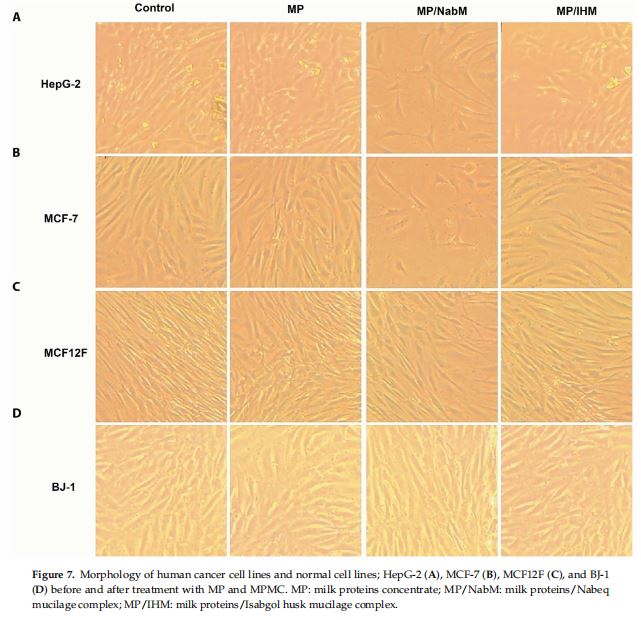
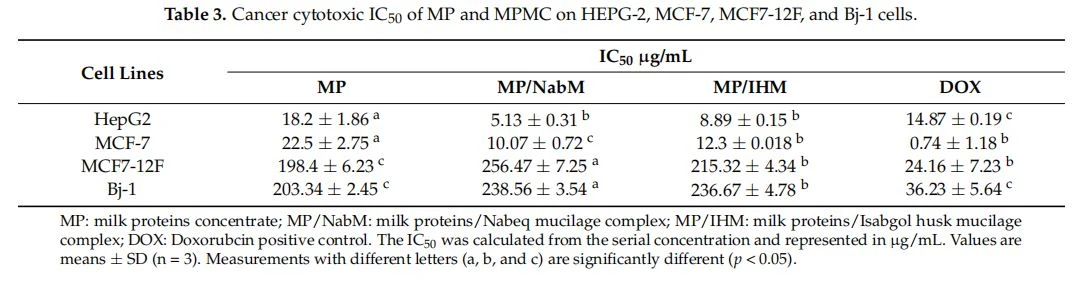
The cytotoxic effect of various concentrations (1, 5, 10, and 20 ug/mL)of MP and MPMC on HepG-2 and MCF-7 cells compared to MCF-12F and Bij-1 normal cells are illustrated in Figures 6 and 7. MPMCexhibited anticancer effect on HepG-2 and MCF-7 cells Figure 6A, B, respectively. The dose-responsive curve exhibited a reduction in cell viability in response to higher concentrations. On the other hand, no significant cytotoxic effect of MP and MPMC on Bj-1 and MCF-12F normal cells was observed (Figure 6C, D). Our results also indicated that MP/NabM had higher anticancer activity against HepG-2 and MCF-7 cancer cell lines, with IC50 values 5.13 and 10.07 μg/mL, respectively. Additionally, MP/IHM exhibited a moderate cytotoxic effect against cancer cell lines compared to respective controls. Altogether, our cytotoxic data suggest that complexing MP with IHM and NabM significantly enhances the anticancer activity compared to uncomplexed milk proteins, as shown in Table 3. It was also evident that Hep G-2 cells were more sensitive to MP and MPMC compared to MCF-7 cells as manifested by the lower values of IC50.

The anticancer effect of milk protein-derived antitumor peptides has been previously reported. In this context, Jeong and Hong [33] observed that trypsin hydrolysates of α-lactalbumin had a cytotoxic effect on human bone cancer SJSA-1, human colorectal cancer HCT 116, and human gastric cancer NCI-N87 cell lines. It was found that o-lactalbumin, interacts with cell surface modulators and alters cell growth rate, intracellular calcium, and the calcium transport rate [34]. It is worth noting that bovine lactoferrin induced apoptosis in MCF7 cells in a dose-dependent manner [35]. Moreover, the casein and whey protein fractions of milk showed antitumor effects in an animal model as well as in vitro antiproliferative activity [36]. In addition, Elzoghby et al.[37] reported that casein nanoparticles can be used to encapsulate the hydrophobic anticancer drug, flutamide, to control the drug release, improve its anti-tumor activity, and decrease its hepatotoxicity.
The anticancer effect of IHIM and NabM was previously reported [6,38]. The cytotoxic effect of MP and MPMC might be attributed to the presence of amino acids such as glutamine, arginine, and cysteine which are reported to exhibit anticancer activity against colorectal cancer [39]. These results are in agreement with the high content of glutamic acid of MPMC (Figure 5).
2.8.2. Determination of p53, Bax, Caspase-3, and Bd-2 Proteins Level
In order to investigate the cytotoxicity mechanism of MPMC, the level of apoptosis marker proteins p53, Bax, Caspase-3, and Bcl-2 was determined in HepG-2, MCF-7, Bj-1, and MCF-12F cell lines treated with ICs0 of MPMC (Figure 8). The level of pro-and anti-apoptotic markers is associated with apoptosis induction in cancer cell lines[40,41]. Results indicated that MP/NabM and MP/IHMenhanced apoptosis in HepG-2 and MCF-7, but not in MCF-12F and Bj-1 cell lines. The level of caspase-3, p53, Baxsignificantly increased compared to respective controls(Figure 8), whereas Bcl-2 protein was reduced in all treatments. Interestingly, MP also showed a significant alteration in apoptosis protein markers. This was consistent with the results of the anticancer study and could be referred to as the cytotoxic effect of a number of milk protein-derived peptides as discussed above (Section 2.8.1).

2.8.3.DNA Damage Protection by MPMC against Oxidative Cleavage of RNH1 Plasmid
The RNH1 plasmid DNA has three forms on agarose gel electrophoresis ordered from top to bottom as open circular, linear, and supercoiled circular DNA. The oxidative stress by Fenton's reagent induced DNA damage. Subsequently, the level of DNA forms is altered. However, open circular and linear forms indicate DNA damage and supercoiled circular DNA indicates more protection potential. In this assay, we tested whether MP and MPMC at their IC50 can protect against the degradation of supercoiled circular form in response to oxidative stress. As a result, both MP/NabM and MP/IHM showed high protection capacity similar to DNA control (lanes 3 and 4, Figure 9A). On the other hand, no significant difference was observed in DNA treated with MP compared to DNA control and DNA treated with Fenton's reagent only (lane 5).

2.8.4.DNA Damage Protection by MPMC against Oxidative Cleavage of Genomic DNA
Using the PCR technique, the protective properties of MPMC on genomic DNA damage induced by the Fenton reaction were examined. In general, DNA damage reduces the copy number of certain genes, therefore producing lower band intensity in gel electrophoresis. Band density MTHFR gene of blood genomic DNA incubated with Fenton's reagent with and without the IC5s0 of MP, MP/NabM, and MP/IHM was tested. It was found that MP/NabM and MP/IHM (lanes 3 and 4, Figure 9B)prevented DNA damage, and subsequently protect the MTHFR template cutting site. Therefore, higher PCR product band intensity in the electrophoresis gel compared to respective controls was produced (Figure 9B). These results indicated that the antioxidant activity of MPMC inhibited the production of free radicals that mediated DNA damage.
2.8.5. Gene Expression
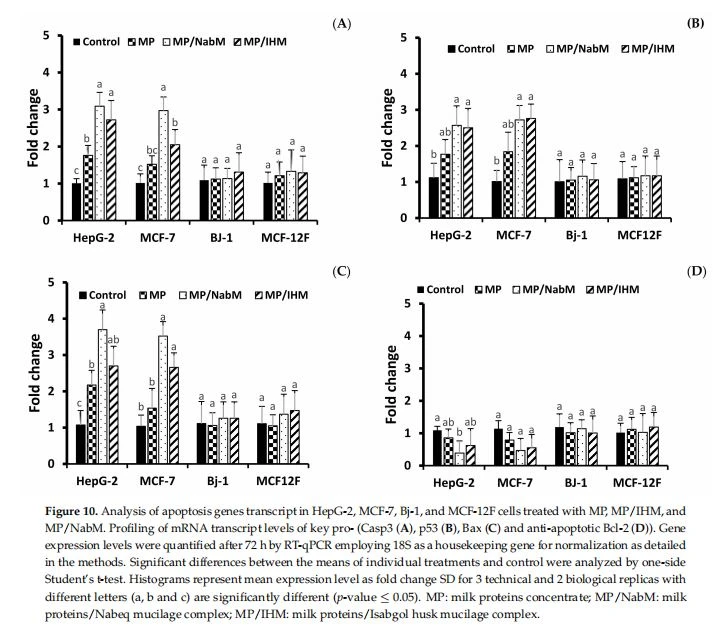
In agreement with apoptosis protein marker obtained data, results of RT-qPCR revealed that incubation of HepG-2, MCF-7 cells with MP, MP/NabM, and MP/IHM induced a significant upregulation of pro-apoptotic mRNA markers, namely, Casp3, p53, and Bax, whereas the expression level of the anti-apoptotic marker Bcl-2 was significantly down-regulated(Figure 10A-D). Caspases are actor proteins that play a vital role in apoptosis initiation and sustaining. However, upregulation of caspase 3 protein is indicative of execution of the main intrinsic pathway of apoptosis (Figure 10A, B) which is characterized by the collapse of the mitochondrial membrane with Bax-induced cytochrome c release, and activation of caspase 9 leading to the subsequent engagement of caspase 3 [42]. Up-regulation of Casp3, p53, and Bax, along with reduction of Bcl-2 expression revealed that MP, MP/NabM, and MP/IHM triggered apoptosis. In this regard, upregulation of p53 stimulated expression of Bax, which in turn, will induce cytochrome c release, followed by caspase-9 and -3 activation. However, Bcl-2 as an anti-apoptosis is known to inhibit cytochrome c release [43], the treatment resulted in significant reductions in the mRNA transcript levels of the anti-apoptotic marker gene Bcl-2 due to MP/NabM and MP/IHM treatment, which facilitates unopposed Bax-induced cytochrome c release and subsequent apoptosis. In this study, MP/NabM severely mediated apoptosis compared to MP/IHM and MP as observed in (Figure 10). Observed anti-cancer effects of MP/NabMor MP/IHM proceeds via modulation of a p53-dependent apoptosis pathway since both its protein and mRNA transcript levels were significantly up-regulated.
Click the link to get further information: https://www.xjcistanche.com/news/nano-milk-protein-mucilage-complexes-characte-55049190.html